State of the Arts
State of the Arts: October 2022
Season 41 Episode 2 | 26m 46sVideo has Closed Captions
Capturing Revolutionary War Sites, Alexandre Arrechea at ArtYard and "Possessing Harriet"
Xiomáro photographs Morristown’s historic Revolutionary War spaces, including Washington’s headquarters. A founding member of the Cuban Collective, Los Carpinteros, artist Alexandre Arrechea creates monumental work at ArtYard in Frenchtown. And East Lynne Theater Co. in Cape May presents the New Jersey premiere of Kyle Bass’s “Possessing Harriet,” about a young woman's flight to freedom in 1839.
Problems playing video? | Closed Captioning Feedback
Problems playing video? | Closed Captioning Feedback
State of the Arts is a local public television program presented by NJ PBS
State of the Arts
State of the Arts: October 2022
Season 41 Episode 2 | 26m 46sVideo has Closed Captions
Xiomáro photographs Morristown’s historic Revolutionary War spaces, including Washington’s headquarters. A founding member of the Cuban Collective, Los Carpinteros, artist Alexandre Arrechea creates monumental work at ArtYard in Frenchtown. And East Lynne Theater Co. in Cape May presents the New Jersey premiere of Kyle Bass’s “Possessing Harriet,” about a young woman's flight to freedom in 1839.
Problems playing video? | Closed Captioning Feedback
How to Watch State of the Arts
State of the Arts is available to stream on pbs.org and the free PBS App, available on iPhone, Apple TV, Android TV, Android smartphones, Amazon Fire TV, Amazon Fire Tablet, Roku, Samsung Smart TV, and Vizio.
Providing Support for PBS.org
Learn Moreabout PBS online sponsorshipNarrator: At ArtYard in Frenchtown, Cuban artist Alexandre Arrechea's curiosity about the town and its river informs his latest work.
Mora: There is something very similar about all Cuban artists.
It was very hard for anybody to travel out of Cuba.
So Alex is extremely Cuban in the way that he has an infinite sense of curiosity for absolutely everything.
Narrator: At Morristown National Historical Park, photographer Xiomáro tries to imagine the world that used to be.
Xiomáro: People suffered in the worst way you can imagine during this war, and it's a hard thing to convey, but you're trying to compact all that and compress it into one image that leaves you with a better understanding of what it is, even if it's just a feeling.
Narrator: And the East Lynne Theater Company in Cape May presents a play about a young woman's escape from slavery, based on a real story from 1839.
Thomas: I know you're scared.
Bass: I consider it a tragedy.
In order for her to be free, she can never -- likely never see or even hear from her mother, her sister ever again.
Announcer: "State of the Arts," going on location with New Jersey's most creative people.
Announcer: The New Jersey State Council on the Arts, encouraging excellence and engagement in the arts since 1966, is proud to co-produce "State of the Arts" with Stockton University.
Additional support is provided by these friends of "State of the Arts."
[ Music plays ] Narrator: During the most brutal winter of the American Revolution, the Continental Army camped in soldier huts on the wooded hillsides of Jockey Hollow, close to Wick Farm.
In nearby Morristown, George Washington and his staff made the Ford Mansion their winter headquarters.
These places played a pivotal role in keeping the revolutionary effort alive.
And in 1933, these sites in Morristown, New Jersey, were designated the first National Historical Park in America.
When the National Park Service commissioned photographer Xiomáro to capture Morristown in detail, he dove in.
I almost approach it like an actor taking on a role.
So I try to get immersed in it.
What was it like to be a soldier at that time?
What was it like to be Washington?
What was going on in these rooms?
Who was walking around here?
What were they doing?
Those are the things that I bring to it, and I try to get a sense of that in the photographs, as well.
Pfister: It's almost like watching a writer put together a book.
He did ask a lot of questions.
"Who used this?
Who used that?
What might be the most important thing in the room?"
I like to call him a historian with a camera, a historian through the lens.
Xiomáro: Yes.
See?
There's a circle here.
That oval.
I don't know if I can get it.
[ Music plays ] I like to play with light and shadow a lot.
[ Music plays ] Many people, when they see my photographs, if they're not familiar with my fine-art photography, they almost expect real-estate photos where everything's brightly lit, you can see every detail.
[ Music plays ] I very rarely use artificial lighting.
I use the existing lighting, as that's the way it was back then.
It was dark.
I like the sense of mystery, of shrouding some things in darkness.
With some of my photos, your eyes have to adjust to the darkness in the same way you have to when you enter a room, and then things start to reveal themselves to you.
This is a sense of people's sense of discovery and also giving them a sense of what it was like to be in a room a couple hundred years ago, which was generally pretty dark and uncomfortable.
When you come here, you are behind a stanchion or a velvet rope.
You can only see so much.
And I'll take a general shot to kind of establish the room that we're in so people know what we're looking at.
But then I'll try to zero in on things.
It might be something simple like a cup that's all metal and beat-up.
And I want to give people a sense that they didn't have the kind of comforts we have.
[ Beeping ] I'm also aware of, obviously, artistically the compositions.
I try to have some kind of order that directs your eye to certain things.
And my mind is actively engaged.
There's a lot of minute movement of the lens to get the composition locked in the way I want to do it.
Yeah.
I just love this mirror.
And this detail is just gorgeous, and it's probably not something a lot of tourists are going to see from their vantage point behind the door.
So... [ Camera shutter clicks ] It's definitely a tightrope that I have to walk.
The Park Service already has a body of work that's purely archival.
I don't want to take a purely documentary photo, but I can play with composition.
So what I do is I try to photograph things in a completely different perspective.
Alright.
A good example of that, I think, is a photograph I took of the very room that George and Martha Washington slept in.
Most people are going to see that from the point of view of the doorway, because that's where the velvet rope is.
And there's actually a little closet space that's just used for storage.
I went to the very back, and I just stuffed my 6'2" body in there as the best that I can, and I took a photograph from behind the bed looking out into the hallway.
And that's a view no one's ever going to see unless you work at the Park Service.
So it's documentary, but it's not a common view.
[ Music plays ] Pfister: There's an image that shows the three or four steps on the second floor going from the servants' side to the main part of the house.
It's easy to imagine the main characters of this house, whether it's George Washington or the Ford family.
Of course, the servants are not always thought about or talked about.
I've probably walked up there a thousand times over the years, but seeing that one photograph was really moving.
It was very compelling, and it's probably the one I've spent the most time looking at and thinking about.
That is one of our goals, is to get visitors to really reimagine this space.
Xiomáro: One of the things that really interested me was what's called a camp bed.
And it's this bed that the soldiers took with them.
But they're very small.
It's almost coffin-like, you know?
But it's like -- They've got a covering.
And that just really fascinated me that they slept in those things.
It wasn't just the soldiers.
These were, like, dignitaries.
They just didn't have enough beds for everybody.
I wanted to go in those things.
I wanted to test it out.
But, of course, they'll throw me out if I did that, so the best I can do is to get in there with my camera.
And so this gives you a sense of the claustrophobia, you know, how tight it is in there.
And the fabric is pretty thin.
You can see the light going through it, so it doesn't give you much warmth, I wouldn't think.
And I really like that photo because I think someone visiting the Ford Mansion, they'll see the outside of the -- the camp bed, but I wanted them to see something they can't see on tour.
The Wick House is basically a farmhouse, so it's not a wealthy person's house like the Ford mansion was.
[ Music plays ] But then I zeroed in on details, and there might be a piece of hardware with an interesting shape to it.
There might be a shadow falling on it that also gives you another interesting shape below it.
And then what I try to do is take other shots around the Wick House to kind of give you a sense of the area.
So one of the things that I did was take a shot of this fence that kind of leads the eye to the Wick House.
And then I walked around the area, too.
So there's an -- I think it's called the Orange Trail, not far from the Wick House.
What was really interesting here were the trees.
They were almost like sculptures in some cases.
That's another dimension to the park.
When you walk along the path, it's almost like you're on a museum route.
The soldiers' huts.
They just look like cabins.
But when I went inside of them, the floor is just dirt.
The bunks are just planks of wood.
All I know is that it was not comfortable, and I wanted to get those details in the pictures.
At the same time, I found a beauty to these huts.
There's a symmetry in how they were built.
The work that was involved in putting it together.
[ Music plays ] People suffered in the worst way you can imagine during this war.
And it's a hard thing to convey, but you're trying to compact all that and compress it into one image that leaves you with a better understanding of what it is, even if it's just a feeling.
So I think photographs can do that.
It can transmit a feeling of the moment.
Narrator: "Rediscovering Morristown National Historical Park," an exhibition of Xiomáro's work, begins the celebration of the park's 90th anniversary.
Pfister: How do you present yourself in a way to modern audiences?
I think every historic site deals with this topic.
And one way that we have now that we can rely on is this body of work.
[ Music plays ] Announcer: Later on the show, a Cuban artist makes monumental new work in Frenchtown.
Announcer: But next, a new play set in the years before the Civil War.
[ Music plays ] [ Dramatic music plays ] Narrator: In September 2022, the East Lynne Theater Company in Cape May, based in an historic old church, gave the new play "Possessing Harriet" its New Jersey premiere.
Harriet: When I saw you working in the hotel, I thought you were a slave loaned out.
Thomas: When I saw you, I thought you was white, so I guess we even.
[ Laughter ] There ain't been slaves in New York... Narrator: It's a story based on fact.
In 1839, Harriet Powell, a young enslaved woman from Mississippi, was staying with her owners in a hotel in Syracuse, New York.
She meets Thomas Leonard, a free Black man who works in the hotel.
He helps her escape.
The play takes place just before Harriet reaches Canada.
It's her last stop, and it's in the home of a famous abolitionist.
Thomas: Well, the slave hunters, they all know who the abolitionists are around here, know where they live.
This here is Gerrit Smith's house in Peterboro.
They gonna come here looking for you.
Bass: What does this play set in 1839 have to say to an audience living in 2022?
Thomas: I know you're scared.
Scared 'cause you never had a tomorrow like the tomorrow you gonna have tomorrow.
But tomorrow you gonna breathe free!
Freedom.
Bass: The historical details -- Like, I don't invent those, right?
I have to find the ones that emanate and touch us now.
Narrator: The play brings to life an actual meeting where the abolitionist Gerrit Smith introduced Harriet to his niece, Elizabeth.
Gerrit: Here she is, Elizabeth.
Elizabeth: My word, cousin!
Narrator: Elizabeth Cady Stanton later made history of her own as a leader in the movement for women's rights.
Gerrit: Our precious cargo.
Our fair lady fugitive.
Miss Harriet Powell.
Narrator: Themes of skin color emerge.
Harriet is described in her bounty poster as a "Bright Quadroon Servant-girl."
Gerrit: "Said girl was about 5 feet and 4 inches high of a well-proportioned form.
Straight black hair.
Dark eyes approaching to black.
A fresh complexion, and so fair that she would generally be taken for white."
Narrator: Thomas Leonard, though free, observes that he cannot escape his own darker skin and admits that Harriet might have an easier time of it.
Thomas: I'm not free from this.
Bound to this, same as those bound in chains.
I'm free to work in the hotel, but I can't be in that hotel.
I am free to pick up the pennies the white people leave 'side their dirty plates and empty cups when they leave them, but ain't free to lay the night in those beds.
Elizabeth: Hardly... Narrator: The play also reveals the tensions among Northern liberals.
Gerrit: She holds perfectly heretical ideas about the oppression of her sex!
But somehow -- somehow the topic of slavery must sit quietly.
Elizabeth: Heretical?!
That men and women are equal?!
Gerrit: I rest my case.
Thomas: [ Laughs ] Elizabeth: Are equal in nature, but not under men's laws.
Gerrit: That's what happens, Tom, when a father treats his daughter as a son.
Elizabeth: Oh, but that I were my father's son!
Bass: The ideas around identity, gender, and class.
All of those things.
Here we are, right, still grappling with those.
Gerrit: She has decided that slavery is wrong.
Oh, but what can be done about the situation?
Elizabeth: Forgive him.
Lang: In some ways, I think a good play is an empathy machine, that we have the opportunity to bring the audience, particularly in a historical piece, to a different time, to a different perspective.
What's it like to be a 24-year-old who is about to lose everything she's ever known -- her mother, her sister -- to trust all these people who she barely knows?
Harriet: I can't go!
Elizabeth: Harriet.
Harriet: I want to go back!
Elizabeth: To Mr.
Davenport?!
Harriet: Yes, to my mother and my sister and the baby!
Back to Mississippi, where I belong!
Elizabeth: You don't belong!
You belong -- Harriet: Where?!
With the secret in my blood you can read in my face, tell me where I belong, Elizabeth!
Elizabeth: Harriet!
Bass: I consider it a tragedy.
I consider the play a tragedy.
That she must make that choice is tragic.
Right?
In order for her to be free, she can never -- likely never see or even hear from her mother, her sister ever again.
Right?
And as far as I know from the research, she never -- I don't think she ever did.
[ Indistinct conversations ] Narrator: The opening night after-party for "Possessing Harriet" was just a few blocks away from the East Lynne Theater Company at the newly opened Harriet Tubman Museum of New Jersey.
[ Indistinct conversations ] Mullock: Harriet Tubman actually lived here in Cape May.
She was working here.
This was shortly after she escaped from the Eastern Shore and the plantation where she was enslaved.
She escaped in 1849.
We can document that she was here in 1852.
This is the time of the Fugitive Slave Act of 1850, which was federal law that stated that even if you had escaped, you were still considered the property of your enslaver, even if you made it north, so she was wanted.
She needed that community that would really support her, and Cape May with a good place for that.
[ Music plays ] Narrator: The two Harriets shared the trauma of enslavement, but their paths were different.
In 1839, when Harriet Powell finally found freedom in Canada, Harriet Tubman was only 17, with 10 long years of slavery still ahead of her.
Kyle's play adheres to the facts, but it focuses on the personal, emotional journeys of the characters.
Elizabeth: I'm sorry!
Narrator: He even found inspiration in his own past.
Kyle's great-great-grandfather, Toliver Holmes, escaped slavery and went on to fight in the Civil War.
For Kyle, Toliver's story resonated with something he had learned in his research about Thomas Leonard.
Bass: The real Thomas Leonard, when the war broke out, he went to enlist, and they told him, "Thomas, you're 73."
And so that fervent fight never left him.
Because there wasn't a whole bunch known about him, I could overlay my great-great-grandfather, some of his history onto Thomas a little bit, which is what I did.
And that absolutely opened the door to the play for me personally, and then a lot of the sort of emotionality came in once I had opened that door for myself.
[ Music plays ] [ Music plays ] Announcer: Last on the show, new work at ArtYard, including an enormous watercolor made with water from the Delaware River.
[ Music plays ] Kearney: ArtYard is based in Frenchtown, New Jersey.
We are here to foment collaborations that are joyful, meaningful, and transformational.
Narrator: Frenchtown, New Jersey, is a quaint town on the banks of the Delaware River with a thriving arts community.
ArtYard, with its brand-new gallery spaces, theater, and residencies for artists, is at the center of it all.
Internationally acclaimed Cuban artist Alexandre Arrechea's exhibition at ArtYard is called "Landscape and Hierarchies."
He created all the work during a residency at ArtYard.
The watercolors, sculptures, and multimedia installations reflect his impressions of Frenchtown.
Arrechea: Frenchtown -- I think it's a beautiful community, and I just love it here, especially as a creator and the possibility of walking around this pleasant, beautiful place.
Narrator: Elsa Mora is ArtYard's artistic director and curated Alex's show.
She first met Alex in Havana in the early 1990s.
Arrechea: This is a very emotional experience for me.
I have been involved in the art world for, like, forever.
I mean, I started at the age of 9.
Narrator: His first works of art were photographs and drawings of Colonial era architecture in Trinidad, Cuba, the city of his birth.
Mora: He very early on developed an attraction to the environment, the landscape, and the architecture.
So that's a foundational element in what he has done.
[ Music plays ] Narrator: Sport, as a metaphor and exploration of competition and human interaction, is also a recurring theme.
The title work at his ArtYard exhibition, "Landscape and Hierarchy" deals with golf.
Arrechea: The context is a forest out of glass, so you have glass trees, so you better be careful with your power, you know, because it might actually put in trouble the entire situation.
[ Indistinct conversations ] The way I work is perhaps to put you in a situation that you seem like you are able to manage it, but at the same time, you have to reflect how you're going to act on that particular situation.
In 1991, after being studying for quite some time already, along with two other art students, we created a project under the name of Los Carpinteros.
Mora: Alexandre experienced success as an artist from a very young age when he was working with Los Carpinteros, and as a collective, they were able to show their work in many museums around the world.
Arrechea: I was part of that project for like 12, 13 years until 2003 -- I decide to take a detour and and create my own -- my own work.
So somehow I'm right now celebrating those 20 years of solo work.
So that's why this exhibition is particularly important for me, because it's -- you know, in 2003, I didn't know what's gonna -- the future is gonna be.
Narrator: In fact, over the past 20 years, Alex has created major works around the world.
"Dreaming Lions" is a public sculpture on Miami Beach, inspired by Hemingway's "Old Man and the Sea."
"Katrina Chairs" is a 50-foot-high sculpture created for the Coachella Music Festival in California, inspired by Hurricane Katrina's devastating impact on New Orleans.
In New York, Alex created a series inspired by the city's iconic buildings.
Exhibited down the center of Park Avenue, "No Limits" plays on the idea of elastic architecture as a metaphor for constant change and evolution.
For his residency at ArtYard, Alex was again inspired by the environment.
Kearney: I think the 71-foot-long watercolor that was made using water collected from the Delaware River is pretty extraordinary.
And having watched him do it...
I don't know how one person could do what he did.
[ Music plays ] Arrechea: I always explain that actions obviously have consequences.
And in this case, one main element that is sort of, like, the guidance for the entire exhibition is the fact that I have been going to the river to collect water to create the work that I'm doing -- specifically, a watercolor under the title "River and Ripples," which means actions and consequences.
[ Music plays ] Vasquez: One of my main jobs here was working alongside Alexandre Arrechea, mainly just documenting his whole filming process of putting all these watercolors together.
And one of my side jobs to do along with that is take Polaroids of the process.
And one other aspect was to kind of take the bucket and put it around towns.
He wanted to show the bucket was integrating with -- with the local Frenchtown environment.
Arrechea: There are a series of videos that I have created here in ArtYard that you can see through a peephole.
And what you're going to see there is the artist, myself, fighting with myself.
I mean, this is a sort of an ambush that I have created, but I don't see the next guy on the -- on the other side, which happens to be myself.
So that idea of failing to recognize ourselves is something that is a very important issue for me.
You know, in the end, we are all the same, but we fail to recognize that.
So, the idea here basically is to invite people to write what they want to see here.
We're going to change the chalk from place and to write what people wish to be written here.
As you see, this is placed in the area where the mouth is.
So it's like giving voices to those faces.
Mora: That is something very similar about all Cuban artists.
And it's a small island and in a way we know each other.
And it is this sense of huge amount of curiosity.
And being Cuban, in particular, it was very hard for anybody to travel out of Cuba.
So Alex is extremely Cuban in the way that he has an infinite sense of curiosity for absolutely everything.
Arrechea: For me to create art is something that is -- is rooted on the idea "this should be important to people."
It's just not about creating beautiful paintings.
I want to create situations that make people to think about the immediate reality that you live in.
...like that for a... [ Music plays ] [ Music plays ] Narrator: Watch or share any of our stories online at StateoftheArtsNJ.com.
While you're there, let us know what you're thinking.
We love to hear from you.
Thanks for watching.
[ Music plays ]
Video has Closed Captions
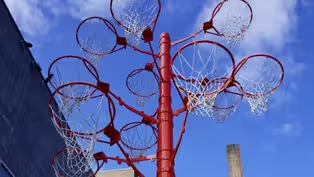
Clip: S41 Ep2 | 7m 42s | Cuban-born international artist Alexandre Arrechea creates monumental new work at ArtYard. (7m 42s)
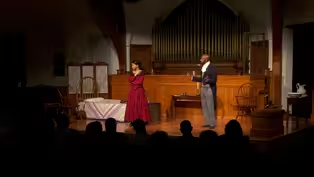
"Possessing Harriet" at the East Lynne Theater Co.
Video has Closed Captions
Clip: S41 Ep2 | 7m 11s | The East Lynne Theater Co. presents Kyle Bass’s play about a young freedom-seeker in 1839. (7m 11s)
Video has Closed Captions
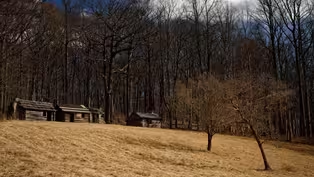
Clip: S41 Ep2 | 8m 23s | Xiomáro's of Morristown’s National Historical Park including Washington's headquarters. (8m 23s)
Providing Support for PBS.org
Learn Moreabout PBS online sponsorship

- Arts and Music
The Best of the Joy of Painting with Bob Ross
A pop icon, Bob Ross offers soothing words of wisdom as he paints captivating landscapes.












Support for PBS provided by:
State of the Arts is a local public television program presented by NJ PBS