State of the Arts
State of the Arts: October 2023
Season 42 Episode 2 | 26m 46sVideo has Closed Captions
Komar and Melamid in America, the Trenton Circus Squad and Heather Palecek’s Solargraphs
Komar and Melamid reflect on their history as a dissident artist duo from the Soviet Union as the Zimmerli Art Museum mounts the show: Komar and Melamid in America. The Trenton Circus Squad features teens from the city and suburbs learning circus skills and putting on shows under a big top. And Heather Palecek makes solargraphs with pinhole box cameras mounted to trees for weeks or even months.
Problems playing video? | Closed Captioning Feedback
Problems playing video? | Closed Captioning Feedback
State of the Arts is a local public television program presented by NJ PBS
State of the Arts
State of the Arts: October 2023
Season 42 Episode 2 | 26m 46sVideo has Closed Captions
Komar and Melamid reflect on their history as a dissident artist duo from the Soviet Union as the Zimmerli Art Museum mounts the show: Komar and Melamid in America. The Trenton Circus Squad features teens from the city and suburbs learning circus skills and putting on shows under a big top. And Heather Palecek makes solargraphs with pinhole box cameras mounted to trees for weeks or even months.
Problems playing video? | Closed Captioning Feedback
How to Watch State of the Arts
State of the Arts is available to stream on pbs.org and the free PBS App, available on iPhone, Apple TV, Android TV, Android smartphones, Amazon Fire TV, Amazon Fire Tablet, Roku, Samsung Smart TV, and Vizio.
Providing Support for PBS.org
Learn Moreabout PBS online sponsorshipNarrator: They call it a circus with a purpose.
The Trenton Circus Squad has a mission.
von Oehsen: We're talking unicycling and aerials and acrobatics and juggling and clowning.
Once they start learning those skills, then the expectation is they give back by teaching those skills and then by building community by performances.
Narrator: Komar and Melamid were art students in the Soviet Union, making tongue-in-cheek subversive work that brought them success in New York.
Melamid: We're serious artists.
We're serious artists!
Narrator: Now, decades later, the Zimmerli Art Museum in New Brunswick presents a retrospective of their work that's a lesson in history.
Komar: Disintegration of Soviet Union was beginning of our disintegration.
I believe we lost our past.
Narrator: And at Stockton University's gallery, artists present a portrait of the Pinelands, including a photographer who uses pinhole cameras set in trees, capturing images that develop over weeks or even months.
Palecek: I think I pursue a collaboration with Mother Nature as a way to showcase a kinship that I have with her, or the forest.
"State of the Art's" going on location with the most creative people in New Jersey.
Announcer: The New Jersey State Council on the Arts, encouraging excellence and engagement in the arts since 1966, is proud to co-produce "State of the Arts" with Stockton University.
Additional support is provided by the Pheasant Hill Foundation, the Work Foundation, on behalf of Philip E. Lian and Joan L. Mueller, and these friends of "State of the Arts."
[ Static crackling ] [ Music plays ] Komar: Melamid: Komar: Komar: [ Speaking Russian ] Melamid: Komar: Melamid: Melamid: Melamid: Komar: [ Laughter ] Melamid: [ Music plays ] Melamid: Tulovsky: [ Music plays ] Narrator: Later on the show, a photographer tracks the sun with her solargraphs, but first, Trenton's own hometown circus.
[ Music plays ] [ Crowd cheers ] [ Music plays ] Man: [ Singing ] Let's get it started.
Narrator: In the historic Wire Works Building in Trenton, New Jersey, where the Roeblings once manufactured wire rope to build the Brooklyn Bridge, young circus performers are honing their skills.
Man: [ Singing ] Get started, get stupid.
Don't worry about it, people.
We'll walk through it step by step like an infant new kid.
von Oehsen: We're talking unicycling and aerials and acrobatics and juggling and clowning.
Once they start learning those skills, then the expectation is they give back by teaching those skills and then by building community by performances.
Moreland: We help them, we train them, but we also try to give them a sense of independence and let them know that it's okay if you can't do something on your own.
But we encourage you try to.
von Oehsen: Our Squad are 12-to-18-year-olds, and we find that the Squad, once they start here, they do not leave us.
So, over the years they keep developing more and more skills and they have many, many opportunities to perform.
So, they really become really strong performers.
And that has opened up a lot of doors and a lot of opportunities statewide to perform a brand-new big-top tent that we have that we're going to be building community throughout the state of New Jersey.
Man: How's everybody doing today?
[ Crowd cheers ] Nice, nice.
We are Trenton Circus Squad.
We are a nonprofit organization, so we run on donations to keep these lights on.
von Oehsen: I think, like all kids, when you're developing, you're trying to figure out what makes you different from everyone else.
Man: [ Singing ] What you wanna do, baby?
Where you wanna go?
I'll take you to the moon, baby.
I'll take you to the floor.
I'll treat you like a real lady, no matter where you go.
Just give me some time, baby, 'cause you know.
Penn: He was having so many difficulties in school that this is the one place that he could come, and he didn't get in trouble for anything.
When he was younger, I used to have to take him for occupational therapy, speech therapy, vision therapy.
But doing all of these things here kind of encompasses a lot of that.
Narrator: Spotting new talent for the Trenton Circus Squad is executive director Tom von Oehsen's forte.
Garland: He showed up at my house randomly one day, and he just asked me, "Hey, I heard that you can dance.
Do you want to join the circus?"
von Oehsen: The circus arts gives them an opportunity to really connect to who they are.
Use this hand.
Okay?
Nice.
And then you want to -- you want to do this.
You want to hit your head, come up, and then do a little cross-eyed and, like, scrambled brain.
Can you try that?
[ Laughs ] I like it.
You ready?
When the opportunity to apply to Ringling Bros. and Barnum & Bailey Clown College came up, I applied and was accepted.
And I took that opportunity and ran away to the circus.
And what an experience -- I mean, I learned all of the skills that we currently have here.
Narrator: You could say Tom von Oehsen ran away to join the circus twice.
After graduating from the Ringling Bros. and Barnum & Bailey Clown College, he returned to the University of Pennsylvania, later becoming a private-school administrator.
In 2008, Tom reignited his dreams by starting a circus program at Princeton Academy of the Sacred Heart.
In 2015, it became the Trenton Circus Squad.
[ Music plays ] von Oehsen: The idea was once the students come, we teach them circus skills and to perform and bring joy and smiles to communities that are in need of those kind of performances.
Anybody that walks by these glass doors -- and they're usually open in the summer -- and they look in, they can recognize kids like themselves doing incredible things, whether they're hanging upside down in the aerials or riding around the giraffe unicycles or juggling or even slamming their head on tables and hearing laughter.
There's this draw that pulls kids in, and once they get in through these doors, they are welcomed with our Squad, which are so open-armed and welcoming and so eager to teach them.
It's like, "You can do this."
Our older Squad, which started as 14-year-olds -- they're in their early 20s -- they have not only amazing performance skills, but they also can really run workshops.
The program is completely free.
So, that's another component that's really amazing.
So, it's an equal playing field for everybody that gets here.
It's really amazing to see the friendships that occur with these students that normally their paths would never cross.
Amon: It's been fantastic to be able to get to know other Squad members and grow closer.
Soriano: From the beginning that I've been here at circus, it's felt like a family.
Garland: Tom, we're like, I kind of look at him as like a father figure.
[ Music plays ] Narrator: Following the 2020 murders of George Floyd and Breonna Taylor, the Squad processed their feelings by creating a show.
They performed it for the Trenton police.
Thomas: It was important to, like, make a show that was really reflective of how we were all feeling at the time.
von Oehsen: We went through a lot of emotions dealing, reliving all the challenges that everyone's had, and we ended with, "What are we going to do?"
And because they felt so confident with their skills, their circus skills, they said, "Let's tap into those and use those as like an icebreaker to get people talking, to get people to come together."
And they started talking about some of the themes.
I got really nervous because they were not your typical circus show that we typically do.
Thomas: The common ground of it was kind of just that they wanted to be more involved in the community and, like, know us more.
von Oehsen: I mean, some of our Squad go to college, some go to community college, some go to vocational school, some go right into the workplace.
But there's also a handful of kids that are staying in circus.
Moreland: Seeing the audience's face after doing a performance... Ladd: The smile on their faces, the look of astonishment -- all of that is the reason we do what we do.
Moreland: ...it's an addicting feeling.
Garland: Because some days I do have rough days here, but when I see, like, the kids are having fun, I'm like, "Okay, this isn't so bad."
von Oehsen: Just like I ran away to the circus, I think that circus should be something that all youth run to.
[ Crowd cheers ] [ Music plays ] Narrator: Last on the show today, a photographer makes handmade images with the help of Mother Nature.
[ Music plays ] [ Music plays ] Ogden: The show is called "A Pinelands Portrait: Art of the Pine Barrens."
I called it that because I was thinking of a kind of specific portrait, not just the Pine Barrens, per se, not just the National Reserve.
It's my portrait, in a sense, of this very specific place, this reserve, but also the surrounding territory.
We have Heather Palecek, who does really interesting processes.
They're not standard digital photographs, straightforward, the work of an instant.
Palecek: These processes force me to slow down.
They force me to be mindful while making my work.
Ogden: One of her photographic series is called "Squash!"
and they're tiny photographs.
We have two in the show.
She's photographed the spotted lantern fly, another invasive species, you know, all over new Jersey now.
Stomp on them when you see them.
Palecek: So, I was painting the bottoms of shoes with photochemistry, placing captured, spotted lantern flies on the photo paper, stepping on them, and then placing it under glass and out in the sun to expose for a couple hours.
I call them, like, "squash" them.
So, physically squashing the bug under glass, and the shoe prints came out really lovely.
I am a historical process photographer, and I work with historical processes in really experimental ways.
The reason I got into doing this type of work was that I was just so burnt out from digital photography.
I hated sitting in front of a computer for hours on end after a photo shoot.
I felt like a part of my art practice was missing, and I realized that what was missing was how I was trained.
I was classically trained in a dark room, and I was just missing that more hands-on approach to kind of getting your hands dirty to make your artwork.
At that point, I decided that I had to do something.
So, pinhole to me seemed like the exact opposite of digital photography.
And I dove into that first and then started exploring with other mediums.
Pinhole photography is the most simple form of a camera, and it's the oldest form of photography, as well.
It's a lightproof box.
It can be any size, the size of a house or the size of an Altoids container.
And then you just poke a little, tiny pinhole in the front of it with either a needle or a pin of some sort and allow the light to come through, and it creates an image.
It's upside down and backwards.
It's basically a camera obscura that you can put a light-sensitive surface inside of.
I think most photographers think waiting five seconds is a long time for a photo, and with solargraphy you have to at least wait a whole day, if not a week or a month or a year.
That's the sun moving in the sky from, you know, east to west every single day.
And every day it moves, depending on if it's winter or summer, it'll move, like, a little bit lower in the sky or a little bit higher in the sky.
So, each streak is one day of sun.
And if there's ever a time where there's a gap in the streaks, that's because there was no sun during that day or hour.
So, here you can see that there's one streak that goes, like, the whole way and there's no sun there.
There's a gap between the streaks.
So, that was just, like, one really cloudy or maybe a rainy day.
At first, I was interested in just capturing the sun, and I did focus mostly on nature, which I will say, throughout my whole career most of my artwork has been focused on nature.
I chose the Pine Barrens because it was a forest in an area of New Jersey that I had never really explored before.
Because it's such a mysterious place to me, I thought that pinhole photography would definitely be the medium to explore it with.
I do pin all of my cameras on Google Maps, so I'll have, like, a geo marking of where they are, but I have found that it's not always completely accurate.
So, it'll be, like, within a 50-yard radius that I have to try to find, like, what tree the camera is on.
So, that's always really fun.
It's been described, or I've been described, as a squirrel looking for their nuts.
But once you do find the camera, bring it back to my studio, and then I will scan the image and then the image, I bring it into Adobe Photoshop.
I invert it from negative to positive, flip it horizontal because the image was created both upside down and backwards.
So, flip it horizontal so that it's like "true" photograph.
And then I bring that image into Adobe Lightroom and will process it.
I usually just bring it to life by adding a little exposure and contrast.
I don't do any serious tweaking of colors to the images, so I try to keep them pretty natural.
It definitely has inspired me as a human and an artist.
It definitely, like, fills that hole that I felt was missing.
And solargraphy specifically has taught me a lot of patience.
I feel like I'm a different person than I was six or seven years ago, before I had started this.
I've definitely learned patience.
I've learned how to lose control in my artwork.
I was always an artist that wanted control over everything.
Working in this way has really kind of broken that habit and allowed me to accept the chance element, not only in my work, but just in life in general.
Narrator: That's it for "State of the Arts" this week.
Find our stories and more at StateoftheArtsNJ.com, or subscribe to "StateoftheArtsNJ" on YouTube.
While you're there, leave us a comment.
We love to hear from you.
[ Music plays ] [ Music plays ] [ Music plays ] [ Music plays ] [ Music plays ] Announcer: The New Jersey State Council on the Arts, encouraging excellence and engagement in the arts since 1966, is proud to co-produce "State of the Arts" with Stockton University.
Additional support is provided by the Pheasant Hill Foundation, the Work Foundation, on behalf of Philip E. Lian and Joan L. Mueller, and these friends of "State of the Arts."
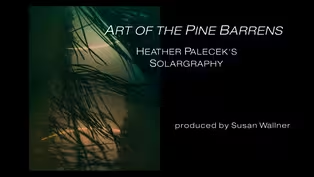
Art of the Pine Barrens: Heather Palecek, Solargrapher
Video has Closed Captions
Clip: S42 Ep2 | 6m 7s | Pinhole camera photographer Heather Palecek and her collaboration with Mother Nature. (6m 7s)
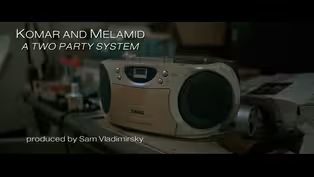
Komar and Melamid: A Two Party System
Video has Closed Captions
Clip: S42 Ep2 | 9m 7s | The dissident artist duo Komar and Melamid from the Soviet Union reflect on their career. (9m 7s)
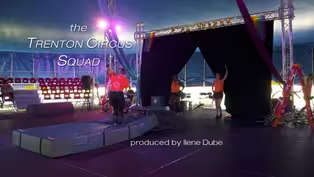
Video has Closed Captions
Clip: S42 Ep2 | 7m 27s | Trenton Circus Squad brings city and suburban teens together to perform under the big top. (7m 27s)
Providing Support for PBS.org
Learn Moreabout PBS online sponsorship

- Arts and Music
The Best of the Joy of Painting with Bob Ross
A pop icon, Bob Ross offers soothing words of wisdom as he paints captivating landscapes.













Support for PBS provided by:
State of the Arts is a local public television program presented by NJ PBS