State of the Arts
State of the Arts: Photos as Windows
Season 40 Episode 6 | 26m 46sVideo has Closed Captions
State of the Arts: Photos as Windows
Edwin Torres photographs his family in the South Bronx and Puerto Rico. Curator and historian Deb Willis's breakthrough exhibition, "Posing Beauty in African American Culture." Princeton University Art Museum explores how LIFE Magazine used photos to persuade the public that the Holocaust really had taken place. And photographer Wendel White’s series, "Schools for the Colored."
Problems playing video? | Closed Captioning Feedback
Problems playing video? | Closed Captioning Feedback
State of the Arts is a local public television program presented by NJ PBS
State of the Arts
State of the Arts: Photos as Windows
Season 40 Episode 6 | 26m 46sVideo has Closed Captions
Edwin Torres photographs his family in the South Bronx and Puerto Rico. Curator and historian Deb Willis's breakthrough exhibition, "Posing Beauty in African American Culture." Princeton University Art Museum explores how LIFE Magazine used photos to persuade the public that the Holocaust really had taken place. And photographer Wendel White’s series, "Schools for the Colored."
Problems playing video? | Closed Captioning Feedback
How to Watch State of the Arts
State of the Arts is available to stream on pbs.org and the free PBS App, available on iPhone, Apple TV, Android TV, Android smartphones, Amazon Fire TV, Amazon Fire Tablet, Roku, Samsung Smart TV, and Vizio.
Providing Support for PBS.org
Learn Moreabout PBS online sponsorshipNarrator: Photographs can change how we see the world and ourselves.
On this special edition of "State of the Arts," documentary photographer Edwin Torres.
We go on location with artist Wendel White to Woodbury, New Jersey.
An exhibition at the Princeton University Art Museum reveals how Life magazine exposed the horrors of the Holocaust.
And photographer, curator, and historian Deb Willis' book and exhibition "Posing Beauty."
"State of the Arts," going on location with the most creative people in New Jersey.
[ Music plays ] The New Jersey State Council on the Arts, encouraging excellence and engagement in the arts since 1966, is proud to co-produce "State of the Arts" with Stockton University.
Additional support is provided by by the Geraldine R. Dodge Foundation and these friends of "State of the Arts."
[ Music plays ] Torres: I grew up in a working class family in the hood in what some people might consider, like, a really dangerous neighborhood.
It was Hunts Point in the Bronx, and, you know, the news and the press oftentimes depicts those places in a bad light because there's only bad news coming from those places.
When I was a kid, I always discovered that there was a lot of, like, family there.
There was a lot of positivity.
There was a lot of enduring hardship together, so my interest has always been photographing people who are underrepresented in the mainstream media.
Narrator: Photographer Edwin Torres was part of a team at ProPublica and the New York Daily News that won a Pulitzer Prize in journalism in 2016.
He was just 25.
It was for a series of articles that exposed how police abuse nuisance laws to unjustly evict poor minority tenants in the South Bronx.
Justino: As proud as you can be for a family member, but more intimate because he's my little brother.
And I'm thankful that he listened to my mom, myself, and that he actually...
I mean, pushed himself enough to become who he is now.
[ Music playing ] Narrator: After winning the Pulitzer, Edwin worked for several years as New York Mayor Bill de Blasio's photographer.
He's now the deputy digital director for New Jersey's governor, Phil Murphy, and lives in Trenton with his fiancée, Joanne Sidoti.
Torres: I love Trenton.
Trenton reminds me of the Bronx so much that I decided to buy a home in Trenton and live here for several years.
[ Music plays ] I kind of just like the spirit here.
I like the people.
I love the historic nature, the art scene.
When I'm out shooting portraits, I just love the people.
You know, sometimes I'll have people walk up to me, ask me, "Hey, can you take my picture?"
Alright, you're gonna look here.
Sometimes I'll just ask people, and they're like, "Uh, what is it for?"
And I'll tell them.
I explain to them, "I'm a photographer.
I'm interested in photographing the community in Trenton, putting together a lot of the stories here."
I give them my contact info.
That way, I can send them a photo afterwards.
That usually brightens up their day.
Step forward a little bit for me.
Like right here.
Okay.
Yeah.
Beautiful, beautiful.
Alright.
Now, this is an old-school camera.
It's film, so it takes me a little time.
Give me a second, alright?
I pretty much have been photographing with analog cameras since college.
You know, from the first day, I just loved the experience.
Medium format cameras, twin lens reflex cameras.
I just love the tactile experience of actually making a picture using older cameras.
Rolleiflex is from the '70s.
My Leica is from the '70s, so yeah, I guess they're all like 50 years old, older than me.
[ Chuckles ] Narrator: Throughout his career, he's always pursued documentary photography as an art form.
Artworks in Trenton presented an exhibition of Edwin's family photographs.
The first image is of Edwin and his mother, who unexpectedly died from COVID at the start of the pandemic.
Torres: April 4, 2020, I learned that my mom passed away, and it just hit me like a wrench to my stomach, you know.
It just took the breath out of me, and I didn't know what to think.
And I spent several months after that, you know, coming to terms and grappling with it, and it was one of the hardest moments, you know, in my life.
And I looked at a lot of the photographs that I had taken throughout the years, and I was like, "I need to do something with this work for my mom."
Sidoti: There's a photo of him and his mom, and the caption is, "My mother, who gave me everything," and it's just -- it's really touching, it's sweet.
I mean, watching someone grieve, you know, for a year and a half or two years now, their mother, I mean, it's hard, and I think that this show has been an opportunity for healing for him.
[ Indistinct conversation ] Torres: The show is broken up into several parts.
It starts with five really large color portraits of my family that I took early on when I was in college.
Parts Two and Three are in tower-like collages.
Those are introducing the characters of my family, daily-life moments.
[ Music playing ] Ariana: Then there's another picture from my -- I believe my first communion, where I had my whole family there, and it was a big celebration.
And I remember seeing my uncle in the corner was taking my picture.
He was moving all around the church just to get a good picture.
I remember that day.
Justino: You can never get used to someone with a camera in front of your face, ever, ever, ever, ever.
He sometimes takes that camera out in the weirdest and most uncomfortable of situations when you don't expect a camera, but somehow, some way, there is a camera around his neck.
Torres: Parts Four and Five are a bit heavier in nature, documenting, you know, issues that a lot of families go through, whether it's health issues, passing of elderly people, you know, Alzheimer's, battling diabetes, my dad getting bypass surgery.
Parts Five and Six are about life, new beginnings, members of the family being born and joining and, you know, some of the more happier moments.
[ Music playing ] And the final part of the show looks at me revisiting Puerto Rico, connecting with my family's hometown, Buen Consejo, and, you know, just speaking to the neighbors, documenting the life and the culture there and getting to know more about myself.
[ Music plays ] I want people to know about my family that they're brave, they're resilient, they're strong, and I think that my show has something special to offer because it's so specific that pretty much anyone from any other family can look at them and think the same about their family.
[ Music playing ] Narrator: Next up, snapshots and portraits of African Americans created over more than 100 years in one of the most important exhibitions of our time.
[ Music playing ] [ Woman vocalizing ] Willis: I love that Toni Morrison said that beauty is.
You know, it just it is, and that's something that has been denied.
And there's a gap in the history of African-Americans and a discussion about black beauty.
[ Woman vocalizing ] It's rarely discussed historically, and so I thought it was really important for me to create a book and an exhibition that reimagined that history, a history that includes joy and pride, that also has the complement and the discomfort of terror.
[ Music playing ] White: She feels very much like a pioneer.
When she was putting this exhibition together, when she got it out there to start traveling, it was really well before the current movement of the notion of diverse beauty.
[ Music playing ] Narrator: This exhibition, "Posing Beauty in African-American Culture," has been traveling ever since it first opened in New York in 2010.
It's now at the New Jersey State Museum in Trenton.
Willis: I'm amazed that this show is still traveling, knowing that the requests for the show and now at the New Jersey State Museum is that people are asking the community, the curators, the supporters of the museums and the galleries are saying that this is a discussion that we need to have in our own museums.
Narrator: Wendel White's photograph of Tecolia Salters, a woman from West Atco, New Jersey, is part of "Posing Beauty."
Willis: She's smiling into the camera.
Her house is decorated with art around her, her handicraft.
I don't know if it was a doily or something on the sofa, but Wendel captured something that we rarely see in older women.
There's that sense of joy.
To photograph this woman was important for me, and I wanted that photograph in the exhibition.
White: She's looking at age and gender identity and a whole range of different things, and including, you know, remarkably beautiful black men and women in the traditional sense, but also in a much broader sense.
[ Music playing ] Narrator: Some of the earliest photographs in the exhibition were commissioned by the great sociologist and civil-rights activist W.E.B.
Du Bois for the Paris Exposition, a world's fair, in 1900.
Willis: Du Bois hired Thomas Askew, a photographer, to photograph people in Atlanta.
He photographed students, wives, entertainers -- unidentified, most of them, because he wanted to have a counter-narrative to the images of black people as human specimens, as on display.
He wanted to humanize and create a space for people to imagine black life outside of the tragic stories that were projected in world's fairs.
Narrator: Since its arrival on the scene as a book and later exhibition, "Posing Beauty" has helped shape a new narrative of black beauty.
Side by side with publicity images and snapshots are works by artists such as "I Looked and Looked but Failed to See What so Terrified You" by Carrie Mae Weems.
[ Music playing ] There's also an installation called "Posing Beauty" by the artist Hank Willis Thomas, Deb Willis' son.
Thomas: Like my mother, I've loved photographs since before I can even remember.
Narrator: His piece is made of images from Jet, the news, culture, and entertainment magazine that focused on African-Americans for over 50 years.
Willis: Everyone I knew had Jet magazine.
It's really like kind of the the Twitter of today, you know, political news, fashion, beauty, gossip, and the centerfold of Jet magazine had Beauty of the Week and their story -- they're, you know, maybe 25 to 50 words.
This is a model or someone who wanted to go to medical school or flight school or become a secretary.
Yes, the women were objectified in one way, but they also wanted to talk about their own desires to become famous or to become writers or to be acknowledged.
[ Music plays ] Narrator: Back when Deb Willis was an art student, she had a hard time learning about black photographers and even finding historic photos of black life.
Ever since then, she's made it her mission to make sure that doesn't happen to anyone else.
Willis: It's still joyful.
You know, there's another generation who's looking at my book that's giving them inspiration to create work about the self and how identity is formed.
[ Music playing ] Narrator: Photographer Wendel White is the focus of our next story with his series "Schools for the Colored."
It revisits a time before Brown v. Board of Education, when schools were fully segregated.
[ Music playing ] White: These are architectural ghosts that haunt the landscape that we inhabit on a daily basis, but it's important to remember these places.
Narrator: Wendel White has explored African-American history and culture through his photography for more than 30 years.
[ Music playing ] His series "Schools for the Colored" focuses on a time when our educational institutions were separate and far from equal.
An exhibit at the Harrison Township Historical Society in Mullica Hill, New Jersey, highlights the ghostly buildings Wendel visited throughout southern New Jersey and Philadelphia.
White: It seemed to me important in particular to look at segregation and segregated schools in the north because the stereotype is southern communities.
Narrator: Richard Taylor attended a segregated school in Woodbury, New Jersey, in the late 1940s.
Taylor: We had all black teachers, and all of them, which were very positive, also very strict.
They had the reinforcement of our parents so that if we got into any trouble or we were in trouble.
White: I've talked to residents in Cape May about them actually walking to school with their white friends, and when they got to the corner, they went to their black school and their white friends went across the street to the white school.
Taylor: Although we went to separate schools, you know, as kids, we played together.
Okay, so there was no -- the kids never had any problem.
It was the adults that had the problems like that, you know.
White: There are a number of cases where these schools are well-known, but they don't -- the building is no longer extant anymore, and so one of the things that I came up with was the idea that I could create a silhouette and put the silhouette in as a placeholder.
In some cases, the silhouette is purely my invention, what I think might have been there.
In some cases, the silhouette is based on photographs or descriptions, at least, of what the buildings look like.
And I was particularly struck by the W.E.B.
Du Bois idea of the veil as a way of understanding race, as a separation between the black world and the white world.
I decided to start creating a way to separate the building from the background, and I make some decisions.
Not every part of the building, sometimes not every part of the background.
There are a lot of formal considerations in terms of how I isolate the building, but basically, I isolate the structure so that it becomes an artifact in the landscape and the rest of the landscape has a veil over it that allows it to represent the notion of looking through from one world, the world, the black world of the schools and the white world that surrounds them.
I hope that it is an opportunity to excavate and to begin to think about the complexity of racial segregation.
[ Music plays ] [ Music playing ] Narrator: Our next story goes to Princeton University Art Museum for their exploration of Life magazine's publication of Holocaust images in 1945.
It contains disturbing images, so please be advised.
On May 7, 1945, the day before Nazi Germany surrendered to the Allies, Life magazine, one of the most popular magazines of the 20th Century, published the largest and clearest photos of the Holocaust seen in the U.S. to date.
The photo essay, titled "Atrocities," was responding to the fact that even though the war in Europe was all but won, many Americans remained skeptical about what had happened in the concentration camps, believing the systematic extermination of Jews and others to be exaggerations or just simply untrue.
Luce: I didn't know, you didn't know, you Americans who were here, many of us didn't know.
Why didn't we know?
Narrator: Except Life did know.
In their photo essay, the magazine claimed that these photographs would prove once and for all that the Holocaust happened and that "dead men will have died in vain if live men refuse to look at them."
But not only was there evidence of the Holocaust at this point, but Life didn't mention the Jewish people once in the entire article.
They consciously identified the subjects in the photos as "political prisoners" and "slave laborers," but left out the most important part of the story.
So why did Life present the Holocaust to the American public this way?
[ Music playing ] Life magazine was not even 10 years old when the German atrocities article came out.
It already played a substantial role in how millions of Americans saw and understood the world around them.
This is the subject of a recent exhibition and book by the Princeton University Art Museum.
This is the first project to have unprecedented access to the Life picture collection and the first to consider the role of photography at Life.
Schapiro: The press didn't deal that much with communicating about the mass murder of Jews, which was really by design.
Americans really wanted to know in the press, particularly in news outlets like Life magazine, about what was happening to American troops, and American troops were not in the areas that held these concentration camps until the spring of 1945.
There was no decision made to go and photograph the camps.
The reasons why Life's photographers photographed the camps was because they happened to be attached to military units that were driving through Germany in the final months of World War II, and they encountered these camps.
Their earlier war photographs were not by any means light or happy, but that paled in comparison to their experiences at the liberation of the concentration camps.
[ Music playing ] The four photographers who photographed the liberated camps for Life magazine were Margaret Bourke-White, George Rodger, Johnny Florea, and William Vandivert.
I don't think these photographers knew much about these camps.
Narrator: They made similar pictures of masses of dead bodies, survivors barely hanging on to life, some dying before their eyes, as well as German SS officers and civilians who were forced to bury the dead that died in their regime.
While we don't know how much the three male photographers knew about the mass murder of Jews specifically, Margaret Bourke-White intentionally photographed the special Jewish barracks, the most uninhabitable, and mentioned this over and over and over again in the notes that she sent back to Life magazine, as the curators of the exhibition discovered through their archival research.
Bussard: I think it's really important to stress -- photo essays are the creation not of Life magazine's photographers but of the editorial staff.
You have art directors.
You have layout artists.
There are researchers.
There are caption writers.
There are fact-checkers for the caption writers.
The process might start with something like 3,000 negatives, which would then get whittled down to maybe 25 or 30 for the final published photo essay.
Narrator: However, Life chose to publish these photos as just one of that issue's news stories, rather than as the main photo essay, which wasn't about the Jews at all, but rather the German people.
The final issue only featured 12 photographs spread across six pages of the magazine.
Bussard: Yes, it starts with the photographs that the photographer delivers, but once that film arrives at Life's offices, the photographer's out of the picture and it moves into these other hands.
Narrator: It's not like the editors at Life didn't know that there were Jews in all four camps that their photographers visited.
The omission was strategic.
While Life did address the mass murder of Jews in 1944, they, like other U.S. news outlets, elected not to do so in the final months of the war, and this had to do with Life's political connections.
Henry Luce, the founder of Life magazine, had very close relationships with the highest-ranking members of the U.S. government and the U.S. military.
Both groups needed Americans to support their taxpayer dollars and their troops going to Germany for peacekeeping operations.
De-emphasizing the Jews and emphasizing the atrocities that the Germans committed created a persuasive argument for staying in Germany.
Framing this as a story of democracy and liberalism defeating dictatorship was an easier sell than one about genocide.
Adelman: The war as a campaign to save Jews was never a very strong selling card for mobilizing the war effort.
What the purpose of the war was itself contested, and so the question of the camps triggered the ambiguity.
Schapiro: Photographs were rushed by train halfway across the continent from the magazine's editorial offices in New York to R.R.
Donnelley & Sons in Chicago, where one-ton rolls of paper were drawn through the dazzlingly fast presses with literally explosive speed and swiftly distributed by means of national rail and postal networks that overcame the vast geographic sprawl of the U.S.
Through my research in the Life Institutional Archive, I found out Life sold 4,016,160 copies of this specific May 7, 1945 issue.
With a pass-along readership in those years of about 5.4, that means that over 21 1/2 million people saw these photographs.
Adelman: They come across as generically European, white, a little bit like us, but starved to death.
That enabled some identification there with the reader, right, that this could be us, too.
Narrator: Life was also afraid of an anti-Semitic backlash.
Anti-Semitism was ingrained into American culture of the 1930s and '40s.
Many blamed the Jews for the Great Depression, and there were even tens of thousands of Nazis in the U.S., many of whom joined the German American Bund, which called for the creation of a Nazi state in America.
Millions of Americans also didn't believe in the Holocaust to begin with.
Although written articles had been coming out for months, Life hoped that if readers could just see photographs of German atrocities printed at greater size and higher quality than previous images published in The New York Times that they would believe the stories were true.
But by not mentioning that many of the subjects of these photos were Jews, Life wrote the Jewish people out of their own history and changed how Americans came to understand what happened.
Bussard: Our project, "Life Magazine and the Power of Photography," is an attempt to remind us all that photographic power starts with the image taken by an individual, but it doesn't end there.
Adelman: We are always doing this when we are looking at photographs, when we are taking photographs.
We are practicing those decisions all the time as amateur editors, including in governing how we choose to look at or not look at and swipe away.
I think what the Life story tells us is that we need to develop better visual literacy about what it means to represent someone else's pain and to look at it.
[ Music playing ]
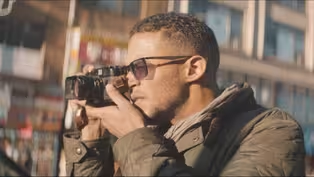
Edwin Torres, Photographer Towers: Holding On
Video has Closed Captions
Clip: S40 Ep6 | 6m 20s | Edwin Torres photographs his family in the Bronx and Puerto Rico in "Towers: Holding On. (6m 20s)
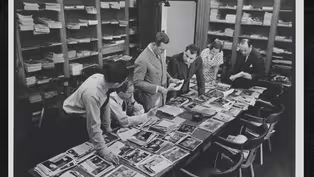
Video has Closed Captions
Clip: S40 Ep6 | 8m 52s | In 1945, LIFE magazine used photos to convince Americans that the Holocaust was real. (8m 52s)
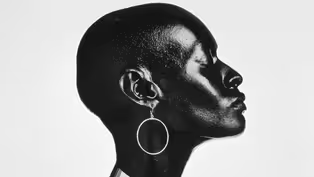
Posing Beauty in African American Culture
Video has Closed Captions
Clip: S40 Ep6 | 5m 34s | Deb Willis on her breakthrough exhibition "Posing Beauty in African American Culture." (5m 34s)
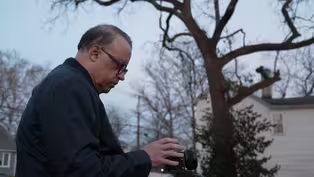
Wendel White: Schools for the Colored
Video has Closed Captions
Clip: S40 Ep6 | 3m 28s | Photographer Wendel White’s series "Schools for the Colored." (3m 28s)
Providing Support for PBS.org
Learn Moreabout PBS online sponsorship

- Arts and Music
The Best of the Joy of Painting with Bob Ross
A pop icon, Bob Ross offers soothing words of wisdom as he paints captivating landscapes.












Support for PBS provided by:
State of the Arts is a local public television program presented by NJ PBS