State of the Arts
State of the Arts: September 2022
Season 41 Episode 1 | 26m 46sVideo has Closed Captions
Ceramic artist Roberto Lugo, jazz vocalist Samara Joy and landscape painter Victor Davson.
Roberto Lugo makes pots that draw on his background as a Puerto Rican kid growing up in Philadelphia. His work is at museums and Grounds for Sculpture. Young jazz vocalist Samara Joy's deeply moving take on the standards calls to mind the greats. And for 30 years Victor Davson ran Aljira, a Center for Contemporary Art in Newark. Now, he's painting landscapes, finding beauty in his own backyard.
Problems playing video? | Closed Captioning Feedback
Problems playing video? | Closed Captioning Feedback
State of the Arts is a local public television program presented by NJ PBS
State of the Arts
State of the Arts: September 2022
Season 41 Episode 1 | 26m 46sVideo has Closed Captions
Roberto Lugo makes pots that draw on his background as a Puerto Rican kid growing up in Philadelphia. His work is at museums and Grounds for Sculpture. Young jazz vocalist Samara Joy's deeply moving take on the standards calls to mind the greats. And for 30 years Victor Davson ran Aljira, a Center for Contemporary Art in Newark. Now, he's painting landscapes, finding beauty in his own backyard.
Problems playing video? | Closed Captioning Feedback
How to Watch State of the Arts
State of the Arts is available to stream on pbs.org and the free PBS App, available on iPhone, Apple TV, Android TV, Android smartphones, Amazon Fire TV, Amazon Fire Tablet, Roku, Samsung Smart TV, and Vizio.
Providing Support for PBS.org
Learn Moreabout PBS online sponsorshipNarrator: Roberto Lugo instantly loved working with clay when he first tried it at age 22.
Now his work is sought after by collectors and major museums, and he has a new exhibit at Grounds for Sculpture.
Artist Victor Davson founded Aljira, a Center for Contemporary Art in Newark, back in the '80s.
Now he's returned full-time to painting.
And Samara Joy.
She won the 2019 Sarah Vaughan Vocal Competition while still in her teens, and now her career has taken off.
"State of the Arts," going on location with New Jersey's most creative people.
Joy: ♪ I mean what I say ♪ Announcer: The New Jersey State Council on the Arts, encouraging excellence and public engagement in the arts since 1966, is proud to co-produce "State of the Arts" with Stockton University.
Additional support is provided by these friends of "State of the Arts."
♪♪ Lugo: Growing up where I did, it affects everything, and I think that's why I talk about it so much.
Even being able to go to college seems like a dream come true.
Being able to have the time to do something like make pottery seems like something impossible that's come in your life.
Narrator: Roberto Lugo grew up in the Kensington neighborhood of Philadelphia in a tight-knit Puerto Rican family.
In his early twenties, he discovered pottery.
It led him to the Kansas City Art Institute and, from there, to Penn State, where he earned a master's degree in fine arts.
Lugo: You know, to some, it might seem like a stretch to connect pottery and the streets of Philadelphia, but, for me, those are two things that I sort of winded up falling in love with.
So, one of the first things that I made was a fire-hydrant soap dispenser, because sometimes my father and I would shower in the fire hydrant when the water would get shut off.
So it's like -- it might seem like a negative experience for somebody else, but for me, these are kind of, like, pleasant childhood memories.
You know, they're wrapped in complicated narratives of, you know, being poor and not having certain things, but at the time, it just seemed like a lot of fun.
Narrator: In 2015, fresh out of grad school, Roberto gave an Emerging Artist talk at a national arts conference.
[ Applause ] Lugo: I put my face on pots because I want to put my face in a place that doesn't belong.
I want you to get used to it.
100 years from now, I want a lot of people of color to be on pots so that you see it every day and you become comfortable with it.
Narrator: His talk went viral, and his career has been supercharged ever since.
His pots are in the permanent collections of the Metropolitan Museum of Art, the Philadelphia Museum of Art, and many others.
He's an assistant professor at Temple University's Tyler School of Art.
But most days, you can find him at his studio just outside Philadelphia's city limits.
♪♪ Lugo: My studio is actually only 5 minutes away from my home, which is great.
Most of the people that have worked here, some of them are former students of mine.
Some of them are people that I went to college with, just people that I've met through the arts.
And that's why I called the exhibition in Grounds for Sculpture "Village Potter," because I really think that it takes a village to be able to create a potter.
♪♪ Narrator: The ceramic pieces in The Village Potter exhibition at Grounds for Sculpture were all made on site.
Schneider: For a four- or five-month period, this gallery was turned into a studio that enabled Roberto to make the work that's here.
That's a long part of our tradition, is working with artists and giving them the opportunity, the technical support to take new steps in their career.
Narrator: The giant vessel was designed by Roberto then fabricated out of high-density foam at the Johnson Atelier, a cutting-edge facility where many pieces now at Grounds for Sculpture were made.
Lugo: The big piece for me is very symbolic of what I do with my smaller work.
People have an inherent need to see themselves reflected in art, you know, and that's why they take pictures of themselves.
They want to feel like they were there, like they existed.
And so this particular piece was designed to be bigger than a person so that a person can climb into the vignette, the central area where I normally paint portraits, and then they can be the portrait.
Narrator: The other pots in the exhibition portray people Roberto admires, including Jean-Michel Basquiat, Celia Cruz, Bob Marley, and the Honorable Ketanji Brown Jackson.
Her portrait is surrounded by peacock feathers, a reference to the exotic birds found strolling the gardens at Grounds for Sculpture.
Schneider: And he was thinking about what the symbolism of peacocks have been around the world, and one of those is honor.
And as he was making that work, it was literally the same week or two that the Supreme Court Justice nomination hearings were occurring for incoming Supreme Court Justice Ketanji Brown Jackson.
And he made that connection of wanting to center her, honoring her, but he was also struck by this idea of someone that was a judge who was on trial and being judged.
Cruz: ...pedophiles were getting... Narrator: Roberto Lugo's reimagined portrait faces keep classic pottery forms fresh.
His research gives him ideas, but his work is all about the world we live in.
Lugo: A lot of times, they remind you of a bunch of different countries.
You know what I mean?
Like... One of the things that's really important for me in my art is the idea of representation, and not just representation of people of color, but, like, of experiences and my particular experience.
When I was in graduate school and actually the end of undergraduate, my brother was incarcerated.
Like many of the stories of people that come from where I do, it was an incarceration that if he was white or if he had more money, he wouldn't have been incarcerated.
There's no doubt about that.
To someone else, they might be a prisoner, but me, I see my brother, you know, having his birthday with a cake in front of them.
And I remember playing in the fire hydrant with him and all the memories that we had together.
So I think of the boy, you know, who, for some reason or another, this world winded up locking up, and it's so difficult.
And that is such a... normal experience for a person that comes from where I do.
♪♪ Narrator: His brother is now free and has a successful business, but the scars remain.
With Roberto, the past is always present.
It's one reason why he wanted to work with Mural Arts in Philadelphia.
Lugo: I really only had a couple of art influences, and one of them was the Mural Arts program in Philadelphia.
I didn't know it a mural-arts program.
I just knew it as all the murals that were in Philly.
But there's a lot of portraits of people of color especially, and that really connected with me.
Like, I never stepped into museums to look at art, never had art classes.
So it's not like I was learning who Dalí was or Michelangelo.
It was just, you know, the portrait of Harriet Tubman that I saw.
So when I started talking to Mural Arts, looking at the work that I do, I knew that I wanted it to be a pot, and I really wanted to do a mural of Black Thought of the Roots.
Tariq Trotter is -- He's Black Thought, which is the lead vocalist for the band the Roots, which is also on the "Jimmy Fallon" show five nights a week.
Black Thought: ♪ Lost your mind trying to call me a moulinyan ♪ Lugo: You know, he grew up in a very similar neighborhood that I did in Philadelphia.
And knowing all of the things that he had to go through in his life to be able to be where he's at and to be such a respected musician has always been a huge inspiration for me.
Black Thought: ♪ Courage esteem is aquamarine ♪ ♪ You mask how you really feel like it's Halloween ♪ ♪ Where they ask how you really feel about my machine ♪ ♪ In a class that I'm only in ♪ ♪ Alien, horsepower like a Mongolian ♪ Narrator: Pottery changed, maybe even saved Roberto Lugo's life.
It's a gift he's making sure to give back.
Schneider: Clay can be for everyone, and so he was very gracious in not having the hands-on making activities in a little corner, in the back of the room, or in another building, but central to people's experience that they, too, like him, can take clay and make art.
Lugo: I had always had a really empathetic soul, even as a child, and so growing up, I always, like, really felt all the detritus around me, all of the crime around me.
It really affected me quite a bit.
But at the same time in my neighborhood, I saw so many people that had to work twice as hard as everyone else.
You know, work two jobs, mothers who were really trying to protect their children.
There are just so many kind people who also live in this place, but all people see is the crime and the poverty.
So, you know, one of the things that I really try to do in representing where I'm from is, like, show the full spectrum and the reality of those places, because a lot of greatness comes from those places because when you're trying to overcome, that doesn't leave you when you go into another career.
And so, as a potter, I still have the work ethic of someone who comes from Kensington, which is a really great asset to me.
♪♪ Narrator: Later on the show, artist Victor Davson explores his newfound fascination with nature.
But next, a young jazz singer with a reverence for tradition.
♪♪ Joy: ♪ Lord, dear Lord above ♪ ♪ God Almighty ♪ ♪ God of love ♪ ♪ Please ♪ ♪ Look down and see my ♪ ♪ People through ♪ Kirk: She has something in her.
And I will just call it soul, something that you feel.
And it just hits you because, you know, music is about a feeling, anyhow, when you get down to it.
And I can't imagine anybody coming to see her and not feeling her spirit.
Joy: ♪ Beside ♪ ♪ Beside, beside, beside a garden wall ♪ ♪ When stars are bright ♪ ♪ You are in my arms ♪ Jordan: Samara Joy, to me, when I hear her, I hear an echo of Sarah, I hear Billie whispering, and it just makes sense to bring her here.
During the lockdown of the pandemic, I'm just sitting and I'm listening to her voice, and I said to myself, "The minute we get out of this mess, I want to be in a space where I see this young lady perform."
Joy: ♪ In my heart ♪ ♪ It will remain ♪ Being here at the Apollo is kind of a surreal experience, considering all the history of singers and musicians who have passed through here since, you know, Sarah Vaughan won Amateur Night and Ella Fitzgerald did the same.
It's amazing to be here performing for the first time.
[ Cheers and applause ] Narrator: Samara didn't grow up listening to jazz, but a YouTube recording of the great Sarah Vaughan changed her life.
Joy: I was supposed to be doing homework, but I was looking up YouTube videos of certain versions of songs to learn for class.
And then her "Lover Man," -- it's a standard -- came up.
She was live in Amsterdam.
Vaughan: ♪ Got the moon above me ♪ ♪ But no one to love me ♪ ♪ Lover man, oh, where ♪ ♪ Can you be?
♪ Joy: And the camera was on her.
Nothing else.
Just her.
No zoom-in.
No anything.
Just her standing there.
Just singing, you know, being gorgeous.
And it completely captured me.
Walker: The thing that I think brings people into Samara Joy's world is that she has this uncanny ability at a very early age to embrace stories and songs that some of us have known for years.
Joy: ♪ That we once knew ♪ ♪ Each tiny star ♪ ♪ Is but a prayer ♪ Narrator: In 2019, Samara competed in the Sarah Vaughan International Jazz Vocal Competition at NJPAC.
She was still in college.
She won, starting a career that has since taken off.
Samara's first album was described by "DownBeat" magazine as "self-possessed" and "deeply emotive."
She's appeared at the Newport Jazz Festival, The Apollo, and the Blue Note.
Her second album is being released by Verve, one of the greatest jazz labels.
And she's played all over Europe.
Joy: Hello.
My name is Samara Joy.
And I'm here in Perugia, Italy, for the Umbria Jazz Festival 2022, my very first residency, so we've been here performing every single day.
♪ Last night your lips... ♪ Narrator: Jazz is all about the music, no matter where you are -- a festival in Italy or an evening church service in Newark, especially if it's the Bethany Jazz Vespers run by the legendary Dorthaan Kirk, named a 2020 NEA Jazz Master for advocacy of the music.
Kirk: So please welcome Samara Joy.
[ Cheers and applause ] Joy: It's one of those things where it's like if Dorthaan calls, you know, I got to go.
Narrator: That night, Samara played with bassist Neal Miner and guitarist Leonid Morozov, a friend and former classmate.
Morozov: It was like a couple months after, you know, I moved to America and I'm here in college, and we'd go in on a jam session together.
And I cannot believe what I'm hearing because it just gives me goosebumps, makes me feel something, makes tears be in my eyes.
It just -- It happens automatically, basically.
It's like your human response to beautiful music.
Joy: ♪ Nostalgia hit me ♪ ♪ As I recall the day I knew that I loved you ♪ ♪ You passed me by on a starry night ♪ ♪ How could I forget?
You were stunning ♪ There's a song in solo written and performed by a bebop trumpeter by the name of Fats Navarro and I wrote the lyrics to.
I believe this is the first time lyrics have been written to the song.
It's called "Nostalgia."
Narrator: Samara is drawn to songs that tell a story.
And the lyrics she wrote for Fats Navarro's "Nostalgia" tell one.
Joy: Because he died when he was 26 years old.
It's sad to imagine what music would be or what the trumpet would be, you know, if he had lived.
But he was only 26 years old when he passed away.
So I wanted to try and write lyrics from his perspective, as if he was talking to his significant other celebrating an anniversary.
He didn't get to live that long, so I tried to write lyrics as if he did.
♪ Nostalgia hit me ♪ ♪ As I recall the day I knew that I loved you ♪ ♪ And now the feelings are just as strong ♪ ♪ As when I first laid eyes on you ♪ ♪ A vision of perfection ♪ ♪ Heaven's very essence ♪ ♪ I believe you're all I'll ever need ♪ ♪ Long as I live, I'll love you for all eternity ♪ ♪ And I'm so glad you chose m-e-e-e ♪ [ Cheers and applause ] Thank you very much.
"Nostalgia."
♪♪ Narrator: Last on the show, the exuberance of nature in new paintings by Victor Davson.
♪♪ [ Indistinct conversations ] ♪♪ Gil: Such a difficult moment that we live in to be able to create something that is so -- so beautiful and and refreshing and, like, kind of like the coin toss back to nature and to our humanity.
Oglesby: I've known Victor and his work for 30, 40 years, I guess.
And to see him branch out into this direction, it's totally new.
Who would have thought it?
Jones: They're landscapes, but they're also these internal -- These are expressions of his internal life.
There's a kind of calmness.
And he has found a way to capture that.
Narrator: Victor Davson made his reputation heading Aljira, a Center for Contemporary Art in Newark.
He spent over 30 years there, creating innovative programing with both established and emerging artists.
But Victor never stopped making his own art, and now he's doing it full-time, immersing himself in a series of monumental landscapes.
Davson: I've been so busy going back and forth from where we live here, you know...in West Orange -- I've never really paid attention to my environment in the way it suddenly struck me as extremely bucolic and beautiful and blooming.
It threw me for a loop in a way because I was very uncomfortable with making landscapes after making work that had to do with activism or work that had to do with abstraction.
I thought that maybe -- "Landscapes, Victor?
You're going to make landscapes?"
But I started making these landscapes and I started making landscapes that were large, landscapes over 8 by 10 feet.
The next thing you know, I have a body of work, maybe 20 or 25 paintings, large paintings, and as large as 8 feet high and 25 feet across.
And I remember making the first breakthrough landscape in the driveway because I couldn't make it in my studio.
And I made it during the summer of 2020.
And then Cicely, whose studio's across the way, she was coming across and giving me a high five.
And, you know, it was a breakthrough moment.
I made this incredibly heroic piece, I would say.
Cicely is the gardener and the landscape painter in the family.
And that particular summer, she had a stunningly beautiful garden.
The house we live in is now surrounded by windows, this cottage.
And I would -- We'd see -- I'd say, "Look at that.
Look at this.
Look."
I mean, I was just so excited and aroused by -- by this environment.
I just had to make this painting.
We were also reading Richard Powers' book, "The Overstory."
Cottingham: "Lives there with her creatures in the minuscule architecture of imagination."
Narrator: "The Overstory" is a Pulitzer Prize-winning novel focused on stories about nine Americans and their relationships with trees told over a span of hundreds of years.
It's been called a breakthrough in environmental fiction.
Victor and Cicely made a ritual of reading and talking about the book on Sunday mornings.
Davson: Not only do we learn more about trees, but we learn more -- We learn something about why people were willing to die to save trees.
The prose and the poetry in the book is remarkable.
It's remarkable.
Cottingham: "Knot holes turn into louvered windows through which..." Davson: One of the things that we look forward to over coffee.
I've always seen trees as, well, they're inanimate objects, they're there.
But all of a sudden, we were talking about trees as having a life, trees communicating with each other, trees sharing resources below the surface of the ground.
Somehow we share something with the trees as human beings.
We live on the first ridge of the Watchung Mountains in West Orange, and the Lenape Trail goes through here.
If you take Eagle Rock Avenue and you walk east, you come to the Eagle Rock Reservation.
And people hike there.
There's a view of New York City.
We do that walk maybe three or four times a week.
It was almost like being in the paintings, in a sense, you know, that kind of visceral feeling of being in the woods and being, you know, part of nature.
Well, I was born in what was a colony at the time -- British Guyana.
My father and my mother were, I would say, lower middle-class people.
My father came from very humble circumstances, but he worked his way up through the post office and became a postmaster.
Born in 1948, I was the victory baby after World War II, or as my older brother would say, the one that was spoiled.
I would -- I think I had in some ways an idyllic childhood.
You know, there was no pressure on me to become something or to, you know, do the arts or to become a attorney, you know, or a doctor.
The population were descendants of slaves and indentured laborers and native Guyanese.
And so there were Chinese -- I had Chinese friends, I had Indian friends, friends that were from my own community who were Black.
So it's a multiracial society.
My recollections are nothing but good except for the politics that polarized the country after independence, which is deeply painful -- is still painful today.
Narrator: Inspired by a lecture about the Black arts movement, Victor Davson came to New York in 1973 for an artist-in-residence position at the Studio Museum of Harlem.
In 1983, he co-founded Aljira, a Center for Contemporary Art, where he spent over 30 years promoting cross-cultural dialogue and understanding.
Davson: Aljira blossomed into something that the New Jersey State Council on the Arts designated a major institution.
Well, the landscapes... are...
They're not representations of what is in front of me.
I'm painting on a two-dimensional surface, but it's made up of things that are in front of me and recollections of things and things seen from the opposite side.
I'm constantly conscious that what I'm making is a work of art that has its own existence outside of what is in front of me.
Painter: I mean, Victor has a wonderful career, and he's done a lot of work based on Guyana, based on U.S., based on his sense of himself as a citizen.
But what he's doing here is enjoying New Jersey, enjoying the world we live in.
And so often we want Black artists not to do that.
We want Black artists to talk about race, tell us about race, tell us about what we need to know, tell us about the United States.
And Victor has done that.
But now he's saying, "Look at the world we live in."
♪♪ ♪♪ Joy: ♪ Uh, two, uh, two, three ♪ ♪♪ Narrator: Watch or share any of our stories online at StateoftheArtsNJ.com.
While you're there, let us know what you're thinking.
We love to hear from you.
Thanks for watching.
♪♪ Joy: ♪ I didn't know what time it was ♪ ♪ Then I met you ♪ ♪ Oh, what a lovely time it was ♪ ♪ How sublime it was, too ♪ ♪ I didn't know what day it was ♪ ♪ You held my head ♪ ♪ Warm like the month of May, it was ♪ ♪ I'll say it was grand ♪ ♪ To be alive, to be young ♪ ♪ To be mad, to be yours alone ♪
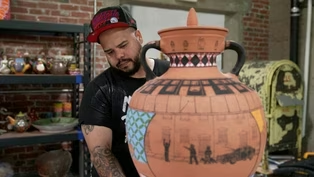
Roberto Lugo: The Village Potter
Video has Closed Captions
Clip: S41 Ep1 | 9m 6s | Roberto Lugo makes art about his experiences growing up Puerto Rican in Philadelphia. (9m 6s)
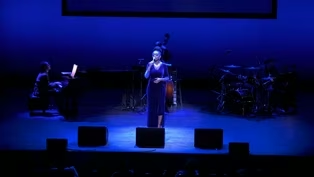
Samara Joy: Reverence for Tradition
Video has Closed Captions
Clip: S41 Ep1 | 6m 50s | Young jazz vocalist Samara Joy is a rising star. (6m 50s)
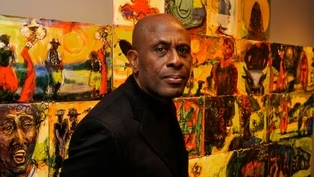
Victor Davson: Lessons from the Trees
Video has Closed Captions
Clip: S41 Ep1 | 8m 16s | Victor Davson paints monumental landscapes based on a new appreciation for nature. (8m 16s)
Providing Support for PBS.org
Learn Moreabout PBS online sponsorship

- Arts and Music
The Best of the Joy of Painting with Bob Ross
A pop icon, Bob Ross offers soothing words of wisdom as he paints captivating landscapes.











Support for PBS provided by:
State of the Arts is a local public television program presented by NJ PBS