State of the Arts
State of the Arts: September 2023
Season 42 Episode 1 | 26m 46sVideo has Closed Captions
NJSO debuts DBR's “Farah,” Philip Roth’s Newark, and an underground classic at Camden Rep
The NJSO debuts Haitian-American composer, violinist and activist Daniel Bernard Roumain’s “Farah." Philip Roth’s Newark explored at NJPAC including a tour of landmarks appearing in his fiction, a visit to his personal library, readings by actors Matthew Broderick, Peter Riegert and more. Plus, Camden Repertory Theater stages an underground classic by Aishah Rahman with a live jazz band.
Problems playing video? | Closed Captioning Feedback
Problems playing video? | Closed Captioning Feedback
State of the Arts is a local public television program presented by NJ PBS
State of the Arts
State of the Arts: September 2023
Season 42 Episode 1 | 26m 46sVideo has Closed Captions
The NJSO debuts Haitian-American composer, violinist and activist Daniel Bernard Roumain’s “Farah." Philip Roth’s Newark explored at NJPAC including a tour of landmarks appearing in his fiction, a visit to his personal library, readings by actors Matthew Broderick, Peter Riegert and more. Plus, Camden Repertory Theater stages an underground classic by Aishah Rahman with a live jazz band.
Problems playing video? | Closed Captioning Feedback
How to Watch State of the Arts
State of the Arts is available to stream on pbs.org and the free PBS App, available on iPhone, Apple TV, Android TV, Android smartphones, Amazon Fire TV, Amazon Fire Tablet, Roku, Samsung Smart TV, and Vizio.
Providing Support for PBS.org
Learn Moreabout PBS online sponsorshipNarrator: At NJPAC, three days devoted to the acclaimed novelist Philip Roth, who set most of his books in the world of the Newark he grew up in, at Camden Repertory Theater, an underground classic from the Black Arts Movement by Aisha Rahman, and violinist, composer, and activist Daniel Bernard Roumain, the New Jersey Symphony's first resident artistic catalyst.
"State of the Art's" going on location with New Jersey's most creative people.
[ Music plays ] Announcer: The New Jersey State Council on the Arts, encouraging excellence and engagement in the arts since 1966, is proud to co-produce "State of the Arts" with Stockton University.
Additional support is provided by the Pheasant Hill Foundation, the Work Foundation, on behalf of Philip E. Lian and Joan L. Mueller, and these friends of "State of the Arts".
[ Music plays ] Narrator: The New Jersey Symphony Orchestra held their final concert of the season in June 2023.
It began with a new work by Daniel Bernard Roumain called "Farah".
"Farah" is the Arabic word for joy.
Bass: [ Singing ] Remember me, a black girl named for joy.
Roumain: This piece is the beginning of my open hand, proclaiming my love for the people that lift me up, and "Farah" is the first piece that is centering forgiveness.
Bass: [ Singing ] Farah, Farah.
Farah, Farah.
Narrator: Singer Becky Bass was the featured soloist.
Bass: I see Daniel as a revolutionary.
I mean, I think that what he is doing is so crucial to music today, especially in the classical world, because you don't see many composers that look like him that are talking about real life things that happen to people of color, and he's really bringing these to light through classical music.
Roumain: What I wanted to do is write a piece that could begin a program that is a celebration.
Narrator: Daniel, known by his initials, "DBR", is the New Jersey Symphony Orchestra's first resident artistic catalyst.
Roumain: It's a curious title that speaks to my role in helping the orchestra adapt to an ever-changing community.
We are looking at equity.
We are looking at diversity.
We are looking at what is the role that orchestral musicians can play in the healing of a community.
Zhang: We commission him to write works for us and he also performs with us.
He's a great violinist.
He sometimes would curate some series to do in Museum of Art in Newark, and also with students.
He's a great advocate, you know, to engage younger people as well.
Roumain: Any note.
Any sound.
I trust her.
[ Violin music plays ] Roumain: Well, I started playing the violin when I was five years old.
It was a small town called Margate, Florida, and I would say each year, I started picking up other instruments, and I kind of had two lives.
I was jamming with my friends on the weekends in, you know, these rock bands, and then during the week, I was playing in all different types of orchestras.
Narrator: After college at Vanderbilt University and grad school at the University of Michigan, Daniel moved to New York City in 1998 to launch his career.
Roumain: My first job was playing for dancers.
I played from 9:00 AM until midnight.
I played for the Martha Graham Dance Company, Jose Limon Dance Company, the Paul Taylor Dance Company.
Oh, Alvin Ailey, of course.
Narrator: Soon, the great dancer-choreographer Bill T. Jones took notice.
Roumain: And I immediately became his music director, principal composer.
I performed with him on stage.
He took me around the world with the company, and that changed my life.
Just a genius.
Zhang: He's a great, fun, collaborative, intelligent person, but he has strong beliefs -- quality, diversity, you know, inclusion.
He has very strong beliefs, and he's not shy of speaking that, which is great.
[ Piano music plays ] Roumain: The wonderful Korean pianist Min Kwon asked me to write variations on "America the Beautiful", and the title of of that work, my variations, is "America" -- capital letters -- "NEVER Beautiful".
[ Piano music plays ] Now, what you have to understand is the piece was written at the height of the pandemic, at a time of worldwide protest.
I never thought I would live long enough to see a worldwide event in which people of all different races and ages and sexual orientations were rallying around the murder of one black man in Minneapolis, in George Floyd.
That was a seismic shift for me, and at the time, I was feeling rage, when I was feeling that "I want my country to be better."
Narrator: In his first composition for the New Jersey Symphony, Daniel dealt head-on with the issue of race again.
Roumain: I work with the title first oftentimes, then the piece comes.
So I thought of, "Well, what's a title that speaks to the now?
What am I feeling right now?"
And it came to me kind of in a text message to a friend.
I said, "I think I know the title of this piece.
It's going to be 'I am a white person who blank Black people' and I'm going to leave it blank."
Classical music still is kind of almost monolithically white in many ways, although that is changing, but the title was a way of centering this idea of how does a largely white institution feel about Black people?
[ Music plays ] Narrator: Daniel's new composition, "Farah", focuses on a very different message and speaks to very different emotions.
Roumain: I spent the last two years, like everyone else, in a kind of cultural hibernation.
I had a lot of time to think.
I was protesting with my fists closed and up in the air.
Rage is exhausting for me, and this piece is the beginning of my open hand.
and 'Farah" is the first piece that is centering forgiveness, Bass: [ Speaking ] "Remember me, a black girl named for joy."
That is how we start this piece.
[ Singing ] Remember me, a black girl named for joy.
Roumain: And the words are by Marc Bamuthi Joseph.
I'm a Haitian-American composer.
Marc is a Haitian-American writer.
He's a wonderful spoken word artist and librettist.
He wrote the libretto for my opera, "We Shall Not be Moved".
Man: [ Singing ] Love is the only word sweeter than black.
Love is the only word sweeter than black.
Love is the only word sweeter than black.
Roumain: Marc and I have been performing with one another for probably about 10 years now.
Joseph: [ Singing ] ...of the wrong class, of the wrong cast.
Placed on the lower track at six years young.
Bass: [ Speaking ] And then with "Farah", with joy, it's this journey of, you know, going through the anger, then coming to a place of forgiveness.
[ Singing ] Look for me at the coast.
When the sun crests, remember how my hips rose.
When the day breaks.
Think of a woman.
Without the luxury to pause.
[ Speaking ] One of my favorite parts is toward the end of the piece, and it goes like, "Could you remember a woman like me and love her presently?
Could you love her before she was a memory?
[ Singing ] ...presently.
Presently.
Presently.
Presently.
Roumain: The question Marc and I have been asking ourselves -- as black men in America, what is our role and responsibility towards forgiveness?
Bass: [ Singing ] Presently.
Presently.
Presently.
Presently.
[ Music plays ] [ Applause ] Narrator: Later on the show, Charlie Parker and unwed mothers share the stage in a play rooted in the Black Arts Movement of the 1970s.
But first, the towering literary figure, Philip Roth, celebrated in his hometown, Newark.
Roth: Tempting as it is, I will not bury you tonight beneath a ton of stories about my happy childhood and the Weequahic section of this city.
More about my emotional affinity to nearly every commonplace, unpoetic thing that was the Newark of my day.
There is no good reason for an 80-year-old man to regret that things were once different or to bore people with a pathetic fondness for carrying on about how everything back then was otherwise.
The Weequahic section is a 20 minute bus ride from this spot.
I know because we made school trips by bus to the museum to look at the famous jewelry collection, many of the pieces Newark made, when I was a pupil at Chancellor Avenue Elementary School from 1938 to 1946.
Schreiber: For a year prior to coming to Newark, when I had no idea that I'd be coming to Newark, I spent the year reading Philip Roth novels.
I don't know why.
And so, I got this job and I came to Newark, and bingo, you know, here I was in Philip Roth's hometown.
I arrived and I sort of felt as if I knew the city, but the city that I knew was the one he grew up in, which was the Newark of the 1930 and '40s and '50s.
So, it was quite a different Newark, and yet, I felt a sense of home.
Roth came to the Arts Center in 2013, when he was 80.
We premiered a film about him, a PBS "American Masters" film about him here.
I got to meet him.
It was thrilling.
Woman: He's so funny and so sharp and it's dazzling writing.
Announcer: Look for "Philip Roth: Unmasked"... Roth: Where should I lift the curtain?
Announcer: ...on "American Masters".
Schreiber: It always stayed with me that there was something to the idea of creating a series of events that examined his work, that allowed for theatrical readings and also allowed us to dig into the controversy around his work in a very intentional way, and so, we did.
We call it "Philip Roth Unbound".
It's a dozen events or so, and we found, as we started to work on it, that there was a great love of Roth's work.
Many of Roth's friends are still -- and colleagues are still here, and they wanted to talk about him.
So, that was our catalyst and our inspiration.
Wilentz: People think that he was a curmudgeon, that he was difficult.
No.
He stood up for standards and he wouldn't suffer fools, but if he got to know you and you liked you, then he was the most generous guy in the world.
He was interested in what I did because at that point, one of his later novels, "Plot Against America", is based on something that he read by the historian Arthur Schlesinger Jr., who was also a buddy of mine.
So, there was a sense, I think, that he was starting to think about history much more seriously.
And it's about Jews, it's about America, it's about what happened, and it kind of comes, you know, full circle right here in this book.
Prose: Rereading the plot, I was thinking that probably more than any other writer, reading it now, I was thinking about the way in which the nightmare -- he's been able to bring the nightmares of the 20th century into the 21st century, and then you realize it's not just the 20th or the 21st century.
It's the nightmares of every century in history.
So, in a way, what he was always looking for, I think, was these recurring patterns that happened in history and then the way they affected individual lives.
Gourevitch: It's exactly what you're saying, about how history slams into people.
It's about those moments when the unforeseen -- in other words, when what will later be looked at as history helps reshape a life, and in his own case, he said, you know, he was a happy child in his view, and an exuberant -- sort of happy to be in Newark boy, played baseball every day, et cetera, and then the war was there, and that became, for him, the first time that he saw how it affected the whole community, saw how it affected, and how the emotions of the war coincided with the emotions that you have, like, at the beginning, you have fear, then you have defiance, then you're proud of your country, then you have this, that -- all of these things that were out there that you think of as your own, and then you start to see later in life, as you look back, the larger shapes, that that kind of became the ambition of that later period.
Schreiber: When one reads his work, it is historically accurate even if he takes the true history and then fictionalizes it in ways that we could never imagine, like in "Plot Against America", where he imagines a U.S. that is led by a President Lindbergh, and "Plot" has been adapted for the stage.
Nine actors will each read a chapter.
Washington: "By 1940, Jewish parents and their children at the southwestern corner of New Jersey's largest city talk to one another in an American English that sounded more like the language spoken in Altoona or Binghamton than like the dialects famously spoken across the Hudson by our Jewish counterparts in the five boroughs.
I pledged allegiance to the flag of our homeland every morning at school.
I eagerly observed its national holidays.
Our homeland was America.
Then the Republicans nominated Lindbergh, and everything changed."
Bogosian: "The November election hadn't even been close.
Lindbergh got 57% of the popular vote, and in an electoral sweep, carried 46 states.
Though on the morning after the election, disbelief prevailed, especially amongst the pollsters.
By the day after that, everybody seemed to understand everything, and the radio commentators and the news columnists made it sound as if Roosevelt's defeat had been preordained.
It turned out, the experts concluded, that 20th century Americans, weary of confronting a new crisis in every decade, were starving for normalcy.
If Lindbergh promised no war, then there would be no war.
for the great majority, it was as simple as that."
Kaczmarek: "Hitler.
I heard him saying, 'Hitler is not business as usual, Rabbi.
This madman has conquered Europe!
He's at war with Russia.
Every night -- Every night he bombs London into rubble and he kills hundreds of innocent British civilians.
He is the worst anti-Semite in history.
And yet -- And yet his great friend, our president, takes him at his word when Hitler tells him that they have an understanding.'"
Schreiber: I think he felt very fondly towards Newark, the fact that he did donate 7,000 volumes of his own personal library to the Newark Public Library.
He appreciated all his life what that library meant to him, and the Philip Roth reading room that the library built is a wonderful space.
Giron: Everything had to be kept in order, so we had to obtain books from his apartment in New York and also from his home in Connecticut.
Visitors can see all of the books that influence Roth, and many contain markings.
So, you can look into the mind of a reader, what he was thinking when he was reading, and you can also see research materials, so which books he used in the creation of his novels.
Steinbaum: Well, the festival has brought foot traffic to the Philip Roth Personal Library.
We also, the library and NJPAC together, produced the audio guide to this space.
So, with the festival, the actor Morgan Spector recorded a narration walking through this space.
Spector: On the far left is a sketch of the apartment where Roth grew up in Newark.
As an adult, as he began writing his 2004 novel, :"The Plot Against America", he asked his brother Sandy to draw him a sketch of their childhood apartment on Summit Avenue.
Roth wrote the book with the sketch in hand, situating the novel's fictitious Roth family in his own childhood home.
Woman: And Roth lived on which floor?
Woman #2: Roth lived on the second floor.
Yeah.
Yeah.
Did you read "Plot Against America"?
Rigert: If you like to read, he will take you into a world that, when the book is over, you're just, like, so sad, not by the book, but that it's finished and you have to stop.
"Rich times.
Morty used to talk to the other men, the fishermen.
Did it so easily."
To me, it's exhilarating to read his books.
He just draws you in.
It's a full meal, Philip Roth, and if you like great literature, he will just -- he'll open your head.
Man: Thank you so much.
Woman: Ah, you're welcome.
Thanks for coming.
Woman #2: That was wonderful.
Woman: Great.
Thank you.
Thank you.
Narrator: Last on the show, a jazz-infused play by Aisha Rahman at Camden Rep. [ Jazz music plays ] Tucked away in a residential neighborhood in the city of Camden, there's a theater with a community-focused mission, built on the legacies of the Harlem Renaissance and the Black Arts Movement.
Desi P. Shelton, a Camden native and an MFA graduate from Sarah Lawrence College, founded Camden Repertory Theater in 2005.
Shelton: They doing the Harlem Renaissance.
They do salon-style readings and salon-style plays.
So, if it was good enough for Langston and Zora, how can Desi Shelton think it's not good enough for her?
Parker: I had a dream there was this giant bird with... wings... big enough to block out the sun.
Narrator: Inside Camden Rep's living room setting, two narratives intertwine within one play.
[ Jazz music plays ] Parker: I get one body.
Narrator: Jazz legend Charlie Parker is dying in his mistress's apartment... Wilma: Damn you, Charlie Parker.
Narrator: ...while young women struggle inside a home for unwed mothers.
Parker: I am what I am.
I am how I was framed to be.
Narrator: The play is called "Unfinished Women Cry in No Man's Land While a Bird Dies in a Gilded Cage".
It was written by Aisha Rahman and first produced in 1977 at the height of the Black Arts Movement.
It was a time when writers like Amiri Baraka, Nikki Giovanni, Audre Lorde, and Aisha Rahman were creating new, unflinching works about the Black experience in America.
Wilma: I'm not going to be a mother.
I'm not even going to see my baby.
Michele: She wrote a monster of a play, but amazing.
Parker: All I ever wanted -- All I ever wanted was the music.
Michele: We had the life of Charlie Parker being played out in sort of like this split-stage situation, but then we also had this life of these teenage pregnant women in this hideaway home for unwed mothers.
Wilma: Charlie Parker died today.
Michele: In the play, we see that actually, Charlie Parker dies, and then we see the effect on the main character, Wilma.
Jacobs: Today is the day where you must decide what to do with the baby.
Man: Presenting Charles Parker Jr. and his symphony.
Narrator: The intimacy of the Camden Rep space adds intensity to the performances.
Michele: We have the band in the kitchen, Charlie Parker sort of in this back area of the first floor, and the audience is leaned up against the wall.
Shelton: And you're thrust right in the middle of the action.
You're right up on it.
[ Jazz music plays ] Narrator: This production went even farther, ramping up the sensory experience with a live band.
Shelton: Aisha Rahman wrote the play like it was a jazz song, she said.
She never said that it had to be a band.
That was our artistic aesthetic.
[ Jazz music plays ] Michele: So, this space literally gives it to you in the best way.
It feels like, "Ah, Charlie Parker's going through it.
I'm right here with him."
You hear the stories of these girls.
It feels like "I'm in the home or I'm like their sister or their mom."
Girl: ...the state would give me one if I could prove I was raped like I said.
Narrator: In her memoir, "Chewed Water", Aisha Rahman described growing up as a foster child to a troubled mother in Harlem.
Girl: How come I have to have a baby?
Shelton: She was a foster child, and you can see a sliver of her in every one of those characters.
Like, I can see her foster mother in Nurse Jacobs.
Jacobs: Not in my church.
In my church, you only do it to get a baby and a family.
Bridgeforth: "Unfinished Women" is such a unique play, and Aisha Rahman speaks to voices that others would not listen to.
Wilma: Yes, I am angry.
You go through this day like a breeze and still... Bridgeforth: Our mission is about giving a platform, a meaningful platform, a professional platform for women of color to have their voice heard.
It's essential.
Woman: Ready?
Five, six, seven eight.
Bridgeforth: A key component of what we do at Camden Repertory is our P.A.C.E.
program, which is Preparing Artists for College Entrance.
It trains young people in a range of performing arts skills, and then we marry that with a very rigorous academic program and academic support.
Most of the cast is either in P.A.C.E.
or are graduates of the P.A.C.E.
program, both in the cast as well as in the orchestra.
Shelton: These students in the P.A.C.E.
program, when we started in 2007, they have gone on to the best schools in the country for what they do.
Joseph Streater was originally from the P.A.C.E.
program and graduated from Berklee College of Music.
He's played with some of the top artists in the country.
Michele: Being a part of the P.A.C.E.
program as a high schooler and then coming into the professional realm of Camden Rep and being in a production was life-changing.
Girl: The man that we all need.
You hear me, Charlie Parker?
We need you.
Bridgeforth: The impact of the work is tremendous.
People's perception of Camden in general change, because then they see that there is positivity and there is excitement and there is deep good in the city and also amazing, amazing talent.
Narrator: Camden Rep continues to grow, thanks to leaders like Desi Shelton, who returned home from Sarah Lawrence College with a mission to cultivate quality theater within the community.
Jacobs: Foolish women!
Wake up!
Bridgeforth: Desi continues to be a pied piper for creativity right here in Camden, and she does that through her own professional training.
She's been awarded fellowships from all across the country.
Michele: I know that's surely an inspiration to other young black women to see her stay in her community and build something amazing.
Shelton: Ozzie Jones, the one who -- I begged him to play Charlie Parker, he said to me in 2004, when I first came back from Sarah Lawrence, "It's your responsibility to give your hood all of that that you learned at Sarah Lawrence and give it back to your hood."
So, I say the same thing to my students.
Everything that you've learned, it is your responsibility to come back here and give it to our hood.
Narrator: Watch or share any of our stories online at stateoftheartsnj.com.
While you're there, let us know what you're thinking.
We love to hear from you.
Thanks for watching.
[ Music plays ] [ Music plays ] [ Music plays ]

Farah: Music by Daniel Bernard Roumain
Video has Closed Captions
Clip: S42 Ep1 | 8m 59s | Haitian-American composer, violinist and activist Daniel Bernard Roumain's "Farah (Joy)." (8m 59s)
Video has Closed Captions
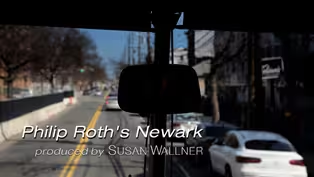
Clip: S42 Ep1 | 9m | The celebrated novelist Philip Roth set most of his work in his hometown of Newark, NJ. (9m)
Video has Closed Captions
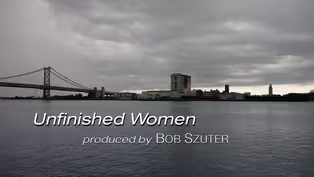
Clip: S42 Ep1 | 6m 31s | Aishah Rahman's underground classic "Unfinished Women," as staged by Camden Rep. (6m 31s)
Providing Support for PBS.org
Learn Moreabout PBS online sponsorship

- Arts and Music
The Best of the Joy of Painting with Bob Ross
A pop icon, Bob Ross offers soothing words of wisdom as he paints captivating landscapes.












Support for PBS provided by:
State of the Arts is a local public television program presented by NJ PBS