
State Program Making Headway to Remove Invasive Asian Carp
Clip: Season 5 Episode 64 | 3m 55sVideo has Closed Captions
Kentucky incentivizes removal of invasive Asian Carp from state waterways.
Asian carp were introduced to the United States in the 1970s as a tool to reduce algae growth on private fish farms. But by the 1990s, they had escaped into the Mississippi River. Today, they are considered an invasive species in our waterways. And the Kentucky Department of Fish and Wildlife Resources has a program that is paying people to catch and remove these fish.
Problems playing video? | Closed Captioning Feedback
Problems playing video? | Closed Captioning Feedback
Kentucky Edition is a local public television program presented by KET
State Program Making Headway to Remove Invasive Asian Carp
Clip: Season 5 Episode 64 | 3m 55sVideo has Closed Captions
Asian carp were introduced to the United States in the 1970s as a tool to reduce algae growth on private fish farms. But by the 1990s, they had escaped into the Mississippi River. Today, they are considered an invasive species in our waterways. And the Kentucky Department of Fish and Wildlife Resources has a program that is paying people to catch and remove these fish.
Problems playing video? | Closed Captioning Feedback
Where to Watch Kentucky Edition
Kentucky Edition is available to stream on pbs.org and the PBS app.
Providing Support for PBS.org
Learn Moreabout PBS online sponsorshipAsian carp were introduced to the United States in the 1970s as a tool to reduce algae growth on private fish farms.
But by the 1990s they had escaped into the Mississippi River.
Today, they are considered an invasive species in our waterways, and the Kentucky Department of Fish and Wildlife Resources has a program that is paying people to catch and remove these fish, and it's welcoming new ideas, too.
Here's more from Kentucky Edition's Clayton Dalton.
Kentucky's invasive Carp Harvest program allows select, vetted professional fishermen to use experimental tools and practices to catch more Asian carp than they otherwise would.
One of these tools is called a sein.
A sein is just a large net that fishers use to encircle schools of fish, basically just acting as a corral so that the fish are to go out and identify a school of carp with their electronics or side scan imaging, encircle the fish, and then they're able to, quickly remove those fish.
The number of carp harvested in Kentucky using seines is impressive.
Our top fisher.
Over the last, three years, they've landed about 7 million pounds of invasive cod.
And if you look at what that proportion is to our statewide harvest, we're around about 30 million pounds of carp harvested since 2024.
These experimental programs exist to keep invasive carp at a manageable level, because their presence in Kentucky waters is harmful to native species.
The species has an ability to, grow very quickly here in the U.S.
growing 8 to 12in in the first year of life, which quickly exceeds the, the predator capabilities of our native species.
They're able to to populate areas very quickly.
And, the species feeds on, zooplankton, which is the very bottom of the, the food chain in aquatic systems.
So they're able to, disrupt the, the food chains.
The overwhelming amount of carp in Kentucky has affected fishing tourism as well.
We have lots of complaints from our recreational fisheries folks that, they, you know, they weren't able to catch the the bluegill and bass and crappie like they had previously.
Because they weren't able to, to get those livers down to their target species, to the carp.
Thompkins says these experimental commercial fishing practices are working.
We are seen a decline in the population of invasive carp from the wester That is a great thing.
We we attribute most of that to invasive carp being removed through our commercial programs.
That being said, that they they do still have the ability to move through locks and come in and repopulate, as they're being removed.
But, with these deterrents that we're working on, I think we have a really good opportunity here to slow their immigration even more and to be able to fish them down to a manageable and acceptable level within the, the Berkeley and Kentucky reservoir systems.
Tompkins says they're working to move the use of seines from experimental to legal for invasive carp fishers in 2027 for Kentucky edition.
I'm Clayton Dalton.
Kentucky's invasive carp harvest program is federally funded, and the state typically receives between 3 million and $4.5 million a year.
 New
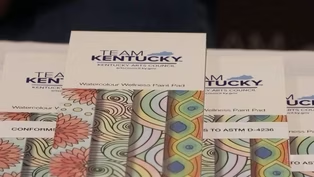
NewConference Helps Artists Plan for Disaster Recovery
Video has Closed Captions
Clip: S5 Ep64 | 3m 41s | Conference focuses on protecting arts disasters. (3m 41s)
 New
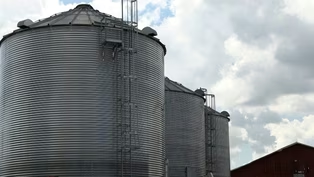
NewFarmer’s Close Call Highlights Grain Bin Safety
Video has Closed Captions
Clip: S5 Ep64 | 4m 1s | Survivor shares story to highlight grain bin rescue training. (4m 1s)
 New
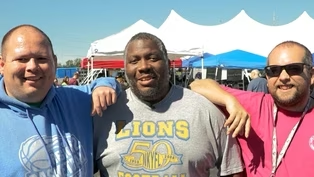
NewNorthern Kentucky Political Event Aids Special Olympics
Video has Closed Captions
Clip: S5 Ep64 | 3m 27s | Northern Kentucky political tradition turns focus to Special Olympics fundraising. (3m 27s)
Providing Support for PBS.org
Learn Moreabout PBS online sponsorship New Episode
- News and Public Affairs

Top journalists deliver compelling original analysis of the hour's headlines.

- News and Public Affairs

Today's top journalists discuss Washington's current political events and public affairs.

 New Episode

 New Episode

 New Episode



Support for PBS provided by:
Kentucky Edition is a local public television program presented by KET