
State Tests Drones to Battle Fast‑Spreading Kudzu
Clip: Season 4 Episode 409 | 3m 59sVideo has Closed Captions
Kentucky pilots drone program to fight invasive kudzu vine.
It's sometimes referred to as the "vine that ate the South." Kudzu is native to Asia and was brought to the U.S. to help control erosion. But the fast-growing, invasive plant can smother just about anything that gets in its way. Now, the Kentucky Department of Fish and Wildlife Resources is piloting a project that attacks kudzu from the sky using drones.
Problems playing video? | Closed Captioning Feedback
Problems playing video? | Closed Captioning Feedback
Kentucky Edition is a local public television program presented by KET
State Tests Drones to Battle Fast‑Spreading Kudzu
Clip: Season 4 Episode 409 | 3m 59sVideo has Closed Captions
It's sometimes referred to as the "vine that ate the South." Kudzu is native to Asia and was brought to the U.S. to help control erosion. But the fast-growing, invasive plant can smother just about anything that gets in its way. Now, the Kentucky Department of Fish and Wildlife Resources is piloting a project that attacks kudzu from the sky using drones.
Problems playing video? | Closed Captioning Feedback
Where to Watch Kentucky Edition
Kentucky Edition is available to stream on pbs.org and the PBS app.
Providing Support for PBS.org
Learn Moreabout PBS online sponsorshipWell, it's sometimes referred to as the vine that ate the South.
Kudzu is native to Asia and was brought to the U.S.
to help control erosion, but the fast growing invasive plant can smother just about anything that gets in its way.
So now the Kentucky Department of Fish and Wildlife Resources is piloting a project that attacks kudzu from the sky using drones.
Kudzu is, is a very aggressive, exotic, plant, that grows, you know, some people say, flew today.
And unfortunately, usually, grows in areas that, aren't readily accessible by equipment like tractors, four wheelers, that kind of stuff.
So, this is kind of the idea of like, how do we do this?
How do we make it so someone's not trying to walk through, two foot deep, three foot deep vegetation with a backpack sprayer, trying to treat to treat the kudzu and take care of it.
So we thought, well, drones is something that's come, into the, landscape of treating, crops, that kind of stuff over the past five, ten years.
I said, well, why why don't we try this on, kudzu and see how well it works?
So we got about eight different projects, lined out in.
I think you ended up being five different counties, going from Whitley County up to, Lee County.
In the southeastern part of the state and said, let's try the, let's try different types projects, with different chemicals.
They're labeled to treat, kudzu, with aerial application.
And see which one works best.
So last year we did that, and we had, you know, pretty good results when you're looking at the site from, from a far distance.
We got really good control.
But you still, if you walk through it, you can see, young sprouts of kudzu coming up, through it.
And, you know, they're, foot or so long right now, we're realizing that, by the end of the summer, they will probably need to be treated again.
And we say that this will probably need to be done, at least, two treatments, and then, you know, little spot treatments later, together control and then to continue to watch, as you go.
It's pretty impressive aerial application of, your treating, using only five gallons per acre.
So, if you take a five gallon bucket of, of mixture and imagine that covering a football field.
So, they go up and they have specialty nozzles, to make big droplets.
They fly as close as they can to keep the, to help, not have drift.
And, then you swallow and they spread it, so, you know, so they can usually do.
I think it was somewhere, between 5 and 6 acres for every fly.
If we want to move forward, this one of the limiting factors is, is actually, drone operators in the eastern half of the state.
Because at this point, most of the drone operators are around our heavily ag areas, trying to do, you know, cover crops, fungicides, grains, you know, spraying out to hayfields doing that kind of work.
And we don't have very many to the East to actually be able to build on these projects.
And that's actually something right now.
My biologist down the southeast is working with local conservation districts to try to come up with a way to get the funds to get some, drones or the idea of getting pilots down in that part of the state to actually, to make this more readily available resource to landowners, in the southeast.
Interesting.
Stewart says, to his knowledge, Kentucky is the only state piloting a drone project for attacking kudzu.

First‑Gen College Hopefuls Get Early Start at WKU Camp
Video has Closed Captions
Clip: S4 Ep409 | 2m 43s | WKU hosts free camp giving first‑gen college‑bound teens a preview of campus life. (2m 43s)
New Leadership Steps in at Fayette County Public Schools
Video has Closed Captions
Clip: S4 Ep409 | 2m 53s | Acting superintendent outlines plan to stabilize Fayette County schools after financial turmoil. (2m 53s)
Post Clinic Nears 30 Years of Care for Uninsured Residents
Video has Closed Captions
Clip: S4 Ep409 | 4m 47s | Post Clinic nears 30 years of providing free healthcare services to Kentuckians in need. (4m 47s)
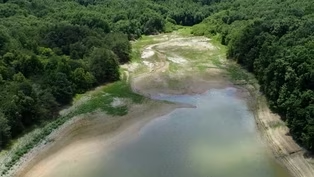
State of Emergency Declared in Liberty
Video has Closed Captions
Clip: S4 Ep409 | 2m 52s | Extreme drought conditions drop water levels at lake that supplies drinking water. (2m 52s)
Providing Support for PBS.org
Learn Moreabout PBS online sponsorship New Episode
- News and Public Affairs

Top journalists deliver compelling original analysis of the hour's headlines.

- News and Public Affairs

FRONTLINE is investigative journalism that questions, explains and changes our world.

 New Episode
 New Episode
 New Episode
 New Episode
 New Episode
 New Episode
 New Episode
Support for PBS provided by:
Kentucky Edition is a local public television program presented by KET