Inside California Education
Steelhead in the Classroom
Season 5 Episode 4 | 26m 46sVideo has Closed Captions
Journey to Humboldt County to see how students are raising steelhead in the classroom.
Journey to Humboldt County to see how students are raising steelhead in the classroom and returning them to rivers, tour the newly built Food Literacy Center cooking school and farm in Sacramento, meet California’s Teacher of the Year, and meet two students in San Diego who represent their fellow students’ interests on the school board.
Problems playing video? | Closed Captioning Feedback
Problems playing video? | Closed Captioning Feedback
Inside California Education is a local public television program presented by KVIE
Funding for the Inside California Education series is made possible by the California Lottery, SchoolsFirst Federal Credit Union, Stuart Foundation, ScholarShare 529, and Foundation for the Los Angeles Community Colleges.
Inside California Education
Steelhead in the Classroom
Season 5 Episode 4 | 26m 46sVideo has Closed Captions
Journey to Humboldt County to see how students are raising steelhead in the classroom and returning them to rivers, tour the newly built Food Literacy Center cooking school and farm in Sacramento, meet California’s Teacher of the Year, and meet two students in San Diego who represent their fellow students’ interests on the school board.
Problems playing video? | Closed Captioning Feedback
How to Watch Inside California Education
Inside California Education is available to stream on pbs.org and the free PBS App, available on iPhone, Apple TV, Android TV, Android smartphones, Amazon Fire TV, Amazon Fire Tablet, Roku, Samsung Smart TV, and Vizio.
Providing Support for PBS.org
Learn Moreabout PBS online sponsorshipNarrator: Coming up on Inside California Education: Something fishy is going on at schools throughout California.
Discover how students are raising trout and salmon right in the classroom and returning them to rivers and streams, teaching these ‘small fry to appreciate nature.
Hazel: Now they're gone, but they're going to have a happy life now in the river.
Shannon: Those connections really helped kids, um, become more environmentally literate, but also more conscious citizens of what's around them.
Narr: Join a class field trip to the newly built Food Literacy Center Cooking School and farm in Sacramento.
It's a unique partnership between the school district and a non-profit that share the same goal: getting students to eat more fruits and vegetables.
Jason: Good morning juniors!
Students: Good morning.
Jason: How are you feeling today?
Narr: What's it take to become California's Teacher of the Year?
This recent winner credits his own experience as the son of two educators who fought for bicultural education back in the 1960s.
Providing social justice perspectives he brings into his own classroom.
Jason: They say that teachers are kind of, uh, were gardeners.
You know, we're always planting seeds and you never know when those seeds are going to sprout.
Narr: Plus, this 12th grader isn't just speaking at a school board meeting; she's one of two student members of the board.
See how San Diego is giving these students a chance to represent their constituents, their classmates, on questions and issues affecting their education.
Lea: I get a very unique perspective.
It's a student perspective, and being able to carry that on the board is very important.
Narr: It's all coming up next on Inside California Education.
Annc: Funding for Inside California Education is made possible by The California lottery has been reliably raising additional money for public education for decades.
More than $41 billion since voters created the lottery in 1984.
And thats the reason why California lottery exists.
Its why we do what we do and work so hard to do it.
Thank you, California - our schools appreciate your support.
Annc: Imagine a credit union where school employees are treated like the heroes you are.
At SchoolFirst Federal Credit Union, everything we do starts with helping school employees and their families live better today and plan for tomorrow.
Learn more at schoolsfirstfcu.org.
Annc: The Stuart Foundation: improving life outcomes for young people through education.
ScholarShare 529: Californias state-sponsored, tax-advantaged 529 college savings plan designed to help pay for the cost of higher education.
Additional funding for Inside California Education is made possible by these organizations supporting public education.
♪♪♪ Narr: It is a miracle of nature.
A lifecycle both primal and astonishing.
The journey of the salmon from egg to fully grown, from the river to the sea and back again, sparks in us both wonder and reverence.
Alia: Right now they are still fry.
As they get bigger and bigger, theyre gonna keep getting so large, theyll be smolt Narr: That wonder and reverence is sparked early in classrooms like Alia Cravens, at Dows Prairie Elementary in McKinleyville on Californias north coast.
For the past three and half months, Alia and her first graders have raised sixteen steelhead trout.
Today marks the final day of weeks of feeding, filtering the water, and watching them evolve from egg to alevin to tiny fish called fry.
Spencer: You need to feed ‘em a lot, give them fresh water... And you have to take good care of them.
Narr: Besides the attention and care, the students have learned much about the salmon's life cycle.
They've read and drawn and hung paper fish and molded clay habitats.
But tomorrow morning is the big payoff: The fish will be released into the nearby Mad River.
Charlie: It's gonna be sad, but I'm gonna be excited for them to be back into their normal habitat.
Stella: I'm happy that they're going to live a happy life, probably, and I'm sad that we have to say goodbye.
Alia: Its all about the connection for them making a connection to our wildlife, making a connection to their role in our environment and why thats important.
What role they play.
Narr: Making and strengthening that connection between students, nature and the environment, and promoting environmental stewardship early on, is a primary reason why dozens of schools and districts have programs like this one.
It all started in British Columbia in the 1970s and migrated southward to Washington, Oregon, and California a decade later.
Today, there are trout or salmon in the classroom and experiences statewide for students K through 12, with lesson plans and unique outdoor experiences customized for each grade.
Narr: The programs all receive funding through the California Department of Fish and Wildlife.
Most have partnerships with county water agencies and fishing organizations.
Here, the Humboldt County Office of Education works with the Blue Lake Rancheria of the Wiyot, Hupa, and Yurok tribes to bring the program to more than fifty classrooms throughout the district.
Alia: I expect it's going to be pretty high energy.
Should be a fun day.
Narr: Next morning.
Time for the steelhead to finally begin their journey home Theyre placed in a water-filled cooler.
The first graders finish their trout drawings, then everyone boards the bus for the short trip to the California Department of Fish and Wildlife hatchery alongside the Mad River.
♪♪♪ Narr: Here to meet them, Shannon Morago, STEM specialist for the County Office of Education.
Today's lesson, she says, completes the circle.
Shannon: I think it's kind of cool that it-- and amazing for... for kids that it starts outside of the classroom.
The... the fish are collected here, the eggs are collected in the hatchery, and then they're raised by the kids and then brought back here.
Alia: So, take a moment to say goodbye to your fish.
Student: Goodbye.
Alia: It is definitely bittersweet.
I love that we've had this experience together.
I'm glad that we could come to the river and release them and they get to be in their habitats.
Our classroom will feel a little empty without them.
Hazel: Now they're gone.
But they're going to have a happy life now in the river.
Shannon: And so, I think that those connections really help kids, um, become more environmentally literate, but also more conscious citizens of what's around them.
And I think that the program ties that together really beautifully.
There it goes!
There is goes!
Narr: These steelhead are an endangered species.
But on this brilliant spring day, in this river, thanks to these kids, their modest population has grown by sixteen.
Who knows how many will survive to adulthood-- to journey to the blue Pacific and back here to spawn.
But whatever their destiny, their mere existence has educated and inspired a new generation.
Alia: I think any time there's an opportunity for hands on learning where students can connect with nature, with wildlife, they can learn about it, and then take those lessons for caring for their environment, caring for wildlife... help them be stewards of the land.
♪♪♪ Narr: Depending on the school district, these aquatic education programs are called either Trout in the Classroom, Salmonids in the Classroom, or Steelhead in the Classroom.
According to the California Department of Fish and Wildlife, their Classroom Aquarium Education Program is available in virtually all of Californias 58 counties.
It includes teaching materials, teacher training, even trout and salmon eggs delivered to more than two-thousand California classrooms each year!
♪♪♪ Amber: I think we have an attitude in this country that if we want kids to feel special, we'll give them a treat.
Well, if you want kids to feel special and all they get is treats all the time, they're actually going to feel very special when you come and show up and give them a fruit or vegetable because you're adding something to their life that they don't often get.
Narr: Amber Scott has been on a mission to get kids to eat their fruits and veggies for more than a dozen years.
She's the founder of a non-profit called the Food Literacy Center.
They run afterschool programs in several Sacramento schools showing, students how to prepare healthy meals.
Amber: Kids want to eat fruits and vegetables.
The kids actually tell us that they know we care about them because who shows up - what crazy people come in and say, yay, were here to eat broccoli!
Uh, and because thats our message, it comes across as we care.
Narr: Sacramento City Unified School District was so enthusiastic about this message that when an opportunity came up to turn vacant land into a farm, they turned to the Food Literacy center.
And they asked if we'd be willing to run a farm.
And I said, well, if we had a farm, uh, there would be vegetables being grown and we really want people to know what to do with those vegetables.
So it really does need a cooking school on site.
Fast forward many years, a lot of meetings and a lot of planning.
Uh, this site is an example of government gone right.
Narr: The one-acre farm is still taking shape, but once it's completed, it will double as a public park.
There's another half acre community garden in front, and inside-- a brand new cooking school where students from Sacramento City Unified can come for field trips.
Instructor: And that's all of your ingredients.
And then you'll make it in the bowl too.
Narr: On this day, students on a field trip from Ethel Baker Elementary School are learning how to make veggie tostadas served with fruit-flavored water Evelyn: Students here, they build not only cooking skills and nutrition knowledge, but also resiliency and confidence when it comes to being able to make a healthy meal on their own.
When we give our students kids safe knives and graders and cutting mats-- for some of them this is the first time they've been able to use a knife and learn how to use it safely.
Haidy: Uh, I was working on the... the... rice and, um, beans and the cheese.
I enjoyed it cause the food was good and I like learning how to cook.
Narr: The mission of the Food Literacy Center ties in directly to Sacramento City Unified's goal of improving nutrition for its 40,000 plus students.
The district's new Central Kitchen opened in 2022, where meals are cooked from scratch and fruits and vegetables are sourced from local farms.
Diana: And we had seen a lot of students just throwing away all the fresh fruits and vegetables that we had sourced locally from local farmers.
Um, all the effort that we put into this produce, but then it would go in the trash.
And so our goals are to align with the goals of Food Literacy Center to get the kids to eat their vegetables and fruits.
Narr: Then, the district found something interesting.
In the schools where students had been exposed to the Food Literacy Centers programs the students were more likely to pick healthy options.
Diana: Those students come through the lunch line and they will try nearly anything that we serve.
Um, even if they're not sure what it is, they will try it.
And often they will like it.
Amber: Sacramento is a thousand percent, one of the leaders probably in the nation of what theyre doing with school lunch.
Uh, and part of that is because of our unique situation of being in Americas Farm to Fork Capital.
And part of that is the leadership of the nutrition services program here.
This model, to our knowledge, hasnt been done in other districts.
And so, its our opportunity to gather the data and show that this really works.
Narr: Sure, you could collect dataor you could just pull up a seat at one of the picnic tables here.
Dig in, and join the students eating veggie tostadas, topped with tomato lime brown rice, cabbage jalapeno slaw, and pickled onions.
Evelyn: I love this job because I see it work every week.
I see kids try a new fruit or vegetable every week, and I see kids find joy in making a new recipe.
Narr: Still ahead on Inside California Education: Meet two high schoolers who sit on the San Diego Unified Board of Education, where they provide input on the issues that affect their fellow students.
But first, meet Californias Teacher of the Year, and discover how his own unique childhood led to his passion for inspiring students and promoting social justice.
♪♪♪ Jason: As an English teacher, I love this subject because we get to study life.
And so my mantra for English is through reading, writing, thinking, and speaking we study texts to find out more about what it means to be human.
Jason: Okay.
Good morning, juniors.
All: Good morning.
Jason: How are you feeling today?
Narr: Spend a little time in Jason Torres-Rangels AP English classroom, and you may notice several things.
First is this teachers deep connection to his students.
Jason: My students absolutely teach me every day.
Um, and they always surprise me.
High school students have so much wonder.
Um, and theyre so curious.
They have lots of questions.
Theyre hilarious, theyre hysterical.
Um, and they are just so fun to be around.
Narr: That connection and affection for their students is shared by many thousands of California public school teachers.
But Jasons exceptional commitment to creating a safe and nurturing space in his classroom may be one of the reasons why he was named Californias 2022 Teacher of the Year.
Its an honor this educator at L.A.s Theodore Roosevelt High School is quick to share with others.
Jason: I see it as a really great opportunity to shine a light on the profession, um, on the hard, hard work that all teachers put in, um, and that all educators put in -- counselors, librarians, custodial workers, administrators.
It's truly a team effort.
Narr: That “team effort ” was exemplified and, in a way, pioneered by Jasons parents.
In the early 1980s, Domingo and Evelyn Torres-Rangel, began alternating the school years each spent in the classroom, becoming the first couple in the L.A. Unified School District to share one fulltime teaching position.
Their goal -- create equal time to focus on their careers and their two sons.
Today, these two retired math teachers couldn't be prouder of their son.
Evelyn: He really tries to understand people.
He just really understand the whole person.
Domingo: He always has been blessed with that gift, this amazing ability to interact and communicate and connect with people.
Ben: Everybody has their own style.
There's no one way of being a great teacher.
But I think it starts with just caring about students and prioritizing relationships and creating a welcoming classroom community.
And that's something he really excels in.
Jason: I think I approach every day with a sense of joy, um, a sense of humor.
Some folks think that students kind of have this limited perspective sometimes, but they're incredibly plugged in.
Um, they're incredibly aware of what's going on and they'll bring in things and educate me.
Narr: That shared learning, that mutual respect is one reason why Nanette, a senior in Jason's class, nominated him for the Teacher of the Year award.
Nanette: Since like my junior year, I've seen a whole different perspective of how school really is and how, um, a teacher can really impact your life.
Carolina: I was really proud of my teacher, um...
I think it was very well deserved.
Mr. Torres is a great teacher, in my opinion, and obviously others.
Narr: Torres-Rangel teaches at a school that has a long history of social activism.
In 1968, Theodore Roosevelt High in the Boyle Heights area was one of five East L.A. schools where students and some teachers boycotted classes demanding bicultural education, that Spanish be allowed to be spoken, and calling for more Latino teachers and administrators.
Jason: Uh, who wants to go next?
Narr: That commitment to social justice remains an essential element in Jason's daily lesson plans.
In this exercise, they're discussing the practice and societal impact of child labor throughout history.
Jason: I definitely approach education and teaching from a social justice perspective.
Um, from a sense of, you know, asking deep questions about the world.
Who are we?
What does it mean to be here?
Um, what are the kind of ingredients of our society?
What do those mean to us?
And, you know, what are aspects that we might improve or change?
They say that teachers are kind of, uh, were gardeners, you know, were always planting seeds.
And you never know when those seeds are gonna sprout.
But when... when those seeds sprout, um, its always... its always really special.
Ben: One teacher can make all the difference in a student's life.
The one teacher who actually takes the time to get to know a student, who shows that they really believe in that student, who works with that student and doesn't give up on that student.
That can really change a student's trajectory for the rest of their life.
Jason is definitely that kind of teacher.
Narr: For this statewide Teacher of the Year, the hope is that each and every student leaves his classroom with a renewed voice, a sense of their importance in the world, and an understanding of the role they play in making their community and the world better.
Jason: And that really they can do whatever they want, um, that you know, whatever their... their dreams are, whatever their passions are, they can forge that career, um, that academic path.
Um, its... it's there for them.
♪♪♪ Lea: Going to school every single day, I'm able to speak directly with students as a student and providing that more comforting lens than a student may have a dialog with an adult.
Um, I get a very unique perspective.
It's a student perspective, and being able to carry that on the board is very important.
Narr: Lea is a student board member on the San Diego Unified Board of Education.
Like the five adults on the board, she's responsible for making sure her constituents views are heard, except her constituents are fellow high schoolers.
Lea: In my current term, some of my focuses include restorative justice, campus police reforms, gun violence prevention, and, of course, community and student empowerment.
Narr: San Diego Unified created the position in 2019, adding a second student three years later.
Lea and fellow student board member, Matthew, say they bring an important perspective to the board.
Matthew: Students will be the leaders of the future, but we can also be the leaders of today, given the right resources and abilities.
We have the knowledge and ability to do so.
And I think San Diego unified has just done that-- fostered our potential and turned us into the great leaders that we are today.
Dr. Lamont: Those closest to the problem should be closest to the solution.
Narr: Superintendent Lamont Jackson is a San Diego native raised in these schools.
He says students are facing a different world than he did growing up.
Dr. Lamont: I think all of us as adults have an experience of ‘then.
But our students are living in the ‘now.
And the world is changing, and they are closest to those changes, and theyre closest to the impact.
And so what it means is they bring, uh, a different perspective and... we need to listen to that.
Matthew: We have a very strong student-centered culture with certain members of staff, and that's wonderful.
Um, you know, certain members of staff like the Superintendent, dont see students as the-- just the end users or just that group that we listen to every now and then, but as partners, collaborators, and leaders of today.
I think thats definitely part of making me feel heard, but I think there are definitely roadblocks.
Narr: Roadblocks like not having an equal vote.
Student votes are preferential, meaning their vote is recorded in the official minutes, but it's not counted in the final tally.
Richard: I think that's something that needs to change.
Changing it is complicated.
Narr: Board member Richard Barrera says he envisions a future where student votes do count, especially as more adults recognize the value that students bring to the table.
Richard: What's happening is the decisions that school boards make that affect students more than any other subgroup.
Students are disenfranchised from having a real voice, uh, in those decisions.
Narr: Lea is also advocating for student board members to be paid, which she says will open up opportunities for low income students.
She traveled to the state capitol to testify in favor of a bill that would provide student board members with compensation.
Despite these barriers, board members say the students are effecting change.
Richard: When COVID hit... students, they immediately would talk about mental health as the number one issue.
And I... and I think they were out in front in terms of their understanding of the importance of addressing mental health out in front of adults.
So, students have come forward and said, we want mental health education to be part of the core curriculum.
So, students have had a voice in not only creating the policy, but then figuring out how to implement that policy.
Dr. Lamont: This isn't about us giving them power.
It's about honoring the power that they have.
It's about honoring the gifts that our young people have.
And if... if we really think about historically, young people have been at the peak of movements.
Um, they've always had the power.
Um, I think for us, it's... it's stop being stubborn and... and allow them to lead us.
Narr: Students were instrumental in the decision to raise the Black Lives Matter flag over the San Diego Unified School District headquarters in 2023.
The move came after the board passed a resolution in honor of Black History Month.
Dr. Lamont: Historically, the voices of the most marginalized have not been heard.
Students haven't been seen.
And we want to create an environment where students really belong.
Lea: Being able to have a voice in that, um, really empowers you to really focus and also enjoy your education and value it more.
Matthew: It's been life changing for me, and it's been amazing to know that I bring change to the Board of Education as well.
♪♪♪ Thats it for this edition of Inside California Education.
If you'd like more information about the program, log on to our website insidecaled.org.
We have videos from all of our shows and you can connect with us on social media.
Thanks for joining us.
We'll see you next time on Inside California Education.
Alia: Right now they are still fry.
As they get bigger, theyre gonna keep getting so large... Instructor: And that's all of your ingredients.
And then you'll make it in the bowl too.
Amber: This site is an example of government gone right.
Jason: Now weve done our brainstorming.
Now your write an analytical paragraph.
Matthew: It's been life changing for me, and it's been amazing to know that I bring change to the Board of Education as well.
Annc: Funding for Inside California Education is made possible by The California lottery has been reliably raising additional money for public education for decades.
More than $41 billion since voters created the lottery in 1984.
And thats the reason why California lottery exists.
Its why we do what we do and work so hard to do it.
Thank you, California - our schools appreciate your support.
Annc: Imagine a credit union where school employees are treated like the heroes you are.
At SchoolFirst Federal Credit Union, everything we do starts with helping school employees and their families live better today and plan for tomorrow.
Learn more at schoolsfirstfcu.org.
Annc: The Stuart Foundation: improving life outcomes for young people through education.
ScholarShare 529: Californias state-sponsored, tax-advantaged 529 college savings plan designed to help pay for the cost of higher education.
Additional funding for Inside California Education is made possible by these organizations supporting public education.
California Teacher of the Year
Video has Closed Captions
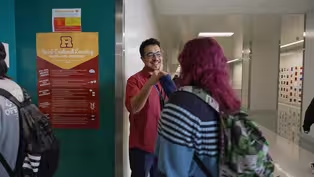
Clip: S5 Ep4 | 5m 20s | Meet California’s Teacher of the Year. (5m 20s)
Video has Closed Captions
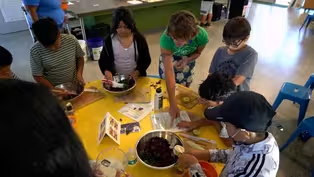
Clip: S5 Ep4 | 4m 56s | Tour the newly built Food Literacy Center cooking school and farm in Sacramento. (4m 56s)
Video has Closed Captions
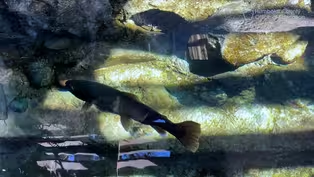
Clip: S5 Ep4 | 6m 10s | Journey to Humboldt County to see how students are raising steelhead in the classroom. (6m 10s)
Video has Closed Captions
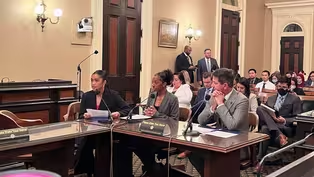
Clip: S5 Ep4 | 5m 14s | Meet two students in San Diego who represent their fellow students’ interests. (5m 14s)
Providing Support for PBS.org
Learn Moreabout PBS online sponsorship
- News and Public Affairs

Top journalists deliver compelling original analysis of the hour's headlines.

- News and Public Affairs

FRONTLINE is investigative journalism that questions, explains and changes our world.












Support for PBS provided by:
Inside California Education is a local public television program presented by KVIE
Funding for the Inside California Education series is made possible by the California Lottery, SchoolsFirst Federal Credit Union, Stuart Foundation, ScholarShare 529, and Foundation for the Los Angeles Community Colleges.