Roots, Race & Culture
STEM & POC - Extended Interview
Clip: Season 2 Episode 3 | 21m 11sVideo has Closed Captions
Learn about why Blacks and Latinos aren’t leaning towards STEM careers.
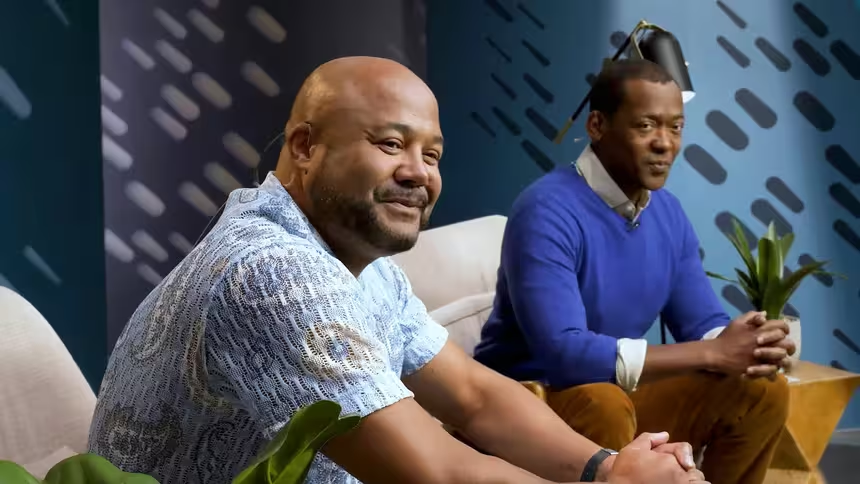
Colleges across the nation are facing a crisis with the lack of Black and Latino students in STEM fields. We speak with Dr. Ferguson and Juliette Bautista about why Blacks and Latinos aren’t leaning towards STEM careers, and how Utah measures in this spectrum. How can we help to tip the scales and help more Blacks and Latinos to enter these fields?
Problems playing video? | Closed Captioning Feedback
Problems playing video? | Closed Captioning Feedback
Roots, Race & Culture is a local public television program presented by PBS Utah
Roots, Race & Culture
STEM & POC - Extended Interview
Clip: Season 2 Episode 3 | 21m 11sVideo has Closed Captions
Colleges across the nation are facing a crisis with the lack of Black and Latino students in STEM fields. We speak with Dr. Ferguson and Juliette Bautista about why Blacks and Latinos aren’t leaning towards STEM careers, and how Utah measures in this spectrum. How can we help to tip the scales and help more Blacks and Latinos to enter these fields?
Problems playing video? | Closed Captioning Feedback
How to Watch Roots, Race & Culture
Roots, Race & Culture is available to stream on pbs.org and the free PBS App, available on iPhone, Apple TV, Android TV, Android smartphones, Amazon Fire TV, Amazon Fire Tablet, Roku, Samsung Smart TV, and Vizio.
Welcome to Season 7
Bold and honest conversations tackled with humor, insight, and empathy.Providing Support for PBS.org
Learn Moreabout PBS online sponsorship- Alright, we're gonna jump back into this because I want to hear about one of the most important topics that, you know, most people want to get into certain fields for is the pay.
You know, is it a lucrative field to get into?
- Oh yes, oh yes.
It's not only economic, it's only like flexible hours in technology.
For example, entry level is around $83,000, and the average salary is about $120,000.
But, it's more in more position.
And there is tech companies who has a benefit like a fertility plan.
- [Danor Gerald] Oh, wow.
- Yes, maternity leave.
Because this is another thing, they need diversity, they need women, and also Black, Hispanic, Asian, everyone needs to be part of technology.
This is so important.
- So, it's good money.
You start out, you know, 80-something thousand is like an entry level.
And I've heard something like that, depending on where you're living, if you're doing like an entry-level tech job, and it jumps up to like- - This is in Utah, the salary in Utah.
- This is in Utah.
- In Utah.
- Because there is a report University Utah to has this salary.
- [Danor Gerald] Oh, that's great.
- Yeah, and that's a pretty good living in Utah, I think.
Yeah, absolutely.
- Yeah, that'll get you by around here.
And honestly, most degrees, that's not entry-level wages, once you graduate college with most degrees.
- It isn't.
It's not entry-level wages.
And I remember when I went to to school for psychology and like those mental health fields, I remember they told me I was gonna start out at $13 an hour with a master's degree.
And I was like, "No, no."
(everyone laughing amusingly) - And that's often specific to engineering.
So, when we talk about STEM science, correct?
Biology, chemistry.
Unless you're getting an education certificate or doing a fifth year, it will really be hard for you to just graduate with a bio or chem BS degree and start a job.
Engineers, however, are different.
They're often aligned with internship opportunities in their junior year of summer, or in their senior year.
And this is how many larger tech companies recruit.
And that's how... You know, one thing that... You know, a friend of mine that passed away not long ago, Cameron Russell Williams, his mother- - [Lonzo Liggins] Oh yeah, I remember him.
- Has an organization now.
And BPOU believes in the same ethos of elevating tax brackets and mindsets, and we feel that BPOU is doing the same.
Now, to answer some of your questions for what's a potential income, this is actually part of often that will lead to that generational change.
Access to greater housing, access to a county or city where there will be higher education, a Blue Ribbon school.
Where now, that student that is a doctor or that student that came from a more depressed neighborhood such as like myself, outside of the DC, Maryland, Virginia area, can now be in a higher income bracket, have access to public schools, not necessarily have to send their kid to a private school or take loans out to do so.
Just because there's tax dollars that's focused often in a predominantly white community, that now the Black and brown physician now has access to.
So now, their kids can be able to create generational wealth.
But in regards to salaries, you know, once you're a resident, you start around 45 to $55,000.
This is after medical school.
But mind you, medical school has a lotta debt.
We are trying to also do our best to change that or assist our Black medical students when they're in school as well.
But income potential, I often tell many of my students, "Don't pursue medicine for money, pursue medicine because you want to change people's lives."
Because if you wanna make a lotta money, it's often not medicine.
It will be often people with the least amount of training, if you can get a patent early on in undergrad and that can pay you well, becoming an engineer and getting an MBA and moving quickly up the corporate ladder can also lead to that.
But yeah, salaries, it varies by specialty and subspecialty.
So you can have a retina surgeon, that's someone that operates specifically on the back of the eye.
I know when I got outta the military, one of the air force retina surgeons, when he left, he was starting at $1,300,000.
- Wow.
- What?
- For a practice.
(everyone laughing happily) - Mind you, he's got 25 years of experience.
- Right.
- And he's highly subspecialized.
I didn't know if he was specialized enough to say, "I only do the right eye versus the left eye," but there are some specialties like that.
Emergency medicine often will be as low as $285,000 to...
I've met some ER docs that are in the $600,000 range.
Orthopedists- - Wow.
- "As as low as 300K."
(laughing amusingly) You had me for a second there because you know, growing up, you did hear, "Well, you gotta be a doctor, or a lawyer, or an engineer, to make any real money in the world."
And that's not necessarily the case, but there is a lot of opportunity to build that wealth.
But you know, again, like I agree and understand, like you don't necessarily go into the medical field because you're just trying to make money.
I mean, what you do is worth more than- - If you do, you'll sometimes be unhappy.
- Yes.
- You'll end up choosing a specialty that has high compensation because you're trying to pay off debt, or you have this thinking, "Oh, more money and I will be happier."
And I've known some miserable docs that are in highly-compensated specialties that ended up doing another residency afterwards.
- Wow, there's wisdom in that.
- Can I ask what were your paths to get to where you are?
Why don't we talk to you first?
Where did you start out from, and then where did you end up to be with this?
- [Danor Gerald] How'd you get in this chair?
- (laughing happily) Okay, I have my background in Peru and in United States, okay?
And in Peru, I started assistant engineer in an entity of government, and then go to the private entity.
The five years was like creating technology, and then go to project management, how do you say, executive roles.
And then come back here, and I try to get a job here in United States.
Nobody knows me because I am immigrant, nobody knows my achievement- - [Danor Gerald] Background, experience, yeah.
It's like starting all over again.
- Nobody knows my university.
And it was hard to get a job, so hard.
And because you're a second language, it's so hard too.
However, I started to connect, I started to create my networking, and I started to meet in the Project Management Institute here because I am PMP.
And currently, I realize they teach me how to create my networking, they teach me how to establish my resume, they teach me the system.
I have mentored there.
And finally, I decide to start Club Ability because I realized there is more people like me, more people to try to get a IT job.
And it's so hard if you have not connection, if you don't have mentor.
And this is a reality.
And complimenting the previous question, I want to add about my special needs students.
My special needs students knows very well where is the limit of their treatment.
And this is the thing, if we give the value, the skill to create technology, they can improve their treatment and they can improve their life.
And for this reason, I admire you because medicine change everything.
I am very commitment in medicine because I know how it is get a treatment, a long treatment.
- Wow.
- Yeah.
- You know, I think that's really amazing that you're focusing on special needs students.
Because that hits on a point to me, is that these skills and this type of education, when you are able to prove what you can do it, everything else kind of disappears, you know what I mean?
If you can save someone's life, nobody cares what color you are.
If you're saving their life, they're... (laughing happily) Well, some people- - [Lonzo Liggins] Actually, they do.
(everyone laughing amusingly) - Let me go back.
I almost saw myself in the world where racism doesn't exist.
- Yeah.
(laughing amusingly) - But you know, I think that goin' back to the special needs students, I mean yeah, of course there's a very specific sort of glass ceiling that's put over them.
But then, when they show a creation of technology, which in fact their special need might actually make them better at.
You know 'cause some people can focus more because of their specific disabilities or special needs.
I think that's just amazing.
Like, thank you for addressing that community.
- I think if we go to the hospital with primarily children, children's hospital, and you see all these kids, they know that the medical treatment they have and it's long.
And I think you are doing amazing work with them.
- [Richard Ferguson] Thank you.
- You inspire amazing, amazing thing.
You are improving and this is remarkable.
- [Richard Ferguson] Thank you, Juliette.
- And you know, that brings me to a question that I've always wanted to ask you.
You know, often when we have conversations, you talk about being from Washington DC, the Baltimore/Maryland area, and comin' from these rough eras.
Tell us about how you came to be an MD.
- Oh, wow.
At first, I wanted to be an astronaut.
- Oh, wow!
- But then, I looked at how long it takes and how super selective and difficult it was.
Mind you, this is something that was being revealed to me in third grade.
(everyone laughing amusingly) But, I knew I wanted to go into science.
And some of that was inspired by my dad, and it was often just science fiction.
My dad was a mechanic in the DC area.
And while there, I had become associated with a Medical Explorers Program.
And the Medical Explorers Program was an after school opportunity that was often offered to honor students in high school and junior high, where they got to spend some time with a researcher, or a physician would go and do a presentation to them.
So, that started early on in high school with me.
And I'm like, "Alright, maybe being a"...
I actually wanted to still be a scientist.
I actually didn't decide to go the MD route until about, oh, I was a sophomore in college at Northwestern.
- [Danor Gerald] Wow.
- But, I knew I could be in that field.
And it often started with my access to Howard University and a dean there, Dr. Warren K. Ash, who did some pioneering work with a herpes virus.
But, he helped me to get an opportunity as a lab researcher during my junior summer and senior summer in high school in DC.
I was able to work on the African American genome typing project.
And so, I really wanted to become a geneticist.
But then, I saw how long it was (everyone laughing amusingly) to lead to any gratification in such work because I met many a postdoc.
And I was like, "Wow."
- I sounds like patience was the thing that led you.
- Yeah.
(everyone laughing amusingly) I was like, "Wow, you're still takin'"...
I was like, "Wow, you're still workin' in here, and you're how old, and you're...
Okay, and you're living in... You're in that car?
Maybe I need to go a different route."
So, that's when I shifted and actually restarted a Black pre-med society that had gone defunct at Northwestern.
And sorta said, "I know I have a buncha peers that wanna do the same."
And so, that then led to me joining the military, getting a scholarship with the US Army, that led to me being able to care for soldiers around the world.
And also leading into my first specialty, which was ophthalmology.
The Iraq War kinda disrupted that a little bit.
And then, once I got out of the army, I came here to University of Utah, finished in family medicine, and been practicing emergency medicine ever since.
But often being the only Black physician in many a white space, I'm like, "This can change."
- Yeah.
I gotta say this, man.
You sound like you just gave three lifetimes worth of experience.
And I'm looking at you, I'm like, "How old is this brother?"
(everyone laughing amusingly) - [Juliette Bautista] He's so young.
- Younger than us.
- Yeah.
(everyone laughing amusingly) That's the sad, scary part about it.
- That's terrible, I feel bad now.
- Wow, you were gonna succeed no matter what you did, that's clear.
That is very clear.
- So, what do we do to change it in Utah?
I mean, Utah in particular, you know, let's take it back locally.
What specific things do you think should or could happen here that could make things better for Black and Hispanic students to pursue STEM?
Juliette, why don't we start with you.
- I think currently, the government and private sector are very engagement with this topic.
They are building an environment with the goal to everyone to be welcome here.
The thing is, we are in a speed maybe, we can do it more.
And this is part of this conversation.
This is not only government, this is not only Club Ability, this is not only here, this is everyone's, everyone's need to do something.
Everyone's need to inform about that possibility to be in STEM, to be- - We have to talk to our...
So, parents need to talk to their kids.
- Yes, their schools.
- Yeah, the schools.
- In my organization, there is many immigrant who come here.
And one of topic they told me recently is labeled a mathematic.
In South America, they have like a calculus, and then come back here and they have a, how do you say?
A level... - [Danor Gerald] A level down.
- Down.
- [Danor Gerald] Oh.
- And they don't have the information.
We need to explore everything to communicate what kind of opportunity we have, what kind of program with mentorship are, and what can I do to open the door for others like me.
- [Danor And Lonzo] Mm-hmm, yeah.
- Wow, that's interesting 'cause you know, there's always this... You know, whether you're switching even between colleges in the United States, you know, if you transfer to a different school, there's always these things, "Oh, what credits are accepted and what credits are not accepted?"
And I would imagine coming from another country and another institution, like that would be doubled or tripled, the challenges there.
- And some parents, they don't speak English, and they need a translator.
And they need to wait, "Is the translator here?"
It's challenge, it's challenge.
- [Danor Gerald] Yeah, it's challenging.
- But, I think we have hope and we can do it together.
- [Richard Ferguson] We have more than hope.
- [Lonzo Liggins] Yes.
- We have more than hope.
(laughing happily) We have you two.
(laughing happily) - What do you think, Dr. Ferguson?
What do you think of the issues with it?
- I think part of it is awareness to many of our non-BIPOC allies that systemic racism exists.
And it's gonna take legislation, it's gonna take private institutions and federal, to slowly undo this.
There are many kinda pots out there of resources, but they're just not connected together to focus on DEI initiatives, STEM initiatives.
They just don't talk to each other.
So, I'm hoping that BPOU, Latino Health Initiative, other nonprofit's project success, we can do a better job at a grassroots level, connecting many of our Black and brown communities to the STEM field, to medicine.
But one thing that I think BPOU is gonna try to do, or is doing, is we're going to go to schools.
We're going to go to junior highs, we're gonna go to high schools.
We're gonna meet with black student unions to give small presentations.
And then connecting them with our partners and allies that are in research fields, that are within biotech companies, to say, "Hey, can they have an opportunity this summer?
We will fund them."
- Wow.
- And then, getting grant access, and often grant writers, to be able to allow us to have continued funding.
And then, we eventually have a partner because we can't do this alone in Utah.
If it's gonna be relying on just Black and brown organizations to address this, it will be very slow coming, there'll be a lot of one-off successes, but it won't be sustained.
We're gonna need allyship for this to be able to work.
And part of our work here in being on this show is to recruit allies.
We know that many of our white peers can appreciate diversity.
And I think sometimes because they walk around in a space where they don't have to question their race, or make decisions based on their race, or not realizing that certain things there's no limit to access to them, or they're not being told because they don't often have to consider their race in the equation, sometimes gender.
We want to make sure they're aware and know how they can make a difference in the state, in the nation, by supporting organizations like ours.
- Well, let's wrap it up there then.
Where can we go to support your organizations?
- Yeah.
- Okay, we love any support about the sponsorship program.
90% of our students are low-income families.
We have a program for adults, moms, and youth- - Let's say a company wanted to either come and help provide mentorship or even provide some funding, how would they reach you?
- Send me an email at info@clubability.org, and we'll send a conversation to see how it's working.
Also, we love the idea to have a field trip of volunteers in our program, and see more role models, and also devices for our students too.
- [Danor Gerald] Yeah, devices.
So, info@clubability.org.
- Yes.
- And then, they can just reach out to you and get some information, provide some support, and- - Yes, let's schedule a meeting, yes.
- [Danor Gerald] That's awesome.
How about you Dr. Ferguson?
- Yeah.
We will appreciate support in many ways.
Part of that is through membership.
So, if there's any Black physicians that I have not reached yet that want to join BPOU, it's free to join.
You just go to www.bpou.org, click on the Membership tab, fill out that app, and I will be reachin' out to you shortly.
And if there's any of our allies that want to support either with in-kind service, providing a job opportunity, preceptorship, shadowing, health education resources, helping us to improve our website, or you wanna partner with us on some of our health campaigns to improve healthcare outcomes in the Black community: info@bpou.org.
We also have a YouTube channel, so you can watch some of our material there.
And also, an Instagram.
So you know, info@bpou.org; Instagram, "Black Physicians of Utah;" or even just myself, richard.ferguson@bpou.org.
Either way, we will respond and we appreciate any support.
- I can feel the engines revvin' and the needle gettin' ready to move, so.
- Yeah, I do.
(Danor laughing happily) Great show, guys, great.
Thank you so much for bein' on.
We just thoroughly enjoyed this conversation.
- Thank you, thank you so much for your time.
- Awesome.
- Yeah, you too.
You guys are amazing.
Preview: S2 Ep3 | 30s | We discuss why Black and Latino workers are often underrepresented in STEM fields. (30s)
Providing Support for PBS.org
Learn Moreabout PBS online sponsorship













Support for PBS provided by:
Roots, Race & Culture is a local public television program presented by PBS Utah