One-on-One
Stephanie Rogers; Trish O’Keefe; Mary Kate Naatus, PhD.
Season 2024 Episode 2745 | 27m 21sVideo has Closed Captions
Stephanie Rogers; Trish O’Keefe; Mary Kate Naatus, PhD.
Stephanie Rogers, Co-founder of Hardbodyz Fitness & Rebel Core Modern Pilates, talks about entrepreneurship. Trish O’Keefe, PhD, Senior Vice President & Chief Nurse Executive at Atlantic Health System, & President of Morristown Medical Center, discusses nurse leadership. Mary Kate Naatus, Dean of continuing Education & Professional Studies at Seton Hall University, talks about lifelong learning.
Problems playing video? | Closed Captioning Feedback
Problems playing video? | Closed Captioning Feedback
One-on-One is a local public television program presented by NJ PBS
One-on-One
Stephanie Rogers; Trish O’Keefe; Mary Kate Naatus, PhD.
Season 2024 Episode 2745 | 27m 21sVideo has Closed Captions
Stephanie Rogers, Co-founder of Hardbodyz Fitness & Rebel Core Modern Pilates, talks about entrepreneurship. Trish O’Keefe, PhD, Senior Vice President & Chief Nurse Executive at Atlantic Health System, & President of Morristown Medical Center, discusses nurse leadership. Mary Kate Naatus, Dean of continuing Education & Professional Studies at Seton Hall University, talks about lifelong learning.
Problems playing video? | Closed Captioning Feedback
How to Watch One-on-One
One-on-One is available to stream on pbs.org and the free PBS App, available on iPhone, Apple TV, Android TV, Android smartphones, Amazon Fire TV, Amazon Fire Tablet, Roku, Samsung Smart TV, and Vizio.
Providing Support for PBS.org
Learn Moreabout PBS online sponsorship- [Narrator] Funding for this edition of One-On-One with Steve Adubato has been provided by NJM Insurance Group.
Serving New Jersey’s drivers, homeowners and business owners for more than 100 years.
Johnson & Johnson.
New Jersey Sharing Network.
The Turrell Fund, a foundation serving children.
The New Jersey Economic Development Authority.
IBEW Local 102.
Lighting the path, leading the way.
The Port Authority of New York and New Jersey.
Moving the region through air, land, rail, and sea.
Horizon Blue Cross Blue Shield of New Jersey.
Here when you need us most.
And by The Fidelco Group.
Promotional support provided by The New Jersey Business & Industry Association.
And by NJ.Com.
Keeping communities informed and connected.
- This is One-On-One.
- I'm an equal American just like you are.
- The way we change Presidents in this country is by voting.
- A quartet is already a jawn, it’s just The New Jawn.
- January 6th was not some sort of violent, crazy outlier.
- I don't care how good you are or how good you think you are, there is always something to learn.
- I mean what other country sends comedians over to embedded military to make them feel better.
- People call me 'cause they feel nobody's paying attention.
_ It’s not all about memorizing and getting information, it’s what you do with that information.
- (slowly) Start talking right now.
- That's a good question, high five.
(upbeat music) - Recently, together with my colleague, Mary Gamba, we had a conversation with Stephanie Rodgers.
She's the co-founder of Hardbodyz Fitness and co-founder of Rebel Core Pilates, talking about fitness, talking about wellness, talking about being an entrepreneur.
Stephanie started Hardbodyz 15 years ago.
It's an interesting journey.
It's an interesting story about a woman who got into the field of fitness as an entrepreneur, and frankly, is helping people change their lives for the better.
Let's check out that conversation.
- Stephanie, how you doing today?
- I'm great, thank you, Steve.
Thank you for having me, how you doing?
- I'm great, listen, I need to disclose a couple things.
You are my trainer, and so, in spite of that, people should still respect your work (Stephanie and Steve laughing) 'cause I'm falling apart.
And also, more importantly, my wife, Jen, has been going to you for years.
Stephanie, real quick, your journey into not just fitness, but being the entrepreneur that you are, describe that.
- Yes, so actually, about 15 years ago, my brother and I, we decided we wanted to do something as a family.
We were both in different jobs that we weren't really happy in, and fitness was always a forefront for our family, a very important thing for us.
And so, we found ourselves, our dad was in real estate, he found the property.
He said, "Listen, I think we've got something great here.
Let's do something."
So we put together what we thought was gonna be our small family gym, and thank God, 15 years later, we've grown to 10,000 square feet, and we have, you know, we've met people from all walks of life.
It's been quite a journey, but an amazing one.
- Mary, I know you do walk.
(Mary laughing) You walk.
- Well, it's so funny.
I strategically- - You walk at five o'clock every day, I know that, 'cause you tell me not to call you, so go ahead.
- Yeah, no.
I walk every day, - But I do have a question tied to that, and I do believe that it's leadership related.
I believe that there is a grit resilience involved in exercising, and you get into that habit, and you get into that mindset, but for those of us like me, that is, like, sometimes I get away from it, what advice do you have for people that are just getting back onto the horse, if you will, back onto the Peloton, back into the gym, to really just getting over that hump?
I know, for me, that's a really tough obstacle.
- Absolutely, it's something that honestly I face every day.
We as humans, we try to be perfect with everything that we do.
We always strive for perfection, right?
So people think a little bit here and there is just not enough, and that's not the case.
Any little bit is better than nothing at all.
More steps, more movement.
Five minute of a walk is better than nothing at all, and same thing, one 10-minute workout a week is better than none at all.
So I tell everybody, any little bit that you can do, just start, because it creates momentum, right?
And that 5, 10 minutes will then turn into 15 or 20, or an extra day, so every little bit counts, and our bodies are made to move.
The more that we move, the more that they wanna move.
The more sedentary that we are, the more they wanna stay sedentary, so I just think any little bit is key.
Just do what you can every single day, and those habits will build, they stack just like all the good things in our lives do.
- So, you know, Stephanie, Mary actually coined the phrase, not in the entire world, but the first time I heard someone use the word, being more intentional, it was Mary.
And so, starting in 2024, in my leadership and communication coaching, I said, "We need to be more intentional about the decisions we make, more intentional about how we manage our time, more intentional about the terrible meetings.
why are even having that meeting?
Be intentional about it."
Connect intentionality, being more intentional about wellness/fitness, making it intentional, part of your life.
It's not easy, but it's not gonna happen automatically just because you say, "Yeah, I wanna get fit."
- You're right, it takes one step, and literally one physical step, one foot in front of the other.
It's a very intentional thing, just like we make a choice every single day.
Am I going to eat A or B?
Getting up off the couch or getting out of bed 10 minutes earlier to get that walk in is a very intentional step, but it's necessary, and most people find that it's not as hard as it feels initially.
- I have a quick follow up to that.
The connection between Steve and I have been really leaning into wellness and leadership.
- Yep.
- We teach it, we coach it, and you hear a lot about, obviously, the connection between exercise and wellness, but like me, again, not to make this about me, but I will, I get more stressed and anxious about getting back on the Peloton or adding more exercise.
So where do you find that balance to get to that point where exercise does become a good-way crutch to get to your positive frame of mind and overall wellness?
What's that connection?
- I think a couple things.
I think number one is, again, we're hard on ourselves as humans.
I think that we need to take some pressure off.
We need to take some pressure off and remind ourselves that we get to do these things every day, that we get to wake up and go to this class, or go for this walk.
Some people don't have those luxuries.
Some people don't have that available to them, or don't have the time, or- - Or they're physically, excuse me, or they're physically not able to, so, I'm sorry.
- Exactly.
- Pick up your point, Stephanie.
- Yeah, it's an excellent point.
Some people physically aren't able to, and, you know, we have this great reminder every single day at the gym at Hardbodyz.
We have this wonderful member who is, he's actually in a wheelchair, and he's, - Oh yeah.
- And I believe you've seen him, right?
- He's amazing.
- He's amazing.
He walks through those doors, and no matter what kind of day I'm having, it's instantly just look at this guy.
(Steve chuckling) He's coming through these doors, 'cause he can and he wants to, and he's getting himself here, and you know what?
There's no other excuse in the world that's gonna stop him.
So I think number one, taking some pressure off of ourselves to be able to do what we wanna do when, and- - Go ahead, Stephanie, finish your point, because I was gonna also say, a lot of times, when you are pushing me, and I see you push other people, I'd rather not be there.
I'd rather be hanging out and drinking a cup of coffee and chilling, but there's also, I'm sorry I'm taking you off track there, because it is a blessing, and it is an opportunity to do that, but sometimes the truth is you have to fight through the laziness that we feel to, like, say, "I'm gonna cancel with Stephanie today."
That's real.
- Absolutely it is.
It is, and- - What's the payoff for fighting through that urge to just plop, which has its place at times?
Go ahead.
- It does, and sometimes, you know, to your point, sometimes we definitely do need to listen to our bodies.
If something is going on, and we really need a rest day, prioritizing rest sometimes is just as important as prioritizing movement, but if you are at the point where you're like, "Ugh, I really should do this, and I don't really feel like it," I've never met a person who has regretted doing that workout or getting that walk in, right?
You always feel better after, so I try to tell everybody, think about it in the opposite.
Think about it from the end goal.
How good are you gonna feel doing that little bit as opposed to now not doing it and being like, "I really should have done that."
You're gonna come down on yourself for not doing it, so those little things will amount to more, is my point.
- The biggest leadership lesson you've learned as an entrepreneur is?
- Honestly, the community.
The community means everything.
The community that we've built, as far as the team that we have in place, I couldn't do what I do every day without my team to support and work together, and I just think that kindness matters.
Kindness is everything.
Being kind to people and being there for people to support them on days that they need it, to give them the push that they need on the days that they need it.
Community is everything.
That's the biggest thing that I've learned on this journey is finding your community is a beautiful thing.
- Stephanie, thank you, not just for joining us, but for having, as I said, in all seriousness, a positive attitude, and doing the work you're doing every day that tries to help other people be healthier.
Stephanie Rodgers, co-founder of Hardbodyz Fitness and co-founder of Rebel Core Modern Pilates.
Stephanie, great seeing you.
Take care, see you soon.
- Bye, Steve, thank you so much.
- You got it, stay with us, we'll be right back.
- [Narrator] To watch more One on One with Steve Adubato find us online and follow us on Social media.
- Recently my colleague, Mary Gamba and I, had a conversation with Trish O'Keefe, Senior Vice President and Chief Nurse Executive, Atlantic Health System, and President of Morristown Medical Center about nursing.
Trisha's a nurse by background.
About the healthcare system.
About wellness in the healthcare system.
Whole range of issues about healthcare today.
Check it out.
- Good to see you too, Steve.
- For our audience, describe Atlantic Health.
- Sure.
Atlantic Health System is made up of six different hospitals, ambulatory centers, urgent care centers, a very large Atlantic medical group, and serving at least 11 counties in New Jersey, if not beyond.
- Trish by way of background, we've talked to you before, you come out of the nursing field, correct?
- That's right.
- Do you find that more and more nurse professionals are moving into executive roles in the healthcare world?
- Yeah, most definitely Steve and have seen it during my career as well too.
You know, from a nursing perspective, you do have a reference in regards to patient care, patient experience, what the needs are of patients, of the community as well too.
And we've really created a network in New Jersey, those that are nurses and our presidents of hospitals.
A couple of us actually went to school together at Seton Hall for our cohort, for our PhD.
We stay very close and support each other and talk about initiatives and work through initiatives at the state level as well as regionally.
So now excited about the advancement in nursing in an executive field.
- As Mary jumps in, lemme also disclose that Atlantic Health is one of our underwriters that supports our healthcare programming.
Please, Mary.
- Sure, and I would love to talk just a little bit about the state of nursing today.
I know we're now, I can't believe it, four years I guess into the pandemic, out of the pandemic.
And there was a lot of talk for some time about the physician leader, the physician shortage, the nursing shortage.
Where are we today in real time and where do you see the state of nursing in particular in the upcoming months ahead?
- Sure, definitely Mary, we definitely know nursing was not immune to the great resignation right, during the very challenging pandemic.
People retired earlier, people had opportunities to go elsewhere within the country, right?
Their partners or loved ones were able to go down south and not staying in New Jersey.
But we also saw, and very similar to when we've had other crises in the country and in New Jersey like 9/11, like after Sandy, people really want to get involved in caring for the community.
So we've seen a great interest in people wanting to go into nursing, whether it's initial career, whether it's second career, but definitely our challenges right now, similar to hospital settings that our faculty also retired.
So thinking about the pipeline going into our academic centers have been challenged by taking X amount of new students because of the limited availability of faculty.
So we've had some opportunity to work very closely with our schools of nursing in the area and looking at joint appointments from our nursing staff.
Those very seasoned, educated, practicing nurses also interested in going part-time as faculty.
So working on expanding additional adjunct faculty to increase the pipeline for nursing right now.
So some exciting times there as well and balancing all we're balancing at this point.
- But, you know, Trish, opportunities, but interesting challenges in this way too.
So I think a lot about, Mary and I, and we do a lot of leadership coaching with physicians.
We do some nurse leadership, nursing leadership as well.
But one of the things I've heard from the nurses that I've coached over the years in my other life as a coach in the field is the stress, is the pressure, is a whole range of issues.
Dare I ask about, and you help us understand, not just nurses caring for others, nurses caring for themselves, nurse wellness.
Is there such a thing?
- Yeah, you know, Atlantic Health, and I know many systems across the state and nationally have really focused on the wellbeing of a nurse.
You know, how do we support them with work-life balance.
Exactly what you're saying, Steve.
So we as medical centers and as systems need to make sure that we offer that.
We offer flexibility of work schedules, flexibility of how they want to continue in their professional career.
We know working at the bedside can be mentally challenging, but also physically challenging.
So we've been looking at developing new types of roles.
Virtual nursing is a great example.
What virtual nursing is is a nurse working closely with the patients when they come into the hospital.
As we know, documentation can be very burdensome to the practicing nurse.
So how do we divide that type of workload?
Nurses not having to be right at the bedside, but working closely and doing an admission of a new patient or developing a discharge process for that patient when they're going home.
So we need to look at new types of roles for nurses, right?
Again, it's not always just at the bedside.
So to allow that work life balance.
And also from a scheduling perspective.
We have weekend programs, night programs.
Our schedules are two hour, four hour shifts, whatever works for the nurse so they're able to balance their wellbeing and their families as well too.
They have a lot of responsibility, particularly women in the healthcare field.
- My last question is this, it's really about coaching and mentoring.
Steve and I talk about the importance of bringing up future leaders and coaching and mentoring.
In your opinion, how has that changed or evolved over the past few decades, right?
I've seen myself, I'm gonna be 50 very soon, and I've seen how I coach and mentor has changed dramatically.
I would just love to hear your perspective on what more can and should our leaders of today be doing to coach and mentor our up and coming leaders, whether nurse leaders or staff or physicians.
- Sure Mary, you know, it's that creating, creating that environment of support, whether it's formal mentorship, informal mentorship as well too, really sitting down with that mentor.
What are their plans professionally?
How do we advance them?
How do we circle, you know, our organizations about that advancement for them?
You know, we also know that over the past four years that our new nurses that are coming out had very limited clinical experience, right?
Rightfully so because we weren't allowing people in the hospitals.
So we know they were book smart, educated well, but the clinical experience was different.
So we have been creating residency programs, additional mentorship programs, much longer than we used to in the past, over a year plus.
But making sure that they have a voice in telling us what their needs are and we need to respond as an industry and as a system.
- Trish, thank you for all the work that you and your colleagues are doing, and to the doctors, the physicians, the nurses, all the other clinicians and administrators and folks in the healthcare world.
We say thank you.
You're still heroes to us.
Trish O'Keefe, thank you so much for joining us.
We appreciate it.
Stay with us folks.
We'll be right back.
- [Narrator] To watch more One on One with Steve Adubato find us online and follow us on Social media.
- Recently, my colleague Mary Gamba and I had a conversation with Dr. Mary Kate Naatus.
Mary Kate is the Assistant Provost and Dean of Continuing Education and Professional Studies at Seton Hall University, one of our higher-ed partners.
We had a conversation about the value of higher education, teaching leadership to college students.
The value of a global education, turning students into more global citizens, even though they're just sitting there with their phones on Instagram and you live in your own world here.
It's challenging, it's difficult.
College higher education today, a conversation with Mary Kate Naatus, right here.
- Mary Kate, good to see you.
- Absolutely.
It's a pleasure to be here today.
Thank you Steve, and thank you, Mary.
- So teaching, coaching leadership for younger people, do you think it's in any way significantly different coaching, teaching, mentoring younger people about leadership today as opposed to 10 years ago, and if so, how?
- I do think it's different, Steve, and thank you for asking.
I think that as much as possible as educators, we need to provide opportunities for students to have experiential learning.
Meaning, we provide the basics, we provide frameworks, but at the same time they need to learn by doing.
So exposing students to situations where they're uncomfortable, where they need to take a risk, where they have to step out of their comfort zone and develop those leadership skills, which sometimes are a little bit painful along the way.
Those are the most rewarding experiences.
And I think in the post-pandemic era with a lot of our students having spent a number of years in a fully virtual environment, it's even more important that we create those uncomfortable experiential social context where they have to navigate in new situations.
And, you know, I think that was always valuable, but I think today it's absolutely necessary.
- Mary, what's our favorite expression about being comfortable?
- We have to get un- we have to get comfortable being uncomfortable.
- And Mary Kate, we say that in our seminars, and people go, no, no, no, I don't want to be uncomfortable.
And our response is, trust us.
We won't make it dangerous, but we will put you in a situation where you have to present an idea that you have to the board of trustees or decision makers, or you're gonna do this Q&A because you've already presented and now you're gonna have tough questions and it makes you uncomfortable.
And they'll say, well, how does that make me better?
And the answer should be obvious.
You don't grow until you get to the edge of your comfort zone.
But all of us want to stay in the comfort zone.
I'm off my soapbox, Mary.
Jump back in.
(Mary laughs) - Well, sometimes I swear you could read my mind.
My next question was gonna have everything to do with lifelong learning.
When we had met a couple of, I guess, a little while ago, we had talked a little bit about your passion for lifelong learning and what you're doing in the continuing education area.
Talk about where that passion for you came from and how you're working to instill that in the students, in your orbit as well.
- Yeah, absolutely.
So I love the concept of life-long learning.
It's become a little bit of a buzzword, but it's very true because you can go and get a degree, you can get a master's degree, you can get a law degree or a PhD, but the world around us is so rapidly changing.
And I feel like with the onslaught of artificial intelligence, that has never been truer.
So what I learned in my PhD classes many years ago, a lot of it has changed, the way work is done in the field of business has changed.
So we need to provide opportunities for our students who are investing at our universities for four years, for six years, the opportunity to constantly up-skill, so that their skills remain relevant in the workforce, in the industries and also in life in general so that they feel like they have the tool chest and the competencies to be able to achieve their greatest potential no matter what it is that they do.
And I think every single field or industry that we could think of is disrupted, not only by AI, but also other rapid technological changes.
And, you know, seeing the world gaining global competencies, I would include that among that lifelong learning that is so enriching on many levels.
- I'm curious about something.
There are people, more people than ever, questioning the value of higher education, questioning whether you even need it or not, and some don't.
Some can have great careers, be very happy and successful without college.
What do you say to those who question whether, not just whether you need a college education or not, what college could and should do for young people in these very challenging times?
I know it's a big picture question, but Mary's, put it this way, her two boys, going to great schools.
Our kids were blessed and fortunate.
They're going to great colleges and universities.
Our daughter talks about where she wants to go even though she's just in eighth grade, but that's not everyone who A, who has the ability to do it.
B, there are some folks who are saying, I question the value of it, whether it's even worth it.
'Cause it ain't cheap.
Please.
- Right.
I think that every study that you read that tries to monetize and quantify the value of a college education, they all seem to come out with substantial additional earnings over the course of a lifetime, substantial job satisfaction.
But that's not to belittle the trades.
I completely respect the trades and people who go into those areas as well.
So, you know, considering the huge investment that families must make to afford a college education, and I also have a son in college and two other children who will be approaching college age soon, I know that is very real.
We, as the higher ed institutions, need to make sure that we're not just sitting on our laurels doing things the way we've always done them, and we need to be including every opportunity.
Yes, our students need to learn the liberal arts and they need to be good thinkers and critical thinkers, but they also need to have job-ready skills.
And we need to help create pathways for them, so that they gain the experience while they're still in college, setting them up for success so that there's an ROI that we can convince parents and families is there.
And it's not just something that's sort of, you're on your own to deal with.
I don't want to overly focus on that, but I think it's extremely important, especially considering that investment.
- To Mary Kate's point.
Mary and I often say the biggest enemy in the world of leadership and organizational life is the status quo.
Meaning, we're good the way we are.
There is no such thing for those who've watched our program before, they know I say it all the time, status quo is not really an option, even when you're really good, because that means you're not growing, and you're not evolving, and you're losing to the competition.
That being said, Mary Kate, I want to thank you for joining us, and talking about leadership, and a whole range of other issues connected to higher ed.
Mary Kate, all the best.
Talk soon.
- Thank you so much, Steve.
Thank you, Mary.
- [Narrator] One-On-One with Steve Adubato is a production of the Caucus Educational Corporation.
Celebrating 30 years in public broadcasting.
Funding has been provided by NJM Insurance Group.
Johnson & Johnson.
New Jersey Sharing Network.
The Turrell Fund, a foundation serving children.
The New Jersey Economic Development Authority.
IBEW Local 102.
The Port Authority of New York and New Jersey.
Horizon Blue Cross Blue Shield of New Jersey.
And by The Fidelco Group.
Promotional support provided by The New Jersey Business & Industry Association.
And by NJ.Com.
NJM Insurance Group has been serving New Jersey businesses for over a century.
As part of the Garden State, we help companies keep their vehicles on the road, employees on the job and projects on track, working to protect employees from illness and injury, to keep goods and services moving across the state.
We're proud to be part of New Jersey.
NJM, we've got New Jersey covered.
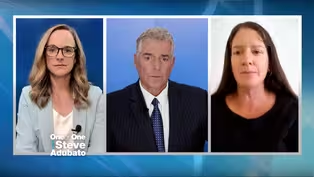
Lifelong learning, collaboration, and leadership
Video has Closed Captions
Clip: S2024 Ep2745 | 8m 50s | Lifelong learning, collaboration, and leadership (8m 50s)
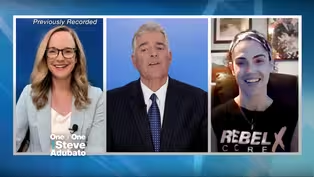
Stephanie Rogers talks entrepreneurship & leadership
Video has Closed Captions
Clip: S2024 Ep2745 | 9m 56s | Stephanie Rogers talks entrepreneurship & leadership (9m 56s)
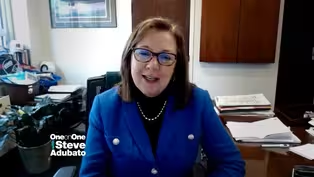
Trish O’Keefe addresses nursing & the future of healthcare
Video has Closed Captions
Clip: S2024 Ep2745 | 9m 10s | Trish O’Keefe addresses nursing & the future of healthcare (9m 10s)
Providing Support for PBS.org
Learn Moreabout PBS online sponsorship
- News and Public Affairs

Top journalists deliver compelling original analysis of the hour's headlines.

- News and Public Affairs

FRONTLINE is investigative journalism that questions, explains and changes our world.












Support for PBS provided by:
One-on-One is a local public television program presented by NJ PBS