State of Affairs with Steve Adubato
Steve Malanga; Iveth Gonzales; Jessie Gómez
Season 7 Episode 20 | 26m 48sVideo has Closed Captions
Steve Malanga; Iveth Gonzales; Jessie Gómez
Steve welcomes Steve Malanga, Senior Fellow of the Manhattan Institute, to address the legitimacy of our democracy; Then, Iveth Gonzales, Bilingual Community Services Specialist at NJ Sharing Network, talks about the misconceptions surrounding organ and tissue donation in the Hispanic community; Later, Jessie Gómez, Reporter at Chalkbeat Newark, talks about the desegregation of New Jersey schools.
Problems playing video? | Closed Captioning Feedback
Problems playing video? | Closed Captioning Feedback
State of Affairs with Steve Adubato is a local public television program presented by NJ PBS
State of Affairs with Steve Adubato
Steve Malanga; Iveth Gonzales; Jessie Gómez
Season 7 Episode 20 | 26m 48sVideo has Closed Captions
Steve welcomes Steve Malanga, Senior Fellow of the Manhattan Institute, to address the legitimacy of our democracy; Then, Iveth Gonzales, Bilingual Community Services Specialist at NJ Sharing Network, talks about the misconceptions surrounding organ and tissue donation in the Hispanic community; Later, Jessie Gómez, Reporter at Chalkbeat Newark, talks about the desegregation of New Jersey schools.
Problems playing video? | Closed Captioning Feedback
How to Watch State of Affairs with Steve Adubato
State of Affairs with Steve Adubato is available to stream on pbs.org and the free PBS App, available on iPhone, Apple TV, Android TV, Android smartphones, Amazon Fire TV, Amazon Fire Tablet, Roku, Samsung Smart TV, and Vizio.
Providing Support for PBS.org
Learn Moreabout PBS online sponsorship- [Narrator] Funding for this edition of State of Affairs with Steve Adubato has been provided by RWJBarnabas Health.
Let'’s be healthy together.
PNC Foundation.
The Port Authority of New York and New Jersey.
Moving the region through air, land, rail, and sea.
The Fidelco Group.
The New Jersey Economic Development Authority.
Robert Wood Johnson Foundation.
Working for a more a healthier, more equitable New Jersey.
Community FoodBank of New Jersey.
PSEG Foundation.
And by The Adler Aphasia Center.
Promotional support provided by The New Jersey Business & Industry Association.
And by BestofNJ.com.
All New Jersey in one place.
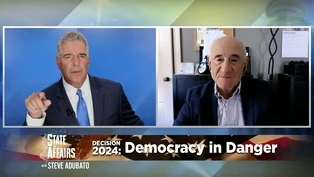
[INSPRATIONAL MUSIC] - Hi everyone, Steve Adubato.
Listen, you're gonna see a graphic right out of the box here.
I've been thinking about this together with our terrific producers, and the graphic says this, and please do not think we're trying to be inflammatory or get you to think that it's worse than what it is.
Decision 2024: Democracy in Danger.
Steve Malanga, a senior fellow at Manhattan Institute, that's the graphic.
Do you actually believe, 'cause we were debating, do we put a question mark at the end, democracy in danger?
Or just say democracy in danger.
Are we in danger?
- I think there are enough people who believe that, that it is a problem because when people believe that, they begin to believe that this is no longer a legitimate democracy.
Whether they're right or wrong, the perception is important and that is the perception right now.
So in that respect, it's clearly an issue.
- So you and I grew up in the same neighborhood, a little bit younger than you are along with your younger brother Tom.
- You had to point that out.
- Yeah, so we grew up in a neighborhood, let's just say, Italian American neighborhood, most of the people who we grew up with probably voted for Donald Trump when they became of age.
Fair to say?
- Probably.
If that's true, however, I would remind you that ours was a blue collar neighborhood.
- 100% - So I would say the vast majority of the adult men were not college graduates, they were tradesmen.
- Agreed, agreed.
- So one of the things you just said is something that has flipped enormously in the last 10 to 15 years.
How did the Republican party become the party of blue collar Americans?
- Don't ask us a rhetorical question, Steve Malanga.
Answer it.
How?
What did the Democrats do wrong?
- Well, it's interesting.
I wrote a piece, a couple of pieces actually, when Chris Christie was running for reelection in New Jersey about how his campaign had split the union movement in New Jersey.
Public sector unions were adamantly opposed to him.
The private sector trained unions loved him and endorsed him.
This created a big to-do in New Jersey, but it also was, I think, a foreshadowing of something happening in larger respect.
The private sector unions were saying, "We can't afford the taxes.
"We can't afford the public sector "that we have in the state and we need a pro-growth agenda."
I think the part of what happened is that the Democratic party has moved left enough so that a lot of blue collar people don't see a pro-growth agenda anymore in the Democratic Party and they feel like they've been left behind and there of course have been stories about them being called the "deplorables" and so forth.
- Yeah, Hillary Clinton called them deplorable.
But hold on, Steve, you're describing the Democratic party.
That's your perception.
People can agree, disagree, but the, "Republican party" as it is today.
Wouldn't it be fair to say that if three quarters of Republicans, if not more, regardless of how many times former President Donald Trump is criminally indicted, regardless of how much time he's going to spend in jail or excuse me in court, we don't know what's gonna happen after that and including January 6th.
We're voting for him anyway.
He's our guy.
He's our party.
You're trying to tell me that if the rule of law, you did a separate segment with us on shoplifting, rule of law matters.
Does the rule of law even matter to most Republicans in the "MAGA" Trump movement today?"
Or, "Hey, listen, that's just an inconvenience."
You tell me.
- Yeah that's very interesting.
What I would say is a lot of people, even within the Republican party, are trying to explain this because there are alternatives in the Republican party.
One of the things of course that's gone on in the last eight years is Republicans hold a lot of governorships and some of them have been pretty successful.
Why aren't MAGA people turning to them?
The only explanation I've heard actually talking to people who support Trump about this is it's like a giant, I don't want to use this phrase, it's like a giant screw you, if you will.
- To whom?
Steve, to whom?
- What?
- To whom?
- The people who are doing things like, indicting Trump, they feel like, you don't indict a guy who's running for president and essentially, this is part of the conspiracy that they feel is out there.
But it is interesting because the Republican party does have clear alternatives, people who've been governing and putting out policies, but they're not making any headway with this group.
- What's the attraction of Donald Trump?
What's the attraction of Donald Trump?
- Well, that's an interesting - By the way, just to be clear.
Democracy in danger, check out what President Trump, former President Trump said about those who are engaged in the activities, the insurrection around January 6th, many of whom are in jail right now, who he said he would seriously consider, including the leader of the Proud Boys at the time, that he would pardon them if you were elected again.
So explain to us, while I argue democracy is in danger, what the appeal is to Donald Trump please, Steve.
- Yeah, I think the appeal is basically he's the one who, day after day on Twitter, when he was president, he would attack a position.
Things that had nothing to do really, even with running the country, he would attack other people on Twitter the way a Twitter troll was and there is a bizarre appeal because finally after these years- - The name calling?
- Yeah, absolutely.
- Mocking people, their weight, their appearance.
A woman, I would never have sex with her.
I couldn't be charged with that, because she's not the type.
Steve, what's the policy appeal?
What's the ideological appeal?
Because you're a policy guy.
- Trump's policies can be extremely inconsistent.
Some of them are not what I would call conservative at all.
Some of them don't follow from others.
It's very difficult, I mean...
In our publications, we wrote a lot during the Trump years about his policies and we talked a lot about his policies that just don't make sense.
Tariffs, extreme tariffs.
Steve, it's not about policy, it's about personality.
It's clearly about personality.
- We'll do this for speaking of personality, policies and whatever.
We got a couple minutes left.
President Biden, as we speak right now and again late September, we're doing this program, be seen later.
We don't know what's gonna happen.
To what degree is democracy in danger because the large number of Americans, Democrats included, seriously questioned whether Joe Biden has the cognitive ability to be president again and be 86 at the end of his second term, please.
- Well, we see this in the polls.
More and more Democrats are saying and I'm reading every day, more and more Democrats are saying, "We need to find somebody else."
I don't know about the issue of democracy being in danger, I think because we do have- - Sorry for interrupting, Steve.
The choice is Trump and Biden 2024.
Is that more dangerous for the country?
- Mystifying is what I call it.
How we got here, I have no idea how we actually got here.
Again, I say this, you could list governors in both parties who've been governing and have a record and have policy records and very distinct policy records.
This country has often looked to governors, why?
Particularly coming through the pandemic.
Anyone who governed during the pandemic has a clear record.
You know what they stand for.
Why are we where we are?
I honestly cannot con completely explain that.
- I'll explain this.
It's been too long since we've had Steve Malanga on and we'll have him on a lot more because his thoughts, his perspective, his writing and checkout the information to get to Steve and the work that he is done.
His books, his regular columns that he puts out together with the folks of the Manhattan Institute.
Very thoughtful, provocative.
Good stuff, Steve, thanks for joining us.
- Thank you.
- Stay with us, we'll be right back.
(grand music) - [Announcer] To watch more State of Affairs with Steve Adubato, find us online and follow us on social media.
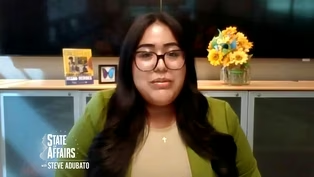
- We are pleased to be joined by Iveth Gonzales, Bilingual Community Services Specialist, and also a daughter of a donor connected with the New Jersey Sharing Network, our longtime partners as we continue to create greater public awareness around organ and tissue donation.
Iveth, thank you for joining us.
We appreciate it.
- Thank you for having me, Steve.
- Talk to us about the very personal connection you have to the organ and tissue donation universe, particularly obviously as it relates to your dad.
- Yeah, so a lot of people ask me what brought me to the Sharing Network and I share with them that my dad brought me here.
I grew up in a Peruvian immigrant household, a family of four, and I am a first generation college graduate.
But last year my life changed drastically.
My father passed away and he was diagnosed with idiopathic pulmonary fibrosis.
He was a very active person, he played soccer, and if he was not playing soccer with his friends he was actually playing football with my younger brother.
He was 47 at the time, and this news changed our lives forever.
He was in the hospital for two months bedside and then he did have to be emergency intubated, and which led him to go into the ICU for a couple of weeks.
With this news and this devastation, he was in the ICU.
And with the discussion of the healthcare team and nurses, my father's health with not making any meaningful recovery, and through this, this is where New Jersey Sharing Network came into our lives.
They brought hope and light at the darkest time.
They gave us an opportunity to give the gift of life through organ and tissue donation.
And automatically for us it was yes.
My father was a selfless person.
He would give the shirt off his back to anyone.
And he became an organ donor.
And through Kenny donation, he was able to save two lives.
And like I truly say, it's something painfully beautiful, painful because I lost my father, but beautiful because he was able to save two lives and bring light and hope into their lives.
- Your dad, Victor, 47 years of age.
- Yeah.
- And it's interesting how you said, Iveth, that I think you said very quickly or immediately you knew what the right thing to do was.
But my understanding, and we've talked to folks in the Sharing Network about resistance, pushback, misconceptions, the need to educate.
You told our producers that there was some pushback in your family.
What exactly was the pushback and how did you deal with it?
- So there was a lot of pushback from my father's side.
So my father is the youngest out of seven.
So everyone is older.
And like I did say, I come from a Peruvian traditional household, and they couldn't even believe the fact that, you know, he was, I would say sick and also in the ICU.
So they were waiting for a miracle to happen.
But there is a lack of trust with the medical hospital staff and the Hispanic community through a long period of time.
So with these news, we had to explain to them that he was not going to make meaningful recovery, and we had to sit down and we had to discuss.
And my mother and I knew what the answer was for us.
We knew he would make meaningful and give the gift of life through organ and tissue donation.
- Did you think that's what your dad would've wanted?
- Yes.
I truly believe.
He was a very selfless person and a giving person.
A lot of people knew him for his big contagious smile, and he would always give and help people the best way he could.
- Yeah, you know, and if I have this quote wrong, please help me, but I believe you told our producers that some of your dad's family members wanted him to go to heaven whole.
- No, that is correct.
- How did you respond to that?
- I had to respond in a way that they, you know, I had to simplify everything.
I had to make sure that they understood what this gift of life that my dad, you know, gave, I had to simplify everything into terms that they understood.
And especially this is, even the topic of death isn't really discussed in the Hispanic communities.
So even the fact that he was in the hospital on a ventilator, it was just not processing, but we had to sit down and just simplify the term.
- How did you connect with the Sharing Network to start working there?
- So actually because of the meaningful impact they had in my life during the darkest, literally darkest time, the New Jersey Sharing Network staff, they were there for my mom, my younger brother and I that last day.
And they were there to even walk us to our cars.
And that literally stuck with me.
And that's what brought me to Sharing Network.
And I actually graduated with my master's degree in Public Administration from Rutgers Newark.
And because of that, it stuck with me, I wanted to do something to help people, and make a change and educate.
And that's what brought me to the Sharing Network.
And I saw a job opening and applied.
- Iveth, let me put you on the spot here.
So one of the things we've learned about organ and tissue donation is that different communities, whether it's religious, ethnic, cultural, or there's a combination of issues, that people either push back on or need to be educated about what organ tissue donation really is versus what the misconceptions are.
Dare I impose upon you to send a message to the Hispanic community in Spanish that resonates with them.
And then you can tell us after what exactly you said, please.
Por favor, regístrese para ser donante de órganos y tejidos en nuestro página web.
Pueden salvar muchas vidas.
Un donante de órganos puede salvar ocho vidas y mejorar la vida de 75 personas o más.
Please.
- I said, please register to be an organ donor and a tissue donor, and you can register through our website www.NJSharingNetwork.org because you can save many lives.
One organ donor can save eight lives and enhance the lives of 75 people and more.
- Iveth, we've done a lot of programming connected to organ and tissue donation.
We call it public awareness, public education, but in reality, it's really people like you who through horrific, unimaginable tragedy, a loss of your father, Victor, at 47 years of age, choose not only to work at the Sharing Network but to come on the air and to share and to educate and to break down barriers.
You're a real leader and you're making a big difference.
Thank you so much, Iveth.
We appreciate it.
- Thank you, Steve.
- You got it.
Stay with us.
We'll be right back.
(grand music) - [Announcer] To watch more State of Affairs with Steve Adubato, find us online and follow us on social media.
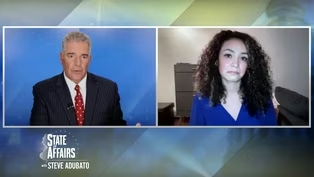
- We're pleased to be joined by Jessie Gomez, reporter for a terrific website information platform committed to education, Chalkbeat, Newark.
Jessie, great to have you with us for the first time.
Won't be the last time.
- Thanks for having me.
- Tell everyone what Chalkbeat is.
- Yeah, so we are pretty much embedded in Newark.
We cover education inequities across the city and also education overall in the state.
So we're really a grassroots organization that focuses on, you know, the voices of students and families on the ground.
And a lot of our reporting reflects that.
- Okay, so this is, there's so many aspects to issues of education, so many educational issues, but this is the thing that we wanna talk about today.
So in 1954, the United States Supreme Court determined in the Brown versus Board of Education of Topeka case that separate but equal doesn't work, that our schools needed to be desegregated, they need to be integrated.
All these years later New Jersey has the sixth most segregated public schools in the nation.
A, how the heck did we get here?
And B, what do we do to move forward to have our schools be more integrated?
And frankly, for those who are disproportionately Black and Hispanic, give them an opportunity for the best education that the state can offer, through the Constitution, which says you're supposed to do that.
Go ahead.
- Yeah, so it is pretty surprising.
I mean, New Jersey is one of the most diverse states, yet its public school system is among the most segregated in the country.
Like you said, it's the sixth most segregated state for Black students in terms of the exposure to white students and the seventh most for Latinos.
And that's, you know, it's really concerning, 'cause at least in Newark, we know that at least more than 90% of students identify as Black or Latino.
So it is a pretty prominent issue, especially within Newark schools.
And so we know that the state has, you know, sort of has allowed for this, because according to their laws, the state is, the students are supposed to go to school where they live.
And so, you know, a student in the Newark can't go to school in, let's say, Montclair or another city.
And so the educational experience in students in cities like Newark is very different from those, perhaps, in South Jersey or more suburban areas.
So that's where we got here today.
And like you said, the state's constitution also says that, you know, school segregation is pretty much not allowed in the states.
So, you know, right now there's a lawsuit before New Jersey, where the the state is pretty much, there's plaintiffs are pretty much saying that the state might be responsible for addressing the fact that these schools are segregated.
And that's something right now that we're awaiting a decision on.
- Jessie, let's put this in perspective.
2018, a lawsuit was filed by the Latino Action Network and the NAACP.
They're the plaintiffs, arguing that the state of New Jersey has promulgated, promoted, allowed for, however you wanna describe it, the segregation of our schools.
So here's the question.
Are we waiting for a court decision to tell the state leaders to do something?
Or are there efforts underway to have our schools become more integrated and less segregated, regardless of what the courts do, please?
- Yeah, so at this point, there really is no solutions being made from the state.
So like you said, this lawsuit was filed in 2018.
We're still waiting a decision on that.
But pretty much this lawsuit is arguing that the state is responsible for addressing the fact that schools across New Jersey are segregated.
Again, we really haven't even touched on solutions yet, because we're still at the point where, you know, we're trying to find out who is supposed to address this problem.
So when we look at it- - Jessie, I'm sorry to interrupt, but proposed solution, for argument's sake?
So I live in Montclair.
Montclair, and I've said this in an earlier segment we did, have magnet schools.
There's the 1960's and '70's, Montclair desegregated the schools to a large extent and used busing to do that.
How about this?
Montclair, Glen Ridge, neighboring town, disproportionately white, they merged the public schools so it's one school system.
I'm not saying it's the solution, but wouldn't that integrate our schools more with white, Black and Latino kids more likely to be in school together?
- Well, it's a possible solution.
So right now, like I said earlier, under New Jersey law, students are supposed to go to school where they live.
And so if you ask a city like Newark to, you know, let's say desegregate its schools, Newark can't do that.
About roughly 8% of students are white in Newark schools, Newark public schools, so to say Newark could integrate their school district is sort of impossible.
Now, there have been other solutions proposed by advocates sort of along what you said, perhaps making county-wide school districts.
Newark is in Essex county and Essex County is pretty diverse in itself.
So that might be a possible solution.
But again, at this point in time, there hasn't been an official solution or solutions floated, you know, by the state or state officials because we're still at the point to find out who is going to address this issue.
- So no one's stepping up and we're waiting for the courts.
Let me, shift gears if you can.
The teacher shortage.
How real is it, particularly in cities like Newark, please?
- Well, teacher, it's, I mean, it's happening everywhere and across the country, and we see that especially in Newark.
But I think that the larger problem here too is in terms of segregation is how diverse teachers are.
So we did a deep dive on teacher demographic data in Newark, and we found that there's an unproportionate number of students of color to teachers of color.
And so specifically we know that white teachers make up a majority of the teaching staff at one in five district schools.
And Black teachers make up the majority a little bit more than one in four schools.
But more strikingly, there is no school in the district, Newark public schools, that has a majority Latino teaching staff, even though roughly half of all public schools have a majority Latino students.
So it is a problem when it comes to diversity among teachers.
So it's one thing to fill classrooms with teachers, but it's another thing to be mindful of how to actually fill them and making sure that those teachers represent the student body - Well said.
Jessie, let me follow up on this.
You and your colleagues at Chalkbeat doing a great job journalistically keeping us abreast of what we need to understand, doing the research, the investigative reporting, et cetera.
In terms of learning loss post-COVID, whatever post-COVID means, is it disproportionately worse in urban communities, the learning loss for our students?
Please.
- Well, at least in Newark, what we're seeing, and we're really seeing this across the state, is there was a big drop in 2022 spring state test scores in New Jersey.
We saw, you know, those scores drop dramatically in both math and reading.
So in Newark there is a very big push to make sure these kids get back up to speed.
So much so that the mayor in Newark, Mayor Ras Baraka, he actually launched a 10-point action plan to make sure that students are reading, that they're refining their literacy skills, and that Newark Public Schools are also implementing tutoring within the school day, whether that be before or after or during.
'Cause again, a lot of students need help to get back up after COVID.
I mean, we know that COVID disrupted student learning, and it also had an impact on their emotional and mental health as well.
So all of these things combined with seeing teachers that don't look like them and, you know, the different experiences these students are having have really contributed to what we're seeing today in schools.
- We've been listening to and watching Jessie Gomez, reporter at Chalkbeat Newark.
Their website has been up to find out more of the important work they're doing journalistically about education.
Jessie, thank you for joining us.
We appreciate it.
- Thank you.
- I'm Steve Adubato, that's Jessie Gomez.
We'll see you next time.
- [Narrator] State of Affairs with Steve Adubato Is a production of the Caucus Educational Corporation.
Funding has been provided by RWJBarnabas Health.
PNC Foundation.
The Port Authority of New York and New Jersey.
The Fidelco Group.
The New Jersey Economic Development Authority.
Robert Wood Johnson Foundation.
Community FoodBank of New Jersey.
PSEG Foundation.
And by The Adler Aphasia Center.
Promotional support provided by The New Jersey Business & Industry Association.
And by BestofNJ.com.
At the Community Food Bank of New Jersey, we are working now more than ever to fill the emptiness caused by hunger.
We are the state's largest anti-hunger organization.
And together with our 800 plus community partners, we are committed to delivering food, help, and hope, to our hundreds and thousands of neighbors in need.
The Legitimacy of our Democracy and Social Media
Video has Closed Captions
Clip: S7 Ep20 | 9m 9s | The Legitimacy of our Democracy and Social Media (9m 9s)
Misconceptions About Organ Donation in Hispanic Communities
Video has Closed Captions
Clip: S7 Ep20 | 9m 9s | Misconceptions About Organ Donation in Hispanic Communities (9m 9s)
The Teacher Shortage and Desegregation in NJ Schools
Video has Closed Captions
Clip: S7 Ep20 | 9m 20s | The Teacher Shortage and Desegregation in NJ Schools (9m 20s)
Providing Support for PBS.org
Learn Moreabout PBS online sponsorship
- News and Public Affairs

Top journalists deliver compelling original analysis of the hour's headlines.

- News and Public Affairs

FRONTLINE is investigative journalism that questions, explains and changes our world.












Support for PBS provided by:
State of Affairs with Steve Adubato is a local public television program presented by NJ PBS