One-on-One
Steve Politi; Karen J. Nolan, Ph.D.
Season 2024 Episode 2743 | 27m 33sVideo has Closed Captions
Steve Politi; Karen J. Nolan, Ph.D.
Steve Politi, Sports Columnist for NJ Advanced Media, shares a discussion on various sports topics, including the NCAA's name, image likeness policy and the 2026 FIFA World Cup coming to NJ. Steve Adubato and Mary Gamba are joined by Karen J. Nolan, Ph.D., Associate Director, Center for Mobility and Rehabilitation Engineering, Kessler Foundation, who talks about advancing patient care.
Problems playing video? | Closed Captioning Feedback
Problems playing video? | Closed Captioning Feedback
One-on-One is a local public television program presented by NJ PBS
One-on-One
Steve Politi; Karen J. Nolan, Ph.D.
Season 2024 Episode 2743 | 27m 33sVideo has Closed Captions
Steve Politi, Sports Columnist for NJ Advanced Media, shares a discussion on various sports topics, including the NCAA's name, image likeness policy and the 2026 FIFA World Cup coming to NJ. Steve Adubato and Mary Gamba are joined by Karen J. Nolan, Ph.D., Associate Director, Center for Mobility and Rehabilitation Engineering, Kessler Foundation, who talks about advancing patient care.
Problems playing video? | Closed Captioning Feedback
How to Watch One-on-One
One-on-One is available to stream on pbs.org and the free PBS App, available on iPhone, Apple TV, Android TV, Android smartphones, Amazon Fire TV, Amazon Fire Tablet, Roku, Samsung Smart TV, and Vizio.
Providing Support for PBS.org
Learn Moreabout PBS online sponsorship- [Narrator] Funding for this edition of One-On-One with Steve Adubato has been provided by The New Jersey Economic Development Authority.
Valley Bank.
PSE&G, powering progress.
Delta Dental of New Jersey.
Everyone deserves a healthy smile.
The Healthcare Foundation of New Jersey.
The New Jersey Education Association.
The North Ward Center.
NJ Best, New Jersey’s five-two-nine college savings plan.
And by The Turrell Fund, a foundation serving children.
Promotional support provided by ROI-NJ.
Informing and connecting businesses in New Jersey.
And by Meadowlands Chamber.
Building connections, driving business growth.
- This is One-On-One.
- I'm an equal American just like you are.
- The way we change Presidents in this country is by voting.
- A quartet is already a jawn, it’s just The New Jawn.
- January 6th was not some sort of violent, crazy outlier.
- I don't care how good you are or how good you think you are, there is always something to learn.
- I mean what other country sends comedians over to embedded military to make them feel better.
- People call me 'cause they feel nobody's paying attention.
_ It’s not all about memorizing and getting information, it’s what you do with that information.
- (slowly) Start talking right now.
- That's a good question, high five.
(upbeat music) - Hey, Steve Adubato here.
Sometimes I get to do a show, a program about things I'm fascinated, and I hope you're fascinated as well, because a guy you're gonna listen to knows more about sports at every level than anyone I know.
He's Steve Politi, sports columnist for "NJ Advance Media."
You can read him on NJ.com, "Star-Ledger," a bunch of other places.
He was just voted, Steve, check this out, the number one, did you know that you were selected as the number one sports columnist for the second year in a row by "The Associated Press?"
Did you know that?
- I'm aware of that.
Thanks.
Yeah.
- Congratulations, my friend.
- The big award is I get to keep this job and keep doing it, which I love so much.
- Hey, when we get to keep our gig in media, that's a good thing.
- It's a good thing.
- Can we do this?
I'm gonna go through a bunch of things with you.
I do wanna talk to, can we start with the significance?
I wanna talk to you about college sports, the Devils.
Mary Gamba runs our company, is a Devils fan.
I'm a Rangers fan.
We're doing this show, when we're doing it, it'll be seen later.
Sorry to the Devils fans out there.
You write about the Devils, the Giants, College sports at every level.
Rutgers, we'll talk about all those things.
NIL, transfer, portal, all that.
Can we start with this wacky March 7th game, Manasquan High School against Camden High School basketball game.
What the heck was the game?
Why does it matter?
And you wrote about it and got a lot of attention.
Explain what happened.
- Sure.
I mean it became a national story.
Camden was winning the game late, state playoff game, and Manasquan hit a shot that beat the buzzer, clearly beat the buzzer, ruled correctly by the referees on the court that it had beaten the buzzer.
And that's when all hell broke loose because one referee wasn't sure about this decision.
They huddled up, changed the call to the incorrect call, so that awarded the victory to Camden.
You know, within minutes, I think the referees realized their mistake, but it was too late.
They walked off the court and the decision was made.
So it became just a viral national story.
Manasquan of course, what we do in these situations as parents in the school districts sued and brought the case to court and there was all sorts of outrage across the nation about it.
But, you know, the decision was made and nothing changed.
Camden won the game.
- Why do you think the story became a national story that everyone was talking about, Steve?
- I think the video was just so, you know, you see bad calls all the time.
It's part of sports.
There's the human error in all sports.
It's just that the fact it was just such a glaring error to make the call correct and then go back and reverse it.
- Camden, sorry to interrupt, Steve.
As I watched the video, I was trying to understand this, and by the way, Camden's an extraordinary great basketball program.
Manasquan, I mean, the fact that they were even in that game and potentially winning it at the end is amazing.
We'll talk about that in a second.
Did the Camden coach go up to the referees and lobby for the call to be changed?
- I mean, I think there were certainly words that were said in the heat of the moment.
You know, this is what coaches do when there's a close call, you're always gonna say, wave it off.
That wasn't good.
From what I understand, it had nothing to do with what the referee was doing.
He was unsure, he was gonna seek out his partner.
What the referee should have done, and all referees agree, you make the call, you leave the court, you make it with authority.
You had the best view of it.
You're the one who should be the one who made it.
But clearly he wasn't sure of it and went through his partner and that's what happened, yeah.
- Last question on this, Steve.
The fact that Camden, urban community, disproportionately black, I think all the players are black on that team, Manasquan, Jersey Shore, white kids.
- Yeah.
- In your mind, sports, we love sports.
I'm obsessed, like a whole bunch of other people.
Is there a racial component to this story at all?
And if so, what do you think it is?
- Man, I hope not.
- I hope not either, but I don't know.
- Yeah, I mean, people brought up the fact the referee was black.
I thought that was very unfair.
I mean, the man made a mistake.
I don't think you can besmirch him that way.
And this is what sticks with me, Steve.
After all this happened, people were calling on Camden to reverse the decision, to come forward, to forfeit.
- Yeah Camden, say you didn't win the game and give it to Manasquan.
Who would do that?
Who would do that?
- Derek Jeter when he hit the home run in '96 and the ball, no he didn't go, "Well that wasn't good."
- What was the kid's name, something Maier?
- Jeffrey Maier, yeah, - Jeffrey Maier, Jeffrey Maier went out there and reached, it wasn't a home run.
Jeter's like, "I guess it's a home run."
Now the Yankees are gonna go, "Sorry, you win now."
- What I loved is the Manisquan players, they were at the game when Camden won the state title.
- Were they rooting for Camden?
- I don't know if they were rooting for Camden, but when Camden won the game, they stood and gave them a standing ovation.
And that to me, that stuck out to me as a great sign of sportsmanship.
You know what, you're unhappy.
You were robbed.
Everyone knows you were robbed, but you were there to support them.
The massive gone girls team happened to be playing in the game after that.
But you were there, stood up, gave a standing ovation.
That's the takeaway.
That was what stuck with me.
They rose above it.
- Shift gears 'cause there's so many things I wanna talk to you about.
The great Steve Politi, identified as the number one sports columnist second year in a row by "The Associated Press."
How about this one?
College sports, I just had this conversation with your colleague John Fanta over at Fox Sports, who's terrific.
I asked him about college sports today, where we are with the transfer portal, kids being able to go to one school after another, four years in college, four different schools.
The NIL, name, image, likeness, who's got the big money?
Who's ever got it, come to our school.
What the heck is college sports becoming and what does it mean for New Jersey based institutions of higher learning competing, particularly in basketball and football?
Please, Steve.
- I mean, it is hard and I understand traditionalists.
If you love the way college sports was 50 years ago, five years ago even, it's hard to watch.
And Seton Hall is the perfect example.
They go to the NIT final, win the championship, hang up banner, months later, the entire team, not just gone, but the star player of that team is taking money.
So Kadary Richmond leaves and goes to a competitor over in Queens at St. John's.
Nothing to do with money?
- Of course everything to do with money, and they admit it.
And I think that that's part of it for years.
I mean, we're talking a hundred years of college sports, athletes couldn't capitalize on the fact that they're a billion dollar industry.
For the first time, they can.
That's a good thing.
But it's really up to the people in charge of college sports to figure this out now and to give us some sort of structure.
- Steve, athletes were getting the shaft for years.
Universities and coaches making, you know, big money, money coming in.
You wanna try to compensate the athletes.
Is the pendulum, has it gone too far the other way where you can't keep a kid and there's hard to create any loyalty or chemistry with the team?
- I mean, you could certainly say that.
I think the bigger problem is that these kids know they have a small window to earn money and there's just no structure.
There's no rules, there's nothing to say that they shouldn't move.
And I think that's where the NCAA's gotta figure this out.
There's gonna be a settlement in a $20 billion lawsuit that'll give back money to money owed to the NCAA players in the past.
From that, they must come up with something that gives some sort of structure.
- Yeah, I just found out that the United States House of Representatives is dealing with that issue of past athletes wanting their share.
How dare they?
And they should get money.
But balance is the thing.
So how about this, I'm a Giants fan.
You write about the Giants.
Two things.
Saquon Barkley, you wrote in a column, did you not Mr. Politi, that it was good that the Giants were not engaged in the emotion of keeping Saquon Barkley, whom I love, number 26.
I got a big poster.
I love this guy.
Works hard, in the community, terrific.
And you said, don't let the emotions and don't let the fans who want him influence your decision.
Like, what's that?
We're the fans, Steve.
We'll let him go to Philadelphia?
- Do you enjoy winning championships?
If you enjoy winning championships, you shouldn't overpay a running back when you don't have an offensive line to block for 'em.
They shouldn't have drafted them, number two overall.
They made a mistake to do that.
I mean, it was too high.
He was a great player, but let's be honest, I mean they were six and 11 with them.
They've been bad with him.
They have so many other needs.
I think they made the right decision not to do what they've done so many times in the past, with by the way they did with Eli Manning, which was, they loved Eli, they thought he had some gas left in the tank, gave him a contract when clearly, he was past his prime.
And that set this franchise back to where it is now.
- You know, you're talking about paying people and you shouldn't pay Saquon Barkley.
Look at what they're paying Daniel Jones.
And you don't have to go into the weeds in this.
You don't have to be a Giants fan either.
But come on.
Daniel Jones, you think he's worth the money, the Giants are paying him?
What has he done on the field?
- Well, if you look at some of the contracts they're giving to other quarterbacks, he's gonna be underpaid at the rate he's going.
But I mean, they paid what the market gave him.
I totally agree with you that it might turn out to be a mistake to give the money they gave to Daniel Jones.
But at least now, what I like what they did in this draft, they gave him a receiver, a deep threat in this draft, someone they could throw the ball to.
Maybe if they can block for him, that'll help.
- All right, I'm gonna ask you about the Devils in a second.
When did you become obsessed with sports writing?
- I became a sports writer when I was working for "The Nutley Sun" in the 80s, my town paper in New Jersey.
- Are you talking about the Orechio's "Nutley Sun?"
Yes indeed, Orechio family Nutley Sun.
Yeah, where you get $4 an hour covering high school sports.
- Stop it.
- Yeah, yeah.
- You worked with Carl Orechio?
I think he was the publisher over there.
- Frank Orechio and Carmen Orechio.
- Frank Orechio, oh my God.
"The Nutley Sun."
The building over by the stadium, right across by the Nutley Stadium.
- And right by the La Roche, yep, right down there.
Yeah.
- So hold on, so you write for "The Nutley Sun" but how do you wind up making a living as a sports writer?
- You know, I went to college for it, North Carolina, just kind of fell in love with it.
Got my first job down there and just been doing it ever since.
You know, I mean.
- Where'd you grow up?
- I grew up in Nutley, yeah.
I lived in town.
Yeah.
- Wow.
All right, Devils.
I'm not just doing this for Mary Gamba, who runs our company on a day-to-day basis.
But she's an obsessed Devils fan.
I am a Rangers fan.
As we speak, the playoffs are going on, the Rangers are in it.
The Devils never had a chance.
- No.
- What are you making a face for?
- That they never had a chance.
That's an accurate statement.
- But there are a lot of Devil's fans watching right now.
Give them reason or what reason do they have to be hopeful, moving forward?
- Well, I think that you still have a very young, talented Corey.
You've got Jack Hughes.
I mean, you've got Luke Hughes's brother, an excellent defenseman.
You know, they were starting a couple kids who were teenagers, all season on defense.
The biggest problem, everyone knows what it was, the goal tending was terrible and they didn't identify it early enough.
They didn't fix it until it was far too late.
You know, now they go into this off season, they've got to at least get to a point where they've got average tending.
They had the worst goal tending in league this year.
That with a couple of rookie defensemen playing, it makes it very hard.
- Real quick, do you care about the World Cup coming to New Jersey?
- Of course.
- Okay, but why does it matter?
- I mean, because it's the biggest sporting event in the world and we're gonna have access to I think nine different games, including the final, which will be at the Meadowlands.
Which is just, I mean, you know, what I love about the World Cup is those teams live in our communities, during this.
I mean, I'm not sure you're gonna run into 'em while you're getting your bagel on the way, but who knows?
Maybe Messi will be sitting there in Jersey City.
You have no idea where these guys are gonna be.
- Hold on, speaking about incredibly popular and well-known athletes.
I'm a struggling golfer and I'm obsessed with women's golf mostly because of Nelly Korda.
She played two tournaments back to back in New Jersey for the LPGA, the Ladies Professional Golf Association.
How much impact does a Nelly Korda have on women's golf and people being interested in it?
- You know, sadly not to the level I thought it would have.
And I went there and talked to her when it was in Upper Montclair at the end beforehand, and she's great.
She's American.
She's good looking.
She's incredibly talented.
She's got everything you think you would want from your star player.
You would think she'd have a Caitlyn Clark kind of effect on the sport, and she hasn't.
- Not, not.
- It hasn't taken off.
Maybe it's just the fact it's golf.
A little bit harder to make an inroads like that.
But you would hope that the LPGA would be able to capitalize on her ability and her talent, - Can we try this one?
Hall of Fame baseball?
- Okay.
- You've written that the cheaters being denied into the Hall of Fame, otherwise known as Alex Rodriguez.
I'm not saying he's a cheater.
I'm saying others have said that.
- I think you could say that.
- This is public broadcasting and we don't take a stand.
So here's the question.
To what degree, and you've written about this, Steve, do you believe that the baseball, the Hall of Fame of baseball is totally hypocritical or partly hypocritical in who they're letting in and who they're not letting in and what it has to do with steroids?
Talk about that, 'cause you've written about it.
- No yeah, I'm a voter and I've kind of looked at it this way.
- You have a vote in the Hall of Fame?
- I do, yeah.
And I look at it, can you write the history of the sport without these players?
And the idea you could have a hall of fame for baseball not have Barry Bonds or Roger Clemens to me is just sort of absurd.
Alice Rodriguez as well.
And the other part of it is, as we're keeping out some players who have used steroids, I think it's almost a certainty that we've already let in several players, David Ortiz.
- You said Barry Bonds should be in?
- Absolutely.
- He should be in?
- Seven time MVP.
I mean, this is the home run record holder.
How do you keep someone out like that?
I mean, I understand what you're saying about people who say, "Well, he cheated and used steroids."
It was pretty prevalent at that time in baseball.
- Should ARod be in?
- I vote for ARod as well, yes.
- You did?
- I did.
Yep.
And this is my little moral code.
- Go ahead.
- If I think steroids needs you as the great player, I won't vote for you.
If I think you are already a great player and you've used steroids, that's my line in the sand.
- Last question, Rutgers football, I'm a Rutgers alum with so many others.
I'm a Seton Hall basketball fan, but I do root for Rutgers football team.
Can, in your opinion, they ever compete in the Big 10?
- I think so.
I think this year they're gonna compete in the Big 10.
The key is that this- - Did they just lose a quarterback?
- Well, that's the question.
- To the transfer portal?
- They finally have a quarterback from Minnesota, Ethan Cali of MACIS.
Hopefully he'll be the answer.
But the big thing is for the entirety, the first 10 years in the Big 10, Ohio State, Penn State, Michigan, always on the schedule.
None of those three teams are on the schedule this year.
Even if you're replacing with Southern Cal or Washington, it's a chance finally for them to get out from underneath those three powers.
- Hey Steve Politi, this was a guilty pleasure for me and I hope it was valuable for all of you watching.
Steve Politi, a sports columnist with "NJ Advanced Media."
As I said before, "The Associated Press" voted him, the number one sports columnist second year in around the country.
Steve, you are a pleasure every time I talk to you, and you're terrific.
Wish you all the best.
Thanks Steve.
Thanks Steve.
Appreciate having me, thank you.
You got it.
Stay with us, we'll be right back.
- [Narrator] To watch more One on One with Steve Adubato find us online and follow us on Social media.
- Recently, my colleague Mary Gamba and I had a conversation with Dr. Karen Nolan, who is one of the researchers at Kessler Foundation.
Karen's area of research is about brain injury, people recovering from brain injuries, helping people frankly improve the quality of their lives through different technologies that will help them physically move around better, navigate in their world after a serious brain injury.
It's a compelling, important conversation.
And this is Dr. Karen Nolan.
We welcome Dr. Karen Nolan, Associate Director of the Center for Mobility and Rehabilitation Engineering at Kessler Foundation, one of our longtime partners.
Hey, Karen, describe your role at Kessler Foundation.
- So I'm the Associate Director of the Center for Mobility and Rehabilitation Engineering.
My primary job is to do research in mobility impairments, post-stroke and brain injury, and also to provide training to new scientists and to really bridge the gap between research, industry and new innovation that's coming out, as well as getting the research that we do into the hands of patients and the medical professionals that need to implement new technologies and strategies.
- Along those lines, Mary and I have worked together with Kessler Foundation and the great CEO Rodger DeRose for years.
And we've actually just finished a round of the Advanced Kessler Foundation Leadership Academy.
Karen was part of that.
One of the things I've picked up about you and your colleagues is the tremendous passion that you have for your work.
Where does your passion for this work and the people you serve come from, Karen?
- So we love what we do and we're helping individuals with disabilities.
So we're helping people walk again.
So the patients and the individuals that I deal with have had a brain injury, a stroke, or a traumatic brain injury, and they're unable to move in the way they were able to move before their injury.
And so I am able to do innovative research to bring techniques, strategies, technology, robotics, whatever it is to help them regain their movement.
And that could be walking again independently so that they could get the mail.
That could be walking again, so they could go to the mall That could be walking again so they could safely cross the street.
So it's really just helping give back independence.
And I have the ability to research really innovative things that can help people.
- What's better than that?
I can't imagine much.
Mary, pick it up.
- Sure thing.
Let's talk a little bit more about that innovation that you were just referring to.
How has really the technology... Now there's artificial intelligence.
What role has technology and AI, artificial intelligence, really played in the innovation?
Or has it played a role in the past, say 10, 15, 20 years?
How is what you're doing in innovating, how is it evolving?
- So it's amazing 'cause I've actually been at the foundation for almost 19 years.
And when we first got there, the strategies for helping people with mobility impairments was really to provide bracing.
It was to provide assistance or to provide a compensation for the deficits that they have.
And now with the new technology, the new way we can use data, what we're really trying to do is provide solutions or recovery.
And so we can do that many different ways.
We could provide innovative training, which provides people the ability to train more, to get more steps, to get more rehabilitation, to do it in a personalized and very innovative way so that they regain function.
Whereas in the past, what we were doing is really compensating for whatever deficits they had.
So the innovation that we're using is new technology, new robotics, and we've been applying robotics for about 10 years, really successfully in clinical trials.
And what we're seeing is recovery of walking function, which really relates to quality of life.
So we're able to provide not only feedback to the industry to make that technology better, but we're able to put it right on the unit.
So Kessler Foundation is located inside Kessler Institute for Rehabilitation, and we work hand-in-hand with the clinicians.
So many of our clinical trials are right on the hospital unit, getting it right to the bedside, right to the patients so we can make an immediate impact.
- Karen, beyond the innovation, beyond the technology, beyond the advancements in the field over this past several years, to what degree is the work you do with people who are dealing with brain injuries, serious traumatic brain injuries, to what degree has it become or has it always been personal for you?
- The people that we work with are amazing.
So the patients that we encounter are amazing.
And because we truly love what we do and we want to help people get better, we listen to their needs.
And over the years that I've been there as a researcher, I get to ask questions and then I get to do research to solve those questions.
But it's very personal.
- Give us a such as.
Such as?
- So somebody comes in and they're not walking as fast as they'd like to.
And so the opportunity comes to give them... And maybe their ankle is not lifting when they walk, which provides...
It causes people to trip.
So if your ankle isn't working, your knee isn't working, it's very difficult to walk.
It's something that prevents somebody from taking that next step.
You need both limbs when you have to take a step, You take one step, then you take the next step.
I often describe walking as a series of very coordinated falls.
'Cause when you take a step, the reason you don't fall is you put out that next step.
You put out that next side, the left side, then the right side.
Unfortunately, after a brain injury, you have a very uncoordinated one side.
It's either paralyzed, weak, could have spasticity.
There's many different injuries that happen after a stroke or brain injury, usually on one side.
So what we're doing is giving people the ability to sort of function in a more independent way by giving them either bracing or helping them recover.
So one specific example is we worked with a company to look at functional electrical stimulation braces, and that electrical stimulation provided the lift and movement at the lower limb that they didn't have.
So we're using intelligent technology in a very smart way to replace what's been lost.
But instead of compensating, meaning bracing, providing rigid support, we're giving active support that people can participate more fully and return to the activities they wanna do.
- Wow.
Mary.
- I'm just sitting here in awe and it's making me think a lot about.
- Same here.
- I know, I love it.
And Karen, we talk a lot about wellness here on "Lessons in Leadership" all the time.
What impact is this innovation that you're talking about, what impact is it having on... Obviously, you talked about your own wellness and that you love what you do, but how about for those patients?
How is it helping their wellness and wellbeing?
- So recently, we had one participant come in, one patient, and we had known her from being in the hospital.
She had had a stroke and her love was cooking in the kitchen and she really wasn't able to stand and walk around her island.
She had a pretty large kitchen and every time she came in, she kept talking about, "I wanna walk around my kitchen and make you lasagna.
I wanna make the whole team lasagna.
I wanna have everyone come over."
But it was difficult for her to grab and reach, do and really have a lot of participation in the kitchen independently.
And so she actually just recently participated in one of our clinical trials.
She was in a robotic device that helped not only her ankle move, but her to help learn how to balance a little more effectively.
So obviously all of those are skills that are needed, walking around your house, moving around, reaching, moving outside the base to your support you need to balance.
So after she was in our trial, her balance got better, her movement and her foot got better.
And my entire team went over to her house and we had a giant family-style lasagna dinner.
- Oh my gosh.
- And everybody participated.
- I'm gonna cry.
(laughs) - It was amazing, it was amazing.
- What did you see in her while she was doing that?
- I saw a spark.
I saw her returning back to what she wanted to do.
I saw her returning back to no limitation and being able to choose what she wanted to do in the community rather than thinking about what she was able to do in the community.
- Hey Karen, to you and your colleagues at Kessler Foundation, it's an honor to work with you and Rodger and the team and learn from you and realize the difference you make every day in the lives of others.
Thank you, Karen.
- Thank you so much.
It's always a pleasure.
- You got it.
I'm Steve Adubato.
That's Mary.
That's Karen Nolan.
- [Narrator] One-On-One with Steve Adubato is a production of the Caucus Educational Corporation.
Celebrating 30 years in public broadcasting.
Funding has been provided by The New Jersey Economic Development Authority.
Valley Bank.
PSE&G, Delta Dental of New Jersey.
The Healthcare Foundation of New Jersey.
The New Jersey Education Association.
The North Ward Center.
NJ Best, New Jersey’s five-two-nine college savings plan.
And by The Turrell Fund, a foundation serving children.
Promotional support provided by ROI-NJ.
And by Meadowlands Chamber.
The North Ward Center continues to expand their services and outreach in Newark, from the childhood years to the golden years, Offering programs like preschool, youth leadership development, Casa Israel Adult Medical Day program our Family Success center, as well as a gymnasium.
And most recently Hope House, a permanent home for adults with autism, supporting and nurturing our autism community with Hope House 2 coming soon.
The North Ward Center.
We’re here when you need us.

Kessler Foundation & Advancing Patient Care with Innovation
Video has Closed Captions
Clip: S2024 Ep2743 | 10m 6s | Kessler Foundation & Advancing Patient Care with Innovation (10m 6s)
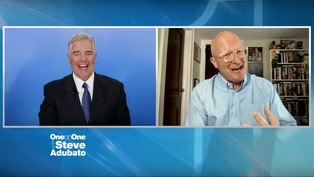
NJ.com Columnist Talks College Sports & 2026 FIFA World Cup
Video has Closed Captions
Clip: S2024 Ep2743 | 17m 1s | NJ.com Columnist Talks College Sports & 2026 FIFA World Cup (17m 1s)
Providing Support for PBS.org
Learn Moreabout PBS online sponsorship
- News and Public Affairs

Top journalists deliver compelling original analysis of the hour's headlines.

- News and Public Affairs

FRONTLINE is investigative journalism that questions, explains and changes our world.












Support for PBS provided by:
One-on-One is a local public television program presented by NJ PBS