State of Affairs with Steve Adubato
Steve Sweeney discusses issues that matter to NJ voters
Clip: Season 8 Episode 18 | 13m 23sVideo has Closed Captions
Steve Sweeney discusses issues that matter to NJ voters
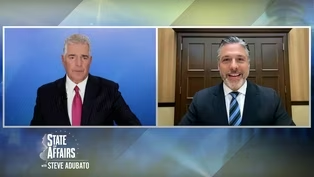
In this special edition of State of Affairs, Steve Adubato sits down individually with Steve Sweeney, the democratic gubernatorial candidate, to discuss his views on the fiscal health of the state, reproductive rights, and education.
Problems playing video? | Closed Captioning Feedback
Problems playing video? | Closed Captioning Feedback
State of Affairs with Steve Adubato is a local public television program presented by NJ PBS
State of Affairs with Steve Adubato
Steve Sweeney discusses issues that matter to NJ voters
Clip: Season 8 Episode 18 | 13m 23sVideo has Closed Captions
In this special edition of State of Affairs, Steve Adubato sits down individually with Steve Sweeney, the democratic gubernatorial candidate, to discuss his views on the fiscal health of the state, reproductive rights, and education.
Problems playing video? | Closed Captioning Feedback
How to Watch State of Affairs with Steve Adubato
State of Affairs with Steve Adubato is available to stream on pbs.org and the free PBS App, available on iPhone, Apple TV, Android TV, Android smartphones, Amazon Fire TV, Amazon Fire Tablet, Roku, Samsung Smart TV, and Vizio.
Providing Support for PBS.org
Learn Moreabout PBS online sponsorship[INSPRATIONAL MUSIC STING] - We continue in our series, "New Jersey's Next Governor: Decision 2025" with an in-depth interview with the former president of the New Jersey Senate, a Democratic candidate for Governor Steve Sweeney.
Good to see you, Senator - Steve, it's great to see you again.
- You got it.
Question right out of the box.
Top two issues if you were governor in January of 2026, top two priorities for you would be?
- Transit, obviously.
Huge problem that, you know, I called for a constitutional dedication of funding in 2020.
Now they gave it a billion dollars but they didn't constitutionally dedicate it.
So, you know, that means it could be spent other places.
And honestly reforming the budget process, Steve, what we do, the way we do it's wrong.
And it would take giving up some authority to the legislature, but it would be worth doing it to come up with a better process so that, you know, we have multiyear budgeting and we do consensus forecasting.
So we don't have these crazy swings in numbers.
'Cause the budget is what drives everything.
So I would say there two of the top.
But there's, look, there's a lot of issues here in New Jersey.
- And I wanna talk about affordability too, but go back to the budget.
Talk to us about your view of state funding of public schools.
The school funding formula.
What's screwed up about it?
'Cause everyone argues, it is screwed up.
A and B, more importantly, what would you do to change it?
- Steve, it's not screwed up.
It might need to be updated.
It's not screwed up.
It's not?
- No, no.
What happened- - We've had so many Republican legislators come on saying, "My district got the shaft.
We didn't get enough money, they had to let go of teachers."
Go ahead Senator.
- I'm glad you brought it up.
It's BS.
They were overfunded for 15 years, these districts.
Overfunded, when I say overfunded, they were getting funding for children that weren't in the school.
So instead of right-sizing the school district, Steve, like if a school district had 1000 less kids, they got paid as they had those thousand kids.
- Why?
- So if you don't have the kids, because, 'cause the legislature screwed it up, it took me eight years to fix it.
Seriously, it took me eight years to fix it with S2, which is what they complained about.
- Senate bill number two.
Go ahead.
- Which means money follows the child.
Now, so if you have an extra 1000 kids in your school, before you didn't get any funding for them.
Now you do.
And if you have less students, you lose that funding because you don't have the students.
And I honestly, a lot of these school districts knew this was coming for years, Steve, and I don't wanna lay people off.
I think that's not the way to go about this.
But you attrition, you right-size the district.
So, but here's the thing, we should be doing every five years, at least five years, a look back, to make sure the formula is performing the way it's expected to and intended to.
The school funding formula was the first formula that the courts approved that met all the needs in the state.
So, but you know, that was done back during the Corzine administration.
And when I was still in the legislature, I was talking about we need to revisit the funding formula to see if something's wrong with it to make corrections.
But the principle, the argument with these school districts and it's, you know, look, they're Democrat districts that lose funding too.
- Both, yeah.
Democrats and Republicans, yeah.
- You lose students.
I'll pay you for your thousand students.
I'm not gonna pay you for 2000 when you only have 1000.
- It's important conversation.
And we'll continue with legislators on both sides of the aisle.
But let me, affordability, New Jersey, and again, you're in the southern part of the state, you look to represent the entire state.
Senator, why, A, is New Jersey so unaffordable for so many, and B, what would you do as governor to change that?
- Well Steve, you know, I put on a 2% property tax cap, if you remember.
- As Senate president.
- As Senate president, when taxes were going up seven to 9% a year.
We need to do government differently.
And it's easy to say, and it's very hard to do.
But I'll give you an example.
In my home county, Gloucester County, we have more shared services than any county in the state.
And...
Which means you're bringing the service, you're bringing the service, but you're providing it cheaper.
Now, Gloucester County is the only county in the state that doesn't have any jails.
If they close their juvenile, they're female, they're male.
We have prisoners.
We send them to places that have empty jail cells.
And we're saving, I think $20 million a year now.
So it's looking at government and the way you're doing it and doing it differently.
I'm thrilled.
We had three school districts, you know, I was working on consolidation, you know, we really working on school consolidation and was able to negotiate with the NJEA a bill, that they agreed to.
Three school districts in Monmouth County voted, the towns voted to merge their school districts.
- What happened?
- Nothing, it worked.
You know what I mean?
- But that's the exception.
Sorry for interrupting, Senator.
The merging or consolidating of school districts is rare in the state, is it not?
- It's rare, but it's starting to happen more often.
There's I think 70 or 80 school districts in the state of New Jersey right now studying consolidation.
And Steve, what I'm getting to is, all our school districts should be K to 12, pre-K to 12.
You know, you have the K to two, the K-4, K-6, you know, they all need to be K-12 districts.
Because one of the other problems is, especially when you have the regional high schools, if you have five schools sending to a regional high school, they're not teaching the same curriculum.
They're not reading out the same books.
I mean, the vast majority of that.
So details matter.
Details matter a great deal.
Now, when we did the school consolidation bill, we worked with the NJEA and they agreed to this bill because, you know, they care about their membership.
You know what I mean?
I get it.
I don't wanna let- - You have a union background.
You have a union background, you get it.
Yep.
- I don't wanna see people laid off unnecessarily.
But the frustration with the school funding was they knew it was coming and they just never did anything about it.
You know, and like at some point you say, "Well, okay, musical chairs, we pulled the last chair."
- Senator, I'm gonna bring up another issue.
Just real quick, I hate to say real quick because it's such a complex issue.
The issue of abortion.
The Supreme Court has done what it has done, the United States Supreme Court, back in the states, New Jersey law is what it is.
If you were governor, would you do anything to change the existing law in the state of New Jersey that codifies Roe v Wade?
- Look, we codified, you know, the Supreme Court's decision, I was in the legislation, we codified it, passed the bill.
But we need to do a constitutional amendment, Steve, because what happens is with legislation, you will know this, what you legislate, you can un-legislate.
We need to protect a woman's right to choose.
And what we need to do is make sure it's in the Constitution so it can't change.
- On the issue of immigration, New Jersey, I'm not gonna say like other states, because places like Arizona and California and other places, Texas, they're impacted differently.
But there's still an impact here in New Jersey.
What, if anything, would you do if you were governor?
Again, federal policy is, you know, that's what it has to change.
But what, if anything, could, and would you do as governor in January of 2026 regarding the immigration crisis?
- I would get our federal legislators in a room and start talking about how we fix this.
You know, Steve, we can't have an open border.
We just can't have everyone pouring in.
But there should be a pathway to coming here legitimately and legally.
And it really is our federal delegations, and every governor in every state in this country should basically get their federal legislators together and say, "Knock this off."
You know, unfortunately, Donald Trump, they actually came up with a bill.
You know this, they came up with a bill that was the strongest border bill in history.
- In Congress.
- Yeah.
And Trump said, "I'd rather have the issue.
I don't want you to solve it."
Well, we gotta stop that stuff, you know, I can work bipartisan.
I've worked bipartisan my whole career.
And the only way you fix big things like this is by working with both sides.
We need to recognize that we're never gonna get anything done if we're doing what they're doing in Washington.
People are frustrated and angry because they're not thinking about us.
They're thinking about them.
And that's what's wrong.
- Senator, I wanna ask you, and not everyone knows this, your background real quick, your background in the labor movement, describe it, and in your connection then to public life, please.
- Well, my background is I'm a union iron worker.
I didn't go to college.
I went right to work.
It was, you know, right have to work when I was a young guy.
I was an ironworker.
I worked on buildings, walked the structural steel, worked on bridges, and then I had a daughter born, two pounds with Down syndrome, Steve.
And it really sobered me up.
And I became more mature.
You know what I mean?
I think that's actually when I actually physically really became a man.
When I realized that I had a responsibility.
And I'm a believer that everyone has a purpose in life.
Some people find it, some people don't.
My purpose is advocating for people like my daughter Lauren, to make sure that she can have the fullest life possible without just what happens now, which is people look at people with disabilities and they just don't think they can do things, and they can.
- Lauren, you've talked about Lauren for years now.
Lauren, and how old is she right now?
- 31.
- I remember the first time I, when, in a conversation with you, in an interview, you started talking about her.
It has had a profound impact on your public and personal life, has it not?
She has.
- Yeah, oh yeah.
She changed me as a person.
But for better, Steve, you know, you don't miss anything.
Like we go by, like when my son was supposed to sit up, he sat up, when he was supposed to walk, he walked, talk, he talked.
My daughter had to learn all those things.
We taught my daughter how to do those things.
So what happens, it makes you a better person 'cause you don't take anything for granted.
- Former Senate President Steve Sweeney.
Thank you so much for joining us as part of our series, "New Jersey's Next Governor: Decision 2025."
Thank you, Senator.
- Thank you, Steve.
- You got it.
I would be remiss as a broadcaster and as someone who greatly admired Michael Aron, who was a mentor to all of us.
He was the dean of the State House Press Corps.
Everybody knows that.
He made a difference.
He did it the right way.
He interviewed every governor for decades in the state and asked the right questions and followed up when he didn't get a straight answer.
He was a great journalist.
He was a giant in the world of broadcasting and media.
And we need to continue Michael Aron's legacy.
Michael, my friend, my colleague, job well done.
- Sentimantal music - [Narrator] State of Affairs with Steve Adubato is a production of the Caucus Educational Corporation.
Celebrating 30 years in public broadcasting.
Funding has been provided by Hackensack Meridian Health.
The Turrell Fund, a foundation serving children.
Operating Engineers, Local 825.
Eastern Atlantic States Regional Council of Carpenters.
New Brunswick Development Corporation.
IBEW Local 102.
PSE&G, Rowan University.
And by these public spirited organizations, individuals and associations committed to informing New Jersey citizens about the important issues facing the Garden State.
Promotional support provided by NJ.Com.
And by New Jersey Globe.
- (Narrator) Life is full of changes.
At Hackensack Meridian Medical Group, we're ready for them.
If you have a cold or chronic illness, our five star doctors can treat any ailment.
Whether you're starting recess or retiring, we're prepared with pediatric and adult specialists.
And if you just moved here, we are in your neighborhood.
You now have access to a health team thousand strong.
So no matter what or when, we're ready.
Bill Spadea's campaign goals for New Jersey Governor
Video has Closed Captions
Clip: S8 Ep18 | 13m 39s | Bill Spadea's campaign goals for New Jersey Governor (13m 39s)
Providing Support for PBS.org
Learn Moreabout PBS online sponsorship
- News and Public Affairs

Top journalists deliver compelling original analysis of the hour's headlines.

- News and Public Affairs

FRONTLINE is investigative journalism that questions, explains and changes our world.












Support for PBS provided by:
State of Affairs with Steve Adubato is a local public television program presented by NJ PBS