
Steven Edwards; Wayne Winborne; Angelica Berrie
8/6/2022 | 27m 54sVideo has Closed Captions
Steven Edwards; Wayne Winborne; Angelica Berrie
Steve Adubato sits down with Steve Edwards, President of The Foundation for the NJ Hall of Fame, to talk about the 14th annual NJ Hall of Fame ceremony; Wayne Winborne, Executive Director, Institute of Jazz Studies, Rutgers University - Newark, talks about the Institute of Jazz Studies; Angelica Berrie, President, Russell Berrie Foundation, discusses the Russ Berrie Making a Difference Awards.
Problems playing video? | Closed Captioning Feedback
Problems playing video? | Closed Captioning Feedback
Think Tank with Steve Adubato is a local public television program presented by NJ PBS
Steven Edwards; Wayne Winborne; Angelica Berrie
8/6/2022 | 27m 54sVideo has Closed Captions
Steve Adubato sits down with Steve Edwards, President of The Foundation for the NJ Hall of Fame, to talk about the 14th annual NJ Hall of Fame ceremony; Wayne Winborne, Executive Director, Institute of Jazz Studies, Rutgers University - Newark, talks about the Institute of Jazz Studies; Angelica Berrie, President, Russell Berrie Foundation, discusses the Russ Berrie Making a Difference Awards.
Problems playing video? | Closed Captioning Feedback
How to Watch Think Tank with Steve Adubato
Think Tank with Steve Adubato is available to stream on pbs.org and the free PBS App, available on iPhone, Apple TV, Android TV, Android smartphones, Amazon Fire TV, Amazon Fire Tablet, Roku, Samsung Smart TV, and Vizio.
Providing Support for PBS.org
Learn Moreabout PBS online sponsorship- [Narrator] Funding for this edition of Think Tank with Steve Adubato has been provided by Hackensack Meridian Health.
Keep getting better.
Horizon Blue Cross Blue Shield of New Jersey.
Here when you need us most, now and always.
The New Jersey Education Association.
PNC, Grow Up Great.
PSE&G, committed to providing safe, reliable energy now and in the future.
NJM Insurance Group.
Serving New Jersey'’s drivers, homeowners and business owners for more than 100 years.
The Port Authority of New York and New Jersey.
Moving the region through air, land, rail, and sea.
The New Jersey Economic Development Authority.
And by Fedway Associates, Inc.
Promotional support provided by NJ.Com, keeping communities informed and connected.
And by The New Jersey Business & Industry Association.
[MOTIVATIONAL MUSIC] - Hi, I'm Steve Adubato.
Everything you've ever wanted or needed to know about the New Jersey Hall of Fame, the gentleman on camera will tell you about it, he is Steve Edwards, president of The Foundation for the New Jersey Hall of Fame Board of Trustees.
Steve, good to see you.
- Good to see you too, Steven.
Mr. New Jersey you are, I'd like to thank.
- Well, at least in my own family, I might be, I'm not sure.
Hey, listen Steve, let's do this, we're gonna be talking about Yogi and Bruce Springsteen and Nicholson Jack in just a minute, but give people the context because on the 27th of October, 2022 at NJPAC, it's the 14th annual, real quick 30 seconds, how did it start?
- It started back, in 2008 was our first annual induction ceremony, and we started the Hall of Fame a few years before that, but the idea that all the organizers that got together and launched the Hall of Fame, thought it would be a great idea to celebrate our great state, to honor our legends, and to inspire the next generation and adults of all ages for that matter.
Our role models are very inspirational people from all walks of life.
And if there's any one thing that I'm most passionate about, and I know a lot of the other organizers, it's about inspiring people and helping people to find their purpose in life because happiness comes from fulfillment, fulfillment comes from purpose, and that's one of the best things about the Hall of Fame and our inductees.
- And by the way, I'm gonna name some people other than Yogi Berra, you're gonna see some pictures in post-production Yogi Berra, Bruce Springsteen, Jack Nicholson, how about some of these, we're gonna be doing a series called "Remember Them, Gone But Not Forgotten," and here are some people we should never forget, James Gandolfini.
- James Gandolfini, yes.
Listen, he was inducted several years ago and people think of him as Tony Soprano but the fact is that he was James Gandolfini, I happened to go to college with him as a matter of fact.
Back at Rutgers, he was a bartender back then and I remember him quite clearly.
But James reached the pinnacle of the acting profession and that's why we inducted him, we didn't induct Tony Soprano, and he was one of the best.
- And how about this, give me real quick, Larry Doby, I live in Montclair, Larry Doby from Montclair, I believe he was the first African-American to play in the American League with the Cleveland Indians, gone, you can't forget him, right, Steve?
- That's correct, as a matter of fact we're naming the New Jersey Turnpike Authority along with the governor and first lady are naming a service area after him up in North Jersey on the Garden State Parkway.
Larry Doby, it's forgotten but Jackie Robinson of course, was the first African-American baseball player, but Larry came in right behind him and it was every bit of a dramatic story that sometimes gets drowned out because Jackie made such a incredible impression, but we don't forget Larry Doby.
- Hey Steve, real quick, you mentioned the turnpike situation, New Jersey Turnpike Authority, renaming of nine service areas on the Garden State Parkway, iconic New Jersey figures, and one of them is Whitney Houston who's at the Vox Hall one, right?
As you talk about Whitney Houston, we'll show some pictures of her as well.
Why Whitney Houston?
- Whitney Houston, like all of the New Jersey Hall of Fame inductees reached the pinnacle of their profession, I don't have to tell yours viewers, Whitney Houston was perhaps the greatest female singer, vocalist of all time.
And Whitney's roots were right here in New Jersey, she wound up living here in Jersey after she made it as big as she made it, and we wanna send a message to others that wanna reach the pinnacle of the music industry that it starts, like it started for Whitney in a church, in East Orange Newark area, and she rose right to the heights of that industry.
So, anyone can do it.
- And real quick, Ocean view is Toni Morrison, that service area, how about Frank Sinatra, Atlantic?
Give me 30 seconds on Sinatra, Hoboken, right?
- Frank Sinatra, hailed of course from Hoboken.
The chairman of the board, he happens to be one of my favorites, his voice is for the ages, as Pete Hamill once said, "As long as people have ears and can listen, Sinatra will matter."
And I think he's very deserving of that service area.
- Talk about the learning center, we're gonna show some video of it, what is the learning center?
- So the New Jersey Hall of Fame at American Dream Entertainment and Learning Center, we're gonna be breaking ground this spring, in the April timeframe.
We'll be cutting the ribbon later this fall, it's gonna be a 10,000 square foot state-of-the-art, immersive, very interactive entertainment center.
And I think, I hope and trust it'll become a symbol of pride for all New Jerseyans and a place that's gonna inspire a lot of people as well.
- There's also a healthcare initiative, which is, what is that one?
- Well, Hackensack Meridian is our lead sponsor, and we're very proud of that fact.
Hackensack Barnabas, all of the hospital chains, we should be so proud of what they've done over the last few years during this very difficult pandemic.
They have been on the front line in some cases, men and women giving up their lives to help save people.
And the fact is Hackensack is our lead sponsor, we're very proud of that and like all of our sponsors, I think that the common denominator is that we're all proud of New Jersey's past, but we also believe in its future.
- And by the way, you're talking about the Hall of Fame healthcare resources that you're talking about and HMH is also a support of what we do as well.
Hey, real quick, Steven, a few seconds we have left, why, give me something on Yogi Berra, Bruce Springsteen, and Jack Nicholson 'cause you told our producers those are the three you wanted to talk about, why Yogi?
- Well, Yogi was so down to earth, I was struck by how humble he was, and that's not to say others weren't but he just had a very down to earth humble streak to him that I was very struck by, and he told me a funny story by the way backstage, that he used to drive Phil Rizzuto crazy, they used to room together.
And he would keep the TV on until like three in the morning, and Rizzuto could never get any sleep, and he used to yell at Yogi, but I thought that was a funny story.
Bruce Springsteen happens to be one of my favorites, I'm a fan of his and he, it was just great to be in his presence and to see him there helping validate our very first induction ceremony.
- A few seconds on Nicholson, I gotta go, give me a few seconds on Nicholson.
- Nicholson, also very humble.
He was, yes sir, no sir, where do you want me to stand?
And I'm thinking to myself, this is Jack Nicholson, he's taking orders from me, something's wrong, the world's officially upside down.
- Jack Nicholson, Yogi Berra, Bruce Springsteen, I'll give you some of the other names, I gotta get outta here but Celia Cruz, Whitney Houston, Larry Doby, Gandolfini, Sinatra, Toni Morrison, Celia Cruz, great stuff.
Hey Steve, listen, I look forward to future conversations with you, collaborating with you on our series called "Remember Them, Gone But Not Forgotten," because we cannot forget New Jerseyans.
Hey listen, I'm five blocks away from The Edison.
He mattered, a lot of them mattered.
Great stuff, Steve.
- He sure does.
- Thank you my friend.
- Thank you, Steve, thanks for the opportunity.
- You got it, stay with us, we'll be right back.
To watch more Think Tank with Steve Adubato, find us online and follow us on social media.
- We are honored to be joined by Wayne Winborne, who is Executive Director of the Institute of Jazz Studies at Rutgers University of Newark.
Good to see you, Wayne.
- Good to see you.
- You know, last time we had you on, you talked about how important the Institute is.
Remind us how important the Institute is, and how it's only one of its kind in the nation.
- It really is, Steve.
It's great to see you.
Thanks for having me on again.
It's always a pleasure, really, an honor, to be able to talk to you and to share with your audiences the things that we've got going on here in Rutgers.
The Institute of Jazz Studies is the world's largest archive and research facility dedicated to jazz in the world.
Right here, in downtown Newark.
Fourth floor of the Dana Library here, and we've got a cross- section of collections, memorabilia, papers, very important information and content for scholars, researchers, casual jazz fans.
We've got a library of over, bumping up on 300,000 recordings, in virtually every format.
So the historian in you can go back and listen to things from the twenties and thirties.
If you're a local resident and you wanna come in, and just hear your favorite jazz artist, we've got virtually everything, virtually everything, that's ever been recorded commercially in jazz.
We've also got collectibles, Ella Fitzgerald's favorite gown, her favorite wig, one of Louis Armstrong's trumpets, Lester Young's saxophone.
And the centerpiece of our collection of course, is our own New Jersey resident, the kid from Red Bank, Count Basie's complete collection.
- Hold on, Count Basie.
So, okay, we're gonna show some pictures of Count Basie.
Tell folks why Count Basie matters so much, even today.
- Count Basie is one of the giants of American music, obviously rooted in jazz, but his influence really spanned across other genres.
His career spanned virtually the entire 20th Century.
So you're talking about someone who was making music in the late twenties and thirties, a young band leader coming out of Red Bank, spending time in New York, learning to play the organ, going to Kansas City, which was a hotbed of music and bars and nightlife, because of the crossroads there between Oklahoma City and Kansas City across the Midwest and into the South.
His bands were among the most popular.
There were radio broadcasts, which allowed him to get notoriety in other cities around the country.
But of course, they went barnstorming.
And Basie was one of those leaders, that A, was able to keep great musicians in the band, many of whom went on to become great soloists in their own right and jazz stars, but also have the longevity to continue post-World War II into the fifties, sixties.
He became an iconic figure, close to people like Frank Sinatra and- - I was just gonna say, Sinatra, as we show video.
There are pictures, I know, of Sinatra and Count Basie because their collaborations.
I've seen documentaries on both of them.
- Yeah.
- Many more with Sinatra, because our family was obsessed from as far back as I can remember.
(Wayne laughs) - Sure.
- They collaborated on some extraordinary music, and Sinatra loved jazz.
- Loved jazz, great jazz singer, the phrasing, he had the respect of a lot of jazz musicians.
Two Jersey boys getting together, made some extremely important albums.
Sinatra would often say, "We gotta get the Basie band in for this", for some of the engagements with they would do in Las Vegas that became historic recordings.
And Basie, of course, and a lot of jazz musicians, loved Frank Sinatra.
You know, Frank Sinatra was, of course, very close to Billie Holiday, worshipped her.
- That's right.
- But they loved the phrasing, what he brought to it.
And of course, audiences across America, I mean, and really of every stripe, love, love, loved Frank Sinatra.
So it's kind of cool that two Jersey guys were able to create that magic on occasion.
- Yeah.
There's some other Jersey people, I'm gonna ask you about Sarah Vaughan in a second, Newark, from Newark itself.
But can you do this for me?
Talk to us about Clement's Place, named after the great, late mentor of mine, a mentor to many, the late Dr. Clement Price from Rutgers-Newark.
Talk about Clement's Place.
- Steve, you caught it.
You said he was a mentor.
I considered Clem a mentor.
He was a dear friend to me, was always very kind to me.
Actually, Clem, the last conversation I had with him, we were huddled up.
He'd given a talk at the University of Scranton.
I'd gone down to hear it, and we knew mutual friends there.
And we spent that evening at dinner, huddled up in the corner, with him trying to talk me into applying for what would become this job.
I know he talked to other people, I have no illusions that he didn't recruit widely for this position, but it's just very special to me that Clem Price, great historian, scholar, the Historian of the City of Newark, distinguished Professor of History here at Rutgers University- Newark, as you say, a mentor to a lot of us.
it was Clem, who, when the building we now refer to as Ruth Bader Ginsburg Hall, 15 Washington Street, I believe it was the former Law School in Newark back in the seventies through the early eighties, if I- - And excuse me, some people wonder why Ruth Bader Ginsburg, because she graduated from Rutgers Law School.
But go ahead.
- That's exactly right.
And taught there, and if I'm not mistaken, did Moot Court in that building.
- She sure did.
- That's right.
And so we're really proud to have that building named after her.
When the building was being renovated, and the talks and plans were being made for what was gonna go on, you know, meeting rooms on the second floor, we have the Great Hall that lots of nonprofits, our community partners, use for their gala dinners.
It's a big, beautiful open space.
What had been the Mock Trial courtroom, I think, if I'm not mistaken, was originally slated to be a convenience store.
And the joke I tell people is that, look, I love some unnamed meat under a hot lamp as much as the next guy, but it was Clem, in talking with Nancy Cantor our Chancellor, said, "No, no, no, no.
That's not what we need.
What we need is a place for the community to gather, for students, faculty, staff, for folks to come in, for artists to join us".
Clem loved good music.
He loved jazz.
He loved good bars.
And so sadly, when he passed away suddenly, before this building was finished, the decision was made to create that space and call it Clem's Place.
And I was very fortunate, I was hired for the position, and it was handed to me, "Here, Jazz Club, do something".
And as I tell people, I'm the luckiest cat in the world, because I get to program that space and we do a cross-section of things.
We've developed a very good reputation among musicians.
So we do a mix of big names, we've had Delfeayo Marsalis, Stefon Harris has performed a number of times.
He's now also on the faculty here.
We have local musicians, we have young emerging artists, we have students from our writing program do their readings once a month, we turn it over it to an open mic for our Honors students once a month, they call it "The Healing Sounds of Newark", and they do hip-hop, and rap, and do all kinds of music.
Some of which I hate, but that's good, (Steve laughs) because the young people need to do their thing.
And I think the spirit of the place, the community, the exchange and mix of different peoples coming together, I think Clem would really love that and be happy with it.
- Yeah, and folks, let me do this, Wayne, for those who don't really appreciate, not that they don't appreciate, they don't know, so they can't appreciate.
We did a half hour special hosted by our longtime colleague Joanna Gagis with NJ Spotlight News.
Joanna was with us at the time, and she did a half hour special on Clement Price.
So look at our website, you'll see it right there.
SteveAdubato.org, put in Clem Price, Dr. Clem Price, and you'll see Joanna's great work around that.
Real quick, before I let you go, can you do Sarah Vaughan, 30 seconds on Sarah Vaughan, which is not fair to her.
We'll put some pictures up as well.
- One of the great voices of the 20th Century, could have sung anything.
Great jazz singer, born and raised here in Newark, cut her teeth at a Baptist Church right up the street.
Some of her friends are still alive.
One of the great American icons in music, great jazz singer, great voice.
She's had a postage stamp named after her, and really comes out of a deep connection to the community here.
Newark was such an important place in New Jersey to her, and provided that sort of fertile ground for her to develop her talent and go on to global status as one of the great singers.
- And in Newark, we never miss Sarah Vaughn Way, you know right where I'm talking about, Wayne.
- That's exactly right.
- And by the way, Rutgers is in fact, one of our Higher Ed partners, and introduces us to folks like Wayne, who's been with us many times.
Wayne Winborne, Executive Director of the Institute of Jazz Studies at Rutgers University-Newark.
Wayne, all the best of you and the team down there.
- Thanks, Steve.
Best to you.
See ya soon.
- You got it, we'll be right back.
To watch more Think Tank with Steve Adubato, find us online and follow us on social media.
- We are honored to be joined by Angelica Berrie who's president of the Russell Berrie Foundation Board of Trustees.
Angelica, good to see you.
- Nice to see you, Steve.
- There were so many other people over this past year that we've recognized.
We did also a recent panel with Russ Berrie Making a Difference awardees, a whole range of different folks.
Tell folks as we put up the website, who are these people and why do they matter so much?
- Well, these are everyday heroes, Steve.
These are people who have done things without any thought of recognition.
But in this pandemic time, their work has increased impact at the time of greater need.
So we have over 3,000 nominees in the past 25 years that we've been doing this.
And every year, we add more.
This year we have 330 nominations.
- And by the way, as we put up the website, the ceremony will be in May.
And I have been honored for as far back as I can remember, Angelica, to have moderated and hosted that event, and we have met so many extraordinary people making a huge difference.
And let me ask you this, Angelica.
For those who don't know how this award initiative started making a difference, please share with everyone.
- Well, Russ had this brilliant idea that we had to recognize people who did things, who were everyday heroes, who were living ordinary lives but doing extraordinary deeds.
And we were very skeptical at that time that we would be able to find so many people.
So through Ramapo, we've had this partnership for over 25 years.
- You know what's interesting, Angelica?
Every time you're on, I asked you this, but I wanna touch on it again.
You and I have talked a lot about relationships.
We've had a long standing relationship with the foundation.
The foundation supports our initiative around making a difference.
But relationships, there have been so many important, significant, impactful relationships that have been developed by those who have won the Making a Difference Award.
Why does that matter so much?
- Well, these partnerships actually leverage off each other.
They increase the impact, you know, they magnify the impact, there's a multiplier effect.
We've had partnerships like with Adam Lowy, who's got Move For Hunger coordinating transportation to get fresh produce from another making a difference hero, Chip Paillex of America's Grow-a-Row.
So just think about that.
Chip's been providing produce for almost 75% of New Jersey's food banks, and the leverage they get from the transportation facilities of Adam Lowy.
It's a magnificent example.
- Angelica, help us understand, because again only from doing the awards, let me do this, and if I'm wrong, you'll tell me.
There are $7,500 awards.
There are seven of those.
There's also a top award of $50,000 and two at $25,000.
For many, if not all of these not-for-profit organizations, is individuals and not-for-profit organizations.
Those dollars make a difference in addition to the partnerships and the relationships, those dollars matter.
Talk about it.
- Well, it's under $4 million.
So if you think about it, it's a lot of impact for $4 million over 25 years What we're doing is we're seeding an environment, Steve.
We're growing a field, and all these seeds, all these organizations have a ripple effect, and each effect is magnified by the people who are volunteers, the 21 communities they operate in.
And just think about that network of change all over New Jersey.
It's transformational over the years.
- You know, let's shift gears, Angelica.
We've talked a lot about diabetes over the years.
We've done a whole range of public health, public awareness program around diabetes for a long time.
There is an initiative, The Russell Berrie Galilee Diabetes SPHERE.
What is it?
And why is it so critical?
- Well, Israel is an important priority area for the Berrie Foundation.
We have a very personal relationship with diabetes.
My husband was a type 2 diabetic, and there's going to be almost a million people affected with diabetes in Israel.
So in the north where 55% are Arabs, it's important to have an initiative like this, because it could transform the healthcare system of Israel.
- Angelica, put Israel on context, because I don't know how many years ago it was, but I took a trip with you and many other folks connected to the Berrie Foundation, and a lot of partnerships and relationships were formed because of that.
What is the direct connection between the foundation and Israel?
- Well, Russ was a Jew and so am I, and I think the importance of Israel to the world as a place of startup nation and the technologies and the innovation that's coming out of there.
Apart from the fact that it is a center for inter-religious opportunities and to be able to have a place with such diversity, it's a perfect place as a laboratory for creating philanthropic change.
- You know, Angelica, last question I wanna ask you is this.
So I do this program around two years into the pandemic, it'll be seen a little bit later in repeats.
So the pandemic has affected all of us in one way or another.
And clearly it has affected the foundation and those who the foundation provides grants to.
The Caucus Educational Corporation being one of them.
How has the pandemic, for you as a philanthropist, impacted your view, not just of philanthropy and giving back but on those who are out there on the front lines every day, making a difference?
- If you just think of one statistic, Steve, 900,000 lives lost in the US alone.
Just think of all the families who are orphaned, widowed, and all the things they lose, their homes, their healthcare, their services and all support systems around them, and how many people fall into poverty when one breadwinner is lost.
So just the impact of the regular needs magnified many, many, many times by this 900,000 deaths.
It's definitely had to shift the way we think about philanthropy, the things we still need to address, whether it's how to deliver services to the elderly.
What kinds of changes this pandemic has cost in the education system?
What are the technologies that are lacking to deliver services, even from healthcare, the nonprofits we fund who are shifting to telemedicine, and what does that involve, you know?
So people who have lost jobs need to be retrained in a different way for a different environment where certain jobs are not going to come back.
So I think the future of work in a post pandemic economy is gonna affect a lot of nonprofits, and there's a lot of mental health issues with the loss and grief of 900,000 lives, you know.
So it's a very dramatic time for change.
And we have to shift the way we think to address emerging needs.
- Well said.
And one of the things that's especially tragic is that we're taping on the 7th of February, again being seen later.
Angelica makes reference to over 900,000 Americans losing their lives to COVID.
By the time this airs, say in March, April, May, that number is obviously, unfortunately, tragically gonna be higher but it's our job to also remember it's not a statistic.
It's not just a statistic.
Those are people.
Those are people's families suffering, struggling to try to get through this.
And I wanna thank Angelica and the team at the Berrie Foundation for allowing us to feature those who are making a difference every day in people's lives.
Ordinary people, allegedly, making an extraordinary difference.
Angelica, thank you so much.
- Thank you, Steve.
It's a privilege to be a partner with you.
- It's mutual.
- [Narrator] Think Tank with Steve Adubato has been a production of the Caucus Educational Corporation.
Funding has been provided by Hackensack Meridian Health.
Horizon Blue Cross Blue Shield of New Jersey.
The New Jersey Education Association.
PNC, Grow Up Great.
PSE&G, NJM Insurance Group.
The Port Authority of New York and New Jersey.
The New Jersey Economic Development Authority.
And by Fedway Associates, Inc.
Promotional support provided by NJ.Com, And by The New Jersey Business & Industry Association.
- Many of New Jersey'’s children have been affected by Covid-19, but now that there'’s a safe and effective vaccine available for children ages twelve and older you can help make COVID-19 history by getting yourself and your child vaccinated.
Let'’s end this pandemic together and help all children get back to being kids.
Visit HackensackMeridianHealth.org/ covid19 to learn more, or to schedule a vaccine appointment today.
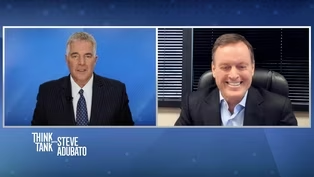
The 14th Annual NJ Hall of Fame Ceremony
Video has Closed Captions
Clip: 8/6/2022 | 9m 1s | The 14th Annual NJ Hall of Fame Ceremony (9m 1s)
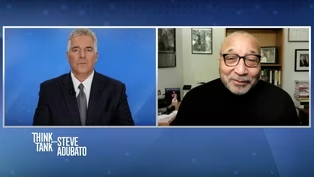
Executive Director on Jazz Studies at Rutgers Newark
Video has Closed Captions
Clip: 8/6/2022 | 9m 37s | Executive Director on Jazz Studies at Rutgers Newark (9m 37s)
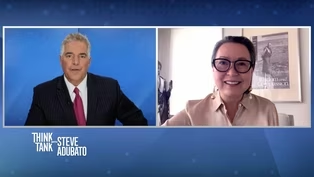
Russ Berrie Awards and its Honorees' Impact on New Jersey
Video has Closed Captions
Clip: 8/6/2022 | 9m 52s | Russ Berrie Awards and its Honorees' Impact on New Jersey (9m 52s)
Providing Support for PBS.org
Learn Moreabout PBS online sponsorship
- News and Public Affairs

Top journalists deliver compelling original analysis of the hour's headlines.

- News and Public Affairs

FRONTLINE is investigative journalism that questions, explains and changes our world.












Support for PBS provided by:
Think Tank with Steve Adubato is a local public television program presented by NJ PBS