
Stimulus Spending, New Census Data
Season 5 Episode 35 | 26m 47sVideo has Closed Captions
How Utah will spend stimulus dollars. Plus Pres. Biden’s first joint address to Congress.
State leaders are debating the best ways to spend the billions of stimulus dollars coming to Utah. New census data reveals major changes in America’s population that could lead to a shakeup in Congress. Plus, Utah’s leaders react to President Biden’s first joint address to Congress. Maura Carabello, president of the Exoro Group, Glen Mills, ABC4 News, and Boyd Matheson, KSL NewsRadio.
Problems playing video? | Closed Captioning Feedback
Problems playing video? | Closed Captioning Feedback
The Hinckley Report is a local public television program presented by PBS Utah
Funding for The Hinckley Report is made possible in part by Cleone Peterson Eccles Endowment Fund, AARP Utah, and Merit Medical.
Stimulus Spending, New Census Data
Season 5 Episode 35 | 26m 47sVideo has Closed Captions
State leaders are debating the best ways to spend the billions of stimulus dollars coming to Utah. New census data reveals major changes in America’s population that could lead to a shakeup in Congress. Plus, Utah’s leaders react to President Biden’s first joint address to Congress. Maura Carabello, president of the Exoro Group, Glen Mills, ABC4 News, and Boyd Matheson, KSL NewsRadio.
Problems playing video? | Closed Captioning Feedback
How to Watch The Hinckley Report
The Hinckley Report is available to stream on pbs.org and the free PBS App, available on iPhone, Apple TV, Android TV, Android smartphones, Amazon Fire TV, Amazon Fire Tablet, Roku, Samsung Smart TV, and Vizio.
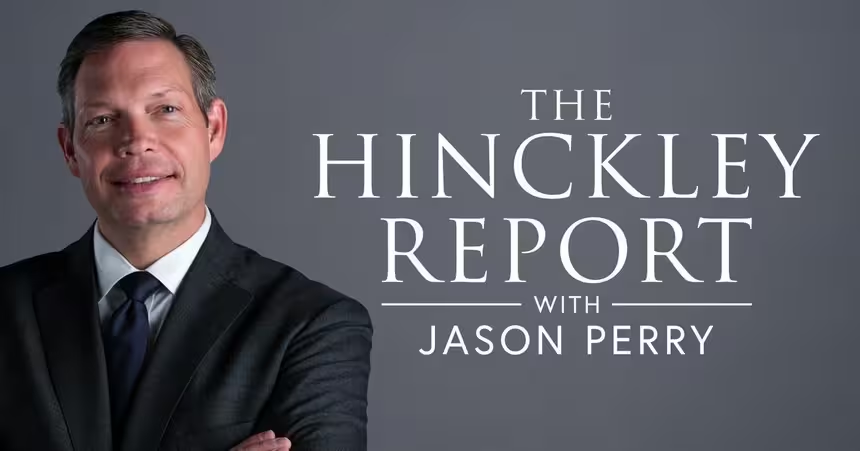
The Hinckley Report
Hosted by Jason Perry, each week’s guests feature Utah’s top journalists, lawmakers and policy experts.Providing Support for PBS.org
Learn Moreabout PBS online sponsorship♪♪♪ male announcer: Funding for the "Hinckley Report" is made possible in part by the Cleone Peterson Eccles Endowment Fund.
Jason Perry: Tonight on the "Hinckley Report" state leaders debate the best ways to spend the billions of stimulus dollars coming to Utah.
New census data reveals major changes in America's population and has the potential to shake up Congress.
And Utah's leaders react to President Biden's first joint address to Congress.
♪♪♪ ♪♪♪ Jason: Good evening and welcome to the "Hinckley Report."
I'm Jason Perry, director of the Hinckley Institute of Politics.
Covering the week, we have Boyd Matheson, host of "Inside Sources" on KSLNews radio; Maura Carabello, president of the Exoro Group; and Glen Mills, anchor and senior political correspondent with ABC4 News.
Thank you for being with us tonight.
This has been a big week in politics, national stage, local stage.
Maura, I want to start with you about the message to the joint session of Congress this week from President Biden.
This is one of the hallmarks of the first 100 days in office.
He was the eve of his 99th day, a lot happened here.
You are a great political strategist.
You advise people on speeches.
Kinda give us a high level view of the tone, the approach, and what he was trying to strike with this speech.
Maura Carabello: So first you alluded to this, I was struck by his sense and his knowledge of the moment in time.
Now this could probably come from his 40 years of anticipating this moment in his life, but he took time.
He called the joint session.
It's not a formal, it's informal.
There's an adage that say events drive politics, and President Biden clearly seemed to understand this adage in the convening.
His tone was a little old school American statesman like.
He had a great moment with the acknowledgment of two women in the dias behind him.
I thought I appreciated his lack of snarkiness really.
And I think that it was-- it felt more traditional that way.
And he did and I'm sure we'll talk about this more he laid down some big markers.
It was a generational speech for him.
Whether he will accomplish it or not I like a president who understands the mantle that says I have a moment in time when I'm laying down a big agenda, not a small one.
Jason: We're definitely gonna have to talk about that agenda 'cause there was nothing small about it.
The first part of the speech as you alluded to, Glen, was a little bit of victory lap to some of the big successes.
Talk about a couple of those.
Kinda give us the Utah lens on how we perceive those things as well.
Glen Mills: Well the biggest thing he came out on was the Coronavirus pandemic response and that makes sense when you take a look at the polling nationwide because that is where he is the most popular.
It's where he has the most support.
So I wasn't surprised to see him do that at all.
He talked about how now every American has a vaccination site within five miles.
Of course, we've seen Utah a head of the national pack when it comes to the roll out with the vaccine, but it wasn't a surprise at all the hit on that.
And then obviously the relief plan that he was able to get through Congress as well was a victory for him even though it was a partisan victory still one that he was able to touch base on in that speech.
Jason: Yeah, Boyd, talk about that particular point 'cause that America rescue plan for sure.
He said this is one of the hallmarks.
You know put a historical perspective, one of the biggest investments in our workers to recover, have our economy recover, how did that play in Utah.
Boyd Matheson: You know I think it's interesting that the pandemic has really shifted the way that we look at government.
I think many people are a little more open to a more prominent role of government, especially as it relates to this kind of funding and projects and programs.
And so I think he struck that trying to really use that as a way to parlay it into his next initiatives, which are also equally big in terms of infrastructure and the American families plan.
I think one of the other things that the president did coming back to Maura's point, he did do this in a different way.
The thing that struck me the most was the use of the term "we" as opposed to I and me and mine from the previous administration.
So that was a stark difference there.
Of course it was a speech in a unique setting with a half empty, you know, with some members of Congress with their feet up on the chairs there was so much space.
So it was an interesting moment there, but I think he really was trying to say look there is a role for government to play.
And we're gonna show you that it can play bigger and that will be the big debate and where a lot of that pushback came from coming out of the speech.
Maura: Another notion on his long term strategy I think we should be watching is that he and Vice President Harris have hit the road.
So that has-- I mean that is key.
That is old school strategy in which not only he's extending his cycle, we're following him still.
He's reinforcing his agenda.
He's really capitalizing on his polling right now.
And they're aware of that, they know they'll see a dip.
So he's laying out not only an agenda, but he's following through with a strategy going into the states that I think we should watch.
Glen: One other important thing I was going to mention on when we talk about this contrast between President Biden and the previous President Trump even Representative Chris Stewart in his response, which was ultimately very critical, he admitted that the president carried a soothing tone.
And so I think that was a common thing that people picked up on during this speech as well.
Jason: What do you think-- Boyd: I think it's also really critical that the president was able to focus on this communication strategy, old school for sure, but it's that discipline component that your communication strategy has to be every bit as sophisticated and powerful as your policy strategy.
And as Maura said hitting the road, getting out there amongst the people, and playing on the messages they've tested and they know work is actually great discipline from the administration.
They get it from a communication strategy standpoint.
Jason: So Maura, that communication strategy, all of you hit a little theme on here too which the president needs to address.
For a long time Republican side, Democratic side.
There's a lot of talk about I want to reduce the size of government.
And clearly these proposals that we're gonna talk about here for just a minute are not doing that at all.
So how does he strike the right balance for that when he's gonna say, hey, it's going to grow a bit and it's for everyone's benefit.
Maura: So I mean, he's got an uphill climb I think on all sides with just how much money we are talking about but I think the key for all of taxpayer spending.
When people ask about how Utahns ever tax themselves or we don't pass taxes, but we often tax ourselves through initiatives.
For me the key is coupling the money with what you get for it.
The reason we don't tend to support it is that we don't think ultimately or government can follow through in an efficient way of using our money.
We don't trust the system of government.
So if they can adequately express to us that the middle class will get stronger and that our families will get stronger.
And that they could-- the government could actually-- and I think that that's what Boyd was saying with Covid.
It appeared in the Biden Administration that they followed through and we got immunizations, but do we trust that they'll help us with our wages?
Do we trust that they'll help us with our families?
And I think we could have a conversation about taxation if we really believed it generationally made us better instead of burdened the next generation.
Jason: Right, I want to get to that burden for a second but first I want to pick up on something Boyd mentioned in the speech.
There was a lot of we in this not a lot of I, but the question is what does that mean?
'Cause Glen there's some of our elected representatives, you're saying well yeah, we're talking a lot about we but you're doing it without me.
Glen: So, and we also heard that in the campaign as well from this president.
He was one that wanted to move forward in a bipartisan way.
However, now that you take a look at what's happening, especially our congressional delegation is looking at that, Mike Lee afterwards was saying this is a guy who campaigned as a centrist and he has been anything but.
Representative Chris Stewart also responding, I kinda mentioned that a little bit earlier and his bottom line was that President Biden is the most partisan president he's seen in Congress.
So it just kind of depends on the lens that you're viewing this through, I suppose.
The president is certainly saying the right things as far as bringing Americans together and both parties together.
However, the congressional delegation and many Republicans seeing that it's in word and not in deed.
Jason: Yeah, I wanna read a tweet from Congressman Curtis to you, Boyd, to talk about this particular issue as to whether or not they're going to come together or not because if what we are all saying is true that this message he's on the road tryin' to sell this message and sell these packages, he's gonna have to address this particular issue.
Congressmen Curtis in one of his tweets said, "I haven't given up hope that the President who promised to be a President for all will show up, but I haven't seen him over the past few months and it didn't happen last night either.
Bipartisanship is vital to Washington working and I have yet to see any effort to work across the aisle in a meaningful way that would unite Americans.
Until then, Utah is waiting."
Comment about that, Boyd.
Boyd: Yeah, I think it's interesting a lot of people talked about the speech, you know, being a shot across the bow of the Republicans.
I think the most fascinating thing was it was really a shot across the bow at the Bill Clinton legacy.
In 1996, President Bill Clinton at that very same podium said that there is not a government program for every problem and the era of big government is over.
And I think what Joe Biden declared this week was that it was just beginning.
That they era of big government is just beginning.
And so I think as it relates to the bipartisanship component, look neither side can have any kind of claim to fiscal responsibility.
So to me that's not the problem in terms of the whether there's bipartisanship or not.
One of the things that the administration has done incredibly well is the messaging.
They've redefined a lot of terms, but when President Biden has been talking about bipartisanship, he's been talking about agreement with, you know, some mayors in some obscure places in the country or a percentage of Republicans agreeing.
And so you no longer have to have members of Congress be on board for it to be bipartisan.
And so that's an interesting conversation that will go back and forth.
I do think if the president has any hope of getting any the any of these across the finish line he's going to have to scale them down or even better slice them up so that they can be debated independently in front of the American people and then they can have votes that will actually have some accountability.
I think he has been open to that, he has suggested on infrastructure.
Maura: I wanna piggyback on this transition that Boyd is alluding to which is interesting.
I think one thing is that after this pandemic there is there is an environment of change as Boyd said.
We can redefine terms.
He has the luxury of having the ear of the people in a way that you could change the political dialogue, but we have to remember that presidents make plans, Congress makes legislation.
And so at one point, he's gotta decide who to pass the baton off with, with his Democratic colleagues, and if they are not using the same message discipline.
If they are taking more strident approach, what happens to his plans at that point?
So I mean, that's for tomorrow, but remember like he's outlining vision and plans.
I appreciate the degree of detail he has but he at one point will have to turn it over to a member of Congress to make it legislation.
Glen: And on those points as well, I want to get into the fiscal responsibility that Boyd brings up and the cost of all these.
We're looking at a two trillion dollar transportation proposal.
The new plan for families around that area as well.
Individually a lot of these things sound wow, that really good.
That can help me, you know, childcare, preschool, free community college, but then you start to take a look at this price tag.
The point I wanna make, he's got the numbers in the house.
Technically he has the numbers in the Senate as well with the tie breaker.
However, you've got the moderate Democrats in the Senate, who are going to potentially hold these issues up with the hefty price tag.
And that's what I'm hearing from sources in Congress is that these are going to be pretty tough sells in the Senate.
Jason: Well, we're hearing that from our elected officials already 'cause you have these ambitious plans.
We agree these are pretty ambitious these proposals coming forward.
Some of them are issues the Republicans have talked about for some time, but Boyd, I'm curious about what Glen was just referring to because even Mitt Romney came out immediately saying 100 days in office and that's six trillion dollars worth of spending which is a lot more than that the whole federal budget.
Boyd: Yeah, as I said before neither side has credibility.
So I will be an equal opportunity offender on this point.
The Democrats and Republicans are both, over the last decade or so, have been willing to spend on anything.
One commentator said the spending is the Republicans are going the speed limit and the Democrats are goin' even a little faster.
But they're both going really fast.
And it's almost the-- almost what I used to call the Dennis Rodman theory.
You know everybody hated Dennis Rodman as a basketball player.
Michael Jordan in the Bull's detested Dennis Rodman when he played for the Pistons.
And they hated him right up until the point he became their Dennis Rodman.
And then they were all too happy to bring a man and spending has become the same.
Democrats are against spending when Republicans are in office, Republicans are against spending when Democrats are in office.
Neither side is serious or has any credibility in terms that we're in 30 plus trillion dollars of debt.
We're adding another six trillion if these packages go through.
And some people are saying hey, this is going to hurt our children and our grandchildren.
And I actually agree that that's true, but more importantly, it is going to hurt the poor and the most vulnerable among us the most when interest rates starts to tick up.
We start paying a trillion dollars a year in interest on that debt.
The only way to get out of that is you're going to see either inflation or printing of money.
Neither of which do a lot and really hurt the poor and the most vulnerable the most.
Jason: Before we leave this entirely, I want to talk about the one issue is going to be required.
He's gonna have to have support, of course, with his colleagues, but it's interesting what you all have been referring to and his own people are saying.
I want to talk about bipartisanship just doesn't mean my colleagues in Congress.
This is Republicans and Democrats over the country trying to accept some of these proposals.
And there's some of this new polling, Maura, I just want to get your sense of this because President Biden's favorability across countries about 58%, but what's interesting is you break it down how his popularity is with the Democrats versus Republicans.
In a most recent poll, 85% of Democrat support him and a recent Gallup poll, 11% of Republicans support them.
In the state of Utah just to get that perspective, he has the support of 13% of the Republicans and support of 92% of the Democrats.
That spread is huge.
A lot of people to win over.
Maura: Yeah, you know, I mean, it's a part of the hypocrisy, we're seeing in the electorate in which we say we want moderate mainstream people, but we don't want to give up the battle we're in in terms of Republic and the partisan battles that we're in.
And I think the polls reflect that because I think what's interesting is moderate Republicans and moderate Democrats often have a hard time busting through to the other party.
So we often say as an electorate.
Boy, we want mainstream, we want moderate, we want balance, but we don't tend to reward that in the polling.
And I think that that's what you're seeing.
What I find interesting and I don't know if Governor Cox will appreciate this but in some ways he has a moderate speaking style as well and so does Biden.
They're very different, they have different agendas.
I'm not suggesting but they are both people that are trying to say, let's work together.
That's a hallmark of both of their approaches.
And will we all recognize this and will we seek problem solvers.
Can we-- have we opened up four years of problem solving or are we once again just going to go back to our old mantras?
Glen: And there's also this dynamic that we're seeing very strong today and that's not exclusive to this president.
We saw it in the last administration, in the administration before that, but some people are just flat out drawing their partisan line in the sand and no matter what the other side does, the president on the other side, they're not going to support and say yeah, that's my president.
And that's a problem.
Jason: So Glen, getting to that partisan issue and support as interesting as we want to talk about the federal stimulus money.
$1.5 billion come to the state of Utah and of course some of our elected officials here said, you know, state of Utah is doing great.
We weren't lookin' for that but we'll take it.
But how we're going to take it and where it's going to go.
Talk about that because you've been doing a lot of interviews recently that is the big thing right now at $1.5 billion is going somewhere.
How do we get it?
Glen: I'll tell you a few things first.
There's about three times the request already for that money.
So that tells you how competitive this is going to be but one important point I want to bring up, there is still a lot of uncertainty and difference in interpretation as to how this money can actually be spent.
So I know that state leaders have inquired with the Treasury Department and they've said look, clear this up for us.
How can we and how can we not spend this money?
They're expecting to hear back from the Treasury Department somewhere around May 10th.
Once they do they'll get a better idea of how this can be spent and then they'll call a special session shortly after that.
Now the special session won't necessarily divvy out exactly how that money will be spent but it'll be to say we're accepting this money, it's here, and my understanding is they'll have a little bit of time to try to figure out how best to spend it.
Jason: Right, Boyd, it's been interesting to watch this play out because there's no clear process right now.
What we're understanding from Glen is we'll get guidance from the federal government's around the 10th but the legislatures planning on having a special session likely on the 18th of May.
What are you hearing?
Are they likely to start distributing some of those funds right then and then please talk for a moment about some of the guiding principles that they have already put forward about how they want to spend the money.
Boyd: I think as it all starts to come together, of course as Glenn said, the request list is really long and growing already.
And what I hope they will do, I hope the approach of this will be let's make sure we're investing in things for the long haul.
Often when this kind of money comes in and we even see it in some of the big federal programs, that you do these things it's kind of like a teaser rate on your credit card.
You know you get it and you get going or you get one time money versus money over time.
So you may launch some wonderful program, but then you've got no way to fund it in year 5, 6, 7, and 8, and it falls apart.
And so I'm hoping the legislature will be very prudent and very strategic in terms of investing.
Utah is uniquely positioned not just in the country, but in the world to really lead out of the pandemic, but we need investment.
We need vision and strategic thinking in terms of doing that otherwise, we'll take the money and we'll spend it.
I actually think that every proposal that comes in should start with a conversation about how would we achieve this objective and outcome, not activities, that's where we get in trouble with government.
But how would we accomplish this outcome with no money and then build from there.
Well no, we couldn't do it unless we had this amount.
Okay, then you do that but the problem is is we start with hey, we need 2 billion for this or 189,000 for that and that's the wrong way to lead.
It's an okay way to govern into debt, but it's not a great way to lead into fiscal responsibility and economic prosperity for everybody.
Maura: As someone who's sometimes critical of our state legislature there's some indicators that I'm pretty excited about with this money coming in.
So one is that I'm hearing from both House and Senate that as you all have indicated they're looking for transformational projects.
I love that term transformational because it speaks to what Boyd is saying.
Let's reach a hallmark objective.
We also know that over the past 10 or 15 years, the federal government has gotten out of infrastructure.
So, that's particularly water infrastructure, which we don't see and they cost enormous amounts of money to maintain these and we have a lot of deferred maintenance throughout the state just because infrastructure is so expensive and there's immediate needs.
This for the first time in historically you have a moment if you do it right to rebuild things that really matter from and that are very expensive, while not have Utah is not trying to decide to pay their bills, you know.
And so if they keep an eye on transformational projects, I think that's key.
The other component that so important is you mentioned the 1.5 billion.
Well, there's almost an equal amount that are going to counties and cities.
And the state has already indicated to local jurisdictions proposed grants that we can do.
Let's team up on what our work is because sometimes the local jurisdictions actually don't-- either don't have the money or don't know what they want.
And I like that the state is indicated to local jurisdictions, let's do some co proposals.
Let's match your federal money with our federal money.
So I'm seeing some indications of some long term thoughtful transformational thinking.
I hope they follow through on that when they convene in May.
We also need to remember the feds too wonky.
The feds are going to give us about half the money this year and about half the money next year to be spent by 2024.
Glen: I think some of the keys we'll be looking at what you've already alluded to is that we're not going to see projects that are going to require recurring funding year after year.
This will be one time payments.
So the infrastructure you talk about, transportation, water.
I've also been talking with Democrats up on Utah's Capitol Hill, they have a little bit different mindset when it comes to spending this money.
We'll see how it plays out but what's at the top of their wish list is they would like to see things like mental health issues being addressed with this money.
Helping kids who have fallen so far behind during this pandemic in education, helping them get caught up.
They would really like to see a focused on the way the pandemic has really hurt the state try to be put to that area.
So that we can make up some ground.
Jason: Wow, so it's interesting points, but there does seem to be a core here of where the legislature seems to want to go on both sides.
This investment idea and leveraging those funds is very good.
Also this great emphasis on statewide benefit evolve reference to here today as well.
I want to talk about some of these states-- some statewide statistics here for a second, Boyd, because the votes that are gonna come, particular in our legislature is going to be dependent upon a little bit on the new lines that are drawn as we have redistricting in the state of Utah.
We just got some of the numbers back from the census, and there's a little bit of a shift nationwide in terms of those lines and how it may impact the House and the Senate on the federal level.
Talk about that for just a moment and then we'll get to what it means for Utah.
Boyd: Yeah, from the national level of course, you know, having states like New York, and California, Pennsylvania, Michigan.
Some of those strong Democratic holds that are going down in population and losing seats.
Places like Colorado, and Texas, and Florida, among others that are gaining seats.
So that will be interesting in terms of the 2022 horse race and control of power in the House and the Senate.
I think the real thing we have to look at of course coming back to the state of Utah.
We have this great commission, I think we have some incredible people on there and this great debate we get to have we currently sort of have this pie shape districts, where you have a little rural with some of the urban areas as well.
Do you do a donut hole?
Do you have just some representation for our rural counties?
What's the best mix there.
So it will be interesting.
Of course this was brought about when the legislature didn't act for so long and then of course by ballot initiative passed.
And the legislature stepped in and that we now have a commission that has begun their work.
And it will be entering to see what they come up with in terms of possibilities as they get into the fall and they've got to have a recommendation back to the legislature I think by November.
Glen: Just one quick point on that, Jason, if I can.
We're starting to see that shift obviously for the census in favor of Republicans.
They're feeling good about that but when you take a look at historically what happened at a midterm election, I think that is also on their side and then you go back to 2020, where they gained some momentum and picked up some seats in the House.
So I think that kind of answers something we talked a little bit about earlier why is President Biden so urgent getting some of this stuff done.
It's because he probably has 2022, you know, on the calendar circled, saying I've got to get some stuff done before this potentially changes.
Jason: So Maura, talk about that because when you talk about ambitious agenda a lot of things are changing around the country.
The populations are changing, particularly some of these more Republican states.
And to pick up a seat or two, places like Texas.
Do you think that's true that's at the heart of this is Present Biden hit the ground running not just 'cause he had 36 years in the Senate, he was a Vice President so he knows how the system works.
Do you think that's why we seen someone so much urgency?
Maura: Glen is spot on, I mean I think you have November of 2022 being a dialogue changer for sure and he knows that you only have so much and you can only the tradition of there's only one or two big things that a president can do particularly with a complex Senate and House.
I think is certainly ringing true.
I think of you bring the census numbers back to Utah.
The fourth congressional is gonna lose a little bit it looks like.
I think we all need to keep in mind, how jammed up the decision makers are going to be in the fall.
So we saw congressional level census data.
We're still waiting for state House and Senate data, right, and that comes out in September, that's sort of the due date on contemplation.
So and then you have I always want to give a shout out to our elections, our state elections office, because they're very good at what they do but they have just, you know, 15 minutes then to figure out how to put those boundaries into impact, and get people their signature gathering.
So I think this is an issue.
If you love to watch politics, this is an issue to watch.
Jason: We're gonna watch this so closely particularly as we see our demographics changing an 18% population growth in Utah just over the last 10 years, it's huge.
Thank you all for your great insights this evening, it's so much appreciated.
And thank you for watching the "Hinckley Report."
This show is also available as a podcast on PBSUtah.org/HinckleyReport or wherever you get your podcasts.
Thank you for being with us, we'll see you next week.
♪♪♪

- News and Public Affairs

Top journalists deliver compelling original analysis of the hour's headlines.

- News and Public Affairs

FRONTLINE is investigative journalism that questions, explains and changes our world.












Support for PBS provided by:
The Hinckley Report is a local public television program presented by PBS Utah
Funding for The Hinckley Report is made possible in part by Cleone Peterson Eccles Endowment Fund, AARP Utah, and Merit Medical.