Un-Wine'd
Stone Mountain Vineyards
Season 5 Episode 4 | 26m 42sVideo has Closed Captions
Learn about Stone Mountain Vineyards as Tassie pairs recipes with their wines.
The views are exquisite, and the wines are delightful in today’s episode of Un-Wine’d. Join Tassie as she talks with owner and winemaker, Deanna Gephart about working with mountain top fruit. In the kitchen, it’s Upscale Cordon Bleu with Pancetta, Baked Potato Soup, and Chocolate Pecan Bread Pudding.
Problems playing video? | Closed Captioning Feedback
Problems playing video? | Closed Captioning Feedback
Un-Wine'd is a local public television program presented by VPM
Un-Wine'd
Stone Mountain Vineyards
Season 5 Episode 4 | 26m 42sVideo has Closed Captions
The views are exquisite, and the wines are delightful in today’s episode of Un-Wine’d. Join Tassie as she talks with owner and winemaker, Deanna Gephart about working with mountain top fruit. In the kitchen, it’s Upscale Cordon Bleu with Pancetta, Baked Potato Soup, and Chocolate Pecan Bread Pudding.
Problems playing video? | Closed Captioning Feedback
How to Watch Un-Wine'd
Un-Wine'd is available to stream on pbs.org and the free PBS App, available on iPhone, Apple TV, Android TV, Android smartphones, Amazon Fire TV, Amazon Fire Tablet, Roku, Samsung Smart TV, and Vizio.
Providing Support for PBS.org
Learn Moreabout PBS online sponsorship>>This week on "Un-Wine'd ," Stone Mountain Winery.
Great food and wonderful hospitality.
So go grab that glass.
It's time to unwind.
>>Production funding for "Un-Wine'd " was made possible in part by >>The Virginia Wine Board, promoting the interests of vineyards and wineries in the commonwealth through research, education, and marketing.
There's a movement growing in Virginia's vineyards.
Discover more at virginiawine.org.
>>And by.
(laid back music) >>I had so much fun talking with Deanna, who is the winemaker and owner at Stone Mountain Wines.
So today in the kitchen, I'll be making some recipes for you that I hope you'll enjoy, including an upscale chicken cordon bleu that's made with Pancetta, a lovely chocolate and pecan bread pudding that is just to die for, and we'll make a wonderful potato soup that is so good on a cold winters day or even in the summer.
Chicken cordon bleu is a wonderful dish but it's a little bit dated.
To me, it's kind of like dinner party from the sixties.
So I wanted to do something a little bit different with this chicken cordon bleu to give it a little upscale feel.
We're going to use some pancetta and a little bit of Dijon mustard.
So what I wanna start with is just about four to six ounces of pancetta.
Now, you can get this pre-sliced in your deli section or usually you can also get it in the deli thickly sliced if you order it that way.
I want to just cut this in some cubes like so.
And then I'm gonna put it in a really hot fry pan so that I can sear it off and get it nice and crispy.
Now, traditionally in cordon bleu, you're going to use ham and a little Swiss cheese.
For this, a little emmentaler, which is a lovely Swiss varietal cheese and it just melts beautifully.
And the pancetta just gives it a little upscale value.
So we're just gonna drop that pancetta in the pan and let it start cooking.
Now let's get that chicken ready to stuff.
It's so much fun to make chicken cordon bleu and you can really be creative with this.
You can be as simple as you want with your cut into your chicken, or you can make it so that you're rolling up, which is what I'm gonna show you today.
So I have a chicken breast that I've already trimmed up a little bit.
I've taken off that sinew that just kind of looks like skin and fat hanging.
So I took that off and you can see that I've got the tenderloin right here.
I want to just cut into that tenderloin a little bit, but not all the way through.
The key to cordon bleu is making sure that you have enough chicken to roll.
Now, if you're uncomfortable doing this, all you have to do is put a slit into the chicken and make a pocket.
But I like to make it so that I'm rolling it up.
So I've got the tenderloin here on the side, as you can see.
I want to take my knife and run a nice horizontal line through my chicken.
And if it's still thick, do another one.
You're making a nice piece of flat chicken that you're going to stuff.
Now, don't worry if you get a couple of holes.
That's not gonna matter.
And if you feel more comfortable, you can actually just pound out this chicken and it's going to be fine.
But here we have our chicken breast all ready to be stuffed.
Now let me check on that pancetta.
So while that pancetta continues to fry, I'm going to make my dip station.
So anytime you're frying chicken or baking chicken, you want to set up that traditional three station dip station.
But our special one for today will be the wet station.
So I'm going to start with one egg.
Now, the first thing I wanna do is just break the yolk on that egg and start to mix it up a little bit.
And then I wanna take a tablespoon of Dijon mustard.
Now this is gonna give you a really rich taste that's going to blend so well with the beautiful chardonnay.
Now I've got about a half teaspoon of onion powder.
Now I use powder on this instead of salt.
Remember that when you're using onion salt and garlic salt, that's a lot of salt.
All right, let's whisk in all of that Dijon and our onion powder and our garlic powder.
Remember a half teaspoon of onion powder, half teaspoon of garlic powder.
And then we're gonna take a cup of milk.
And you can use any kind of milk for this.
I just like a whole milk because I think it coats the chicken really well.
Now my pancetta is all done.
You can see how nice and crispy it is.
It's going to be perfect in this recipe.
And what I wanna do is just put it onto a paper towel so I can drain off all of that excess fat that has come out of the meat.
So we have our pancetta and we have some chopped emmentaler here.
All right, now let's set up our whole station.
This is easy to do.
Don't be intimidated.
Now, let me just tell you.
If you are doing this just with a pocket, take a slice of emmentaler cheese and cook your pancetta in a slice instead of chopping it up.
And then you can just slip it right into that pocket, secure it, and it will not fall out.
But for the rolled version, which is the one that I love to do, this is what we're gonna do.
We're gonna take a little bit of emmentaler and just sprinkle it all over.
Now remember, anytime you've touched chicken and then you dip into your product, you wanna make sure you use all that product or get rid of it because you can spread salmonella, et cetera if you don't.
Okay, so I have this all spread out.
Now what I wanna do is roll it.
And as I roll, if things fall out, just tuck them in.
No problem.
Just tuck and go.
Now the first thing we wanna do is put it in flour.
Now, after I've laid it in the flour, I like to just toss it with some tongs.
So you can secure this with a pick before you do this but I've done enough of them that I feel pretty comfortable, so I'm not going to secure it with a pick.
So what you wanna do then is take it to your wet station.
And with another set of tongs or dry fingers, you want to just roll it through.
There we go.
And then a nice Panko crust.
I love Panko that has just a little bit of seasoning in it.
So it usually has a little bit of parsley.
Sometimes I add a little garlic powder or onion powder to mine.
But this is just right out of the can and it works beautifully for this recipe.
Now let's just shake that off.
There we go.
And put it onto our greased cookie sheet.
And we'll do that with all three.
Then we're gonna pop this in a 350 degree oven for about 25 minutes.
After it comes out of the oven, we'll let it rest, slice it, and then we'll plate it up.
All right, my chicken is out of the oven.
It temped at 165 degrees, which was exactly where I wanted it.
Now I love hollandaise sauce with this chicken but I'm going to beef that up a little bit too.
Well, I'm gonna lemon it up.
So what I wanna do is take a lemon and just zest about half of that lemon.
And this is gonna give so much more flavor to an already great hollandaise sauce.
But about half of a lemon, maybe a third.
Just depends on how much lemon you like.
I love lemon.
It's my favorite flavor.
So I'll juice about half of the lemon.
So maybe a teaspoon and a half to two teaspoons of lemon juice, depending on how juicy your lemon is.
Make sure that you catch all of those seeds.
And then I want to add just a little more acid because I really like this flavor.
And that is, of course, the white wine that we're using with the chicken.
And then let's do about three egg yolks.
So I just want to crack my egg whites into the bowl and then separate my eggs.
Now there are lots of ways you can do this.
Use the shells if the shells aren't too rough.
Use your hands.
You can buy all kinds of tools.
My favorite ways are just like this and using my fingers.
Now let's sprinkle in about quarter teaspoon to a half teaspoon of salt.
You don't want too much, but you don't want too little because you want a nice flavor with this.
And then I'm gonna take two dashes of hot sauce.
Now you can use a cayenne for this but I really like the hot sauce because it has a little extra vinegar in it.
All right, now let's whip that up.
And then I have a stick of very hot butter on the stove that I'm gonna drizzle in on top.
Now we have this lovely hollandaise sauce.
You can see how it coats the back of the spoon.
It's just beautiful.
So let's take one of those pieces of chicken and a nice sharp knife and we're just gonna give it kind of a little slice, sort of on the diagonal.
It makes it more tender that way.
There we go.
(bright music) Now let's just kind of shingle that on our plate, make it really pretty.
And we'll take some of our beautiful hollandaise and drizzle over.
So let's pour this chardonnay.
It's crisp, yet it has an amazing finish and it's gonna be perfect with this dish.
So a little upscale hollandaise, a little upscale cordon bleu.
Mm.
Wonderful.
Wow.
Oh yeah, it's perfect.
So good together.
(upbeat music) >>Well, we're here at Stone Mountain Vineyards and I'm joined by Deanna Gephart who with her husband has this incredible winery.
And thank you so much for having us, for welcoming us to your beautiful view, and to talk a little bit about your winery.
>>Well, thank you for being here.
We really appreciate it.
>>Absolutely.
So tell me a little bit about how you found this place and what you do here.
>>So we retired from the federal government about in 2016 and we had been looking for a winery, and then we found this place and just fell in love with it.
The original family, the owner really had a passion for the wine and he also had been traveling in Europe and saw how they had all of these vineyards on the mountain sides, so he felt like he could come here and do the same thing.
And he owned a lot of land up here and so was able to actually get that done.
>>So tell me what varietals you grow here on the mountain, and then what varietals you purchase elsewhere.
>>So we have a five acre vineyard up here.
We only grow at this point in time chardonnay and pinot noir.
The pinot noir, we did a little bit of a test field about four years ago with it and it has just loved it up here.
And so this spring, we actually put in an additional 700 plants in of pinot noir.
So we're gonna be strictly chardonnay and pinot noir on this upper field.
This field is between 17 and 1800 feet, which has some challenges but it also has some great advantages.
We don't get frost up here so our fruit don't suffer from a lot of what the other farms have to deal with in the spring, so that's really been helpful to us.
And then we buy fruit from Loudoun County, from Nelson County, and also from some of the farms in the Monticello area.
>>So talk to me a little bit about the difference in growing mountain fruit as opposed to growing when you're down in the flats.
>>Some of the things, the challenging side of it, is that we have a little bit of a shorter growing season.
We don't get as much heat up here but we don't get the humidity as much either.
So some of the things that they really fight with down there, 'cause we have the constant airflow going off the mountain, it kind of pushes the undesirable things like frost right off of the mountain and we don't have to worry about any of that.
>>Well, I'm anxious to head into your winery and taste some of your incredible wines.
>>Let's do it.
>>Let's do it.
(laughs) So I know you make two different styles of chardonnay, one that's more crisp and one that's a little more buttery.
So let's try your reserve.
>>Absolutely.
So this particular wine, I only do five barrels of this a year.
>>Oh, wow.
>>So this comes right out of the field and we we put it into the barrels.
We use french oak and neutral oak on this.
And it's then stirred in a sur lie fashion.
And so it stays in those barrels for about 10 months.
So then it comes out and comes upstairs.
>>Mm.
Oh my.
Cheers.
Oh goodness.
That has the most amazing tropical aroma.
Some butter.
Ooh.
Oh, I love it.
So tell me a little bit about the one that's more stainless steel barrel.
>>So that one I laughingly say it makes itself because the grapes come out, we press 'em right off, it goes right into stainless steel tanks and primary fermentation, and we settle it out and clarify it and it's in the bottle.
It's that easy.
But the acids we get out of this field are so special that it really holds its own.
And it's a great front porch, when it's hot and humid out.
It's so nice and cold and it's just that brightness in that wine is just so refreshing.
>>Well, let's taste that rose.
>>Okay.
So this rose now is a brand new release.
We just ran out of our last year's.
So this is actually the pinot noir out of our field.
It's about a 40% pinot and about 60% Merlot.
And the Merlot is also from Virginia here so it's really special.
>>Ooh, that has a nice bouquet.
Mm!
(light music) Oh wow.
I get a lot of strawberry and raspberry in this.
So nice.
Now you have a beautiful blend.
>>Yes.
>>Tell me a little bit about your blend.
>>See what you think of this one.
>>All right.
>>The color is beautiful.
>>After having the rose in the glasses, (Tassie laughs) I lean toward the reds usually.
>>Oh yeah.
Mm.
Oh wow.
I really get a lot of plum and cherry on the nose.
>>Very good.
>>Mm, nice.
Oh, that's really good.
What a great blend.
>>Thank you.
>>Well, I love this.
It's absolutely incredible.
>>Thank you.
>>So what do you see in your future here?
>>Well as I said before, we do about 1600 cases a year.
And I think that we're probably going to expand that just a little bit, just so that we can get back into a little bit of distribution.
Right now we sell everything here in our tasting room.
And I think one o the challenges for some people is the roads.
So being able to have other places where they can get the wine is important as well.
>>Oh yeah, sure, sure.
Well, it's absolutely incredible.
And here's to you and Jim and years of success.
(upbeat music) So the next wine that I'm going to use is a Merlot.
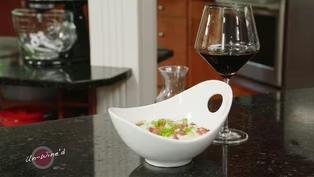
And Merlot is just this medium mellow, just a wonderful wine that goes so well with so many things, including potato soup.
And the thing that really makes this one work is the combination of the bacon and the cheddar with the soup, along with just a little green onion.
So we're going to get some potatoes ready.
Now, these are just a russet baking potato.
And when you get them ready for the oven, what you wanna do is just give them a little stab.
What happens is if you don't stick the potatoes to allow that air to escape, the potato will blow up in your oven and you sure don't want that to happen.
So I'm just gonna take normally six big roasting potatoes but I couldn't find big ones, so I had to buy a bag of smaller ones.
So I've got here about eight smaller potatoes.
And I'm just gonna stick these in a 450 degree oven until they're tender, nice and tender, and I can then just scoop them out of their shells.
So I'm gonna pop these in the oven and I'll be right back to make that soup.
So we have our potatoes all roasted.
And what I wanna do is just cut those in two and then I'm gonna take a spoon and just scoop out everything that I can get out from the skin and just put it over into a blender.
Now, I don't know about you, but in my household when I was growing up, we were definitely a chunky potato soup family.
And I think people come in chunky potato soup and creamy potato soup varietals.
Same thing with mashed potatoes.
Do you mash them or do you whip them?
Well, I like mine whipped.
Sometimes I like them mashed.
But when I grew up, they were always mashed so they were always chunky.
Well, I tend to really like my soups creamy now.
So I'm going to put this in a blender.
If you don't like a creamy soup, don't feel like you have to put it in a blender.
Just mash it with a potato masher and it'll be just great.
But for me, this is the way I like it.
And if you get a little bit of the skin in, don't be alarmed.
It's not going to hurt the soup and actually it will add to the flavor.
I just didn't want it all stringy since I'm making a cream soup.
All right.
And there I got a little bit in.
That doesn't bother me at all.
So we'll just get all of these in.
And the great thing about a potato soup is you can add onion to it, you can add celery, you can add all sorts of things.
My mother used to add turnips sometimes.
It depended on what she had in her pantry.
So just make it accordingly.
I also love potato and carrot soup, and of course I love potato broccoli.
Now, before I get all the potatoes in, I want to add two tablespoons of butter.
And I'm adding that now because I want it to start melting throughout.
For me, when I was a kid, potato soup was definitely a snow day kind of thing.
My mom would always have vegetable soup or potato soup for us when we got home from school if it had been snowing or when we got up, and then we had lunch together if we were home all day.
And that was always our favorite thing to have on those snow days.
Now when you think about pairing soups with wine, wine is really easy to pair with soups.
It depends on what kind of flavor profile you have.
So if you've got a Petit Manseng that you're working with, you might wanna have something with a little bit of ginger root in it, like a carrot or a butternut squash soup.
Just a little bit of ginger root will really bring out that Petit Manseng flavor.
But for a Merlot, I absolutely love to do a cream of potato or even a vegetable soup.
It's great with that.
And a vegetable beef as well.
Okay, so let's season this with a little salt and pepper.
I'm gonna use about three quarters teaspoon of salt and about a half teaspoon of pepper.
Or you can use about half and half.
I always like to mix mine so I tend to put in three quarters teaspoon of salt and three quarters teaspoon of pepper simply because I like a little bit of extra spice.
And then I want to add some cheese.
This is about a cup of sharp cheddar cheese and one cup of milk.
Now let's just blend.
If you start to get stuck just stir it down and you can always add more milk.
If your potatoes happen to be really mealy, you might need to add a little more liquid.
Now, my potatoes tend to be a little bit dry today so I'm going to add about another half cup of milk.
So let's take a little of this delicious soup.
Woo.
It's nice and thick, rich.
We're gonna put that in our bowl.
If you like thinner soup, just thin it out a little bit more with a little more milk.
But I like mine really, really thick.
I like it to be almost like mashed potatoes.
I think when I grew up, my mom always made it so that it was really, really thin.
And when I had the chance to do my own, I liked making it a little bit thicker.
So I'm gonna take some bacon bits, just some nice bacon that I crisped up and chopped up.
And then a little bit of green onion.
And I wanna make sure that I get some of those greens in there because that's gonna add all the color.
You have all the flavor but then you also have that beautiful color.
Let's just top that off.
All right.
Now let me grab my wine and we'll give it a try.
So Merlot is a wonderful wine.
It's medium in acidity, it's medium in tannin, medium in body.
It's just a medium, mellow wine.
It goes so well with potato soup.
It's also really great with vegetarian dishes and with lighter meats.
So let's give this a try.
>>Mm, mm-hmm.
So good.
It takes me back to my childhood.
And with the wine.
Oh yeah.
So next time you have potato soup, give this one a try.
So I hope you've enjoyed your time today with us here in the kitchen and at Stone Mountain.
I love pairing up Deanna's wines, including the chardonnay, this Merlot, and this port with chocolate bread pudding, a delicious potato soup, and this wonderful recipe for an upscale chicken cordon bleu.
So for all of these recipes and a whole lot more, you can find me on vpm.org/unwined.
And until next time, I'm Tassie Pippert saying go grab that glass.
It's time to unwind.
>>Production funding for Un-Wine'd was made possible in part by.
>>The Virginia Wine Board, promoting the interests of vineyards and wineries in the commonwealth through research, education, and marketing.
There's a movement growing in Virginia's vineyards.
Discover more at virginiawine.org >>And by.
(laid back music) (light music)
Video has Closed Captions
Clip: S5 Ep4 | 7m 12s | Tassie pairs merlot with baked potato soup. (7m 12s)
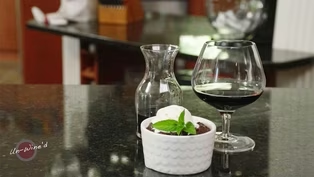
Chocolate macadamia nut bread pudding
Video has Closed Captions
Clip: S5 Ep4 | 8m 32s | Tassie pairs a Port style wine with Chocolate Macadamia Nut Bread Pudding. (8m 32s)
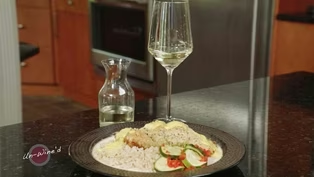
Prepare an upscale cordon bleu dish
Video has Closed Captions
Clip: S5 Ep4 | 10m 48s | Tassie pairs a Stone Mountain Chardonnay with an upscale cordon bleu. (10m 48s)
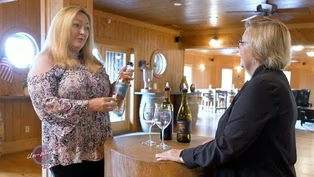
Stone Mountain Interview: Deanna Gephart
Video has Closed Captions
Clip: S5 Ep4 | 6m 7s | Tassie visits Stone Mountain Vineyards and interviews owner and winemaker Deanna Gephart. (6m 7s)
Providing Support for PBS.org
Learn Moreabout PBS online sponsorship






Support for PBS provided by:
Un-Wine'd is a local public television program presented by VPM