
Stoneville Ep. 4
Season 6 Episode 604 | 28m 35sVideo has Closed Captions
A Tolkien family embroidery sampler, vintage collectibles, and a classic Rolls Royce.
This week’s guests bring a 1794 embroidery sampler from an ancestor of J.R.R. Tolkien, a bayonet from the Spanish-American War, Chinese Cloisonné vases, and more. Our appraisers travel in style in a vintage Rolls Royce, and we learn about the history of Greenville’s Hebrew Union Congregation.
Problems playing video? | Closed Captioning Feedback
Problems playing video? | Closed Captioning Feedback
Mississippi Antique Showcase is a local public television program presented by MPB
Stoneville Ep. 4
Season 6 Episode 604 | 28m 35sVideo has Closed Captions
This week’s guests bring a 1794 embroidery sampler from an ancestor of J.R.R. Tolkien, a bayonet from the Spanish-American War, Chinese Cloisonné vases, and more. Our appraisers travel in style in a vintage Rolls Royce, and we learn about the history of Greenville’s Hebrew Union Congregation.
Problems playing video? | Closed Captioning Feedback
Where to Watch Mississippi Antique Showcase
Mississippi Antique Showcase is available to stream on pbs.org and the PBS app.
Providing Support for PBS.org
Learn Moreabout PBS online sponsorshipWelcome to the Mississippi Antique Showcase, where our expert appraisers take a closer look at your rare finds, family heirlooms and quirky collectibles.
We'll uncover the stories behind these unique treasures and of course find out what they might be worth.
Well Bea, can you tell us what you brought us today?
I brought you the sampler of Maria Tolkien from 1794 and she was 11 years old.
And I collect samplers.
I have quite a few, but she is my prized possession.
Yeah, let me tell you, this is a really good one.
All the work in this thing is all embroidery.
It's all with the needle.
And it's just extraordinary and the work in it and I have no doubt that that is the actual age of it too, 1794.
And where did you acquire it?
I got it on eBay.
On eBay?
Yes.
And if you don't mind me asking, what did you pay for it?
I paid $3,900 for it.
Okay.
Now, we have auctioned, and we have sold some, and I often wonder, you know, they pay such extraordinary prices.
I just wonder, what are they going to do with them?
But this one is one that if you were going to invest in something like this, I think this is the right one.
I like this one.
I like it.
and there's no damage on it.
And but and it has a story.
It tells a story.
Would you tell us all all that you know about it?
I'm sure you've researched it.
Yes, I did.
Because as soon as I saw the name Maria Tolkin, you know, little bells went off.
Maria was J.R.
Tolkien's cousin, three times removed.
OK.
Don't exactly know what that means.
Anybody in genealogy would know.
So, yeah, so she is one of the cousins of, great, great, great cousins of J.R.
Tolkien.
She's beautiful.
And the country scene also makes me wonder where, you know, she would have found that, you know, to stitch that because it's quite, quite picturesque, you know, with the cow and the ducks on the pond and the church and then two houses leading to each other with a pass.
So I always wonder where the inspiration of that came from for her.
Yeah, I would have to say that this one, that you made a wise investment.
I'd have to say this one is worth from 5 to 7 thousand somewhere in there.
If we had it, we had it in one of our highly advertised auctions.
We have sold, we sold a sampler one time for 22 thousand.
I think you've made a wise decision in doing this.
Great.
And I think you keep it for a long time.
And I will.
It'll go up in value.
And plus, the kids at least now have proof that their mother isn't off the rocker buying these.
OK.
Well, all right.
Listen, we appreciate you bringing it down to us today.
I really appreciate your help.
Thank you, sir.
♪♪ Hey, we are here with Linda Triplett and we're excited she's here.
She's brought a beautiful piece and we're gonna let her tell you about it.
And so Linda, why don't you tell us about the piece?
Tell them where you're from and tell them about the piece.
So let's have a conversation.
Well, I am currently from Jackson, but I grew up in New Orleans and I grew up in a family surrounded by antiques because my grandparents had two antique stores on Royal Street in New Orleans And they specialized in French antiques.
So this was one of the pieces that was in the home.
Didn't really get to my attention until I had it in my house and I started looking at it and I thought, I wonder what this is.
You know, at one point I thought, is this some original document?
And then I looked at it more closely and I thought, no.
And I looked it up and it appears to be an engraving, a print from an engraving, which I heard was popular back in the 1800s.
So I do I do really like the print.
I think it's a beautiful print, regardless of whether it has any value or not.
It has value to me.
That's right.
That's right.
Well, we have sold we have actually at our auction has sold a lot of prints like this.
You know, we a lot of a lot of ones we have sold have come like a little small frame.
I don't know if you've seen those like you have a small book prints.
We sold a lot of those and people still buy them and they decorate with them and they're really neat pieces.
And so I think we're looking at the 1800s is when these prints were still done, so they're still old, they're still antique, and so they're still neat pieces to have.
I think they're still great value.
And look, I was looking at the frame.
I know we didn't really see the back of it.
The Old Wood Frame is definitely got the age on it.
I'm sure the frame is a lot newer than the actual picture, but it's still an older frame too.
So that makes it a beautiful piece.
I was studying the piece.
I think that looking at values, it kind of varies because it is a print.
So it's not nearly as valuable if it was not being a print, if it was actually something original.
Yeah, original painting or something like that would definitely bring more money.
But even as a print though, you've still got a value of, I feel like, $50 to $75 or so, just in the decorative side of it.
Thank you for showing up today and bringing an awesome piece and sharing it with us on the show.
We're here with Jonnie Patterson.
Jonnie made the trip all the way to the Delta from Liberty.
Yes, that's right.
South Mississippi.
Southwest Mississippi.
You may be one of the longest travelers to come to this Antiques Showcase.
I'm not sure, but that's a long way.
Yes.
But Jonnie is a longtime MPB supporter, former member of the Friends of Mississippi Public Broadcasting, a support group from back a few years back.
Tell us about friends, Jonnnie.
With friends, I had the opportunity to meet various people.
I loved doing the time when we actually sit at a round table and just waited for the telephone to ring.
Took down the information and that way I was able to talk with people that from various parts of not just Mississippi but in other states as well that were listeners of public radio and/or watches of educational TV.
Tell me, Jonnie, what is it about Mississippi Public Broadcasting and public broadcasting in general that you feel is important for your long-time support?
It's very educational, and I think that is one of the key things that drew me in.
As a child watching Romper Room, all of those different educational shows.
At the time, in Bude, Mississippi, I lived in Liberty, growing up in Liberty.
So it was those type of programs that educated me.
Although some of them were elementary, but I'm in middle school, but it still helped me to extend my skills in communication, reading.
So that's what started it.
As an adult, my children was introduced to educational TV for that same reason.
I wanted to do something more.
And with being a volunteer, that helped me initially support.
Then when the funds increased, the income increased, I was able to support it financially and still doing so because I love the gifts because I like to display them.
So everybody knows, ETV, MPB, they know what I do.
Well, thank you so much for your long-time support and your years of volunteering with friends.
And good luck with your Archie football.
Alrighty, thank you.
Here's a little bit more about the Mississippi Delta.
Hello everyone, I'm Richard Dattel, and I'm president of Hebrew Union Congregation in Greenville, Mississippi.
The first immigrants here were Germans, they were Jewish, and they assimilated rather fast.
Greenville Society and politics, meaning government.
So the first mayor of Greenville in 1875 was Leopold Wysenski.
The fourth mayor of Greenville is the man down here, Jacob Alexander.
He was the fourth mayor, the second Jewish mayor, and his great-grandson is a member of our congregation today.
In 1880, when this was chartered, there were about 2,000 people in Greenville.
Of the 2000, 10% of the population was Jewish.
It grew until the 1960s when there were 200 Jewish families, and it was the largest in the state of Mississippi.
There were 26 Jewish merchants on seven blocks.
This particular torah we call the Holocaust either Czech torah or Czechoslovakian torah.
It was stolen by the Nazis during World War II from the town of Milevsko, Czechoslovakia.
So after it was stolen by the Nazis and then of course we won the war, the Westminster Gallery in London found 1600 torahs, reworked them, and then sent them all over the world.
We were lucky enough to get this particular torah in 1990 with one condition.
If a Jewish community in Milevsko, Czechoslovakia.
ever comes back, we will give that torah back.
The significance to where it is open to, it's open to the Ten Commandments.
This particular torah is 400 years old.
The room you're in now is our sanctuary.
It's the new sanctuary.
It was built in 1906.
Everything you see is original except for the seating.
The stained glass windows, people ask me from any of the torahists that come through here, that asked me who made the windows.
They were made in St.
Louis, Missouri by a company called Jacobi and Sons that specialized in making stained glass windows for churches and synagogues.
And if you notice too, the stained glass windows, each particular stained glass has a particular theme to it.
Like over here you've got the 12 blocks, which signify the 12 blocks of Israel, the Star David, so forth.
The other thing that's really important in this room is the pipe organ above me.
It was built in 1896, a company in Louisville, Kentucky.
And we are very happy for anyone to enjoy what we do have here.
Thanks for your time, Richard.
Now let's get back to the showcase.
Well, tell us a little bit about what you brought into the showcase today.
Okay, I'll tell you what I know.
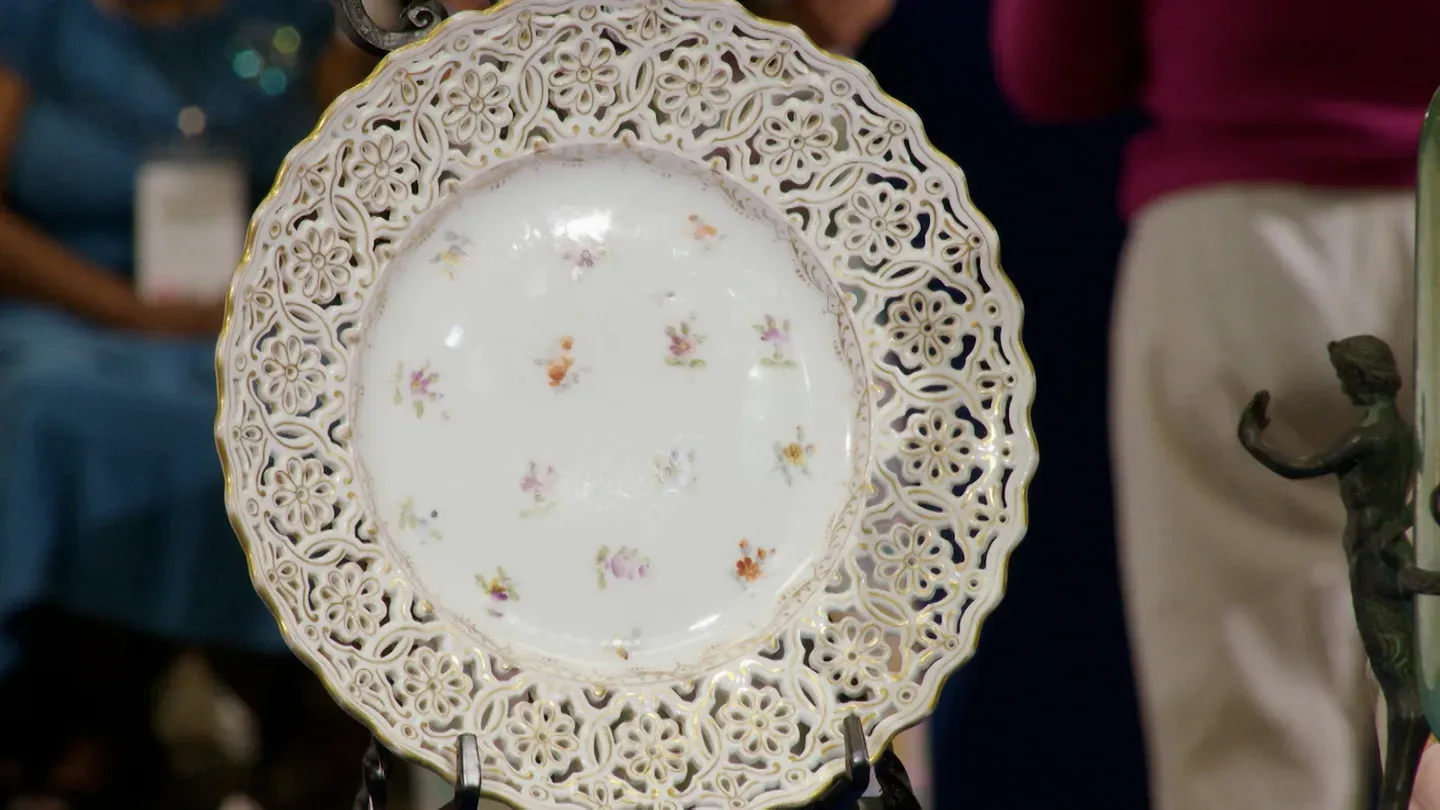
This piece, my daughter and I, are avid estate sale goers, and we go almost every weekend somewhere and she picked this up and it's a Dresden plate.
And I have seen Dresden exhibits and I know that Dresden is a good word.
So I kind of clung to that.
Sure.
The green piece, a neighbor of mine moved away and she had an estate sale and I bought this and two serving bowls for $25.
And then after having it for a while, and then we got Google.
And so Google said that it was something.
So, you know.
So, this first object is gorgeous, and I know why you've held on to it.
It's an Art Nouveau style, at least, or Art Nouveau green art glass vessel.
And it's in a figural metal stand, a cast metal.
It could be spelter, so it's not something as high as brass, but this was pretty typical of the Art Nouveau style.
It's a gorgeous piece of glass.
You've got some speckling in the glass, and I think you even have some dimpling in the glass that's over on this side, which is an interesting art-blown effect.
Sometimes you see it in a larger motif throughout the glass, but either way, you can tell that This was made specifically for this stand and/or vice versa.
So you really have a very attractive decorative Art Nouveau style figural decorative arts piece.
So do you have any idea what it's worth?
And I think there are a lot of collector bases for Art Nouveau decorative arts and there really are, or in the style of Art Nouveau.
And so I think at a well-priced auction and well-advertised auction where you had some Art Nouveau collectors, I think you could probably get somewhere between $600 to $900 for this.
Wow!
Great.
So I think it's a great ROI, return on your investment.
It'd be hard to part with it, but... Right, and I don't think I would either.
I just, I really do enjoy seeing this and you do have a great piece.
Thank you.
So let's jump now to your Dresden porcelain plate.
You were correct.
I think you had a story about you learned some Dresden from a Mississippi museum or about Dresden rather.
After I retired, I did a lot of volunteer work and I volunteered at the art museum in Jackson for all of the torahs, the great torahs that they gave, the Russian exhibit, the Dresden exhibit and one of the things that was so gorgeous was the Dresden porcelain and it was just, it was magnificent.
You probably saw some of the best Dresden there is in the collection.
It probably is special to say, "Why, I have a piece of that."
So this is a plate, a Dresden plate.
I think you've got a very pretty piece.
And I can also turn around and show the audience that we do have several markers.
And so you can see that it is stamped Dresden in Germany.
And then you have a production mark down here as well with a production number.
And so that's always interesting to see because we always look for marks to confirm.
And I can confirm this is the mark of Dresden.
So you've got the real deal here.
Question is, you know, what do you put value on?
Do you have any idea?
I do not.
Well, I mean for this, I think you're looking at a 20th century Dresden, so it's not like we're talking about, you know, a true antique antique where you're talking about 19th century.
I still think you're looking at, just for this plate in a well advertised priced auction, if you have other porcelain, you're probably looking at $150 to $300 for the plate.
I do think if it would have come in multiples, clearly that's going to be a benefit to a potential collector, especially if someone has the same decorative pattern or use pattern.
But I will say this, for whatever reason I'm seeing in the auction market, porcelain is just down generally.
Paris porcelain, different types of European porcelain.
So maybe I could give it, if the tides change, a different valuation.
But for now, I think that's a pretty fair estimate.
I don't think she would be willing to part with it just yet because she still loves it.
I completely understand.
We'll hang on and wait.
Yes, absolutely.
But it is a very pretty porcelain.
Thank you.
Thank you for bringing it in.
Thank you very much.
We've got Meredith and Margaret Allen with us today from Greenwood.
And Meredith and Margaret have brought us a neat bayonet from the Spanish-American War era.
How did y'all come by this piece?
So I don't know, really know that much about it.
It came out of my father's gun case 40, 50 years ago.
And when we signed up to come over here, I started looking in my gun closet for different things.
And this was hanging up in there.
And so I said, well, it's interesting.
I don't know that much about it except that it came out of my father's gun case.
And now it's been in my gun case all this time.
So I thought we'd bring it over here and learn something about it.
Do you think some of your ancestors might have fought in the Spanish-American War?
I'm assuming my great-great-granddad either did or knew somebody that did or got it from somebody that did.
Yeah, you know this bayonet, which is a US Model 1897, was a bayonet that was used on the 3040 Krieg rifle.
Right.
And a neat rifle, I just recently sold two of them.
I love the magazines on them, they fold out.
And I actually deer hunted with one of those guns.
- Really?
- Never killed a deer with it, but it was fun just to carry it.
- Wow.
- Because, you know, I was thinking this gun probably, you know, went off to Cuba and was in the Spanish American war, and probably was.
This piece here, the sheath, is something that you never, hardly ever see.
The one's that have the metal sheaths, you know that metal is pretty tough.
It might be a little rusty, but still hanging around.
The leather ones, you hardly ever see that.
I've probably had the bayonet before, but I don't think I've had the sheath.
Really.
Ok.
Do you have any idea about the value of it?
Oh, I don't have a clue.
Don't have a clue, huh?
Well, you know, I don't really know a lot of times if anybody has a clue.
I'm a big proponent of auctions.
I think if you advertise it like you're supposed to and get it before a crowd that knows what you're selling, then I think you're going to find out well what it's worth.
And I think this knife in today's market would probably bring somewhere between $300 and $400 in a well-advertised auction, which I think is a bargain for something that might have been on San Juan Hill with Teddy Roosevelt and the Rough Riders.
Maybe Teddy Roosevelt dropped it.
And if you could find an old letter in your family there.
Yeah, I might have that letter.
Yeah, it said, "Great-grandpa found this bayonet.
He was right behind Roosevelt."
I appreciate you looking at it and telling us about it.
You know a lot more about it than I do.
Well, sometimes we do a little research, that helps.
Alright, well thank you.
Appreciate that.
All right, we're here with Richard Alcott from Greenville, Mississippi, who brought us two vases that I don't think he knows much about.
But Richard, please tell us which brought us two vases.
That's it.
Now, I was they've been in my family for generations.
I don't know the first thing about them.
I really don't know the provenance of them.
So you said they've been in your family for generations.
Tell me how long, how old do you think these are?
How long?
No idea.
They were around as long as I've been around and longer.
You know, they've been in the family for a long time.
So if I told you that they could possibly be from the 20s, would that check out?
Or the teens.
Somewhere in there?
Yeah.
Right.
Well, they, from what I can tell, and what this is, these are a pair, this is a pair of Chinese Cloisonne' dragon enamel vases, right?
So Cloisonne' is the technique of essentially applying enamel over copper.
So this is copper right here.
You see that?
Yeah.
So that's copper.
And then what we have is we have a little bit of damage right here where the enamel has flaked off and you can actually see the copper.
Well, that's why I was I was using it for a hammer when I was young.
Definitely do not use your Cloisonne' bases as hammers.
Please, everybody watching out there, no Cloisonne' vases as hammers.
So do you have any idea of value?
None.
None?
None.
You haven't looked them up at all?
I wouldn't know where to start.
So these can go way back as far as age.
Now an interesting thing about Chinese items is that they have copied their copies throughout history.
So you can find something that's a thousand years old that's now 200 years old and you can find that same item that might be two years old and sometimes it's hard to tell.
Now these we can pretty safely say are 20th century okay meaning that they're probably from the teens or the 20s could even be the 30s.
This paper label is kind of a tip-off a lot of times that was an import label what's left of this label you see that?
Yes.
So a lot of times you'll see those labels on there and they had some sort of writing.
It could also simply be a store label or something, but the red with the white background is something that we've seen a lot of.
This one doesn't have anything on the bottom, no marks other than old sticker residue right there, but that being said, based on the age and based on the condition, now in perfect condition, they would hold an auction estimate of $400 to $800 and be worth probably somewhere in the $600 plus premium range so $700, $800.
We would be looking at a replacement value of about $1,000 at auction for this age range.
In the current condition they're in, we couldn't assign them anywhere close to that.
If these were older, and you see this throughout history, but if these were older, we've seen these sell for ten, twenty, thirty thousand dollars, you know.
But these are very well done 20th century reproductions, you know, early 1900s to mid 1900s in there, and they're pretty cool.
I'm sorry to see the damage John, but I thank you so much for bringing them in.
It's a great story, too, about using them as a hammer.
But we appreciate you bringing them in.
We appreciate you supporting MPB.
Sure.
Yeah.
Thanks so much for coming down.
Thanks a million.
Good to see you.
We're here with Taiwo Gaynor, who is chief content officer with Mississippi Public Broadcasting.
which means Taiwo has a lot to do with the production of Mississippi Antique Showcase.
What all does that involve?
Well, it's not hands-on production, thank goodness.
We have all of the professionals out here that are working on the show.
For me, it's just kind of putting out fires, really, helping support the foundation who's putting this event on by making sure that people are seated, guests know where they need to be, and then also, you know, kind of jumping in wherever I need to with production.
If they need me to bring some sodas over or grab some extra plates, you know.
Yes, that's the easy stuff.
I'm guessing the hard stuff.
I notice there are a couple of big trucks here, so to bring the gear that we need for something like this has to be a major undertaking.
Yeah, it is.
I mean, there's a lot of pre-production planning that goes into this.
It's once in advance, you know, the kind of coordinating equipment with the technical services division of our agency, working with the foundation for the event aspects of it, and then production is making sure we have all of the pieces that we need for all of the different aspects of production.
So we have multiple sets.
We have this set where you're conducting interviews with important people.
And then there are a bunch of packages that we're filming around the area.
So every town that we go to, we want to not just focus on the event, but we want to focus on the community that we're filming this event in.
So highlighting different businesses and places that are significant like museums and places that are important to this community.
And that's what we're all about.
We've been to Natchez, Jackson, Oxford, Biloxi.
Biloxi.
Yeah, that's right.
And now we're in Leland or Stoneville.
Yeah.
But Taiwo also was the director and executive producer of something we're very proud of at MPB, Everlasting, the Medgar Evers story.
Tell me a little bit about the background of that.
And briefly, I know we've been real fortunate to get some recognition already.
Yeah.
And hopefully more.
Yeah, absolutely.
It has been very well received.
It's been newly distributed nationally across multiple public television stations.
Last count I got was about 277.
And so that's very far reached on a national level.
It's won a couple of awards.
It's won a Mississippi Historical Society Award for Excellence in History.
It's also won a Mississippi Association for Broadcasters Award.
It's been nominated for a Southeast Regional Emmy.
So we're proud of that.
These are Mississippi stories that are being recognized regionally and nationally.
Thank you for your hard work.
Thank you.
♪♪ My name is Dan McCaskill.
I'm a long-time resident of Leland.
Matter of fact, I've lived there all my life.
My connection with the car is, first, it was donated by Nan Parker.
It's a Rolls Royce Silver Spur 1983 model.
Her desire is to have the car sold, and whatever proceeds we get will go to finance the Leland Military Wall of Honor.
It's low mileage, hasn't been driven much, so it's in real good condition.
That's a nice car, I know it's going to ride smooth.
Y'all, we've seen a lot of awesome things, but here we are in Stoneville, Mississippi with a 1983 Rolls Royce Silver Spur.
Look at this thing.
I need this car.
I need it as a mayor's car in Aberdeen.
But I'd really like to have bulletproof glass put in it.
Alright, well if you get this car and put bulletproof glass in it, I'll drive.
Good deal.
Gentlemen, get in.
I'm driving.
♪♪ Join us next time on Mississippi Antique Showcase and find out if you've got a hidden treasure tucked away in your closet.
♪♪













Support for PBS provided by:
Mississippi Antique Showcase is a local public television program presented by MPB