This Is Minnesota Orchestra
Storgårds Conducts Tchaikovsky No. 6
Season 8 Episode 3 | 2h 1m 49sVideo has Closed Captions
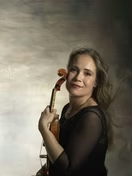
John Storgårds conducts Tchaikovsky's 6th and John Adam's Violin Concerto with Leila Josefowicz.
Soloist Leila Josefowicz joins the Minnesota Orchestra to perform John Adam's Violin Concerto. Chief conductor of the BBC Philharmonic John Storgårds conducts this introspective and emotional program ending with Tchaikovsky's Symphony No. 6.
Problems playing video? | Closed Captioning Feedback
Problems playing video? | Closed Captioning Feedback
This Is Minnesota Orchestra is a local public television program presented by Twin Cities PBS
This Is Minnesota Orchestra
Storgårds Conducts Tchaikovsky No. 6
Season 8 Episode 3 | 2h 1m 49sVideo has Closed Captions
Soloist Leila Josefowicz joins the Minnesota Orchestra to perform John Adam's Violin Concerto. Chief conductor of the BBC Philharmonic John Storgårds conducts this introspective and emotional program ending with Tchaikovsky's Symphony No. 6.
Problems playing video? | Closed Captioning Feedback
Where to Watch This Is Minnesota Orchestra
This Is Minnesota Orchestra is available to stream on pbs.org and the PBS app.
Providing Support for PBS.org
Learn Moreabout PBS online sponsorship(bright orchestral music) - Feel the power of music as it captivates and connects us.
- Music is love.
(bright orchestral music) Music is passion.
- [Sarah] Music belongs to everyone.
(dramatic orchestral music) This is Minnesota Orchestra.
Good evening.
Welcome to Orchestra Hall in Minneapolis.
I'm Sarah Hicks, principal conductor of Live at Orchestra Hall, and here tonight is your host for "This is Minnesota Orchestra."
The first half of our program tonight features works from two American composers distinct in their musical voices.
First we hear from a musical modernist author and inventor, George Antheil, who drew his inspiration for McKonkey's Ferry Overture from Emanuel Leutze's famous painting of George Washington, crossing the Delaware.
Then violinist Leila Josefowicz joins us for John Adams violin concerto, a work with a spinning and singing endless melody.
Our evening concludes with the turbulent emotions of Tchaikovsky's romantic masterpiece.
His symphony number six, Pathétique, a work entwined with the mystery of Tchaikovsky's death.
The Minnesota Orchestra will be led by conductor John Storgårds.
We are so glad you're here with us.
Let's welcome our concertmaster for the evening.
Susie Park.
(audience applauding) (contemplative orchestral music) (audience applauding) (dramatic orchestral music) (atmospheric orchestral music) (atmospheric orchestral music continues) (rhythmic orchestral music) (rhythmic orchestral music continues) (rhythmic orchestral music continues) (rhythmic orchestral music continues) (rhythmic orchestral music continues) (triumphant orchestral music) (triumphant orchestral music continues) (triumphant orchestral music continues) (triumphant orchestral music continues) (atmospheric orchestral music) (atmospheric orchestral music continues) (atmospheric orchestral music continues) (dramatic orchestral music) (dramatic orchestral music continues) (dramatic orchestral music continues) (audience applauding) - [Sarah] The Minnesota Orchestra led by John Storgards and McKonkey's Ferry Overture by George Antheil.
A man of diverse talents who among other things, co-developed a frequency-hopping radio guidance system that laid the foundational technology for Wi-Fi and GPS.
Equally inventive, though, more in a strictly musical sense, John Adams has developed an instantly recognizable musical voice, fusing minimalist techniques and lush orchestral textures.
John Adams composed his violin concerto for the late former Minnesota Orchestra concertmaster, Jorja Fleezanis, and premiered by the orchestra in 1994.
When he began work on the concerto, Adams knew he would need to move away from his usual mass sonorities and turned his focus to melody.
As Adams describes, the violin concerto emerged as an almost implacably melodic piece.
The violin spins one long phrase after another without stop for nearly the full piece.
Violinist Leila Josefowicz has long been a champion of this work, having taken it up early in her career.
She's performed at countless times, including a recording with the St.
Louis Symphony.
Guest conductor John Storgards' affinity for complex violin writing comes as no surprise given his dual career as both conductor and violinist.
While Storgards frequently incorporates solo performances into his conducting engagements tonight his work is strictly on the podium.
The concerto unfolds in three movements, starting with an extended rhapsody for violin over rising figures in the orchestra.
The atmospheric chaconne takes this traditional musical form and transfigures its frame and modality while the solo violin floats through orchestral textures.
The work concludes with a tour de force finale that is equal parts of virtuosic showcase and surging rhythmic power.
Leila Josefowicz and John Storgards take the stage now to perform Adam's violin concerto.
(gentle violin music) (audience applauding) (introspective orchestral music) (introspective orchestral music continues) (introspective orchestral music continues) (introspective orchestral music continues) (introspective orchestral music continues) (introspective orchestral music continues) (restless orchestral music) (restless orchestral music continues) (restless orchestral music continues) (restless orchestral music continues) (restless orchestral music continues) (restless orchestral music continues) (restless orchestral music continues) (restless orchestral music continues) (restless orchestral music continues) (restless orchestral music continues) (restless orchestral music continues) (restless orchestral music continues) (restless orchestral music continues) (intricate orchestral music) (intricate orchestral music continues) (intricate orchestral music continues) (intricate orchestral music continues) (intricate orchestral music continues) (intricate orchestral music continues) (intricate orchestral music continues) (intricate orchestral music continues) (intricate orchestral music continues) (intricate orchestral music continues) (intricate orchestral music continues) (intricate orchestral music continues) (intricate orchestral music continues) (intricate orchestral music continues) (intricate orchestral music continues) (intricate orchestral music continues) (intricate orchestral music continues) (intricate orchestral music continues) (intricate orchestral music continues) (intricate orchestral music continues) (intricate orchestral music continues) (frantic orchestral music) (frantic orchestral music continues) (frantic orchestral music continues) (frantic orchestral music continues) (frantic orchestral music continues) (frantic orchestral music continues) (frantic orchestral music continues) (frantic orchestral music continues) (frantic orchestral music continues) (frantic orchestral music continues) (frantic orchestral music continues) (frantic orchestral music continues) (audience applauding and cheering) (audience applauding and cheering continue) (audience applauding and cheering continue) An absolutely brilliant performance by Leila Josefowicz and the Minnesota Orchestra.
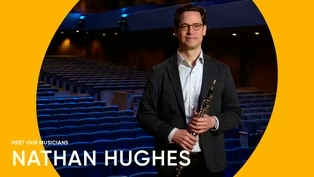
One of the amazing musicians who brings classical music to life here at Orchestra Hall is principal oboe Nathan Hughes.
Nathan will take center stage later this month for Richard Strauss's Concerto in D Major for oboe and small orchestra.
Enjoy this musician portrait of Nathan Hughes.
(gentle oboe playing) - [Nathan] Richard Strauss is one of my all time favorite composers.
(gentle oboe playing) His oboe concerto was written right at the end of his life.
It has these fluid melodies that just go on and on and on, and there are parts of this concerto which remind me of some of his operas.
The the acrobatic parts of the concerto sound like they're right out of "Ariadne auf Naxos."
And some of the sweet, beautiful, sensitive moments sound like they come out of "Der Rosenkavalier."
(gentle oboe playing) I'm Nathan Hughes, principal oboe of the Minnesota Orchestra.
Before coming to Minnesota, I was the principal oboist of the Seattle Symphony.
The orchestra's wonderful and they have a beautiful concert hall and coincidentally, the acoustician for that concert hall was the same as Orchestra Hall here in Minneapolis.
(lively orchestral music) After the Seattle Symphony, I was the principal oboist of the Metropolitan Opera.
(lively orchestral music) This was a very influential time for me and had a huge impact on my playing.
I think I learned how to be an effective communicator through opera.
Most music tells a story.
(lively orchestral music) Every musician at some point has to understand and learn how composers use sound to show different emotions and that's really part of the fun of playing music.
Trying to figure out what was the composer going for?
What story are they trying to tell?
Coming to play with this specific orchestra, which happens to be in my hometown and returning to symphonic music has been invigorating and gives me new things to look forward to every day.
The musicians here are extremely committed and the audience also is so appreciative - [Fei Xie] When we sit in an orchestra in this caliber, you want to be inspired and he's someone that oftentimes he plays something, I'm sitting there listening to it, and I forget to count my bars.
(stirring orchestral music) He's really one of the inspirations that we have in the orchestra and I think it helps to bring up everybody's level of playing.
(stirring orchestral music) - [Nathan] I grew up admiring this orchestra.
I remember coming to concerts when I was younger to come back and get to play in that place that you remembered inspiring you and was the beginning of your thoughts of becoming a musician is, it was very special.
(gentle music) I was born and raised in St.
Paul.
I am the youngest of four children.
There was a lot of music in my household growing up.
(gentle music) My dad played the bagpipe.
All my older siblings sang in choirs and they all played some instruments.
I dabbled a little bit in the violin when I was very young.
I was messing around with percussion 'cause my older brother was into that.
When I was seven years old, my parents dragged me kicking and screaming to audition for the Minnesota Boy Choir.
(gentle music) I was the youngest kid in that choir at that time, and I didn't know anybody and it was very intimidating.
But that quickly changed and I started to hear how beautiful sound can be.
I started realizing that you were achieving something that was sort of greater than yourself, and I found that really inspiring.
Just a couple years after joining the choir, I started taking piano lessons at the MacPhail Center for Music.
Piano for me was a way to deepen my appreciation for music.
When I was 13, my voice started to change.
I could tell my years in the choir were numbered.
I made this observation at some point that the range of the oboe happens to be exactly almost to the note, the same range as my voice was.
I said, okay, this is a way to continue to sing.
(lively oboe playing) When I was 14, my brother took me to Canterbury Downs, which is the horse race track near the Twin Cities.
(lively music) We did this thing called the pick-six.
You just pick the winner of the next six races and if you win it, you win the jackpot for the day.
So we know nothing about horses.
Random pick, all six horses won and we were just blown away.
We could not believe it.
The best part about this is that my brother, you know, he could see how much I was into music.
He could see how much I loved the oboe already, and so he used the money to buy me a great oboe.
(gentle orchestral music) Soon after starting the oboe, I joined the Greater Twin Cities Youth Symphonies.
I was in there for a couple of years, made wonderful friends, and I remember we went on tour and this is when this idea of a multicultural feeling in music started to sort of click with me.
Not only are we learning music by composers that are from all over the world, but we're also traveling all over the world with music.
It's an international language and that was something that really stuck with me.
(gentle orchestral music) I currently perform and teach at the Verbier Festival in Switzerland and at the Pacific Music Festival in Japan, and I try to travel whenever I can, just personally as well.
(lively music) When I was 16, I was accepted into the Lynn Conservatory of Music and this was a jumpstart to an intense musical environment for me.
The school is very small, it's very selective, and everybody who's accepted goes tuition-free.
This is a concept I can totally get behind.
(gentle orchestral music) After Lynn, I went to the Cleveland Institute of Music and then onto the Julliard School, and I worked with some of the best teachers I could ever ask for.
After Julliard, I started studying in the summer at the Marlboro Music Festival in school.
I still go to Marlboro to this day.
It's one of those places where you can go and fall back in love with music.
(choir singing in foreign language) My first project after being hired here in Minnesota was recording Mahler's third symphony.
I remember that week when we got here and I turned around and behind us was the Minnesota Boy Choir.
(choir singing in foreign language) There is a lovely part for a boy choir in the symphony and it's something that I actually sang when I was in the choir.
I feel very fortunate to have grown up in a place that offers so much for young musicians.
(water bubbling) and when you're playing an instrument, again, there's a lot of repetitive motion.
I think it's good to sort of work out the kinks and one thing I do when I exercise when I'm learning a piece is I like to sing the piece.
(singing) Right now, while I'm getting ready for the Strauss, I'm doing a lot of singing while I swim.
(water bubbling) There's something about getting the instrument out of your hand and just vocalizing it that helps me come up with a more natural interpretation for a piece.
(lively music) One of my favorite practice break activities is juggling.
I love it because I can't think about anything else when I'm doing it.
It gets me in a different place so I can restart when I come back to practicing.
(lively music) (Nathan laughs) - [Nathan's Friend] That was so fun.
- [Nathan] The composers use the oboe in a lot of different ways.
They often use us for extremely delicate, sensitive touching moments.
They also like to use us to portray barnyard animals quite often, so we have a little bit of everything in the orchestra.
(intricate orchestral music) One duty that we have as the principal oboe is tuning the orchestra.
The main reason for this is once the oboe player puts a reed into the instrument, we have the least amount of flexibility to change our pitch.
So where string players have tuning pegs and brass players have slides they can adjust and flute players can move a head joint in and out.
We have no mechanism for that on the oboe.
So if you wanna play at a different pitch level, you need to use a different reed or you need to make a trip to the reed desk.
(lively music) All oboists make their own reeds.
It's an extremely personal thing.
It's a craft that you have to hone over many, many, many years.
The end of the tip of an oboe reed is about half the thickness of a piece of paper.
And when we play a performance, we are articulating, we're hitting the end of the reed with our tongue, so reeds are short-lived.
I spend hours and hours and hours and hours doing it myself now, and I also spend hours and hours and hours doing this with my students.
(lively music) Teaching is a very meaningful part of my life.
I feel privileged to have a life in music and if there's a young person that would also like to have this path, I feel it's an honor to help them.
I think one of the things I love most about teaching is that you help the student grow their wings and then you kinda watched them fly.
- [Kate Wegener] Nathan was a very inspiring teacher.
I studied with him for six years at Julliard.
He just has this way of really zoning in and listening to what you're doing and like tailoring his advice so perfectly for the moment and what you need.
- [Nathan] I teach at two of my alma maters, the Julliard School and the Lynn Conservatory of Music.
I'm fortunate to work with some of the most gifted students.
Many of them go on to be leaders in the field.
By the time they're ready to graduate, many of them can gimme a run for my money.
I usually know when they are making reeds that I secretly want to steal, that's when I know they're ready to go.
(gentle orchestral music) I am constantly searching for ways to grow as a musician.
Music is something that can enrich people's life, and that is not only as a performer, but it's also as a listener.
This is something that's so important to protect and to pass on, and it's something that I can't imagine the world without.
- I'm looking forward to Nathan and many of his colleagues in the woodwind section taking their solo turns in our next piece.
Tchaikovsky's last masterpiece is symphony number six, "The Pathétique," has long been shrouded in both controversy and mystery.
A work of structural innovation and emotional intensity.
Its premiere under Tchaikovsky's baton was followed just nine days later by his surprising death.
Scholars and biographers over the years have puzzled over whether to consider this symphony as some sort of personal requiem, and whether Tchaikovsky took an accidental drink of cholera contaminated water, or if his homosexuality, considered a scandal in his time led to some sort of Socratic suicide.
Then there's the title itself.
"Pathétique," an adjective that in both Russian and French translates as impassioned and emotional.
Does it point to a programmatic component or tortured autobiographical subtext?
What speaks to the lasting impact of this work, however, is that even when completely disentangled from these consequential contexts, the music still speaks in a way that is intensely passionate, deeply human, and profoundly moving.
Its pure emotional impact transcends any individual's lived experience and speaks to us all.
John Storgards now leads the Minnesota Orchestra and Tchaikovsky's Symphony No.6, Pathétique.
(intricate orchestral music) (audience applauding) (somber orchestral music) (somber orchestral music continues) (somber orchestral music continues) (turbulent orchestral music) (turbulent orchestral music continues) (turbulent orchestral music continues) (turbulent orchestral music continues) (tender orchestral music) (tender orchestral music continues) (tender orchestral music continues) (tender orchestral music continues) (tender orchestral music continues) (tender orchestral music continues) (tender orchestral music continues) (tender orchestral music continues) (tender orchestral music continues) (tender orchestral music continues) (vigorous orchestral music) (vigorous orchestral music continues) (vigorous orchestral music continues) (vigorous orchestral music continues) (vigorous orchestral music continues) (vigorous orchestral music continues) (vigorous orchestral music continues) (brooding orchestral music) (graceful orchestral music) (graceful orchestral music continues) (graceful orchestral music continues) (graceful orchestral music continues) (graceful orchestral music continues) (graceful orchestral music continues) (graceful orchestral music continues) (elegant orchestral music) (elegant orchestral music continues) (elegant orchestral music continues) (elegant orchestral music continues) (elegant orchestral music continues) (elegant orchestral music continues) (elegant orchestral music continues) (elegant orchestral music continues) (elegant orchestral music continues) (elegant orchestral music continues) (elegant orchestral music continues) (elegant orchestral music continues) (elegant orchestral music continues) (energetic orchestral music) (energetic orchestral music continues) (energetic orchestral music continues) (energetic orchestral music continues) (energetic orchestral music continues) (energetic orchestral music continues) (energetic orchestral music continues) (energetic orchestral music continues) (energetic orchestral music continues) (energetic orchestral music continues) (energetic orchestral music continues) (energetic orchestral music continues) (energetic orchestral music continues) (energetic orchestral music continues) (energetic orchestral music continues) (somber orchestral music) (somber orchestral music continues) (somber orchestral music continues) (somber orchestral music continues) (somber orchestral music continues) (elegant orchestral music) (elegant orchestral music continues) (elegant orchestral music continues) (elegant orchestral music continues) (somber orchestral music) (somber orchestral music continues) (somber orchestral music continues) (incisive orchestral music) (incisive orchestral music continues) (incisive orchestral music continues) (somber orchestral music) (somber orchestral music continues) (somber orchestral music continues) (somber orchestral music continues) (somber orchestral music continues) (audience applauding) (audience cheering) (audience continue applauding and cheering) (audience continue applauding and cheering) (audience continue applauding and cheering) (audience continue applauding and cheering) (audience continue applauding and cheering) - [Sarah] "This is Minnesota Orchestra," is a partnership between Twin Cities PBS, YourClassical MPR, and the Minnesota Orchestra, one of the nation's preeminent ensembles.
Every year, tens of thousands of young people experience music at orchestra hall and audiences around the globe enjoy free access to digital concerts.
The Minnesota Orchestra now led by Thomas Søndergård has been bringing people together around music for generations.
More at minnesotaorchestra.org.
(audience applauding and cheering)
Video has Closed Captions
Clip: S8 Ep3 | 13m 20s | Minnesota Orchestra Principal Oboe Nathan Hughes began his training in the Twin Cities. (13m 20s)
Storgårds Conducts Tchaikovsky No. 6
Preview: S8 Ep3 | 30s | John Storgårds conducts Tchaikovsky's 6th and John Adam's Violin Concerto with Leila Josefowicz. (30s)
Providing Support for PBS.org
Learn Moreabout PBS online sponsorship
- Arts and Music

Art21 showcases today's contemporary visual artists and their groundbreaking creations.







 New Episode


Support for PBS provided by:
This Is Minnesota Orchestra is a local public television program presented by Twin Cities PBS