Columbus Neighborhoods
Stories From The 19th Century
Season 7 Episode 20 | 26m 46sVideo has Closed Captions
Look back at a few 19th century historical events that helped shape Central Ohio.
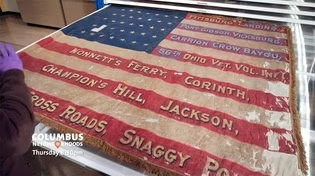
Throughout the 19th century, many events greatly impacted the entire nation. In this episode, we explore a few of those historical events that helped shape Central Ohio. We'll explore the Civil War battle flags at Ohio History Connection, early baseball history in Columbus and the origin of the Buckeye nickname.
Problems playing video? | Closed Captioning Feedback
Problems playing video? | Closed Captioning Feedback
Columbus Neighborhoods is a local public television program presented by WOSU
Columbus Neighborhoods
Stories From The 19th Century
Season 7 Episode 20 | 26m 46sVideo has Closed Captions
Throughout the 19th century, many events greatly impacted the entire nation. In this episode, we explore a few of those historical events that helped shape Central Ohio. We'll explore the Civil War battle flags at Ohio History Connection, early baseball history in Columbus and the origin of the Buckeye nickname.
Problems playing video? | Closed Captioning Feedback
How to Watch Columbus Neighborhoods
Columbus Neighborhoods is available to stream on pbs.org and the free PBS App, available on iPhone, Apple TV, Android TV, Android smartphones, Amazon Fire TV, Amazon Fire Tablet, Roku, Samsung Smart TV, and Vizio.
Providing Support for PBS.org
Learn Moreabout PBS online sponsorshipCertain historic events have not only impacted us as a nation, but have also defined us.
One of the most iconic events of the 19th century was the American Civil War, which took place from 1861 to 1865.
Ohio alone provided over 200 regiments, and each one of them carried their own distinctive flag.
Many of those flags have survived and are now at the Ohio History Connection.
We head over there now to take a look at their collection.
So, Ben, we're here at the Ohio History Connection, where you collect items from all different decades.
And we're actually in a gallery right now that has some Civil War memorabilia.
Can you tell me what I'm seeing here?
Yes, this gallery is called Follow the Flags.
It highlights our large collection of battle flags.
We have over 560 battle flags in our collection that range from the Mexican-American War all the way up to World War Two.
About 400 of those are from the Civil War.
So this gallery really highlights those battle flags.
What is a battle flag and what was it used for in the Civil War?
Each regiment in the Civil War would carry a battle flag.
They would have normally two flags, a national flag that look like the national flag of that time.
They also would carry a regimental flag, which would highlight their specific regiment.
There were about 200 regiments from Ohio during the Civil War.
It was an honor to be the flag bearer because you carry the flag.
And that actually allowed people in your regiment to see where they were supposed to go, follow bad orders, that sort of thing.
Now, I know you have some flags that we don't see on display in these cabinets.
Can you show them to me?
Yes, I definitely can.
All right.
Let's go it up.
Wow.
This is a beautiful flag.
I can't believe this is from the Civil War.
So what regiment was this from?
This actually was from the 44th Ohio Volunteer Infantry, the OVI.
They were formed in Springfield, Ohio.
Now, I know that these are all sort of connected to Ohio, but I see Virginia on that.
What does that mean?
Right.
These were the battle honors.
So after the battle, the people in the regiment would go back and add the different battles that they fought.
And so you see here the siege of Knoxville, surrender of the Cumberland Gap.
Lewisburg, Virginia.
These are all battles that this specific regiment served in.
And what are these made out of it looks like there's some paint, but it is.
Is it just fabric?
Yeah, actually, majority.
The flags are made of silk.
There's a couple of made of wool, but silk was more used widely at that time.
And then the battle honors were actually sewn on later on.
The flags were made by factories that produced these flags for the different regiments.
But actually the battle honors were added later on by members of the regiment.
Great.
Well, this is a gorgeous flag.
Do you have more to show me?
Yeah, I'm actually another one.
That is amazing.
The reds and the blues.
Mm hmm.
So which what flag is this from?
This is actually from the 56th, OVI, believe they were formed in Portsmouth, Ohio.
Again, you can see the different battles that they served in.
This is actually example of a national flag.
This flag was most likely made in New York.
You can tell by the the kind of square canton, the blue field there that indicates that it was made at a surplus station in New York.
So you said you knew that was in New York.
How do you know?
The flags were made in either one of three cities?
The majority the flags we have were made in Cincinnati, the second most that we have were made in Philadelphia.
And then we have several that were made in New York as well.
But there are certain things you can see on the national flags, the way that the the canton, the square there looks, that kind of is an indication of where it came from.
They just made in a certain way in each different city.
The regimental flag that you can tell, by the way, the stars are patterned where they came from.
Wonderful.
Can I see the next one?
Yeah.
Now, that's a lot of blue and that eagle.
You can see some of the definition.
I mean, was that just a matter of really well made embroidery or.
Yeah, actually, that's a good point.
This one actually features embroidery, which is a little different.
The other ones that indicate that this flag was made in Cincinnati.
That's the only city that used embroidery.
This is from the 12th, OVI.
They were formed in Cincinnati at Camp Denison.
Now, how have you been able to track, like kind of the history of these flags and where they came from?
Sure, yeah.
After the Civil War, each of these flags went back to the state of Ohio.
They were actually stored at the Ohio State House.
And whenever reunion groups would get together, Civil War union groups, they would actually come to the state house and they could check out their flag, kind of like a library, basically.
And so they didn't keep the best care of the flags or sometimes the flags weren't returned at all.
The in the 1960s, they actually decided they should try to take better care of them.
They removed him from the state house.
They actually glued them down.
They were glued to nylon with adhesive called polyvinyl alcohol.
And that helped keep them together.
Not the best way to preserve a flag, but that's what they did in the 1960s.
And then for many years, they actually hanged here in the main rotunda at the Ohio History Center.
They took them down in the 1980s and put them in storage and put a few out here on exhibit.
And so you talked about the adhesive.
I mean, what were the pros and cons on this end of history of using that?
It did help in some regards because a lot of the flags were very bad condition and very tattered.
And so gluing it down helped keep it together.
But over time, that glue can eat away at the silk and damage the flag.
We have these preserved.
They get sent off to a company that does all that.
They actually remove all that glue.
They have to soak these flags.
It gets the glue away.
They then add kind of a sheer fabric on on the front, in the back of the flags is called stable text.
And they sell the fabric around the edges of the flag.
And so that's a better method of preserving the flags.
That's really fascinating.
Well, this is another beautiful flag.
Can I see the next one?
Yeah.
Now, this is a little bit different.
I mean, it looks like a flag, but it looks almost like it's made from a different fabric than the other one.
Yeah, I believe this one is made of wool as well, so you can tell it's in a little bit better condition.
This one is actually from the 51st OVI.
Actually form in Dover, Ohio, at Camp Miggs.
And you can tell by the the kind of rectangular field there that this one was also made in Cincinnati.
So how is this flag being able to maintain its colors?
I would guess the material being made of wool helped it retain its colors a little better than some of the other ones.
Oh, that's interesting.
All right, well, can we see the next one, sure.
This is a little bit different.
This one actually has some stuff missing on it.
So what happened here?
Well, yeah, this a lot of this was very detailed work.
And so over time, that just chips away and falls off.
You can see this one has been glued on to the nylon.
So that's the nylon that you're seeing underneath there.
Can you tell me a little bit more about the background of this flag and where it came from?
Yes, this flag was carried by the 36th OVI.
They were formed in Marietta.
This shows some of the battles that they fought in some of the more famous battles or Antietam.
At the top there, it mentions Bull Run.
That would've been the second battle of Bull Run.
Wow.
This has got a rich history in it, doesn't it?
Yes.
And they can see a lot of these battles were later in the war, 1864.
So were these regiments where they all kind of formed at different times?
That's a good question.
Yeah.
Usually the regiments reforms and they only signed up for like three months.
A lot of people thought the Civil War wasn't going to last that long, so they would muster in it for about three months.
But once the war was continuing, they got people to sign up for another three years.
So that around 1864.
But even at that point, the war was still going on.
And so they had to convince a lot of this regiments, to then serve for another year.
In 1864, if you get half of your regiment to resign back up, then they would get veteran status and then you'd get all the veteran benefits.
So there were incentives to continue to fight in the war.
So tell me a little bit more about Ohio's role in the Civil War.
Were there battles fought here?
No, no major battles were fought in Ohio.
There was a minor skirmish in Buffington Island, which is down on the Ohio River.
But that was kind of the major one.
But Ohio did supply about 330,000 soldiers in the Civil War, which is the highest per capita of any any state in the union.
Well, can we see another one?
Sure.
Okay.
Here's another regimental flag.
This one is from the 35th Regiment, and they were formed in Hamilton, Ohio.
And this is the seal of the United States if you see a dollar bill.
Most people recognize that eagle.
It's holding an olive branch in one talon and arrows in the other.
The eagle is facing towards an olive branch because the US favors peace.
Even though these were used, of course, during.
During battles.
Can you tell me some of the ways you were at Ohio Street connection.
Try to preserve these the best way you can.
Well, we keep them in storage.
People love to see these battle flags, but the biggest thing that can damage the flags is, is light.
So having them out on exhibit over time can damage them.
So that's why in this gallery we actually rotate the flags that are only out for a certain amount of time and then we put new ones out.
So we're rotating them all the time.
There's humidity issues.
We try to keep it kind of a stable humidity level, temperature level, anything we can to help preserve these.
And by preservation, we're not trying to restore these flags to how they originally looked.
We just want to keep them how they are.
And hopefully they won't deteriorate any further.
That's wonderful.
Can I see another one?
Yeah.
This is a little flag.
Yeah, very tiny.
Right.
How is this one different than the rest?
This one's a little different.
You can tell.
This is called a guidance.
It's sort of like a pennant shaped flag.
This is actually used by a cavalry unit.
So soldiers on horseback trying to carry a large six by six battle flag would be difficult on horseback.
They kind of act like sails.
And what kind of a blow you around.
So this is the typical type of flag that was carried by a cavalry unit.
This one was actually used by the 13th Ohio Voluntary Cavalry, and they were formed in Warren County.
All right.
Well, I'd love to see something else.
This flag was carried by regiments from Cincinnati and they trained at Camp Dennison.
This one is actually from a battery that was part of the artillery.
This is the the first Ohio volunteer artillery unit.
So they were in charge of cannons, usually light artillery.
So kind of the smaller cannons that you could cart around easily or there weren't as many artillery units as infantry from Ohio, but this is one of the the batteries carried this flag.
So you've talked about a few different kinds of regiments.
How many different kinds of regiments were there in the Civil War?
Yeah, there was basically three types of regiments, the infantry, which was the majority.
That's the infantry soldier.
That's your your basic soldier.
And then you have cavalry units and those are on horseback, and then you have artillery, which is cannons.
Can I see another one?
Yeah.
It's missing something.
That's not in the best of shape.
This is from the 89th Regiment, which was also formed in Cincinnati.
They were actually in the Atlantic campaign serving in Georgia.
Somehow this flag got captured by a Confederate unit.
One of the members actually in 1880 went and somehow retrieved the flag from whoever had it.
In Georgia, this flag stayed in their family for generations.
Ultimately, that family donated the flag to the Daughters of the American Revolution, but they found out quickly that you can't actually own one of these flags.
These belong to the State of Ohio.
We actually don't know them ourselves.
We just we curate them, but they belong to the state.
And so they worked with us and and brought the flag here.
So how can people see these flags that are kind of in storage?
Do you have special events or anything?
We do often periodically have special events where we open up the cabinets and show people the flags and talk about them.
And there are several of the flags on on exhibit in this gallery at all times.
Well, that's amazing that you've been able to keep a hold of these.
So thank you so much for showing us these flags.
I hope people can come in and look at them for themselves because you really can't imagine what they look like until you actually see it.
So thank you for sharing that.
Sure.
Yeah, no problem.
Thank you.
During the American Civil War, many soldiers learned a new game from some of the New York City regiments.
When the war was over, these young men were eager to take that game back to their hometowns.
And in 1866, baseball clubs started springing up all over, including here in Columbus.
We checked in with local historian Joe Santry to tell us more.
The 1800s were really the beginning.
And baseball evolved.
Every year, the rules changed a little.
The players got better.
The ballparks got better.
This was what set up it becoming the national pastime.
It was the work of these early pioneers.
Baseball began around 1845 as a New York game.
It remained a regional pastime until the Civil War, when soldiers from all over embraced it as a way to kill time when they were in camp.
Every town formed a team.
Now, Columbus, the first team created was the Columbus Buckeyes, and they played the first recorded game on April 6th, 1866, at Parson's and Broad Street, which was the grounds of the Franklin County Insane Asylum.
And the first team beat the second team 95 to 44.
Six teams were organized that first year.
The names of some city leaders who played are recognizable today Chittenden, Neal, Denison and King, for instance.
People from all walks of life joined the teams.
One of the teams, the Capitals, had a young man named P.W..
P.W., his batted last, and he always played right field.
At the end of the season, he gets called into the manager's office, and we were imagining what it would be like.
P.W.
Thanks for coming out.
We had a lot of fun.
We hope you had fun, too, but don't quit your day job.
So he created a band.
His name was P.W.
Huntington.
Now, the guy who wore his bed at night has his name above the ballpark.
Columbus had six teams when the National League was formed in 1876.
But when they were trounced by a team from Cincinnati, they decided to consolidate so they could be more competitive.
Jimmy Williams organized the Columbus Buckeyes and all professional team.
In 1877, The Buckeyes played in a seven city league with teams in the United States and Canada that Williams created.
In 1883, Columbus made the big leagues and Williams secured a franchise for the Columbus Buckeyes.
When the American Association expanded from 6 to 8 teams.
For the first year, they didn't do really well.
But the second year they finished in second on that team was Eddie “Cannonball ” Morris.
He was the greatest left handed pitcher of the 1800s who was one of the very first pitchers to throw overhand.
He threw over handed and the umpire read the rulebook and he goes, Don't say you can't do it.
And when he stood on recreation parks, pitching square, he faced west.
And so when he threw the ball, it came out of the South.
One of the local sportswriters called him a “southpaw, ” and the name has stuck for every lefty ever since.
One of my very favorite people on the Buckeyes team, his name was Eddie “Dummy ” Dundon, which was sort of an irony.
They weren't really politically correct passing out the nicknames in the 1880s.
But the irony was, is he was actually the valedictorian of his school, the Ohio School for the Deaf and dumb.
Dumb meaning not that you weren't intelligent, but that you couldn't speak because you couldn't hear their true philosophy was to raise deaf children as closely as they could to hearing children.
Well, that included playing sports.
So they formed the very first Ohio High School baseball team.
Of course, there was nobody to play there.
No high school had a team.
So they played the colleges.
Ohio State, Ohio Wesleyan, and they got pretty good.
And they traveled the eastern United States, and they actually beat Major League teams.
Eddie was the first to play in the majors, but he had a problem.
When he would slide into second base, he couldn't hear if he was out or he was safe.
So he worked out some hand signals with the umpires.
They might go, you know, Whoa, Eddie, stop there.
You're all right.
Or Eddie, you're out.
Go back to the bench.
Well, he played for ten years and his teammates played for even longer.
Now they go, “you're safe ” and “you're out ” all because of their handicaps.
The 1883 and 84 Buckeyes.
We were arrested for playing baseball on Sunday.
There was a big, big meeting at City Hall, and on one side of the aisle were all the pro baseball people, and all the other ones were the pro blue law people.
And it was almost violent.
And finally, a very elderly man stood up.
His name was William Dressler of the Dressler Hotel fame.
And he stood up and goes, Gentlemen, this is ridiculous.
He goes, How about if the players agree not to play on Sunday?
We let him out of jail and we'll just forget the whole thing.
And they did.
But the problem was, is in 1884, everybody worked six days a week.
And Sunday was the only day they had free to go to a ballgame.
So the finances of the team went right in the dumper.
In 1896 through 1899.
Columbus played baseball in the Western League, a high minor league.
In ‘99.
There were hints that the National League was going to drop four teams and go back to an 18 league.
The man who ran the Western League was named Ban Johnson and he takes the Columbus team to Grand Rapids, Michigan, which is in the low minors and took the low minors Grand Rapids team and brought them to Columbus.
Well, this angered the Columbus fans.
In 1899, the National League had a message for four teams, You're out.
The Western League moved into those cities and was renamed the American League.
By 1901, it was considered a major league and that former Columbus team that was moved to Grand Rapids, they made one more move.
And today they're called the Cleveland Indians.
For as long as I can remember, being from Ohio was interchangeable with being a Buckeye.
But one viewer asked if the origin story about Ohioans first being called Buckeyes all the way back in the late 1700s is the actual story.
Now, I don't know about you, but I'm curious to find out.
WOSU's Curious Cbus answers your questions about our region, its history and its people.
Today, Ohioans wear the nickname Buckeye with pride.
But how did this strange nut become so beloved in the first place?
Well, it turns out that the origin story we've been told again and again for generations might just be a tall tale.
We asked historian Raymond Irwin to tell us more.
The nickname is Applied to Human Beings comes from an historian, Samuel Prescott Hildreth, who wrote a book in 1852 in which he claimed that the nickname comes from a early settler named Ebenezer Sproat, who was a colonel in the militia and led the procession at the first court in Washington County in September 1788.
From there, the story goes that some friendly indigenous peoples were there and shouted the name “hetuck ” at him, which the white settlers translated at the time as “big eye of the buck.
” Because Sproat was six foot four and well-built.
And the idea is that that nickname then became applied to other settlers in Marietta and then applied to people from Ohio.
From there on, the real story, though, is that Hildreth made up the story.
And we know this because “hetuck ” has no relationship to Buckeye.
And matter of fact, after some digging in the native languages, I discovered that that probably comes from the Lilliput word or Delaware word for “Hitukw, ” which just means tree.
And so at a dinner in 1792, the captain of Delaware Peoples, the Lilliput Peoples was commenting on Sproats size and he said, that guy basically is as big as a tree.
And that's probably where it came from.
The actual origins of the Buckeye nickname are much more complicated because in the early 19th century, the word Buckeye was an insult.
It meant fake or false or shoddy.
And it comes from the fact that the buckeye tree produces wood that is very poor quality.
Or at least they thought it was poor quality.
Eventually, though, the Buckeye becomes kind of rehabilitated in the first two decades of the 19th century, and the white settlers discover that Buckeye Wood is actually not a bad thing.
They start making spoons out of it and plates and things like that, and they discover certain medicinal qualities from the nut which indigenous peoples had known for a long time.
But the white settlers discovered kind of later on.
And so the name Buckeye then became applied to humans, we think, in the 18 teens and 1820s.
And it meant essentially a person from the West or someone from the frontier.
It wasn't initially applied to people from Ohio at all until we think the late 1820s, early 1830s.
And by 1833, Daniel Drake, who is a physician from Cincinnati, uses the term Buckeye to apply to people born in Ohio.
In the 1830s, there are several things that imbue certain positive characteristics.
For example, one of the gubernatorial candidates, Wilson Shannon, was the first candidate born in Ohio, 1802.
He used Buckeye as a campaign nickname.
Around the same time, there was the war between Michigan and Ohio over the strip of land that included Toledo.
And that was because the canals were projected to go up to Lake Erie.
And Michigan claimed it.
Ohio objected.
Governor Lucas sent militia.
Michigan sent its own militia.
And there was a war.
And Governor Lucas used the word Buckeye to be kind of like a battle cry that the Buckeyes would not be intimidated.
And then in 1836, William Henry Harrison used the Buckeye theme for his own presidential candidacy, which is successful four years later.
And in fact, in 1840, the Log Cabin campaign.
The Log Cabin is made of Buckeye Wood.
So you go from an insult in the 18 teens to something of immense pride in the 1830s.
A very quick turnaround for the Buckeye.
Do you have a question for curious cbus?
Head over to wosu.org/curious to submit your idea vote on which question we should investigate next and see what we've covered so far.
Thanks for being with us.
And remember, you can catch all of our episodes on Columbus Neighborhoods dot org.
Plus see our stories on the WOSU Mobile app.
And you can follow us on Facebook, Twitter and Instagram.
We'll see you back here next week on Columbus Neighborhoods.
<<Music>>
Stories From The 19th Century Preview
Video has Closed Captions
Preview: S7 Ep20 | 30s | Look back at a few 19th century historical events that helped shape Central Ohio. (30s)
Providing Support for PBS.org
Learn Moreabout PBS online sponsorship











Support for PBS provided by:
Columbus Neighborhoods is a local public television program presented by WOSU