Bower School of Music & the Arts
Student Ensemble Series: Percussion Chamber Ensemble
4/29/2021 | 53m 37sVideo has Closed Captions
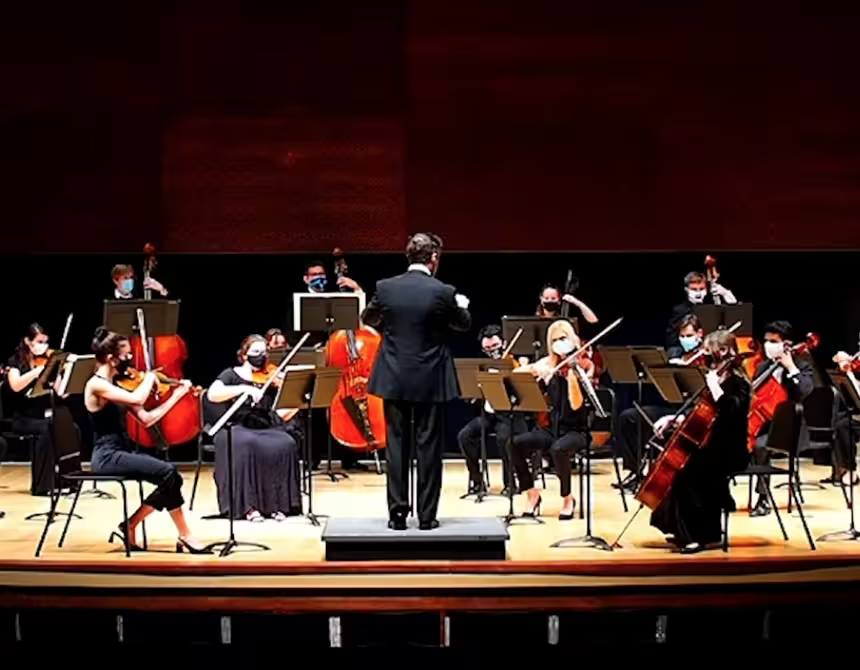
Join the Bower School of Music’s Percussion Chamber Ensemble, directed by Troy Jones.
Join the Bower School of Music’s Percussion Chamber Ensemble, directed by Troy Jones, in an evening of percussion pieces, featuring Timothy Yontz, guest conductor.
Problems playing video? | Closed Captioning Feedback
Problems playing video? | Closed Captioning Feedback
Bower School of Music & the Arts is a local public television program presented by WGCU-PBS
Bower School of Music & the Arts
Student Ensemble Series: Percussion Chamber Ensemble
4/29/2021 | 53m 37sVideo has Closed Captions
Join the Bower School of Music’s Percussion Chamber Ensemble, directed by Troy Jones, in an evening of percussion pieces, featuring Timothy Yontz, guest conductor.
Problems playing video? | Closed Captioning Feedback
How to Watch Bower School of Music & the Arts
Bower School of Music & the Arts is available to stream on pbs.org and the free PBS App, available on iPhone, Apple TV, Android TV, Android smartphones, Amazon Fire TV, Amazon Fire Tablet, Roku, Samsung Smart TV, and Vizio.
Bower School of Music & the Arts
All videos in the Bower School of Music & the Arts seriesProviding Support for PBS.org
Learn Moreabout PBS online sponsorship(light piano music) (audience clapping) - [Troy] Ah, great, we have activation.
Thank you for being here tonight.
And I am Professor Troy Jones.
I wear many hats, but one in particular is the instructor of percussion here at the Bower School of Music and it's always a pleasure again to be able to perform in front of people and also for the ones who are watching through our streaming experience as well.
So, welcome to a night of percussion performance.
Usually with these concerts, there's going to be a variety of different things that you're going to hear.
So, as a general understanding, there will usually be a lot of changing and moving to prepare for each of the selections.
So, some of those things you'll experience.
We try to make it as minimal as we can but I did want to let you know that right up front.
Our first selection is called "Mercury Rising", which is by the great Nathan Daughtrey.
And Nathan Daughtrey has really made a name for himself.
He's been writing for a long time, in particularly percussion, but he's also getting into other fields as well.
But he has written now over 60 to 70 different percussion ensemble pieces that are played on a regular basis around the nation and also now international.
In fact, the selection we'll perform for you tonight was actually originally written for a Siberian percussion set tech all the way in Siberia.
And he wrote it just for a competition, and they do a lot of that, percussion ensemble competitions there.
You'll hear a variety of balanced mallets and membranophones and all of these different types of instruments that he was going for.
And it's just an excitement called "Mercury Rising," which as you know it's pretty cold in Siberia.
So here it is, "Mercury Rising", by Nathan Daughtrey.
(light dramatic music) (light music) (dramatic music) (light music) (dramatic music) (light music) (dramatic music) (light music) (dramatic music) (audience clapping) (audience cheers) Thank you very much.
Our next selection is not too far a cry from what we just played in the opener, but this is actually more of a public service announcement kind of piece.
There's been a lot that's been happening, as evident with us with masks on and the fact that we're social distancing and all of these things that's been going on.
What's great, of course, is there is looking like there's light at the end of the tunnel.
Music, of course, represents pretty much what happens in society.
And Chad Heiny has done a pretty good job in voicing his frustrations with something called "Canon Fodder".
He is a freelance composer and performer in the Pittsburgh area.
He's also done a lot of work at several different universities on posts at different places, but he's a fantastic percussionist and now starting to figure out he's a rather prolific composer as well.
This is pretty much his rendition of the things that bothers him.
His concern is that there's a lot of things happening in the world that isn't pleasant, and what you will hear on stage from our percussionists will be a lot of different depictions of that.
He says that there's a lot of things that's going on in the world, yet the clocks keep on ticking and you will hear an incessant clock ticking being represented by the woodblocks.
You will also hear canon fodder or fire coming from the tongs, and this is the aggression.
It's a very interesting piece and there's a lot of repetition, and then we have this very interesting contrasting section which is pretty much sort of just to take a moment and look at what we're doing.
We'll hear that being played in an eerie kind of way on the chimes.
To have three sets of times on the stage is a little peculiar, but you'll certainly figure to see why in just a moment.
And then we will end off with the same kind of rage but also with a little bit, of course, a glimmer of hope that we can get things back on track.
So here is "Canon Fodder" by Chad Heiny.
(light tapping) (dramatic drumming) (chimes ringing) (light dramatic music) (audience clapping) All right, we're here.
Hey, thanks again for your patience.
Our next selection is a very special work by Mr. David Gillingham.
We've done a work of his earlier this academic term as well.
He's a prolific composer and we're very, very excited that he tends to write for percussion.
It's very, very awesome for him to do that.
And I had the pleasure of meeting him and talk to him about why.
And he says, "It's just I really enjoy the expressive possibilities for color."
And you will hear that in spades today.
This is a work that's probably unusual where it will not sound sometimes like percussion.
He has such a talent, there will be moments where it almost sounds like strings for voices.
Certain things that he's able to do with the lower end of the marimba and different types of mallets to make this flow.
This particular work, "Normandy Beach 1944", the composer states "On June 6, 1944 at dawn, the British and American forces landed on the beaches of Normandy in an elaborate amphibious operation.
A total of 425,000 American, British, and German men lost their lives in the ensuing conflict."
This particular piece was composed in commemoration for this important, yet tragic day, that changed the course of World War II.
Some things about Mr. Gillingham is that he writes music about very prolific or life-changing or even events that change the direction or paradigms, and he stays pretty true to that.
He doesn't really write too many things about cute little fuzzy bunnies and these kinds of things, it's usually very intense works.
We have the pleasure to this evening of actually having a guest conductor for this work.
It is an absolute pleasure to work with this gentleman.
I've had the honor of working with him for the past two to three years now, and he's done some, you know, actually some paradigm shifting here at the Bower School of Music.
He's our head of Instrumental Studies and our Director of Bands, and he came up to me wanting and saying, "You know what?
I really do want to conduct them and get an idea or an experience to work in percussion since this is something that I haven't had the opportunity to do."
Which is certainly his MO.
If there's something he needs to work and develop, of course, he will do that.
And this is certainly a way to do that.
And we have enjoyed him immensely coming in and working with our ensemble.
So without further ado, my esteemed colleague, and I like to call friend, Dr. Timothy Yontz.
(audience clapping) (soft music) (suspenseful music) (soft music) (suspenseful music) (light music) (light dramatic music) (light music) (soft music) (audience clapping) Stayed together this time, that's great.
Moving right along.
For our next selection called "Epic Proportions" by Jonathan Ovalle, this is pretty much a written out jam session for lack of a better term.
The more academic way of thinking of this is that he actually used the word epic proportion to create just a deluge of different combinations all dealing with five.
So you have two syllable, then you have the three syllable.
And he did two plus three, he did three plus two, he did all five.
There's all kinds of different derivatives of five and that's where you get the "Epic Proportions" from.
This piece moves throughout all of the musicians here on stage.
Everyone has a great deal of responsibility to make this happen.
However, our two featured soloists today will be on drum set, Steven Melman, and also Paul McCray on marimba.
And, for these two gentlemen, you're gonna hear a lot of solo work like you would be in a jazz jam session, so to speak.
So, without further ado, here is "Epic Proportions" by Jonathan Ovalle.
(audience clapping) (dramatic music) (light music) (light dramatic music) (light music) (dramatic music) (light music) (light dramatic music) (light music) (light music) (light dramatic music) (light music) (dramatic music) (audience clapping) Thank you for hanging on to the bitter end here.
We'll be concluding our concert with a piece called "Cyclone" inspired by the composer's friend.
Jim Casella, this composer, his friend actually went up to try to tackle the great Mount Everest and he talked about his experience and these winds that would happen.
A lot of folks tend to think that, you know, the altitude and the really arduous journey of which of course is intense in and of itself, but it's the unexpected winds, they say, that kind of can throw you off balance.
So this is actually a depiction of a cyclone of winds that you will see and hear throughout the ensemble.
In addition as a little bit of a slight danger, so I'm gonna have to conduct a little further here 'cause we'll have some students who will actually be demonstrating some wind moves, just to say the least.
So I'm sure you'll notice that once it happens.
Jim Casella is an amazing composer.
He actually got his start in drum corps, Drum Corps International, and a lot of his incredible writing with the Santa Clara Vanguard which propelled him into a variety of different genres in percussion.
And he's been writing now for some time.
The founder, at least co-founder, of Tapspace Percussion and there's just so much that he's been able to accomplish in his career.
And his music is, and he's now even now writing for film.
It's amazing how you're writing for percussion and it just starts to evolve into something like this 'cause so many people are interested in his music.
So now he's writing for film.
He's hanging out up there in Portland, Oregon area where he's been performing and teaching, and of course writing.
And this of course was dedicated to his friend, and I think his son went to this particular high school where they premiered it.
And it's just a fast and furious work.
Just as a disclaimer, there will be very loud sounds.
So, if loud sounds are jarring to you, I just want to prepare you now that it can definitely get pretty strong here.
So here's Jim Casella's "Cyclone".
(audience clapping) (light music) (suspenseful music) (light music) (dramatic music) (light dramatic music) (light music) (dramatic music) (audience clapping) (audience cheering) (light piano music)

- Arts and Music
The Best of the Joy of Painting with Bob Ross
A pop icon, Bob Ross offers soothing words of wisdom as he paints captivating landscapes.













Support for PBS provided by:
Bower School of Music & the Arts is a local public television program presented by WGCU-PBS