
Reimagining
Season 2 Episode 6 | 23m 47sVideo has Closed Captions
RISD Costume and Textiles, Natural Perfumery, and artist/entertainer Larry Krone.
Join the ART inc. team at the RISD Costume and Textile department, a natural perfumery, and Joe’s Pub in NYC for a performance by artist/entertainer Larry Krone.
Problems playing video? | Closed Captioning Feedback
Problems playing video? | Closed Captioning Feedback
Art Inc. is a local public television program presented by Ocean State Media
Reimagining
Season 2 Episode 6 | 23m 47sVideo has Closed Captions
Join the ART inc. team at the RISD Costume and Textile department, a natural perfumery, and Joe’s Pub in NYC for a performance by artist/entertainer Larry Krone.
Problems playing video? | Closed Captioning Feedback
How to Watch Art Inc.
Art Inc. is available to stream on pbs.org and the free PBS App, available on iPhone, Apple TV, Android TV, Android smartphones, Amazon Fire TV, Amazon Fire Tablet, Roku, Samsung Smart TV, and Vizio.
Providing Support for PBS.org
Learn Moreabout PBS online sponsorship(radio static buzzing) - Art is everywhere.
It might be a dance with your favorite partner or the dance of a butterfly's wings.
It might be a delicate fragrance or a delicate orb made of glass.
It might be something you've never even imagined because art is incorporated into almost everything, and we're excited to share that everything with you.
Welcome to "Art Inc." - [Announcer] If you want to know what's going on... (upbeat music) (upbeat music continues) (upbeat music continues) (staticky buzzing) (soft upbeat music) - [Tracy] "The Fabric of Our Stories."
- Clothing is made with the intention that it's going to go on the body, it's gonna be worn outside.
It might be exposed to weather, you're gonna get it rained on, you're gonna sweat in it.
There's a corset downstairs that has breast milk stains in it.
Maybe it's blood from a wound.
We're not necessarily pursuing conservation to try and make them look brand new.
We're not trying to bleach away signs of life and return them to the shop window state.
Conservation can look like really coming to understand and appreciate a stain rather than pulling it off a textile.
(gentle music) - Here at the RISD Museum, we have a costume and textile collection that numbers about 35,000 objects.
We like to say that we cover all of the world and all of time.
We have pieces that date from 1500 BCE, and there are pieces that are being made for us today.
People who come into museums often see the beautiful exhibition with the pristine objects on view.
What they're not necessarily seeing is all of the work that happens below ground.
We are looking at these pieces carefully.
We're making sure that they're stored properly, we're bringing them out to study.
I'm Kate Irwin.
I am curator of costume and textiles.
- It's beautiful.
- Yeah.
It's definitely lived a life, seeing all of the discoloration, the staining.
The part of conservation that I enjoy the most is coming to understand how something was made and coming to really gain appreciation for the amount of time and the skill of a maker.
- Wow, that's so much stickier than I expected it to be.
- [Anna] A big part of this process was figuring out ways to talk about how things just naturally grow and evolve and change.
My name is Anna Rose Keefe and I am the assistant conservator of costume and textiles.
- And there's also sort of a different and more abstract part of our job where we're really using our work to engage students.
Whether that's just thinking about the nature of conservation work or when you intervene and when you don't, or thinking about the context of a piece.
I'm Jess Urick and I'm associate conservator of costume and textiles.
- There is an assumption that something goes to the museum and it will just stay the way it is in perpetuity, and that's just not a reality.
There are certain pieces that are going to just age no matter what.
And they weren't made to last forever and they therefore will not last forever.
We've really decided to kind of embrace that.
- I don't see a lot of thread trails.
I don't see a lot of clues.
- No.
- We can't tell the stories that we had hoped that we could tell with these items anymore.
So if they're just sitting in the dark and they're falling apart, then we have to make a decision.
What is healthy for the collection right now is to present them for a formal deaccession, that is a formal removal from the museum collection.
(soft jazz music) (soft jazz music continues) (soft jazz music continues) - Because we have this relationship with RISD, we can kind of pan out and think a little more critically about what the end of life could look like for a museum object.
- We programmed a course and exhibition called Inherent Vice, where we were able to bring students into our collection, provide them with materials that had been deaccessioned from the RISD Museum, and allow them to turn these pieces into new works of art that then went on display in the museum again.
- Working with students in this way in Inherent Vice is really pushing the boundaries of all of our work in the museum in the best of ways.
It was certainly a far reach to propose that students not only handle and work with and really explore, but then to actually pull them apart and to remake them into something else is really next level.
- We brought the dresses into the class and it was like a school dance and everyone was awkward along the walls at first because there's this, it's a palpable aura around museum objects where initially everyone was kind of afraid to touch and was sneaking up on them and looking at us and saying, "Are you sure it's okay?"
And it was really fun to watch that evolve over the course of the class to then they're wearing them out in the city and they're like "Get these stinky things off of me."
Conservators are so often tasked as the sort of do not touch people, and we felt so powerfully that there has to be a way to bridge that gap and break that artificial barrier.
(gentle music) - [Anna] RISD students are makers.
- It's a bomber jacket that's made out of the lining of a wedding dress.
- They feel a real kinship with the people who made these objects, even if we've lost their names.
- The skirt of this wedding suit, as Christopher is calling it.
(upbeat jazz music) (upbeat jazz music continues) - [Kate] There's energy that's being put into all of these makers efforts that were not recognized by anybody including the museum, up until, you know, very recent years.
- These pieces have been more deeply considered than they ever would have been before.
(gentle jazz music) - Building all of those connections that are gonna last way beyond the scope of this exhibition.
I see it so much more as a beginning than an ending.
(gentle music) (upbeat music) - [Tracy] "Natural Perfumery."
(soft upbeat music) (soft upbeat music continues) - So is Natural Perfumery an art, science, alchemy?
How would you describe it?
- I would say it's all three.
I would definitely classify it as an art because for me it's a creative endeavor.
The fact that I'm an independent small, you know, niche perfumer means that I pretty much get to do what I want and tell stories through my fragrances, which is what I do.
(soft upbeat music) - So you're not just a perfumer, you're kind of like a fragrance guide.
- A little bit.
And people definitely need it more when smelling natural perfume because they're not used to natural smells anymore.
Our entire life is surrounded with synthetic fragrances, from our laundry detergent to our hair products or whatever.
- Everything smells fresh too.
- They might think they don't like something, but they've never smelled the natural version of it.
So it's really, like, kind of an educational process.
(bottle sprays) - [Narrator] The essence of precious scents caught at that precise moment of fulfillment, distilled with exquisite artistry for your every mood.
To be lovely is to feel lovely when your fragrance expresses your gayest self.
- Perfume is a very mysterious art, but when you kind of pull back the curtain and look at the ingredients, there's three categories: top notes, heart notes or middle notes, they mean the same thing, and base notes.
And when you're formulating a perfume, you wanna try to choose ingredients from all three categories.
Top notes are what you smell first.
So at Natural Perfumery, top notes tend to be citrus, spice, herbs, things like that.
Heart notes are what they sound like, they form the heart of the fragrance.
And so heart notes are almost always flowers.
And then base notes are things like woods and resins, you know, vanilla, patchouli, frankincense, vetiver, things like that.
So to formulate a well-balanced perfume, you wanna have ingredients from all three categories so they kind of seamlessly transform into each other and wear that way.
So it really is kind of telling a story on the skin.
- Fragrance is really magical.
I really love the magic of what fragrance does for me and how it can make me feel.
- I think the magic of fragrance is related to memory and the strong tie that our sense of smell has with our memories.
I grew up, my mom likes to call it a farm in New Hampshire, but it was really more of like a commune situation.
She doesn't like when I say that.
- Were you inspired by the smells of that lifestyle?
- Yeah, I think I was.
I spent a lot of time outdoors as a kid.
I collected acorns and, you know, so I was kind of that type of kid, so I was always familiar with natural smells and kind of drawn to nature.
- You're doing natural fragrances, but it feels like a beautiful, elegant boutique in here.
- Thank you.
Yes, my goal is to ditch the past hippiness (laughs) and embrace a more modern style of natural perfumery.
(gentle music) - [Tracy] Mmm.
It smells so good.
(soft upbeat music) The Art Of: Belonging."
(upbeat music) - When I was a little kid, we would always go to the circus and one time they were having elephant rides in the parking lot and one of the women who was handling the elephants in the show was sort of hosting it.
She was standing by the elephant in her costume.
It was like armor, like it was, it was just a different thing in real life.
The stones were much bigger than I imagined they would be.
You could just see how it was made and what someone had done to create that.
And I think about that almost every day.
(upbeat music) (gentle acoustic music) My grandma Henny used to call me Renaissance Man (laughs) and I liked it and I've sort of carried that on.
(gentle acoustic music continues) I just have an impulse to, well first of all, to save and collect things.
(upbeat music) I am a thrift shop maniac and, you know, it's all around me.
A part of thrift shopping for me is really the history.
I've learned so much about the way people lived and different priorities.
And even if I do these shy collaborations where I'm using embroidery someone else made and I add to it, I still feel like I'm connecting and collaborating.
People looking at the work can connect to it.
They can feel included.
Oh yeah, this is good.
This is Heather.
This is Susan.
Oh, how ironic.
This is the "Mother" pin.
(laughs) Fell off.
(laughs) It's a really cool one.
I'll get it back on.
(laughs) A few years ago, the RISD Museum purchased one of my pieces.
Connection happened actually through fashion and costumes that I make.
(upbeat music) Because I was in the process of making a book and my friend Todd Oldham was doing the photography for the book.
My fashion work is all House of Larreon.
I make all the costumes and gowns for Bridget Everett.
She is an absolute muse.
One of my slogans is "Poor taste is our signature."
(laughs) Earlier in my life, and you know, probably even up to now, I had a hard time finding myself in a masculine identity, like relating to other men.
But I'd started going to a bar where they played country music and I just, I loved it.
♪ And I still have faith, mm ♪ ♪ I do have faith ♪ ♪ In you ♪ (gentle music) - And I also was not out of a closet then either.
I was considering myself to be straight.
This world of country men was like inviting me to be my own self, but have it be presented as masculine.
And it was really, it actually was a way to bond with other men.
♪ But it's really who I am ♪ - People think sometimes when they hear that I'm doing country music that it's a joke, you know, or that I'm somehow maybe standing away from it and examining it, but no, I feel like I'm in it.
♪ Oh, you ought to see my heart ♪ ♪ Yeah you ought to see my heart ♪ ♪ It's got it's own thing going on ♪ ♪ It's very deep inside of me ♪ - I do consider myself an entertainer.
One of my monikers is artist/entertainer and I love it because it really pisses people in the art world off.
(laughs) It's like there's such a divide between art and entertainment.
It really dumbfounds people.
(laughs) ♪ One of my most beautiful parts ♪ ♪ So you ought to see my heart ♪ ♪ My heart ♪ (audience cheering) (audience applauding) - I really started to accept performance as more of a collaboration, too.
My performances have evolved.
From the beginning, I included my sister.
It was Larry Krone and Family.
It was my sister, and then also her husband Randy and then it expanded to include my now husband, Jim Andralis and other friends.
(soft ukulele music) I felt so ashamed of myself in the presence of my ancestors because of how messed up my family has become.
It's not been good.
(laughs) I got into a really bad fight with my parents about 10 years ago and then it carried on for a few years and I really tried to fix it and they just, a couple years in, they just sort of gave up.
You know, it felt like they gave up on me and they caused a real ripple in our whole family that we're still recovering from.
Yeah, so what a difference.
I mean, the title is inspired by this Ronnie Millsap song and it just, there's very few words in it.
It says, "What a difference you've made in my life.
You're my sunshine day and night."
♪ What a difference you've made in my life ♪ (gentle ukulele music) (audience cheering) (audience applauding) (Larry chuckles) - Thank you.
I'm sorry, this is so out of tune.
That wasn't exactly the most precious song, so it could stand it.
I like changing on stage.
I just wish I had anticipated this.
The idea often is that you're stripping down and you're becoming more vulnerable or more, you're getting to your real self.
I wish I thought to wear appropriate underwear, But at the same time there's a joke, which is that no matter how far down I go, no matter how many clothes I take off, each thing is always a costume.
You know, there's many of us in the LGBTQIA community, plus other people, (laughs) who we really struggle.
We find ourselves in this situation where the people who are the closest to us treat us the worst.
And many of us get to a point when we decide we don't need that and we can actually do what's easier.
We can love the people around us who love us back and make those people our family, so thank you.
Jim surprised everyone by playing the accordion on the song.
He came from the audience.
♪ Touching me then yesterday ♪ ♪ Was something that I never thought ♪ - And then I had a surprise choir that I'd planted in the audience.
(singers vocalizing) And then Bridget Everett came up and she sort of led in sort of this benevolent maternal image, just like leading the choir while I was behind there changing clothes, and I came out, we're all matching and we closed the show.
- [Interviewer] Do you miss her mom?
- Oh, god.
Yeah, I do.
I mean, I don't miss the person she is now.
I am very happy to be rid of her, (laughs) that one.
But no, I do.
I really, there's so many times, like I'll see a musical or something and like oh, this is just something that we would do together, you know?
Yeah, I do.
(Larry chuckles) Barbara Walters over there.
(laughs) (soft acoustic music) The idea was that, you know, I had succeeded in creating this family and that they were all just really there in the audience and we could create this music together.
(singers vocalizing) (soft acoustic music) I'm Larry Krone, I'm an artist/entertainer.
(chuckles) - [Tracy] Thanks for watching and we'll see you next time on "Art, Inc." (staticky buzzing) (upbeat music) (upbeat music continues) (upbeat music continues) (upbeat music continues) (upbeat music continues) (upbeat music continues) (upbeat music continues) (upbeat music continues) Watch more "Art Inc.," a Rhode Island PBS original series now streaming at ripbs.org/artinc.
Video has Closed Captions
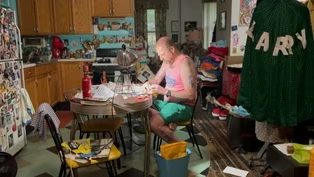
Clip: S2 Ep6 | 10m 2s | Artist/Entertainer Larry Krone takes a deep dive into themes of family and belonging (10m 2s)
Video has Closed Captions
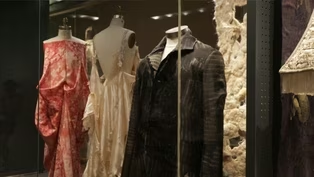
Clip: S2 Ep6 | 7m 53s | The RISD museum offers a behind the scenes look at two very different textile exhibitions. (7m 53s)
Video has Closed Captions
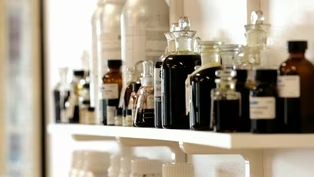
Clip: S2 Ep6 | 4m 24s | In this ART inc. story, we explore natural perfumery with Perfumier Charna Ethier. (4m 24s)
Providing Support for PBS.org
Learn Moreabout PBS online sponsorship

- Arts and Music
The Best of the Joy of Painting with Bob Ross
A pop icon, Bob Ross offers soothing words of wisdom as he paints captivating landscapes.












Support for PBS provided by:
Art Inc. is a local public television program presented by Ocean State Media