
Suicide Prevention Month, Caleb’s Kids, Black Film Festival
Season 52 Episode 38 | 26m 46sVideo has Closed Captions
National Suicide Prevention Month, Caleb’s Kids and the Detroit Black Film Festival.
For National Suicide Prevention Month, NAMI Michigan Executive Director Kevin Fischer discusses efforts to combat mental illness stigma and suicide. Caleb’s Kids Founder and CEO Kiesha Jackson shares how losing her brother to suicide inspired her to create her organization. Plus, details on the 5th annual Detroit Black Film Festival and Taste of Black Spirits National Conference.
Problems playing video? | Closed Captioning Feedback
Problems playing video? | Closed Captioning Feedback
American Black Journal is a local public television program presented by Detroit PBS
Suicide Prevention Month, Caleb’s Kids, Black Film Festival
Season 52 Episode 38 | 26m 46sVideo has Closed Captions
For National Suicide Prevention Month, NAMI Michigan Executive Director Kevin Fischer discusses efforts to combat mental illness stigma and suicide. Caleb’s Kids Founder and CEO Kiesha Jackson shares how losing her brother to suicide inspired her to create her organization. Plus, details on the 5th annual Detroit Black Film Festival and Taste of Black Spirits National Conference.
Problems playing video? | Closed Captioning Feedback
How to Watch American Black Journal
American Black Journal is available to stream on pbs.org and the free PBS App, available on iPhone, Apple TV, Android TV, Android smartphones, Amazon Fire TV, Amazon Fire Tablet, Roku, Samsung Smart TV, LG TV, and Vizio.
Providing Support for PBS.org
Learn Moreabout PBS online sponsorship- Coming up on "American Black Journal," it's Suicide Prevention Month and we're gonna talk about eliminating the stigma that surrounds mental illness.
Plus we'll see how one nonprofit is helping young people with their mental wellness.
And also coming up, we'll have a preview of this year's Detroit Black Film Festival.
Don't go anywhere.
"American Black Journal" starts right now.
- [Announcer] From Delta faucets to Behr paint, Masco Corporation is proud to deliver products that enhance the way consumers all over the world experience and enjoy their living spaces.
Masco, serving Michigan communities since 1929.
Support also provided by the Cynthia and Edsel Ford Fund for Journalism at Detroit PBS.
- [Announcer] DTE Foundation is a proud sponsor of Detroit PBS.
Among the state's largest foundations, committed to Michigan-focused giving, we support organizations that are doing exceptional work in our state.
Learn more at DTEFoundation.com.
- [Announcer] Also brought to you by Nissan Foundation, and viewers like you.
Thank you.
(bright music) - Welcome to "American Black Journal."
I'm Steven Henderson.
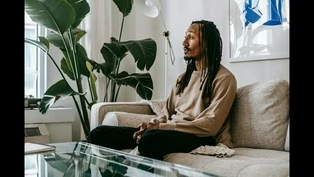
September is National Suicide Prevention Month, and that is a time to raise awareness about mental health conditions, shift public perception, and share vital resources that can help prevent suicide.
My first guest is the executive director of the Michigan branch of the National Alliance on Mental Illness.
I spoke with Kevin Fischer about his efforts to improve the lives of individuals and families that are affected by mental illness.
So September is a National Suicide Prevention Month.
I feel like in our community, in the Black community in particular, this takes on a different kind of dynamic, perhaps, than it does in others.
There's a real sense of shame, I think, that gets associated with mental illness and help for mental illness, and that drives a lot of what people are dealing with underground.
That happens even more astutely, I think, when we're talking about our young people.
- Absolutely.
I always tell people, mental illness doesn't discriminate.
Neither does stigma, but stigma varies by community and culture and the stigma associated with mental illness and suicide prevention in the African American community is very unique and it is very powerful and we need to address it.
- Yeah, yeah.
So talk about some of the things that happen during Suicide Prevention Month that you think help move the needle here.
- Well, one of the first things we need to do is increase awareness.
NAMI, for example, during the month of September, we host what we call NAMI Walks events, which are very much like Breast Cancer Awareness.
We just had one at the University of Michigan last weekend.
We'll be hosting one at the University of Detroit Mercy on September 21st and we'll have one in Grand Rapids on Davenport University's campus on September 28th.
And while there are fundraising events for our local affiliates, most importantly, they are awareness-raising events and they're also behavioral healthcare fairs.
So for example, in Detroit, we will have over 20 behavioral healthcare provider organizations there that are there with lots of information, help the community understand what resources are available and how to access those resources.
And equally as important, let's shed the stigma and the shame associated with mental illness, so we can encourage people who need help to seek that help and then make it as easy as we possibly can to connect them with those resources so they can utilize 'em.
- Yeah, yeah And I mean this is an issue where the success of intervention is unquestioned, right?
When somebody gets help, when somebody intervenes with someone who's having a problem, we're able to prevent the worst from happening.
But it is about that intervention and it's about the awareness and the acknowledgement that someone needs help.
- It truly is.
If we can remove the stigma associated with mental illness and encourage people to seek the help that they need, that's the battle.
With regard to suicide, one of the most frustrating myths is that a person who decides to end their life, once they make that decision, there's nothing you can do.
Nothing could be further from the truth.
In 90% of cases, people who have survived suicide attempts have told us, "I didn't want to die.
I was trying to end an emotional pain."
And most said, "I just needed somebody to talk to."
And so not everybody needs a psychiatrist or psychologist, though if that's what you need, don't be afraid to do that.
But most people, especially specifically related to suicide, just need to be heard.
They find themselves in temporary situations.
They don't think there's a way out.
They're afraid to raise their hand and say, "I need help," again, especially in our community, because we don't want to appear weak, we don't want to appear needy.
And we need to understand that mental illness is a medical diagnosis.
It's not a choice, it's not a weakness of character or faith, and having suicidal thoughts is common.
Acting on those thoughts is not, and that there is help available.
- Yeah, yeah.
So you lost your son to suicide 14 years ago I believe.
- Correct.
- I wanna give you a chance to talk about that, the healing process that you've gone through, and things that you would say to other parents and other people who are dealing with this issue.
- Yeah, so 14 years ago, June 27th, 2010, we lost my oldest son, Dominique, to suicide at age 23.
He had been diagnosed with bipolar disorder and schizophrenia about three years prior, and we were totally ignorant to behavioral healthcare and all of that.
The healing journey for me has been one that's very interesting because after losing Dominique, and this is very common, you're 10 times more likely to experience suicidal ideation yourself after losing someone to suicide.
So I went through that.
I came very close to taking my own life.
I am very grateful and blessed that I did not go through with that.
I have a therapist, I belong to support groups, but my work at NAMI is truly my real therapy.
Being a resource to others that Dominique and I didn't have is really helpful for me.
And so I always say I don't like the way I got here, but I'm glad I'm here and I'm glad I'm able to help others who aren't aware of the resources that are available, as Dominique and I were.
- Yeah.
Do you see progress over time, in terms of getting people to be more aware, be less affected by stigma, and I guess more motivated to deal with intervention and things like that?
- So awareness is increasing.
Unfortunately, stigma is also increasing.
So that's really tough.
I just saw the most recent death by suicide numbers and we experienced a slight decline.
In 2022, we lost 69 less people, nationally, to suicide than we did the previous year, but keep in mind, those are staggering numbers.
Our death by suicide rate in the United States is at an all time high.
- Yeah.
- Almost 50,000 people were lost to suicide.
That's twice as many people than we lose to homicide each year.
So the numbers are really scary.
Stigma, to me, is still the leading culprit.
And it's the most cost effective way, if we can normalize the conversation about mental illness, encourage people to get help, we can improve the quality of and save lives.
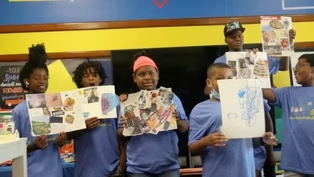
- A Detroit nonprofit, called Caleb's Kids is also addressing the difficult topic of suicide and offering messages of hope to young people.
The organization provides mental health support and resources for middle and high school students.
"American Black Journal" contributor, Angela Brown, has the story of how a personal tragedy inspired the creation of Caleb's kids.
- Suicide is the second leading cause of death for youth ages 10 to 24.
So I wanted to do something to show our youth that they have options, that they can get help if they're going through things in life, and that they don't have to turn to self-harm, suicide, or other risky behaviors.
Caleb's kids was started in 2016 after I lost my younger brother to suicide.
After he passed away, I really engulfed myself in all things mental health, and so in doing so, I learned how much of an issue it was for our youth.
The workshops that we do, they teach the youth about mental health.
So they teach them how to recognize how something is going wrong in their life, how something is going wrong in their minds and in their bodies.
It also teaches them different coping skills.
So how do you cope when something is going wrong?
And when you're coping, if it's not getting better, it gives them the resources of where to go to get help.
- It helped me to feel, like just be patient, everything will be okay.
And you don't have to be sad all the time.
- As you're creating your Vision Board, you want it to be something that represents you.
So some of the things you can think of...
In my former life, I worked in human resources.
So I was an HR manager at a Fortune 50 company.
And in doing that, I focus a lot on wellness and morale and engagement.
So oftentimes I would have to help my employees work through different stressful activities that may be going on, either within the workplace or outside of the workplace, or even helping them work through some mental concerns that they have had personally, or even suicidal employees who have confided in me that they wanted to end their lives.
So I had some work in helping those employees, but after my brother passed away, I really just want to learn even more about it to prevent it from happening.
Because one thing with suicide, it leaves so many questions unanswered.
So I wanted to just engulf myself in all things mental health so that I would learn, one, how to recognize when someone may be in mental distress and how to help them overcome.
So with both of those, with my work experience, as well as the research after my brother passed away, I'm still learning, but those are the two biggest things that have impacted how much I know about wellness and mental health.
- I liked how Miss Keisha was really easy going and she explained thoroughly about how her brother died, why and how it's important to talk about it.
And she showed us examples of why it's important and who we can call, what we can do if we're going through things or what her brother went through.
- The biggest aha moment is just the realization that our youth go through so much.
There's different levels of trauma that our youth go through, and in the African American community, specifically, like our youth have a higher predisposition to being exposed to some of those stressors that may cause someone to be depressed, or have anxiety, or have panic attacks, or having PTSD.
So that really has been more so eye-opening as I've really delved into all the things around trauma as it relates to youth, specifically.
I'm enough because I believe in myself and I am enough because I know that the power to accomplish anything in life is in me.
- It's amazing, it's the best experience, and it would definitely help you.
- Two.
- One, two, three.
(camera clicks) All right.
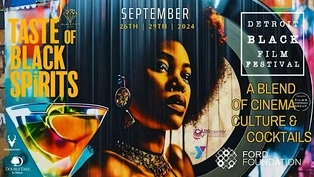
- And finally today, the fifth annual Detroit Black Film Festival takes place at various venues around the city on September 25th through the 29th.
The lineup includes 57 independent films from 13 countries and from Africa.
New this year is the Taste of Black Spirits National Conference, which is part of the festival.
Here's a peek at one of the films, followed by my conversation with the festival's co-directors, Marshalle and Lazar Favors.
- What's mine?
- So, what kind of night is it?
- You got somewhere to be?
(laughs) - But you said just the one, so- - We both know it's never just the one.
(upbeat music) I'm not ready for the night to end.
- Even though we both know I shouldn't.
♪ Yeah yeah yeah ♪ - Why next?
- Marshalle and Lazar Favors, I love seeing you, but I especially love seeing you guys in advance of the film festival, which is now five years old.
I actually can't believe it is five years old, but it's coming up again.
Tell us about this year's Detroit Black Film Festival.
- Thanks so much for having us.
We're super excited.
Detroit Black Film Festival, plus Taste of Black Spirits, it's a dual event, happens September 25th through the 29th.
We have four screening locations.
We are kicking it off with short films, and feature films, and documentaries, everything across the board.
It's gonna be a really, really great time.
- Yeah, yeah.
So the cocktail end of this is new, Lazar.
(laughs) Why do I suspect this was your idea?
(laughs) - Well, we've introduced the event in 2021, called Taste the Black Spirits.
And we've been traveling, taking that event across the United States, and last year, we decided to why not blend both of our events together, right?
Why not add the cocktail concierge to the cinema and culture?
So we blended it last year and it worked to perfection.
We were able to combine our audiences and give them both an experience that neither one had experienced or would not have experienced if it was not going on at the same time.
So it worked very well and we decided to do it from now on, actually, so Taste of Black Spirits and Detroit Black Film Festival will happen at the same time within each other from now on.
- But let's go back to the beginning and talk about how much this festival has grown.
It has become much more than it started out as, isn't that right?
- That's correct.
- It's interesting because when we first started Detroit Black Film Festival, (laughs) it started during the pandemic.
- I remember that.
- And so, absolutely.
And so our first year it wasn't what we expected, but it actually turned out to be really great because we were able to gain an international audience from around the world because it was virtual.
We had all of our films that were screening online and the connection that we had doing the Zoom calls and being able to connect artists with the audience virtually worked out really, really great.
And then once we were back in full effect, in person, it just made it that much more exciting because people got to be in the same place and the same space as the filmmakers.
People that had made connections during the pandemic were able to come to Detroit and meet each other personally and experience their films in person as well.
So it's grown in a sense that our audience has grown, and even with the number of films.
We have 57 films from around the world this year that we are featuring.
- Yeah.
Let's talk about the films and how you choose them.
You usually have quite a bit from Detroit and you are great at featuring Detroiters, but as you point out, the films come from all over the world as well.
Let's walk through the process of how you figure out what's in the festival and then tell us what we should be excited about this year.
- Well, it comes from the diaspora.
So we have films that come from all around the world, and the criteria, we start with a jury and they have 10 different categories that they rate the films in.
And some of them are really technical, like production quality, sound, all those things, but honestly, the biggest, I think, criteria is just overall entertainment, quality entertainment.
Do we think our audience are going to enjoy this particular film?
And so it narrows down to that, and we get hundreds of films.
We deliberate and then our final lineup is what people come out to experience.
And we have several screening locations, the Michigan State University Detroit Center, the Marlene Boll YMCA Theater that's downtown, and the Car Center Performance Studio as well.
The Car Center usually has the documentary films.
We have a number of films that we're calling our "Racial and Social Justice" series.
So for those who like social impact films, we have that.
At the YMCA, most of them are feature films, and those are kind of our urban films, our dramas, but we do have some romantic comedy in there as well.
And so there's something for just everyone to enjoy.
- So Lazar, tell me about the spirits and what people will be able to experience with that part.
- So last year we introduced Rod Isley.
So he'll be back with us this year.
We are also doing a grand tasting of Beyonce's Sir Davis whiskey.
We're doing a, I wanna say a private grand sampling in the Cage Jewels Lounge.
So we created some lounges for brands and products for folks who participate in the lounges, but also we have three days of education.
So we bring in spirit buyers from Meyer, we bring in folks who have offered capital, distributors like MHW, and so forth.
And we also have Derrick Whitehead, who is a financial guru, who comes in and talks about how to structure your business, how to use your money wisely, which is very important for all of us, right?
But it's gonna be a great time.
And then the sampling itself, you're able to sample over 150 African American-owned spirit brands, beer, wines, and beverages.
When I say beverages 'cause we also have non-alcoholic items and beverages.
And we also are presenting some of our Detroit products, like Nikki's Ginger Tea, our guy Black Eden from Out of Idle Wild, and several other brands.
So it's gonna be a great time.
It's gonna be full of education, entertainment, and elevation is what I like to call it.
- Yeah.
(pair laughs) - So you've been doing this for five years.
I wonder if y'all can reflect some on the effect that you feel like this festival is having on Detroiters, on film, on black film and the support for it.
It seems like there's a lot of momentum that's just been built up while y'all have been doing this.
- There's been a lot of momentum that is built up within the last five years, especially in the Detroit community.
I know that our community, like the independent film community kind of knows this, but I don't know if the broader community knows how much content is really being made here.
I could say that there's at least three to four feature film productions that are happening in Detroit, in the metro Detroit area, on a consistent basis.
And some of those films are in our festival as well.
So this is a great time to see the film.
Some of them are on streaming platforms already, but this is a time for you to connect directly with the producers, directors, the actors that are in these films.
And the momentum is just going to increase and get even stronger, I think, and festivals like this gives artists a platform for the community to really experience what's happening in the Detroit independent film community, and the independent community across the board.
- Yeah, yeah.
Go ahead, Lazar.
- And I think it gives us, as filmmakers, and as independent filmmakers who are working in the market, there's an opportunity to hear their voices, right?
To tell these stories that we may not hear on a large or a huge festival, or streaming channel.
But we've seen some short films, I'm talking about some amazing short films, since day one.
Our very first year, I think, we only had very few films, but 90% of those films, so the first year of Detroit Black Film Festival was difficult to choose because it was so many, it was so many great films that were submitted that we end up awarding probably 60% of the films that we chose because they were all great films.
And the stories range from narrative to short documentaries to, it was a film called "About Our Hair," right?
About the Black hair.
It was a great film about that.
So the things that folks we're able to reach and the things we're able to achieve with what we do, 'cause we're very intentional about what it is we do.
We're very intentional about delivering the message and the power of our voices and the power of what we are able to do as Black people.
And I think this is one of those platforms that really gives us, as Black people, an opportunity to really raise awareness about our experiences.
- And what's really great is that you are gonna see some new faces, up and coming actors that you may not have known before.
And you're also gonna see some very seasoned actors that have household name recognition, like Lynn Woodfield and Malik Yoba and Aunjanue Ellis.
And so it's gonna be an array of what folks are gonna experience.
- Yeah, yeah.
- And we definitely got our Detroit filmmakers in there, right, we definitely got those in there.
Got some great films happening, and those films will play at the Marlene Boll Theater.
Some great actors, some great films, and we've always supported our hometown filmmakers.
We try to give them as much of a stage presence as possible because we have a lot of visitors and we want them to really shine in that, and we set the presentation up for them to really shine.
- Who are making a name in their own right.
- Yes.
- Yeah.
All right, well again, Marshalle and Lazar, it's always great to see you and I'm always really excited about the work you're doing with the film festival.
Thanks so much for being here on "American Black Journal."
- Thank you.
And people can find out more about the film festival at Film Freeway, Detroit Black Film Festival.
- All right, thank you.
- And that's gonna do it for us this week.
You can find out more about our guests at AmericanBlackJournal.org, and you can connect with us anytime on social media.
Take care and we'll see you next time.
(upbeat music) - [Announcer] From Delta Faucets to Behr Paint, Masco Corporation is proud to deliver products that enhance the way consumers all over the world experience and enjoy their living spaces.
Masco, serving Michigan communities since 1929.
Support also provided by the Cynthia and Edsel Ford Fund for Journalism at Detroit PBS.
- [Announcer] DTE Foundation is a proud sponsor of Detroit PBS.
Among the state's largest foundations committed to Michigan-focused giving, we support organizations that are doing exceptional work in our state.
Learn more at DTEFoundation.com.
- [Announcer] Also brought to you by Nissan Foundation and viewers like you.
Thank you.
(bright music)
Caleb’s Kids supports young people’s mental health
Video has Closed Captions
Clip: S52 Ep38 | 4m 9s | A local Detroit organization Caleb’s Kids supports students struggling with mental health. (4m 9s)
Detroit Black Film Fest couples with Taste of Black Spirits
Video has Closed Captions
Clip: S52 Ep38 | 12m 33s | Detroit Black Film Festival couples with Taste of Black Spirits National Conference. (12m 33s)
National Suicide Prevention Month with NAMI Michigan
Video has Closed Captions
Clip: S52 Ep38 | 7m 27s | Suicide Prevention Month spotlights efforts to combat mental illness in Black community. (7m 27s)
Providing Support for PBS.org
Learn Moreabout PBS online sponsorship
- News and Public Affairs

Top journalists deliver compelling original analysis of the hour's headlines.

- News and Public Affairs

FRONTLINE is investigative journalism that questions, explains and changes our world.












Support for PBS provided by:
American Black Journal is a local public television program presented by Detroit PBS