One-on-One
Bernard China; Bob Garrett; Dale Caldwell
Season 2022 Episode 2507 | 27m 8sVideo has Closed Captions
Bernard China; Bob Garrett; Dale Caldwell
"Bernard China opens up about the road to his life-saving heart transplant and the issues of organ and tissue donation in minority communities; Robert Garrett talks about the major issues with the nursing shortage and the issues with vaccine hesitancy throughout the state; Dale G. Caldwell discusses the connection between innovation and leadership.
Problems playing video? | Closed Captioning Feedback
Problems playing video? | Closed Captioning Feedback
One-on-One is a local public television program presented by NJ PBS
One-on-One
Bernard China; Bob Garrett; Dale Caldwell
Season 2022 Episode 2507 | 27m 8sVideo has Closed Captions
"Bernard China opens up about the road to his life-saving heart transplant and the issues of organ and tissue donation in minority communities; Robert Garrett talks about the major issues with the nursing shortage and the issues with vaccine hesitancy throughout the state; Dale G. Caldwell discusses the connection between innovation and leadership.
Problems playing video? | Closed Captioning Feedback
How to Watch One-on-One
One-on-One is available to stream on pbs.org and the free PBS App, available on iPhone, Apple TV, Android TV, Android smartphones, Amazon Fire TV, Amazon Fire Tablet, Roku, Samsung Smart TV, and Vizio.
Providing Support for PBS.org
Learn Moreabout PBS online sponsorship- [Narrator] Funding for this edition of One-On-One with Steve Adubato has been provided by Delta Dental of New Jersey.
Everyone deserves a healthy smile.
Investors Bank.
New Jersey Sharing Network.
IBEW Local 102.
Lighting the path, leading the way.
PSE&G, committed to providing safe, reliable energy now and in the future.
Fedway Associates, Inc. Johnson & Johnson.
The Healthcare Foundation of New Jersey.
And by The Port Authority of New York and New Jersey.
Moving the region through air, land, rail, and sea.
Promotional support provided by The New Jersey Business & Industry Association.
And by New Jersey Globe.
- This is One-On-One.
- I'm an equal American just like you are.
- The way we change presidents in this country is by voting.
- I'm hopeful that this is the beginning to accountability.
- Life without dance is boring.
- I don't care how good you are or how good you think you are, there is always something to learn.
- I did do the finale, and guess where my trailer was?
A block away from my apartment, it couldn't have been better!
- People call me 'cause they feel nobody's paying attention.
_ It's not all about memorizing and getting information, it's what you do with that information.
- (slowly) Start talking right now.
- That's a good question, high five.
(upbeat music) - Hi everyone, I'm Steve Adubato.
We kick off this program with an important conversation, and for those of you who are not familiar, or aware of, the importance of organ and tissue donation, as we speak right now, there are 4,000 people plus waiting for a life-saving organ.
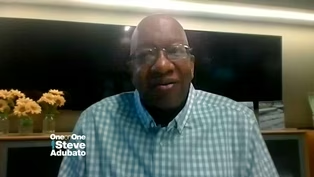
And one of the people who was waiting for a long time, we are honored to be joined, right now, you see him on camera, Bernard China, a heart transplant recipient.
Mr. China, first of all, thank you for joining us.
- Thank you for having me, sir.
- Let me put this in context.
Back in August of 2017, you woke up, hard to breathe and the rest of the story, you tell us.
- The rest is just tragedy, I guess.
And then it just turned to the best thing that ever happened to me.
- Which was?
And we should let everyone know that we work in collaboration with the New Jersey Sharing Network.
The website will be up throughout the program, if you wanna find out more about organ and tissue donation, that is the place to go.
(Steve sighs) You received your heart.
What date?
- December 30th, 2020.
- So you have a second birthday that day?
- Yes, sir.
I tried to tell my kids that, but they told me, "No, you only get one birthday".
(both laugh) - No, I think you get two.
Talk to us.
Obviously we can never do justice, Mr. China, to the experience that you had leading up to this transplant.
But when you woke up, and you realized you had a new heart, and someone gave the gift of life to you, what were you feeling and thinking?
- Well, that was an experience, that when I woke up, it was about about 10 to nine that morning, I woke up and I was like doing like this, telling them to take the tube out of my mouth and the whole nursing staff, and including like janitors and stuff that were on that floor, they were standing by my door.
And when I woke up, I turned, and they was like, "Hey", they was clapping.
And I was crying, because I knew what happened, but me, myself, to be honest, I didn't think I was gonna make it.
And to hear that, and to be able to speak, and talk to different people at that time, it was a great experience.
And the rest is that, I'm taking it every day, one day at a time, just doing what I'm supposed to do.
And it's just joy.
- So that was actually at Newark Beth Israel, we happen to know, that operation.
Question, you were in the hospital for how long?
- 128 days.
I went in September 8th for a right heart cath, and the procedure's about maybe 20 minutes, and I'm gonna tell you this, these are my doctor's words.
After he did the procedure, he said, "Your numbers are high.
I gotta find- Your numbers are high, I gotta admit you.
And I gotta find you a damn heart" and walked out the room.
And from there to January 18th, I was in Beth Israel Medical Center, waiting on a heart.
- Did you find out who the donor was?
- No, I didn't find out who the person is, but I do know that he's a 29-year-old male, Caucasian male.
Yes.
- Gave the gift of life to you.
- Yes, and I'm very appreciative that we was a 10 outta 10 match and that I was a candidate to receive this second chance of life.
- You know, it's interesting, of the 4,000 plus people waiting for the gift of life, an organ to save their life, 67% of those who are waiting, just in a state of New Jersey, are people of color.
And so, one of the reasons we're doing this segment with Mr. China, other than to celebrate his second birthday, and to recognize him, and wish him (hand knocks) all good things, the other thing is to make it aware to everyone that the issue of organ and tissue donation is even a more serious problem in the Black and Brown community.
Talk about that, Mr. China.
- Yes.
You know...
Since I had the heart transplant, I tell a lot of my friends, that I guarantee you, there was 10 of us and probably only one or two of us that are donors.
So I try encourage everybody to be a donor, because you never know whose life you could save or who you could help.
And it's not just the heart and the kidney, it's also skin tissue, and a lot of the other stuff that can be used to save somebody, to give somebody a second chance in life.
- So you've been advocating?
(Bernard laughs) - Yes.
- You have been.
You've been telling people, educating people, and that's why the website is up right now.
And listen, there is some resistance on the part of different people in different communities, but in some cases it's a harder, I'm not gonna say a sell.
It's harder sometimes in the Black and Brown community when it comes to this issue, is it not?
- Yes, it is.
And the thing is that, this right here, people see this band, there you go.
(Bernard laughs) There you go.
And when they see that band, that's like, I just explode because I'm ready to just tell them the great news about being a donor.
And it's a joy.
- Yeah.
Well, my wife is a kidney donor, and we learned it firsthand through family.
- Right.
- And to you, Mr. China, to your family, to the people who care deeply about you, first of all, remind them, you do get two birthdays.
(Bernard laughs) You get to decide that.
(Bernard laughs) And the other thing is, to our friends and colleagues and partners at the New Jersey Sharing Network, website up again, we thank you for allowing us to do this public awareness and to meet extraordinary people like Bernard China, a heart transplant recipient.
Mr. China, we wish you all the best.
- Thank you, sir, thank you.
- You honor us.
We'll be right back.
- [Narrator] To watch more One on One with Steve Adubato find us online and follow us on Social media.
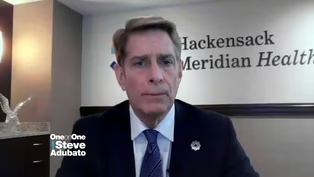
We're joined once again by Bob Garrett, who is the CEO of Hackensack Meridian Health, which is in fact an underwriter of our healthcare programming.
Bob, thank you for joining us.
- Great to see you, Steve.
- Bob, we've talked about COVID from so many perspectives and if I'm not mistaken, HMH I believe, had one of the first COVID patients back in March, March 4th was it, 2020?
- That's correct, Steve.
March 4th, 2020, the first COVID patient in the state of New Jersey was being cared for at Hackensack University Medical Center.
- Part of the HMH system system, 17 hospitals, 36,000 employees.
Bob, let me try this.
Last time we talked, I wasn't able to get into this with you, but I do want to now, the nursing shortage.
I know your nursing team well.
The physicians I work with and I teach, and I said I teach in the Physician Leader Academy at HMH, they're so reliant on those nurses.
I don't like saying how bad is it, but Bob, how bad is the nursing shortage?
A and B, what options do you and other healthcare leaders have in dealing with it directly to help the patients at HMH?
- Yeah, so staff is short, it's tight.
There is a significant nursing shortage.
There was one before we got into the Omicron surge and of course, that made it even worse as nurses unfortunately, did contract COVID and were out for a period of time.
So, what we've done at Hackensack Meridian is, we have had to hire an additional staff through agencies.
We've actually hired over 1,000 RNs, nurses, to supplement our regular nursing team members.
- [Steve] Is that more expensive, Bob?
- I'm sorry.
- [Steve] Is that more more expensive?
- Much more expensive, Steve.
So, there are nurse out there, agency nurses that are being paid even $250, $300 an hour in places like California and not that far behind that in New Jersey.
So, significantly more than what we've seen in the past.
But honestly, at this point, we want to make sure we have the appropriate number of caregivers, particularly on the front lines fighting COVID.
So we've taken that step to hire those people.
We've also reassigned nurses from other activities, if they weren't doing direct patient care.
We've been able to restructure, reassign as the COVID surge continued.
We were able to, as an example, reschedule some procedures and surgeries that were not time sensitive.
And those nurses and other team members that were working in those areas were reassigned to the front lines.
We've also, through our workforce reassignment office at Hackensack Meridian, we've reassigned about 450 team members, some of them being nurses to the front lines.
So these might be nurses who were working in research positions or in academic positions, but certainly have the clinical skills to help their colleagues on the front line and we have reassigned them for those purposes.
So we've really put together a comprehensive strategy to be sure that staffing is at good levels throughout Hackensack Meridian Health.
- Bob, while I have you, I need to try this one.
How the heck does healthcare and science and decisions about vaccines, which people could debate whatever they want, but you and your colleagues, particularly those on the frontline know that those are the sickest in the ED, the ER, are those who are not vaccinated.
Question, how the heck has healthcare become so, I'm not gonna pull you into political discussion, but how the heck does it even become political?
- You know, Steve, it shouldn't be political at all in in my view, this is basic.
I mean, the science is there, vaccines have proven to be effective.
Now, some people might say, well, look at all the breakthrough cases because of Omicron.
Yes, that's true, but look at- - P.S., we're taping at the end of January.
We're praying, this airs after that, it's not as bad, but there may be a new variant, we don't know.
I'm sorry, Bob, pick it up from there.
- We don't know, you're absolutely right.
But, yes, there have been breakthrough cases that have broken through the vaccine because of a particular variant like Omicron.
But if you look at the severity of those patients, they by and large have not been hospitalized.
And even those that required a hospitalization, it was a relatively short stay.
Very few of those people who were double vaccinated and boosted ended off in our critical care units or ended off on a respirator or even worse, passed away as a result of COVID.
So yes, the vaccine has been effective.
The science has proven it.
I think without the vaccine, from a global perspective, we would be in really, really bad shape right now, if it wasn't for the vaccines.
So this should not be political, Steve.
This is pretty basic.
But look at, we're a health system.
Our responsibility is to the communities we serve and we're not gonna not treat a patient that hasn't been vaccinated.
We have to treat all patients.
But I would urge to the people that are viewing your show, if you haven't been vaccinated yet, please get vaccinated.
It does work.
If you haven't been boosted and you're eligible for a booster shot, please get the booster shot.
It does work, it does make a difference.
- Bob, before I let you go, we had you on a while back with the great, you remember, right?
Harry Carson.
- Yes.
- You and Harry Carson came on, Harry Carson, the great New York football Giant.
I believe he's in the Hall of Fame.
I believe he's in the hall of fame.
- He is.
And also, HMH directly, if you watch any Giant press conference, praying after a win next year, you'll see the HMH logos all over, the Hackensack Meridian Health.
I remember you and Harry Carson came on to talk specifically about vaccine resistance in the African American community.
Now, that was a while back.
Before I let you go, Bob, what progress have we made in that regard?
A and B, what do we still need to do?
- Tremendous progress has been made in really vaccinating the underserved communities.
We work very collaboratively with community organizations, with churches and the gap that was once very wide between the vaccination rates of people of color and their white counterparts has closed significantly.
We're not 100% there yet, there's still work to be done.
But through the great work of people like Harry Carson and others, that gap has really been closed significantly.
- And, we really, before I let you go, in all seriousness, a lifelong Giant fan?
- Lifelong Giants fan, I'm still proud to admit it.
- Even when we lose, you stay, that's loyalty.
- Yeah, I do, I do stay with it.
I can't say I'm not frustrated by it.
I'm always thinking optimistically.
I'm an optimist by nature, Steve.
So I'm thinking 2022, it's gotta get better.
- I also happen to know Bob's Catholic, so he may be doing a novena.
Not everyone may appreciate that, but I know he will.
Hey, Bob Garrett, who's the CEO of Hackensack Meridian Health.
Thanks, Bob.
- Thank you so much, Steve.
Great to see you.
- We'll be right back.
- [Narrator] To watch more One on One with Steve Adubato find us online and follow us on Social media.
- We have him back.
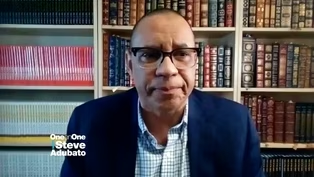
He is in fact, Dr. Dale G. Caldwell, who is the Executive Director of the Fairleigh Dickinson University Rothman Institute of Innovation and Entrepreneurship.
Good to see you doctor.
- Hey Steve it's great to see you again and again, as I said I admire all that you're doing so it's an honor to be on your show.
- I am a fan of what you're saying, no who I'm I kidding.
(laughs) Hey let's do this.
Let's do this.
Innovation and entrepreneurship, I'm obsessed by leadership.
You know, I write about it, think about it, talk about it.
And as I always say, make mistakes around it.
What is the connection between innovation and leadership and then we'll do entrepreneurship?
- Yeah and that's a, that's really a great question.
In fact, we at, at it, I think Jim Berud who you may know was the Executive (inaudible) to the Rothman Institute.
And he added that innovation to really take entrepreneurship to the next level to really try to identify the latest and greatest.
And one of the things is, you know in this country we thrived on innovation and sometimes we get so comfortable, with our success that we don't look at innovation.
So we're really trying to promote innovation in every aspect, but really around entrepreneurship.
- Okay so let me follow up on that.
I often say in leadership seminars and in my leadership coaching in another life I have outside of broadcasting that quote unquote, the status quo even when you're doing well is not really an option.
It's not actually a good option because if you're not evolving if you're not innovating, you're going backwards.
And I don't want that turn into a long-winded plaque somewhere.
I really believe that in our industry university, life whatever.
Do you believe the status quo is not really an option?
- It's not only not an option.
See, but what's happened over time is it's become even less an option.
You know, when we were young kids growing up there was more technology has made things move so quickly.
You know, we're now working in avatars we're now doing things and you see the rate of change has accelerated.
So if you aren't moving forward, not just even, a little bit, you have to be moving forward a lot.
So you have to innovate and innovation needs to be the standard.
- And so change is not a question of whether you accept change it's whether you embrace it and drive it.
And I would argue that-- And again, I'm not gonna turn it into a leadership seminar with you, but I have a feeling you and I could go back and forth for a long time about this, that too many people that I'm around professionally in all walks of life they'll wait to be told what to do that's not only not leadership that's the opposite of innovation, correct?
- That's the opposite of innovation.
And frankly, people are looking for people.
I don't care if you're an administrative assistant.
I don't care if you're a CEO of people who are thinking outside of the box, who are thinking around the corner and that's the way, and you work with a lot of young people.
I work with a lot of young people and that's what we need to let them know is that you've gotta be thinking about tomorrow, today.
- Before I go into entrepreneurship and even though this is a not for profit.
Yeah I love when people call it, oh the Caucus Educational Corporation.
You're a not for profit.
Yes we're a not for profit.
That has a bottom line, that has to raise money, that has to keep our expenses down, run like a very tight business.
And any nonprofit that doesn't do that has problems.
But here's the question.
We're a nonprofit in the age of COVID two years into this we're taping this in February, 2022 be seen later, COVID has forced the issue of innovation more than ever.
- Yeah, absolutely.
- Talk about it.
- Well absolutely.
And what's happened is there's always a positive with negatives.
And so COVID has forced us to get out of our comfort zone.
And one of the things is this video, I've been doing a number of things with regular video meetings, and you can really, you know the 2080 rule, the 20% of the people do 80% of the work.
Well, if you have regular videos and you're trying to set up a program or something, the bad 80% drop off and the 20% stay on and you can work with people across the country as if they're right next door.
And I don't think people have really taken advantage of that as much as they possibly can going forward.
- Let's talk entrepreneurship A, but B what are entrepreneur zones?
- So one of the things is the opportunity zones which and everyone knows that you knows under- - Yes, federal government supported them, we interviewed-- take a look at our interview with Senator Corey Booker, one of the leading initiative, leading supporters in the US Senate regarding that.
What is the difference between that and an entrepreneur zone?
- Well, the trouble with a lot of opportunity zones and Corey, you know I've known Corey for years, will say that is it actually accelerates gentrification in some communities.
Some communities, I think Newark's done a good job of really trying to bring the communities.
So what I mean by that is you pay these developers to come in, they make these beautiful hotels, they squeeze out the local entrepreneurs.
So I wrote an article, an ROI and another one NJBIZ about this idea why don't we have entrepreneur zones where we create an ecosystem of entrepreneurial businesses in the economic challenged community so that they can thrive and grow and they won't be pushed out by a lot of these developers?
And Tim Sullivan, who I love is just a great guy.
- New Jersey Economic Development Authority.
- Exactly New Jersey Economic-- And they actually put this in the economic development legislation.
And so I'm chairing a committee to really look at doing entrepreneur zones.
And we're focusing initially on Trenton and Bridgton with the idea that maybe we can do that.
And my obsession is ending poverty.
And I think entrepreneurship, and job growth is really the secret to really ending poverty.
And that's why these entrepreneurs zones are really focused on it.
- Let me ask you something you mentioned entrepreneurship and businesses coming out of communities, but dare I ask you your father was very closely aligned in worked shoulder to shoulder with Dr. King.
Dr. King was a big advocate of economic entrepreneurship and its connection to civil rights.
Do I have that right?
- Absolutely, absolutely.
And so my dad was at, in the March on Washington, and the March on Washington was for jobs and freedom.
And so Dr. King in the poor people's camp and around that and so if he were alive today he would go full force on entrepreneur zones, full force on turning communities around because the reality is IBM is not gonna move into the poorest sections of Newark and hire 10,000 people.
It has to be the local businesses that are thriving, that are innovative that are meeting the needs of the community that can do trauma informed job training and give people jobs.
And so that's, I think this is an extension of the civil rights movement Steve.
I really think that entrepreneurs zones is the next iteration of where this movement can go.
- I'm gonna you about the work with veterans in just a moment, but I'm curious about this.
Your passion for innovation, entrepreneurship and everything connected to that tied to the larger civil rights fight that goes on as it should.
Where's it come from?
Does it come from your dad?
- It comes from my dad, but it also comes from experiences.
I've been on the New Brunswick Board of Education for 22 years now.
I'm president of the board right now.
I actually had an opportunity to be the head of school at the Village Charter School, Steve, and in Trenton it was 90% free and reduced launch, 90% African American and many of our kids.
And I talked to Ras Baraka the mayor of Newark about this had what looked like it was post-traumatic stress disorder, PTSD.
And so I actually coined a term called urban traumatic stress disorder and found that mindfulness actually helps folks and adults focus.
And so the idea is that trauma informed entrepreneurship training, trauma informed job training, bringing in mindfulness.
And so I really saw firsthand how when you help people thrive then their lives are transformed.
That they feel good about who they are and where they go.
And I think that that as the politicians in the world should be really focusing on making entrepreneurship and job creation job one.
- Before we end the program I wanna ask you about this veterans initiative.
What is the veterans launching ventures?
What is it?
- So veterans launching ventures that we've done that for about 12 years.
And this is one of the reasons the pandemic has forced us to go on Zoom, Steve.
And so we had about 12 to 20 people in person.
We had to go on Zoom the program expanded to 25 states and three countries.
We had an article in a veteran's administration paper a few weeks ago that convinced 500 people to apply to our program.
So we quickly had to pivot and so we went from one veteran program where we are training veterans or immediate family members, a nine week program on developing a business plan and growing their business.
So we've now have expanded that to three programs so we can accommodate the need.
There are veterans out there who are looking to create their own business so they can survive.
- So it's interesting for years, got a minute left let's find a job for a veteran a veteran needs to get a job.
Yes, that's true.
But you're saying there's another way.
- There's another way.
And many of these entrepreneurs, if given the support they need and the guidance are extraordinary entrepreneurs, and they can create jobs.
- Look at their training.
- Look at their training.
- Look at their training.
- Look at the discipline that they have.
You know, and that is the foundation of successful entrepreneurship.
So this veteran's program should really be a major investment of corporations and government going forward.
- Dr. Dale G. Caldwell is Executive Director of Fairleigh Dickinson University's Rothman Institute of Innovation and Entrepreneurship as a student, not only of leadership, but obsessed with entrepreneurship and innovation or we wouldn't be here right now.
That's not about me.
That's about our team.
So I feel like Dr. Caldwell and I are speaking the same language and I look forward to future conversations.
All the best Doctor thank you.
- Thank you.
Thanks for this opportunity.
Take care, take care everybody.
- You got it.
Stay right there I'm Steve Adubato that's Dr. Caldwell.
We'll see you next time.
- [Narrator] One-On-One with Steve Adubato has been a production of the Caucus Educational Corporation.
Funding has been provided by Delta Dental of New Jersey.
Investors Bank.
New Jersey Sharing Network.
IBEW Local 102.
PSE&G, Fedway Associates, Inc. Johnson & Johnson.
The Healthcare Foundation of New Jersey.
And by The Port Authority of New York and New Jersey.
Promotional support provided by The New Jersey Business & Industry Association.
And by New Jersey Globe.
- Hi, I'm Joe Roth.
In New Jersey there are nearly 4,000 residents in need of a life saving organ transplant, and one person dies every three days waiting for this gift of life.
One organ and tissue donor can save eight lives and enhance the lives of over seventy-five people.
You have the power to make a difference and give hope.
For information or to become an organ and tissue donor visit www.njsharingnetwork.org, and be sure to talk with your family and friends about this life saving decision.
The Connection Between Innovation and Leadership
Video has Closed Captions
Clip: S2022 Ep2507 | 11m 7s | The Connection Between Innovation and Leadership (11m 7s)
The Issues with Nursing Shortages and Vaccine Hesitancy
Video has Closed Captions
Clip: S2022 Ep2507 | 8m 38s | The Issues with Nursing Shortages and Vaccine Hesitancy (8m 38s)
Issues with Organ Donation in Minority Communities
Video has Closed Captions
Clip: S2022 Ep2507 | 7m 57s | Issues with Organ Donation in Minority Communities (7m 57s)
Providing Support for PBS.org
Learn Moreabout PBS online sponsorship
- News and Public Affairs

Top journalists deliver compelling original analysis of the hour's headlines.

- News and Public Affairs

FRONTLINE is investigative journalism that questions, explains and changes our world.












Support for PBS provided by:
One-on-One is a local public television program presented by NJ PBS