One-on-One
Sukanya Krishnan; Nicole Hollingsworth; David Wildstein
Season 2022 Episode 2511 | 28m 31sVideo has Closed Captions
Sukanya Krishnan; Nicole Hollingsworth; David Wildstein
Sukanya Krishnan discusses the need to be adaptable in the television industry; Nicole Harris-Hollingsworth discusses behavioral health and social determinants of health; David Wildstein discusses the the challenges faced by New Jersey's most influential leaders.
Problems playing video? | Closed Captioning Feedback
Problems playing video? | Closed Captioning Feedback
One-on-One is a local public television program presented by NJ PBS
One-on-One
Sukanya Krishnan; Nicole Hollingsworth; David Wildstein
Season 2022 Episode 2511 | 28m 31sVideo has Closed Captions
Sukanya Krishnan discusses the need to be adaptable in the television industry; Nicole Harris-Hollingsworth discusses behavioral health and social determinants of health; David Wildstein discusses the the challenges faced by New Jersey's most influential leaders.
Problems playing video? | Closed Captioning Feedback
How to Watch One-on-One
One-on-One is available to stream on pbs.org and the free PBS App, available on iPhone, Apple TV, Android TV, Android smartphones, Amazon Fire TV, Amazon Fire Tablet, Roku, Samsung Smart TV, and Vizio.
Providing Support for PBS.org
Learn Moreabout PBS online sponsorship- [Narrator] Funding for this edition of One-On-One with Steve Adubato has been provided by The Russell Berrie Foundation.
Making a difference.
Rowan University.
NJM Insurance Group.
Serving New Jersey'’s drivers, homeowners and business owners for more than 100 years.
Horizon Blue Cross Blue Shield of New Jersey.
Here when you need us most, now and always.
PSE&G, committed to providing safe, reliable energy now and in the future.
The Healthcare Foundation of New Jersey.
The Robert Wood Johnson Foundation.
The New Jersey Education Association.
And by Fedway Associates, Inc.
Promotional support provided by The New Jersey Business & Industry Association.
And by New Jersey Monthly, the magazine of the Garden State.
Available at newsstands.
- This is One-On-One.
- I'm an equal American just like you are.
- The way we change presidents in this country is by voting.
- I'’m hopeful that this is the beginning to accountability.
- Life without dance is boring.
- I don't care how good you are or how good you think you are, there is always something to learn.
- I did do the finale, and guess where my trailer was?
A block away from my apartment, it couldn'’t have been better!
- People call me 'cause they feel nobody's paying attention.
-_ It'’s not all about memorizing and getting information, it'’s what you do with that information.
- (slowly) Start talking right now.
- That's a good question, high five.
(upbeat music) - Hi, I'm Steve Adubato.
You know, in this business, you get to, every once in a while, interview, well, I love everyone we interview, but you love some people more than others, and Sukanya Krishnan is with us.
She's an Emmy-award-winning host and anchor.
She is the co-host of a terrific show called "The Suki & Scott Show."
By the way, welcome my friend.
- So nice to see you, as always.
It's been a minute, but you know what?
You never change.
You keep getting younger and younger, and I need to know what the secret is.
- Well, I've got a doctor I'm gonna share his name.
(laughs) - I thought you were gonna say, "Lighting, Suki.
It's all in the lighting."
- That too, to our team behind the scenes.
By the way, "Suki & Scott," it's Facebook Live every day at seven, if I'm not mistaken?
- Yeah.
No, no, no, we're doing it at one o'clock in the afternoon on Wednesdays and Thursdays, and then we're on like VUit, MeTV on Saturdays broadcast, but we're also on STIRR and Crackle, et cetera, et cetera.
- Look at me, screwing up the promo there right out of the box- - Don't worry about it.
That's why I'm here.
That's why I'm here.
- And Suki has been, for past background, PIX, FOX5 in New York, CBS, TLC.
By the way, can we do real quick on that, we'll come back to "Scott & Suki," you're host of TLC's "Find Love Live!"
right?
Set that up for us.
- So, I'm gonna set that up for you.
So, obviously, global pandemic going on, this is 2020, and I think like many networks, they were trying to figure out what can they do to be creative in the terms of connecting people.
And so TLC is really about connection, right?
I mean, it's about the heart.
It's about people.
It's about stories.
So, they came up with this concept called "Find Love Live!"
and which was something people were already doing, which was dating virtually on their phone, you know, swipe left, swipe right.
We decided to take it to TV, and put a twist on it where we'd have, I don't know how to say this, but it was like the modern-day version of something that we all grew up with, "The Dating Game," but it was the current iteration of how people are meeting each other, which is basically, through their phone, dating, meeting, talking.
And we were sort of the middle person, and I was the host of that.
So, it was nice to see something happen during that time of the pandemic, where it felt like we were all alone, and what this did was connect people in a fun, lighthearted way, which they were already doing.
So, that's what "Find Love Live!"
was.
And it was the first iteration of something for that network, TLC, that they've never done "live TV," in that sense.
So, it was a lot of fun.
It was a lot of fun.
- You know, Suki, it's so interesting.
You've got that going.
You've got "Sister Wives One on One" on TLC as well, but then, set up "Suki & Scott," because I'm sitting there going, Scott and Suki, two pros, so many Emmy awards, particularly in this New York region.
You guys come together, you've worked together in the past, right?
- Sure.
Yeah.
- Where'd the idea- - That's how we met each other.
- Over at PIX?
- Over at PIX, yeah.
- Where's the idea come from, "We're gonna do this on our own"?
Because I am fascinated by entrepreneurs in our business, in the media, who decide, "You know what?
It's okay to work for a network."
And I'm, to our friends at PBS, we say, thank you, but you're creating your own thing.
How does that happen?
- Well, listen, I think more and more people are used to having their life curated for them.
Most people are watching things on their phone, whether it's their phone, their laptop.
I mean, look at your kids, look at your friends' kids.
You can see what's gonna be the next real thing.
And while I love broadcast TV, and broadcast is where we all grew up in, for me and Scott, we were sitting around during the pandemic, this is another sort of evolution of ourselves during the pandemic.
We both loved working with each other, our time at that Morning Show had come to an end, and we just didn't want somebody to tell us that you know what?
There's no place for us.
- You know, Suki.
One of the things that's most interesting to me is, I've been let go by so many networks over the years, where they said, "Listen, you don't have to come back again."
And you've been on the other end where management says, "We're," quote, "Going in a different direction."
- Sure (laughs).
- We're thrilled to be.
That means goodbye.
We're thrilled to be partners with public broadcasting, but the reality is, we have to be entrepreneurs in our own way, create our own content.
You and Scott, you both work at PIX.
For whatever reason, or reasons, contractually, you're not there.
What happens that you come together, and create this terrific Facebook, plus on MeTV, and on other platforms.
Go ahead.
- You know what, Steve.
You're absolutely correct.
And we've all been on the other side, and whether we're in TV or not, we've all been in that position where they're like, "You know what?
This is not working for us.
We need to let you go," for whatever reason.
And the fact of the matter is, it is a little jarring.
It's a little unsettling, and you have to kind of get your wherewithal with you.
And when you do- - It does something to your ego.
Sorry.
It does something to your ego.
- It does something to your ego, but the other thing is- - At least mine.
- Like it makes you a fighter.
It makes you a fighter, Steve.
Because when- - Grit.
You've got grit.
G-R-I-T. You've got a lotta grit.
(laughs) - It's true.
It makes you a fighter.
When somebody tells you you can't do something, you're like, "Oh yeah, watch me.
I didn't get here for no reason."
You know?
So, and quite frankly, the world that we live in, I feel like I've paid my dues, and I deserve a seat at the table, thank you very much.
And so, if I can't sit at your table, I'm gonna create my own table, and I'm gonna create my own entrance.
And I'm gonna walk through that door by myself.
So, for Scott and myself, Scott Stanford and myself, we had worked together at PIX, and we had such a great relationship, and we just didn't want somebody to tell us that, "You know what?
This is it for you."
And in the world that we live in, and the social media world that we live in, there's so many different platforms, and we figured that we could take our message to our fans.
And so, the "Suki & Scott Show" was basically created out of, well, two people who wanted to do something together, and wanted to see what we could create.
And it has been a process.
So, it started out as two people just talking with each other, kind of talking current events, news stories, breaking it down by segment- - Family stuff.
What you're doing during the, what binge TV you're watching, all kinds of stuff- - Exactly.
- Then you started having guests.
Who's the guy, who do you have on, the guy who's got the great voice?
He's like a regular guy, but he's got an extraordinary- - George Lopez, are you talking?
No.
- No.
He sings.
You guys have him on all the time.
Nevermind.
I- - Oh, you're talking about Phil Paz.
He's our musical director- - Phil!
Amazing.
- Well, Phil was somebody who was, how about this.
This is what social media does.
It creates communities.
And what Scott and I have been able to do is create a community within our own community, believe it or not, where they talk to each other.
So, they actually tell us people that they watch on TikTok, Facebook Live, whatever they do.
And Phil ended up being a friend of our show.
Now, Phil is great.
He is from Oklahoma.
Doesn't know anything about the "Suki or Scott Show," or doesn't know anything about Suki and Scott.
We meet, we get along.
He has, oh, I don't know, several hundred thousand followers on Facebook.
He's a former police officer in Oklahoma, sniper, sniper, army veteran, and he has his own story.
So, we're able to blend his story with our story, and create a bigger platform.
I mean, he's got a lotta fans, 'cause he's good-looking- - And they follow you now- - And he sings.
- They follow you, right?
And by the way, Suki, I'm not- - We started out with nobody.
Zero.
When I say zero, nothing.
And we're up to like 70,000 viewers, and we'll go to like, given our guests, we might go to like three to four million people watching at some point.
It's crazy.
- Suki, I'm not offended, well, I actually am offended, but I'm trying to act like I'm not, that you and Scott have not asked me on this show.
- I know it'’s- - You know what?
Your invitation, you're coming on the show, and we're gonna have a real conversation- - Whoa, so, listen, Do you know how embarrassing it is to ask to be on a show?
That's terrible that I just did that.
- Steve, we're humble people.
We don't think a big-time guy like you would wanna come on our show.
- Stop it.
- That's how we look at it- - Listen.
My producers are, no, stop.
The producers are putting on the thing, "Hurry up.
Ask about 'Sister Wives,'" 'cause I'll be in trouble.
No, gimme 30 seconds, "Sister Wives."
- "Sister Wives" is, well, one of the franchise shows for TLC.
If you are a fan of TLC, you know what "Sister Wives" is.
So, it's about a polygamist family, and basically, their lives.
I mean, it's been going on for 16 seasons- - Kody Brown.
You had Kody Brown on, right?
- The Brown family, Kody Brown, Janelle Brown, Meri Brown, Robyn Brown.
And it's the dynamics of how they've gotten to this place in their life, where, well, some of the relationships aren't working so well.
Does that sound familiar?
Who hasn't been there before?
And what TLC has created is this situation where people are so invested in these lives.
I mean, that's what reality TV is, right?
You become invested in the people, the character, and it's not characters, they're real people.
So, I got a chance to do the one on one, and the one on one was a take that TLC did because of the COVID pandemic, and everybody wanted to meet in a safe environment.
So, I was able to talk to these people about their real lives.
Why are there certain fractures happening?
Why are certain people not working out?
What was the dynamic?
How do kids play?
How did COVID play in it?
And Kody is vilified for many, many reasons, because he's the head of the family.
But I found Kody to be interesting.
I love Janelle.
Janelle has a different play in the family.
You've got Robyn who is the last wife, who a lot of viewers, I don't think completely understand her.
And I think, you know, jealousy, when you have so many people in a marriage, jealousy kind of plays a factor.
And unfortunately, Christine and Kody are no longer together, and that is sort of the situation that I lay out.
We kinda dig into it.
So, it's part therapy, part fun, part reality, in the sense that it's their real life.
It's a little bit of everything.
- That's "Sister Wives."
- The "Scott & Suki Show," every day, Facebook Live.
What time?
- Facebook Live Wednesdays and Thursdays at 1:00 p.m. Of course we're on YouTube.
We're on Instagram, "Scott & Suki."
- MeTV- - And you gotta watch TLC.
What's wrong with you, Steve?
TLC, "Sister Wives."
It's the hottest show out there.
- I'm a PBS guy, but I can find it.
I'm gonna do it.
And I do only have one wife.
I have one ex-wife.
But I'm gonna find a way to get on the show.
Suki, thank you so much, my friend.
- Steve, you're the best, and thank you so much for plugging us, and the work that we do, and you know what?
And not forgetting your old friends.
You know, I appreciate that, that you understand, that you know what?
There are platforms for everybody, and I'm glad that TLC was able to find me, and I'm able to do a job for them.
So, thank you.
"Sister Wives," everybody.
- You got it.
Good plugging.
Well done.
That's Suki.
I'm Steve.
The "Suki & Scott Show."
Thanks.
We'll be right back- - With Steve Adubato.
(laughs) (hands clapping) - [Narrator] To watch more One on One with Steve Adubato find us online and follow us on Social media.
- We're now joined by Dr. Nicole Harris-Hollingsworth, who's Vice President of Social Determinants of Health at Hackensack Meridian Health.
Doctor, good to see you.
- Good to see you as well, Steve.
- You know, we've done so many segments on this topic, "Social Determinants of Health."
But not convinced people know exactly what they are, please share.
- Well, the social determinants of health are all of the things that affect your health that are not clinical care.
So where you live, how you live, where you shop, where you eat, what kind of transportation you take, the stress that you have in your life, everything that's just not impacted directly by the doctor's office, is a social aspect of how you're cared for.
- Talk to us about what needs to be done, what is being done.
But the follow up is, what's not being done to address these social determinants of health.
- Well, what is being done is really a building of awareness, that there are all of these other factors that are impacting your life and that there are things that people should be mindful of.
In terms of what's not being done, is really a sense of ownership of that.
As people in general, we tend to be very sacrificial.
We'll do something for someone else and completely neglect our own needs.
What institutions like mine and others are really working on, is making sure that as care providers, we're paying attention to those other needs and making sure that we help you with them.
So it's not just, you know, telling you to eat well.
It's making sure that there's a supermarket in your community that has the foods that you need to eat the way that we're trying to get you to.
- You know, HMH is one of the healthcare organizations that support what we do.
And I've also led a Physician Leadership Academy there.
I've taught in that for so years.
And the issue of behavioral health comes up a lot.
But when we started doing this work around social determinants of health, it wasn't being talked about as much as it is now, two years-plus into the pandemic.
Talk about behavioral health connected to social determinants of health please, Doctor.
- Right, so when Hackensack Meridian Health really locked into isolating our work on social determinants and social needs, we identified five key areas.
Those five key areas include food security, housing stability, transportation access, caregiving support, and mental health, behavioral health, and substance use disorder.
It's really the identification of those five core areas that have made the difference.
Within the behavioral health space we know that there is a linkage between that one and the other areas.
So within behavioral health, we're working very closely to tie in specifically issues and concerns related to food.
We know that food has an impact on behavior and on behavioral health resources, and we want to make sure that we're advancing how people are improving their psychological environment, their behavior by making sure that again, food resources are readily available.
There's a presence of food deserts across the state notably discussed in a range of publications.
And what we have found is there's a strong correlation between lack of adequate food resources and the impacts that we're seeing in our behavioral health communities.
So we're really working to tie those things together and to provide supports across those areas.
- You know Doctor, the Community FoodBank of New Jersey and Fulfill New Jersey.
We have a collaboration with the Community FoodBank of New Jersey to talk about food and security issues to do greater public or more public awareness, work around food and security issues and how people can help and make a difference.
You have a collaboration with the Community FoodBank as well.
- Yes, yeah.
I mean, when you mentioned them I had to smile the Community FoodBank of New Jersey and FulFill New Jersey joined with us in partnership with the American Hospital Association's Hospital Community Collaborative.
Specifically to work on food.
We've developed an alliance which we've named the New Jersey Food Equity Collaborative.
Where we're working not only between ourselves as large organizations, and as directors of individuals connecting them to food resources.
But absolutely working to partner with the range of food initiatives across the state of New Jersey.
It's not just about us coming in and trying to create something new.
We really wanna make sure that our collective work aligns with the work that's happening across the state.
We know that between our three organizations we do have a tremendous amount of leverage in that we're touching so many different lives.
And our ability to help other organizations become more effective with those populations.
Especially in getting people to know what organizations are out there is a benefit we're looking to bring to both the food environment, but as I mentioned the behavioral health space as well.
- Before I let you go on behavioral health in the teaching that I've done at the Physician Leadership Academy at HMH, the issue of wellness comes up a lot.
Dr. Amy Freeman, who leads that effort.
And you may ask what's the connection here.
Well, I wanna understand your perception and your perspective on this.
So many healthcare professionals, nurses, physicians, other clinicians, frontline.
The issues that they have regarding mental health and behavioral health issues given the stress of this pandemic, huge.
How does that connect your own people with social determinants of health?
- You know, I'm thinking of the best way to formulate this.
You know, at HMH and I'm sure all organizations have this at their core.
But definitely at HMH, we have a series of core principles one of which is connectedness.
And we want to be connected to our team members to support that wellness.
So as a network, we provided a range of resources and services, you know.
We're entering now our third year of life in COVID.
We know that our workforce and again, like others across the state, are tremendously burdened by this.
Yet as natural caregivers and those in the helping profession.
As I mentioned earlier, they're last to help themselves.
And so we want to make sure they have access to these programs.
Literally everything that we built for our communities, we've also built for our team members.
That's what we call the folks that work here at HMH.
And so connecting those team members to this broad range of resources.
And importantly, we've made these resources very publicly available because people don't necessarily wanna come to us and say like, "Hi, I'm having a problem."
And so anyone be our team member or anyone across the state, can go to the HackensackMeridianHealth.org webpage on the bottom of the page, yep.
It's community resources.
And they can put in the address that they live at in the state of New Jersey and get access to all those resources including behavioral health resources, wellness resources, exercise, meditation, yoga, and other activities.
- Doctor, I wish we had more time.
And most importantly, I cannot thank you enough.
We appreciate, Dr. Nicole Harris-Hollingsworth.
The first time with us will not be the last time.
Vice President, Social Determinants of Health at HMH, Hackensack Meridian Health.
Doctor, thanks so much all the best to you.
- Thank you so much for this opportunity.
- You got it, we'll be right back.
- [Narrator] To watch more One on One with Steve Adubato find us online and follow us on Social media.
- We're pleased to be joined by our longtime media colleague and partner, David Wildstein, editor of "New Jersey Globe."
Good to see you David.
- Hi Steve, how are you?
- Good.
By the way, let everyone know when they can catch the Globe program on 77 WABC radio.
- Every Saturday, from 4:00 to 5:00 p.m. on Talk Radio 77 WABC.
- Look at you plugging.
- I'm trying.
- I know, listen, we gotta do what we have to do and NJ Globe is in fact one of our media partners.
Do this, we're gonna talk about some other, some people, we're doing a series called "Remember Them, Gone But Not Forgotten" about some prominent New Jersey politicians who are no longer with us, who really matter.
We'll talk about that in a minute but, can you put the New Jersey Globe power list in context?
What is it, and why does it matter?
- So, I think it's hugely important, because it ranks the people that actually hold the power behind the scenes.
It's not elected officials, it's not the governor and US Senators, but it's the people behind the throne.
The ones that had the influence that can affect policy, or decide who gets elected, and decide what the public is thinking.
- And it changes every year.
- Every year.
Not as much as you think.
Sometimes you get some real big changes, but you get some people that stay on for a very long time.
- And it's interesting, again, I would love to say, I don't follow the list, I do follow whether I'm on it or not.
I'm honored to be on it, but way more importantly, you got a whole range of figures, but the number one person, on the power list, is George Helmy, the governor's Chief of Staff.
Why the governor's Chief of Staff?
- Well, as you know, New Jersey has the most constitutionally powerful governor in the country.
And nothing happens in that governor's office, without George Helmy, approving it.
That means every bill that's passed before the governor signs it into law or vetos it, Helmy touches that piece of paper.
Every cabinet member that's appointed, every judge and prosecutor that's appointed, go through George Helmy.
He has a huge say on every policy decision made in the state.
- By the way, put up the NJ Globe website, so people can find out more.
That was the fourth edition in 2021 David?
- Yes, well, if you remember, I started doing this in 2000, so I've been doing this a long time but for the New Jersey Globe, this is our fourth one.
- By the way, not every first lady or in the case of Christie Whitman, first gentleman, wait, John Whitman, not every first lady's on here, Tammy Whitman, she's Tammy Whitman, Tammy Murphy.
Number four, very influential on the power list.
Number four, because, real quick, 30 seconds.
- She sure is because she has the governor's ear, but more importantly, she is a fundraising phenom, who can raise millions and millions of dollars.
Quite frankly, I think Tammy Murphy would be on the list even if her husband wasn't governor.
- David, let me try this.
You and I have talked about this before and there's a whole range of media folks on here as well.
You should look at the list and see media folks, labor folks, our friend Greg Lalevee is here, also Sean Spiller the president of the New Jersey Education Association.
So many other people.
But I'm curious about this, you have been fascinated by New Jersey politics since you were a little kid, no?
- I was, I was, age 12.
- Because?
- I think it's the greatest spectator sport on the history of the planet.
- You do?
- I love it, I love it.
I love watching it, I love seeing how everybody thinks, and how everybody works.
- And let me ask you this, in terms of your view of politics, the Bridgegate reality, the experience, that everyone knows about, read about, you were obviously very much involved in that.
- I was - Question?
How did that impact influence and dare I say, taint your view of politics and government?
- Well, you know, first of all, taint is, as it views my way of looking at it.
You know, I think it's helpful when the media has been on the other side and has an opportunity to look at, how things work, how the sausage is made, it's not pretty, you know that.
And I think it's been helpful to me, but also it's been a chance for me to, to sort of get a personal sense of redemption, as you know, as everybody knows, it's no secret, what I did was incredibly wrong and I've had accepted responsibility for it, but it just shows I think, that when you, when you stand up and you say, I'm sorry, I accept responsibility, and you tell the truth, New Jersey is an incredibly forgiving state.
- You know David, so interesting you mentioned, you know I'm a student of leadership, wrote about it, teach it, make mistakes every day all the time, when it comes to leadership.
But one of the chapters in this book that I've been working on is, why is it so hard to just say my bad?
For politicians in New Jersey, and in the nation, why is it so hard to say, I own this, it's on me, my bad.
Why is it so hard?
- I don't know.
I think back to the days when I was young, and serving in local office and you just don't wanna show a weakness and what I've learned, I mean, I wish, and this I think is an important part of holding power too, you've gotta know what you don't know and I wish I had known what I don't know before I was 50.
There's a certain hubris to those who serve in public office, either in front of the, on the ballot, or behind the scenes.
And, I really do, I agree with you, you've gotta be able to just say, I didn't get this one right.
I made a mistake, I could have handled it better.
And I think, I think that people would be a lot better off if more people did that.
- We underestimate other people.
David Wildstein is the editor of New Jersey Globe, check it out, you saw their website there, one of our media partners.
David, thanks so much for joining us we appreciate it.
- Thank you Steve.
Take care.
- You got it.
I'm Steve Adubato, thanks for joining us.
We'll see you next time.
- [Narrator] One-On-One with Steve Adubato has been a production of the Caucus Educational Corporation.
Funding has been provided by The Russell Berrie Foundation.
Rowan University.
NJM Insurance Group.
Horizon Blue Cross Blue Shield of New Jersey.
PSE&G, The Healthcare Foundation of New Jersey.
The Robert Wood Johnson Foundation.
The New Jersey Education Association.
And by Fedway Associates, Inc.
Promotional support provided by The New Jersey Business & Industry Association.
And by New Jersey Monthly.
(Music playing) NJM Insurance Company has been serving New Jersey policy holders for more than 100 years.
But just who are NJM'’s policy holders?
They'’re the men and women who teach our children.
The public sector employees who maintain our infrastructure.
The workers who craft our manufactured goods.
And New Jersey'’s next generation of leaders.
The people who make our state a great place to call home.
NJM, we'’ve got New Jersey covered.
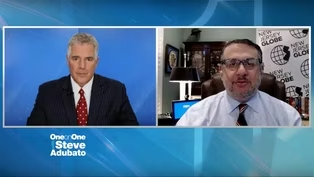
The Challenges Faced by New Jersey's Influential Leaders
Video has Closed Captions
Clip: S2022 Ep2511 | 7m 46s | The Challenges Faced by New Jersey's Influential Leaders (7m 46s)
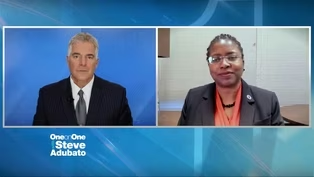
How the Pandemic Increased Mental Health Issues
Video has Closed Captions
Clip: S2022 Ep2511 | 8m 50s | How the Pandemic Increased Mental Health Issues (8m 50s)
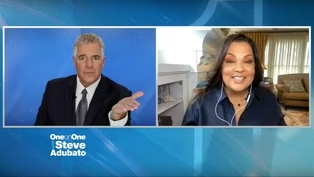
The Need to be Adaptable in the Television Industry
Video has Closed Captions
Clip: S2022 Ep2511 | 12m 25s | The Need to be Adaptable in the Television Industry (12m 25s)
Providing Support for PBS.org
Learn Moreabout PBS online sponsorship
- News and Public Affairs

Top journalists deliver compelling original analysis of the hour's headlines.

- News and Public Affairs

FRONTLINE is investigative journalism that questions, explains and changes our world.












Support for PBS provided by:
One-on-One is a local public television program presented by NJ PBS