Monograph
Summer 2024
Season 6 Episode 2 | 26m 47sVideo has Closed Captions
Host Jennifer Wallace Fields learns how to fly fish with fisheries biologist Dr. Hank Hershey.
Monograph is going to the great outdoors! Jennifer Wallace Fields gets fly fishing lessons from Dr. Hank Hershey, fisheries biologist and artist. We’ll also learn about the hand-crafted lures and musical stylings of Black Warrior Lures from Tuscaloosa and take a boat ride with coastal icon, Jimbo Meador. C’mon, let’s catch some fish!
Problems playing video? | Closed Captioning Feedback
Problems playing video? | Closed Captioning Feedback
Monograph is a local public television program presented by APT
Monograph
Summer 2024
Season 6 Episode 2 | 26m 47sVideo has Closed Captions
Monograph is going to the great outdoors! Jennifer Wallace Fields gets fly fishing lessons from Dr. Hank Hershey, fisheries biologist and artist. We’ll also learn about the hand-crafted lures and musical stylings of Black Warrior Lures from Tuscaloosa and take a boat ride with coastal icon, Jimbo Meador. C’mon, let’s catch some fish!
Problems playing video? | Closed Captioning Feedback
How to Watch Monograph
Monograph is available to stream on pbs.org and the free PBS App, available on iPhone, Apple TV, Android TV, Android smartphones, Amazon Fire TV, Amazon Fire Tablet, Roku, Samsung Smart TV, and Vizio.
Providing Support for PBS.org
Learn Moreabout PBS online sponsorship(happy percussive music) - [Jennifer] Is it truly summer in Alabama if you haven't stuck your toes in the river?
Today we're outside learning to fly fish with Dr. Hank Hershey.
While I try to get the hang of it, we'll also learn about the handcrafted lures and musical stylings of Black Warrior Lures from Tuscaloosa, as well as take a boat ride with coastal icon, Jimbo Meador.
(happy percussive music continues) Come on, let's catch some fish!
(jazzy music) - You can pretty much imitate anything with a fly.
- Yeah?
Wow.
- A lot of times- - Oh, my God!
- So sometimes with fly fishing, you're either trying to imitate what they wanna eat- - What?
- Or you're trying to imitate something that they really don't like and just want to get it out of their business.
- I need to have my glasses on for this.
(Hank laughs) - And there's a mouse.
- Oh my gosh.
Wait, where's the mouse?
- Here's the mouse.
- Oh yeah, it is!
I'm immediately drawn to the sparkly flies that are sitting over here.
- Yeah.
(Jennifer laughs) - [Jennifer] What are the white fluffy ones?
- [Hank] Those are called game changers.
- I like that name.
- Here's a hellgrammite.
- [Jennifer] A little hellgrammite.
Might not.
(both laugh) I would 100% wear that.
- [Hank] This is the adult version of what you've got.
- Oh, cool!
- Let's do this.
- Let's go fishing.
- [Hank] Wait for me!
(Jennifer laughs) - [Jennifer] I should, I don't know what I'm doing.
Speaking of lures, let's hear the story of Damon Toney in Tuscaloosa who's been making fishing tackle and music for most of his life.
- I just grew up fishing, right?
As a kid, I just been fishing all my life, Although it was fun, you fished to stock the freezer, right?
So there'd be food there.
My dad was a teacher, my mom was a teacher.
So you had two professionals.
And yet we had a garden on the side of the house and we were fishing every summer stocking the freezer.
Although we didn't really need it economically, that was a part of my culture.
There's never any question of where food was coming from.
I make my own fishing tackle and I test it on the river.
And then, I take it and then sell it online.
If you have a fishing tackle company, a lot of times they'll name it after the waters on which the lures and things were designed.
And so since I'm here on the Black Warrior River, West Central Alabama, that's where I came up with Black Warrior Lures.
(pensive music) The difficult thing is people think I was in the army or something.
And my dad didn't learn to fish from his dad.
He learned it from a friend, but he passed it on to me.
And so I guess that's one reason I do YouTube, take what I've learned and pass it on to others.
My dad used to make these little fishing corks for floats, that we call 'em, and I decided to make some one week and I went fishing with 'em and they worked well, and I thought, I wonder would anybody want to buy these?
So I just put 'em on eBay.
But what happened was people would always ask, "How do I use the dadgum things?"
Because they're not, they're a little bit, they're not intuitive.
So I saw YouTube as a way to teach my customers how to use the products that I'm making for them.
My early videos were horrible, absolutely horrible.
I hate 'em.
I just, I leave 'em up there.
But I absolutely hate 'em.
Since I started sort of studying filmmaking or trying to understand this whole other art and expression.
So I really wanted every single fishing adventure that I do to at least in some way look like a documentary film.
But I have a background in music, graduated at the University of Alabama and I got hit with like a copyright claim from YouTube.
I'm like, do I have a license to use this music.
And so I said, forget this.
I've got two degrees in music.
I'm gonna put the degrees to work.
And so at that point, I started, I said, I'm just gonna start composing all my own music.
I decided I was gonna probably do electronic music, but somewhere along that search I found out about this thing called a modular synthesizer.
If you go back and watch old videos of like the Jazz Fusion group, like Weather Report, you see Joe Zawinul with a keyboard.
But the keyboard was attached to this big monstrosity and he's got all these knobs and all these wires.
And I found out that this technology had kind of experienced a resurgence.
This old technology had come back.
That's where I decided, well, maybe I can just think more like a composer and less like a performer.
You're kind of a composer arranger/conductor.
You know, you're kind of doing all those.
But it is a kind of what I would call process music.
And that process is playing out, but it's not like I'm separate from the process.
I gotta still manipulate, I gotta twist, I gotta patch, I gotta tweak.
But I just compose the tunes and I'm almost always have a patch ready or almost always have a tune going.
And I just record the tunes.
Once I get about seven tunes recorded, I just put 'em together and put 'em on an album on Bandcamp, and I sell it under the Creative Commons license so people can buy it and actually download it and use it in their YouTube videos.
And I've got, what, 23 albums?
Most of those are seven tunes per album.
Some of 'em a little bit more.
And I have a couple of singles out, but 23 releases.
So it's a nice little library that's been built up.
I grew up in Selma, Alabama, and I grew up fishing along the Alabama River.
So I learned a lot from my dad, also learned a lot from my brother.
And then once I went to college, you just sort of, you just sort of get absorbed into whatever it is you're studying, and that just sort of becomes your life.
So that's why I didn't fish.
I got done with college.
I went to graduate school as well.
I was just outta school and trying to find work, couldn't find work.
I always had a sort of a fascination with canoes.
I wanted to build a canoe with my dad.
I said, ah, this would be a good way to spend more time with my dad, I'm done with school or whatever, and maybe can get back into fishing that way.
But my dad died and that was 2007.
I was just faithless and hating the world and kind of wishing everything would die, you know?
And then I just, one day I just said, forget, I'm done.
Forget this.
I just said, I'm going fishing.
(reel clicking) There we go.
Oh, it's a little catfish actually.
When I was a kid, all we knew is what we knew and what was locally available.
We didn't have a way to see what somebody's doing on the Jordan River in the Middle East.
Right?
Or doing in another river across the state.
There's no geographic boundaries anymore.
I'm on this sort of backwater river.
West Central Alabama.
The way I fish is not popular.
It's not what they're using in the bass tournaments.
If it's not popular how in the world do you find people who are interested?
Well, people are out there looking, there are people out there searching for, okay, how do I fish with just a line in my hand?
I said, well, wait a minute.
My dad did a lot of woodworking.
He made clocks and worked with resins and things.
Said I should be able to make one of these just outta wood.
So I started, I bought a lathe and kind of experimented and eventually came up with a design pretty much like this one.
Almost all look like this now.
This is southern yellow pine.
Whatever's happening telegraphs directly to your hands.
When you're with the rod, the rod sort of dampens it or something.
I can't explain it.
Here we got one.
There we go.
Wait a minute.
Yeah, there we go.
Oh little guy, little striped bass.
It's a minimalist system.
It's just a line, the weight and some bait.
Simple.
It doesn't cost a lot.
And you can catch a lotta fish with it.
And that's why I love it.
- [Jennifer] Woo.
There we go.
(Jennifer laughs) - We'll start by holding pretty close to the reel, pinching the line and just start pulling line off of that reel.
So I keep pulling.
- Okay.
- Feed more, more, more, more, more, more, more, more, more.
Okay, that's good.
The first step I'm gonna teach you is a roll cast.
So a roll cast is really, it requires no back cast whatsoever.
You're just learning what the weight of the rod feels like in your hand.
So you're gonna hold the rod straight up and down, maybe even raise your arm up just a little bit and then you're gonna point the rod down towards the water.
Just flick it down.
I don't think I really need to teach you anything.
- Whoo!
(laughs) - You're a natural.
- Yay.
I had that beginner's luck going for me that first time.
- Yeah.
Bingo.
- Yes!
Okay, I think you're ready for step two, which is the back cast.
So I'll kinda show you what that looks like.
- Okay.
- Before I have you do it.
So I'm pulling it up off the water with that flick motion and I'm pushing it forward with that same flick motion.
And I'm just holding the line with my left hand.
See how my left hand's not really moving and I'm just kind of window washing, window wiping with my other hand.
(both laugh) And then when you're ready to release, you just let go of the line with your hand and the weight of the line will carry itself outta the rod.
- Okay.
Wow.
You make it look easy.
- That's all there is to it.
- Okay.
- There it is.
That's beautiful.
Okay, so now you're gonna pick it up and throw it behind you.
One more.
Yep.
There it is.
There it is.
- But do it more times?
- Do it more times.
See if you can do it so that the line never touches the ground.
Roll cast again.
Get it out in front of you.
There it is.
Perfect.
Yeah, that's it.
- No, I hit myself again.
Oh, oh!
- Oh, it's in your skin.
- I caught me.
- It didn't go deep enough that we need emergency medical care.
- No, I'll be okay.
- That would be something.
- Yeah.
Would that be a first?
- I have snatched hooks out of skin though, so.
- Oh, I was about to say.
- We should be okay.
We won't need a doctor.
- Okay.
Well you are a doctor.
(both laugh) - I'm a fish doctor.
All my patients have fins.
(line whirs) That was good.
So we've given this spot a pretty good try.
I don't think we're gonna catch anything in here.
- Okay.
- But I think if we move upstream and maybe cast in that pool a little bit, we'll have better chances.
- Okay.
Hank does so much more than fish.
While we move upstream, let's visit him in his studio.
(thoughtful music) - I know a lot of people I think don't know what fish really look like.
People don't really have the appreciation for the diversity in forms and colors and stuff that I think most fishermen can appreciate.
Fish to most people are just shadows in the water.
Fish are literally my entire life.
My name's Dr. Hank Hershey.
My parents call me Henry.
My fishing buddies call me Hank.
Sometimes it's confusing for people, but it doesn't really matter.
(laughs) I'm a fisheries biologist by trade and an artist, a creative director.
I wear a lotta hats, but most of my world revolves around fish and fishing.
I think having a really strong sense of place and rootedness is important for anyone.
So that's what I tried to do when I moved to Alabama.
I was really focused on getting to know the people here, getting to know the places especially.
Alabama's like no place I've ever been because of the diversity.
You can be in the Appalachians in Northeast Alabama and then walk down the Piedmont and go over all those cascading falls and the rivers and then you're in the coastal plain, the wiregrass, the black belt.
And we've got some beachfront property as well.
So, you know, it's such a joy to be able to see so many wild places that are so different from one another but so close.
I work for the Army Corps of Engineers as a postdoctoral fellow.
And my job is specifically to understand how fish interact with barriers to migration and rivers.
So usually that's like a dam or something.
A lot of fish require habitat upstream to spawn.
They need to migrate.
And when there's stuff in the way like dams, that can interfere with their lifecycle and it can wipe out entire populations.
It also has effects that are not as obvious as wiping out entire populations.
And those effects are the ones that I'm usually working on.
So half of my job is getting native fish past barriers, and the other half is making sure that invasive fish don't get past barriers.
But getting fish upstream of dams is like a multi-billion dollar like project in this country.
We're just now starting to see some of the funding for that in Alabama.
The Army Corps and the Nature Conservancy recently took on a feasibility study to discuss and plan bypass channels around the dams.
And so those are gonna be just enormous construction projects that divert some water around the dams for fish to basically climb their way upstream.
So it's kinda cool to be on the leading edge of that and we're just trying to do the best we can to set those projects up for success.
If something eats this, we're gonna have some fun.
Slippery!
I love wind.
The fish can always tell when there's a camera on.
I caught a leaf.
Let's go for a walk, a little walk.
I'm just glad the water's so cold.
Okay, put one under those trees.
Forward, backward, forward, backward, forward.
I just don't know.
Nobody wants to play with me.
That's not gonna catch a fish.
Alright, one more cast.
Caught plenty of leaves.
These sycamores are something else, aren't they?
Well, there's none here, but yeah, there's a good one.
I love sycamores.
People who say it's not about the fishing never catch fish.
That's okay.
Time to go to Jack's.
Oh yeah.
The first time I decided I wanted to try fly fishing was when I started packing for my first trip to Alaska.
And my dad was like, well you better bring a fly rod.
And then I just kind of took that rod with me wherever I went.
In college, I moved to Auburn in 2017 to start grad school.
I started learning about bass fishing with a fly rod and I was totally hooked.
Fly selection's really important because if they're not eating what you're throwing, it's not because they're not hungry, it's because they don't think your fly looks enough like food to eat it.
Or they're focused on another food source that your fly does not imitate.
I've met a lot of really talented fly tying artists in the southeast and I've tried to help them out with getting them some business.
And so Hank's Bait Shop kind of turned into a way for me to curate stuff that I knew was good that I knew would work.
I'll do like an assortment of flies every couple months, artists that I admire and then I'll put it all together and sell 'em in batches.
And then I also do some painting.
I just make fish look like the real thing, I think, with some flourishes and characterizations.
I try to emphasize some of the more beautiful traits of fish, just to give 'em a little emphasis, I guess.
Trying to help catch and release anglers memorialize their fish without having to kill 'em or pay for a really expensive mount.
(pensive music) And then the third hat that I wear is I'm the creative director of "Southern Culture on the Fly" magazine, which is an online magazine and we focus on regional storytelling.
I kind of describe it as the skateboard magazine for southern fly fisherman.
It's kind of counterculture.
Our readers are sort of brought together by kind of a common disdain for the pretentious.
We focus a lot on DIY, just kinda figuring it out on your own and finding people like you to do it with.
One of the greatest things about wildlife and fish is that they exist.
People sort of talk about conservation in terms of value and in terms of ecological services.
You know, there's some animals have direct human benefits like fish you can eat and mussels and oysters clean the water, beavers create wetlands that store carbon dioxide and all this stuff.
While I recognize those values, I think it's more important to just recognize the intrinsic value of animals and that every life form really has a right to be here.
The more you understand the linkages between those animals, their requirements for flourishing, the more you can appreciate that worth I think.
- So, which came first, the painting or the fishing?
- They sort of naturally came together.
I mean I was always drawing and doodling as a kid and stuff.
I just felt like science and art always benefit from one another.
Art was always a huge part of how we understood things because people are visual learners.
We understand things through diagrams and through visual representation and you talk about anatomy and stuff and not everybody gets to see a cadaver.
So diagrams and really well drawn diagrams were important for medical science and anatomically correct drawings of fish is one thing.
But I also make diagrams and stuff for publications and- - Mm-hmm.
I always think that one of the most important things about art is the ability to facilitate conversations and make things approachable.
And I kind of feel like, especially with your paintings, the fish paintings, it's a symbiotic relationship and that people that are into fish can now be into art and people that are into art can now be into fish.
- Yeah.
- Know it's like a little- - Right, it's kinda blurring that line.
- Yeah.
- That shouldn't really exist in the first place.
- Exactly.
- It's like, yeah, that's a really good way to put it.
Nature is beautiful in some way or another.
- Yeah.
- Even if you hate camping, you still think flowers are pretty in your garden, and that's not wild.
It's not wilderness, but it's still nature.
And I think making all that tangible with art is really important to me.
But at the same time, kind of doing science in that social context is important too.
And I think art really helps make science more palatable and more accessible.
Let me see if I can run up there and try to catch one.
- [Jennifer] Yeah.
- It'd be really great to have actually have a fish on film.
- That would be.
- For our fishing segment.
(Hank laughs) - [Jennifer] While Hank verifies that there are absolutely no fish in this river, we have a very special treat.
Come along for a boat ride on the Delta with outdoorsmen and living legend Jimbo Meador.
(gentle music) - A lotta people ask me why I quit school.
I said "It was interfering with my education."
(laughs) It was.
But biology, now I took every course I could in biology.
(gentle music continues) Great blue heron.
You know, I've made a living on the water my entire life.
It's the reason I like birds that make a living on the water.
(gentle music continues) There's your eagle nest right here.
- Over there?
- Yeah.
I either wanted to be a mountain man or go to sea.
And I grew up on the eastern shore of Mobile Bay in the summers.
But I grew up in Spring Hill in the winters, which is in the country and closest I could get to the mountains.
I had a trap line.
I trapped furs and sold furs.
In fact, I was doing the Davy Crockett period when everybody's wearing coon skin caps.
I made big money on coon skins.
But this was my stomping ground right here for years.
(gentle music) (gentle music continues) There's a gator, no in front of us, he just went down.
We in gator country now.
I grew up in boats.
My first boat was a rowboat.
And I've written about Duke, the old black guy that I grew up with, and he made cast nets for catching mullet.
And he made me my first one when I was four or five years old, you know, and only thing was he was left-handed and he taught me to throw a net left handed.
And I still do.
But he said it didn't matter.
As long as it gets the job done, we would catch mullet.
I just wrote a thing for "Garden and Gun" about ain't no mullet like a June mullet.
That's what he always said.
Because that's when they're the fattest and good to eat.
And I fished with him and floundered with him and we never missed a jubilee.
So I was a commercial fisherman, I guess, way back then because we were selling what we were catching.
So like I say, really, I made a living on the water my whole life.
Ran a tugboat on the Mississippi River in the Intercoastal, and then I shrimped and I was a fly fishing guide.
Then I was, worked for Orvis, the fly fishing company and covered the whole Gulf Coast between guiding and fishing.
And mostly... that's the way I've made a living.
(happy music) Oh, I was in the boat business and I designed some kayaks that you could stand up in and fly fish out of.
And now stand up paddle boards.
'Cause you can get back in really shallow water.
I found out these duck ponds over in Louisiana, they're shallow ponds, but the red fish get in there and they're tailing, you know, this water's so shallow, they're feeding and their tails come up and these red fish would be in there.
You could tell they were happy as they could be because they were, they just looked happy.
And as soon as you got that boat in there, you could tell that they got nervous.
And the boat's displacing water.
Just like when you get in a bathtub, the water level rises.
Well, the same thing with that pond.
When you push that boat in there, the water level rise.
So I started going in there with pirogues and canoes and then these kayaks that you could stand up in and fly fish out of.
And heck, I've called red fish just dangling a fly in front of 'em.
You can get that close, you know?
So anyway, the biggest fun is coming up with ideas of how to catch a fish.
That's more fun than catching 'em.
And I wanted to be a marine biologist, so that would've been a reason to stay in school.
But my father died fairly young and I decided to go to work.
And I was doing things I like to do and I've done things I like to do all my life.
So if you love it, if you love what you're doing, it ain't work.
And that's all I gotta say about that.
(Jimbo laughs) (happy music continues) (happy music continues)
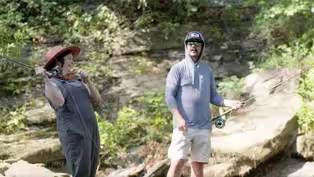
Preview: S6 Ep2 | 30s | Host Jennifer Wallace Fields learns how to fly fish with fisheries biologist Dr. Hank Hershey. (30s)
Providing Support for PBS.org
Learn Moreabout PBS online sponsorship

- Arts and Music
The Best of the Joy of Painting with Bob Ross
A pop icon, Bob Ross offers soothing words of wisdom as he paints captivating landscapes.











Support for PBS provided by:
Monograph is a local public television program presented by APT