
Summit Focuses on Student Learning After High School
Clip: Season 4 Episode 102 | 3m 19sVideo has Closed Captions
Education leaders and students share ideas on learning after high school.
Students in Kentucky need more ways to learn after high school. What can be done to give Kentuckians more postsecondary opportunities? To find some answers, the Kentucky Council on Postsecondary Education hosted a Student Access Summit.
Problems playing video? | Closed Captioning Feedback
Problems playing video? | Closed Captioning Feedback
Kentucky Edition is a local public television program presented by KET
Summit Focuses on Student Learning After High School
Clip: Season 4 Episode 102 | 3m 19sVideo has Closed Captions
Students in Kentucky need more ways to learn after high school. What can be done to give Kentuckians more postsecondary opportunities? To find some answers, the Kentucky Council on Postsecondary Education hosted a Student Access Summit.
Problems playing video? | Closed Captioning Feedback
How to Watch Kentucky Edition
Kentucky Edition is available to stream on pbs.org and the free PBS App, available on iPhone, Apple TV, Android TV, Android smartphones, Amazon Fire TV, Amazon Fire Tablet, Roku, Samsung Smart TV, and Vizio.
Providing Support for PBS.org
Learn Moreabout PBS online sponsorshipStudents in Kentucky need more ways to learn after high school.
So what can be done to give Kentuckians more post-secondary education opportunities?
To find some answers, the Kentucky Council on Postsecondary Education hosted a student access summit.
We wanted to do something with our partners in K-12, and that meant that we needed to look at all of what we call barriers between each of those transitions between early childhood and into post-secondary.
In other words, what happens when you go from the eighth grade middle school, in the high school, from high school, in the college, even from K through three, and then on up.
So this summit is about bringing K-12 folk.
Put them in the same room with higher ed people, policy people and talk about solutions.
We have to become what I call student ready.
We just can't expect our students to be college ready all the time.
So some of the barriers we experienced, like was many students graduating from high school may not be fully academically ready socially or emotionally.
So the other thing too, if you tend to be, Low-Income or from other disenfranchized backgrounds, you may not have had all the opportunities to get all the inputs that you needed to maybe a dual credit course or an AP course.
College should really seem like the answer for a lot of people.
That wasn't really something that was talked about as much as where where I grew up in Northern Kentucky.
And so once I went, I kind of felt like the oddball out, like I kind of thought that that was always going to be on my tables, but I didn't necessarily know what that looked like.
But once, once I got to the high school, and I feel like those conversations started occurring, I definitely think that's when students like you kind of you see the spark, you know, like when when you take it from this like huge dream and you make it seem like it could be a reality.
I think that's the difference.
And I think the only way that that's possible is if there are adults and people and their support system to facilitate those conversations.
What we know is that those individuals who have some type of credential or degree are degree by themselves, to be able to secure employment that will help them take care of themselves and their families and that they are able to have better health care for their better able to have, child care, just be able to take care of their needs.
I think unless you ask a student, you don't know, where can we improve?
And I think, I think bringing us in today, I think we're all at a different spot, in our education and our paths are very, very different.
And so I think being able to have these conversations of like, well, let's highlight what we can do.
Good.
Absolutely.
And like, where are we succeeding?
Yes.
Like I think that's amazing.
But I think it's so vital that we have the conversations of where can we improve?
Like how can we better support students and how to better know that our students themselves.
And I think this is really allowing us to develop an action plan of like, we know we're having these conversations today, but what are we going to do about it tomorrow?
The CPS says they want 60% of Kentuckians to have a college credential by the year 2030.
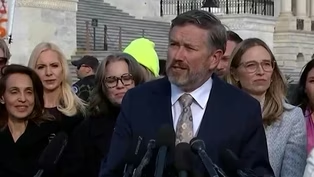
U.S. House Votes to Release the Epstein Files
Video has Closed Captions
Clip: S4 Ep102 | 2m 49s | After months of debate, the House votes to force the release of the Epstein files. (2m 49s)
Providing Support for PBS.org
Learn Moreabout PBS online sponsorship
- News and Public Affairs

Top journalists deliver compelling original analysis of the hour's headlines.

- News and Public Affairs

FRONTLINE is investigative journalism that questions, explains and changes our world.












Support for PBS provided by:
Kentucky Edition is a local public television program presented by KET