
Superior City Football Club
Season 12 Episode 12 | 26m 48sVideo has Closed Captions
It’s gameday with Superior City Football Club, a homegrown soccer team in the Northwoods.
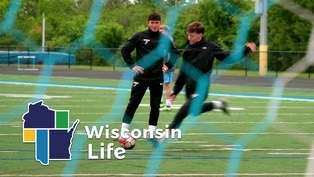
Let the match begin! We join Superior City Football Club, a homegrown soccer team in the Northwoods. Host Angela Fitzgerald takes to the field to meet the players and even takes a penalty kick against the team’s goalie. Then join a Crokicurl competition in Altoona and hear from other Wisconsinites sharing their passions.
Problems playing video? | Closed Captioning Feedback
Problems playing video? | Closed Captioning Feedback
Wisconsin Life is a local public television program presented by PBS Wisconsin
Funding for Wisconsin Life is provided by the Wooden Nickel Fund, Mary and Lowell Peterson, A.C.V. and Mary Elston Family, Leon Price & Lily Postel, Stanley J. Cottrill Fund, UW...
Superior City Football Club
Season 12 Episode 12 | 26m 48sVideo has Closed Captions
Let the match begin! We join Superior City Football Club, a homegrown soccer team in the Northwoods. Host Angela Fitzgerald takes to the field to meet the players and even takes a penalty kick against the team’s goalie. Then join a Crokicurl competition in Altoona and hear from other Wisconsinites sharing their passions.
Problems playing video? | Closed Captioning Feedback
How to Watch Wisconsin Life
Wisconsin Life is available to stream on pbs.org and the free PBS App, available on iPhone, Apple TV, Android TV, Android smartphones, Amazon Fire TV, Amazon Fire Tablet, Roku, Samsung Smart TV, and Vizio.
Providing Support for PBS.org
Learn Moreabout PBS online sponsorship- Announcer: The following program is a PBS Wisconsin original production.
- Angela Fitzgerald: Coming up on Wisconsin Life: Hit the ice in Altoona to learn Crokicurl, a Madison embroidery artist stitching together folk art and community, an art professor from Menomonie turned board game maker, an exchange student finding a home in Monona, and a guide leading tours of a rare old-growth forest in Vilas County.
- This was the number-one tree in the Northwoods pre-settlement.
- Angela: That's all ahead on Wisconsin Life.
[bright music] - Announcer: Funding for Wisconsin Life is provided by: the Wooden Nickel Fund, Mary and Lowell Peterson, the A.C.V.
and Mary Elston Family, the Stanley J. Cottrill Fund, UW Health, donors to the Focus Fund for Wisconsin Programs, and Friends of PBS Wisconsin.
- Let's go, buddy!
[upbeat music] - Goal!
We're kicking off Wisconsin Life.
I'm your host, Angela Fitzgerald.
We're gearing up for Youth Night with the Superior City Football Club, a soccer organization with multiple teams competing across Minnesota and Wisconsin.
Tonight's game is at NBC Spartan Sports Complex in Superior.
[upbeat music] At Youth Night, first and second teams of Superior City FC players face off, [players shout] [whistle blows] with a chance for the crowd to get in on the fun.
[ball thumps] [players cheer] It's a fun way to celebrate this soccer club from humble beginnings.
It truly is a homegrown effort, as they formed a semi-professional, multi-team club with talented players from across northern Wisconsin and Minnesota.
[crowd cheers] The match is about to begin here, so before the ball drops, let's head into our first story.
That takes us out on the ice in Altoona, where players throw stones for a chance to be crowned champion.
[upbeat music] - Kassandra Humke: We are here in the city of Altoona, Wisconsin.
And we're playing on the first Crokicurl rink in the United States of America.
[chuckles] - Roy Atkinson: We're the first, so we lay claim to the U.S.
Crokicurl Championship.
- Oh, no!
[curling stone clatters] - Teammate: You hit it!
- Chris Staack: We took the tournament the second year, and we're here to try to win our second title, let's say, in Crokicurl.
- Kyle Sorenson: I'm the national reigning champion with my partner at Crokicurl here.
Nice shot.
Wait, wait, wait, wait, wait!
- Kassandra: Crokicurl is a sport that is a mixture between curling and a board game called Crokinole from Canada.
Oh!
Do you have to be, like, behind the line?
- Kyle: So, Crokicurl is just a blown-up version on ice.
- Kassandra: Two teams are playing against each other.
They each have two stones.
- Chris: The goal is to get it in the button.
- Kassandra: If they miss that, then they have to hit the opponent's stone.
- It's a lot of collisions.
[stones clack] We want people to get outside, be active.
Good shot.
- Kassandra: It's definitely growing.
The word is getting out there to come and play it.
[upbeat music] - Whoo!
- We have two-time champions here.
- It's still a silly game.
[laughs] Absolutely.
- Look at that guy!
MVP, he's the MVP.
MVP, best player ever.
[upbeat music] - Angela: Next up, we meet a Monona exchange student whose journey is marked by survival, resilience, and expanding her circle of family.
[gentle music] When war broke out back home, all Jwana Rustom could do is watch.
- Jwana Rustom: I called them, and I was like, "Hey, is everything okay?
Where is my family right now?"
And, like, if I don't hear from them, like, I just panic.
Like, are they alive still?
I was like, "What should I do?
"Like, I'm in class right now.
I can't do anything."
And I just felt so powerless.
I can just sit and watch.
And that was like a nightmare for me.
- Angela: For Jwana, growing up in Gaza meant surviving war.
Coming to Wisconsin meant finding a new home.
- Jwana: I'm a Palestinian, one who was born in Gaza.
It was my home, my people, my friends are like, everything there just makes me happy.
I was born in 2008.
I was born literally in the middle of a war.
And I experienced seven wars until now.
- Angela: A State Department scholarship program called YES, Youth Exchange and Study, opened a door.
- Jwana: My best friend, Nastia, she was a YES student.
She got placed here, and, like, she had a great experience.
She was like, "Jwana, you should do this."
- Angela: With her parents' blessing and plenty of nerves, Jwana boarded a plane to Wisconsin.
Her new home looked different than anything she had known before.
- Jwana: I heard about the cheese, the snow.
I was so excited.
People here are just so lovely.
You don't know them, and in the streets, like, "Why are you smiling at me?"
- Angela: In Monona, she moved in with the Atkins, her new host family.
- Liz Atkins: We actually didn't wanna host a student, but Jwana's counselor at school had shared her GoFundMe.
I had, you know, read her story, and as soon as that email was sent, I forwarded it to Caleb.
And I was like, "Hey, I think we should do this."
- Caleb Atkins: Get her!
[Liz laughs] - Liz and Caleb are young, so, like, I never-- I kind of never saw them as a parent, but I also do.
Liz is like one of my sisters.
Caleb is like a brother.
Riley is the bigger one.
She's full of hope.
Then Evie is so goofy and funny.
They welcomed me a lot when I came here.
I owe them so much.
- Angela: For Jwana and the Atkins, connection often came on a plate.
- Caleb: I do pretty much all the cooking at home, and so I wanted to make sure that we incorporated Palestinian food into our repertoire.
- And when I ate that bite, I was like, "Oh, my God, like, my mom used to make it exactly like this."
So, I couldn't handle it, and I cried.
- When she took a bite and she started to cry, 'cause it was like a taste of home.
Food is powerful in that way.
- Angela: But even here, thousands of miles away, the suffering was never far.
- I came here, and I didn't even enjoy, like, two months full until the war happened.
I lost my cat.
I lost four friends.
One of my friends died under the rubbles.
They cannot find, like, parts of her body to bury.
And like, that's not something, like, rare.
And then now, they're just totally gone and all that I have of them is just pictures and memories.
- Angela: She carries grief for family, friends, and the home she left behind.
- It's super weird to losing a soul, cry so much about it, and then start losing more.
And then you just feel, like, numb.
So, you see those pictures and images and you always, always imagine your family being in that position.
And you just don't know what to do.
- She's going through all of this normal teenage stuff on top of surviving multiple wars.
- Caleb: Our big message to Jwana was that, like, whatever you're feeling, like, we'll take it as it comes.
You know, joys, sorrows, everything in between.
- Angela: Her journey isn't over, but from Gaza to Wisconsin, from grief to belonging, Jwana carries her story and her hope with her.
- I just hope to see my country a little bit free, more than now.
And have a little bit more peace than now.
- Liz: I mean, it's just grown.
Like, our family and our extended family and our kids forever.
- Angela: For Jwana, home is no longer just a place.
It's the people who make sure she's not alone.
- Caleb: Draw the circle of your family bigger.
Like, be willing to draw a larger circle because your family is so much more than just the people that are blood related to you.
[Jwana exclaims] - I hope that peace be upon you and everybody else, in their hearts and in their minds.
I really wish that peace can be upon everybody.
[gentle music] - Angela: Now, we head to Madison, where an embroidery artist brings the community together to celebrate folk art and tradition.
- Ireri Andrea Muñiz Ortega: I like abstract forms.
Yeah, I think it's more freestyle exploration, being inspired by nature and colors.
My name is Ireri Andrea Muñiz Ortega.
I'm from Mexico City, and I'm a textile artist.
Coming from Mexico, specifically from Mexico City, if you go out to the streets, there are a lot of colors everywhere, you know?
Like going to a market, the mercado or a tianguis, like all the fruit, all the sounds even.
So, I always try to bring some of that to my exploration and to my creations.
[gentle harp music] I studied communication, and in 2017, that year, there was a big earthquake that hit the city.
And I was, after that, experiencing anxiety attacks, panic attacks, so I was looking for an activity to help me to, like, calm me down.
All these loop movements with the thread and the needle, that helped me to calm my nerves.
So, that not only helped me to, like, heal that really big thing in my life, but also, like, I was, like, hooked.
I wanted to keep doing it.
This is, like, a flower.
And I just love these, like, signs that people put, like, in the markets.
Since I'm here, I found that I'm not the only one having these feelings and these thoughts, right?
So, we are always thinking about home, our casa.
I think community activities, community spaces or projects can help us, like, heal that.
The way I connect with the community right now is through my workshops.
The Día de Muertos celebration that we organize in Viola, Wisconsin, and that event is pretty special for me because of the meaning of the celebration.
We believe that starting the night of October 31 to November 2, the dead temporarily come back to visit the living from the Mictlan, that is the underworld of Aztec mythology.
[soft vocalizing] You know, when you migrate to a new country, there is this process of saying goodbye to this comfort zone, this, like, amazing space that you know.
And then, like, start these new dreams and this journey to a new place.
And I've learned, since I moved to the U.S., to try to carry this sense of home with you all the time.
What's home to you.
- It's match time as we visit the Superior City Football Club, homegrown teams who bring the heat to the field.
[upbeat music] Started in 2017, General Manager Kaden Bergman has seen the team grow from the beginning.
- Kaden Bergman: Hi, Mom!
So, we are located in Hayward, Wisconsin.
We started off in the amateur division of the Duluth League, and then we basically played in Hayward for five years.
Decided we wanted to provide some high-level opportunities for our players, so we moved the organization up to Superior, Wisconsin in 2023, and we've been here for the last three years.
[players shout] [whistle blows] Currently, all of our players are from the Twin Ports area or the surrounding greater area.
So, we wanna really prioritize developing local talent.
- Player: Cut off the space.
- Kaden: I think it's a fantastic opportunity for some of the older guys to come in and teach the younger guys how to have a professional standard for themselves.
[players applaud and cheer] - And how many teams do you have currently?
- We currently have a men's amateur team, a men's semi-professional team, and a women's semi-professional team.
[players shout] [fans cheer] - Angela: Teams supported by a community who show up rain or shine.
- Fan: Thank you.
- Kaden: It's been pretty cool to see the growth.
The community's been fantastic in supporting us.
And all of our board members, we have a lot of volunteers helping to run this club, so they do a fantastic job.
We started off as something small, and it's just continued to get better and better every single year.
- And the kid element was so adorable as well.
- Yeah, we love having the kids coming out and watching.
You know, they could be on this field someday.
So, we'd love them to come out and experience something to work towards.
- Angela: The day may come sooner for some lucky kids, who at tonight's match get a shot at scoring a goal.
[players shout and cheer] - Right here, do a celebration!
At the end of the night... - Producer: Show 'em how it's done, Angela!
- Angela: ...I even got my chance to take the pitch.
[ball thumps] [players cheer] [whistle blows] - Player: Goal!
- Angela: And it's a point added to the score board for Superior City FC, a team full of passion and promise.
[players chant] - In unison: One, two, three, City!
[bright music] - Angela: We now make our move to Menomonie to team up with a professor rolling the dice on a new passion project.
[gentle acoustic music] When we first came across Dave Beck on Wisconsin Life, it was along the Saint Croix River.
The spot became the inspiration for Tombeaux, a computer game where players explore the Saint Croix's ecological history.
- Dave: As the player navigates through this game, they're gonna see more and more that these towering white pines start to disappear.
[electronic beeping] - Angela: Like many children of the 1980s, Dave grew up loving video games.
- Christmas of 1988, I received my first Nintendo Entertainment System from Santa.
[video game sound effects] Playing Zelda, the visuals, the complexity of being able to play that game, exploring worlds.
That's really what changed my life forever.
That caused me to want to become someone who teaches video game design.
[bell chimes] - Angela: And that's what Dave did at UW-Stout.
- Dave: A couple announcements and then we'll get right to it.
So, we can start thinking about what you guys wanna do with your games after you're done here.
- Angela: Now, Dave finds himself on a new path, one that also started with a gift.
- Dominion.
So, this is the first-ever game I received from my wife.
I unwrapped the game and I looked at it, and I kind of laughed, like, "I don't know why you're giving me a board game.
I have really no interest in this."
I didn't say that, but I smiled, and that's it.
And I played it, and it was kind of like this, like, I don't know, something happened.
My whole mind just opened up to realizing, "These exist out here.
"I've walked by these, these walls of games.
There's hundreds of these types of games out there."
And I just fell deep, deep, deep into a hole.
[dice clack] Come on!
[Dave gasps] [group chuckles] [Dave roars] - Angela: Now, a wall of games forms the backdrop for Dave to play with family and friends.
- Dave: Every time I'd sit down at the table with these games was just such a joyous experience.
- I won!
[Dave laughs] - All the while, two very important things happening: surrounded by friends at a table... - One, two, three.
- Dave: ...and not dealing with digital technology.
Okay, so now are we at the end of the round?
That was it.
That's what sold me on the idea of that becoming a hobby that I wanted to pursue.
And, little did I know, eventually become a way of life for me.
- Angela: A way of life that's becoming a livelihood.
- Dave: When I get into something, I just go deep into that.
I really jump into it and it kind of consumes me in a good way.
The players would have lots of different cards.
Water cards... - Angela: Once again, Dave has gone from player to maker.
- My wife says to me one day, "You know what, Dave, I think the next thing you're gonna do is you're gonna design a board game."
And I said, "No way.
"I have no interest in that whatsoever.
I'm making video games."
After that, we're over in Scotland and I had been touring distilleries, sampling some whiskeys, and one night, I couldn't sleep.
And this idea came into my head about a board game that I could make that had to do with maybe running a distillery, making whiskey.
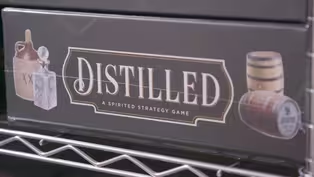
This is one of the first prototypes of Distilled.
- Angela: Again, Dave immersed himself, this time into the world of game creators, taking Distilled to gatherings called protospiels, where games in development are tried out.
And he crafted a social media network of followers, culminating in a crowdfunding campaign to cover Distilled's creation.
- So, I set the funding goal for Distilled at $18,000.
We raised over half a million dollars for this campaign, and I never expected to even come close to that.
- Player: One, two, three, four, five.
- Angela: The extra cash meant Distilled could be what Dave calls a top-shelf game, with quality components and special touches game players love.
And it's been paying off.
- Dan Leeder: Distilled has been doing really well, actually.
It's a very popular game.
It's doing so well, actually, that it's currently out of print.
- Angela: Soon, Dave will have another game on the market.
Luthier, a game based around an orchestra where players make and sell the instruments.
- Dave: The golden age of classical music in Europe, where you're making instruments for the likes of Mozart, Beethoven, Bach, other patrons.
[dice clack] - Angela: All because Dave Beck rolled the dice... - Dave: One, two, three.
- Angela: ...and set off in a new direction.
- Dave: From creation to it sitting on a shelf, it was a brand-new experience.
It was quite the journey.
[bright classical music] Oh, baby.
- Angela: Our last story takes us to the trees in Vilas County, as we join a guide uncovering the diverse ecosystem found in an old-growth forest.
[squirrel chitters] - John Bates: People just absolutely love walking amongst these old trees.
There's another good woodpecker tree, yeah.
It moves your heart, it moves your spirit.
- Angela: Follow John Bates into the woods, and he'll make sure you won't lose the forest for the trees.
- Child: Whoa!
- Angela: He will uncover hidden details.
- And you can age it by the distance between each one of the new stems.
This was a good year.
- Angela: And illustrate the big picture.
- So, we're in what's called a hemlock hardwood forest.
- Angela: John knows well that whole forests in Wisconsin have been lost, tree by tree.
- John: We cut down, in northern Wisconsin, tens of millions of eastern hemlocks.
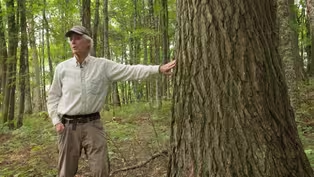
This was the number-one tree in the Northwoods pre-settlement, and now it represents 1% to 2% maybe of the whole Northwoods.
- Angela: The Van Vliet Hemlock State Natural Area is one spot where these great trees still loom above, making this a rare example of remaining old-growth forest.
[bird calls] Finding the state's few remaining pockets of old-growth forest set John on a mission.
- I just wanted to find all these places.
It was an adventure for me.
It's joyful.
It was exciting to find places that I didn't know about and to be thrilled by them.
- Angela: Thrills he shares on his tours.
- The song is "sweet D."
[whistling] - Angela: And in his guidebook.
- These trees are our living ancestors.
They've been here for a very long time.
These old trees tie history together.
That time actually happened.
- Angela: But don't mistake these ancient trees for antiques.
- John: They're not something fossilized that we're looking at in a drawer.
They're living, but they're still 400 or 500 or more years old.
- What are they even dropping?
[John laughs] - Angela: The hemlocks are living, breathing.
- So what are you getting?
What are you finding?
- Angela: Trying to regenerate.
- So what are these?
- Child: They're hemlock cones, I think.
- John: Young hemlock cones right here.
- Angela: Old growth spawns new growth.
A cycle of life that also means accepting death.
- When somebody dies and we mourn, we grieve, and rightfully so.
But when a tree dies out here, is allowed to die, it has an ecological function that's really significant.
And it should be celebrated.
All the salmanders now living underneath there, all those white-footed mice and voles that are feeding every, the barred owl that was keeping you up.
Yeah, yeah, what do they eat?
- Angela: Toppled trees nurture new ones.
- We'll see some old trees completely covered in moss and are called nurse logs because they're nursing along all these seedlings on top.
You can see the perfect lineup of Eastern hemlocks, and now we got a bunch of yellow birch on this end.
- Angela: That lineup of new life on a log includes more than growing trees.
- John: That a hand lens?
- Hiker: Yes.
- John: A tiny little mushroom.
- Angela: Forest life comes in many sizes.
- John: It's worth looking at.
- Angela: And many shapes.
- John: Slime mold.
It's really weird looking.
This is called doll's eyes, 'cause, yeah, it looks like doll's eyes, right?
This is white baneberry.
Try to eat it, it'll be the bane of your existence.
[group laughs] - Angela: A walk in the woods with John Bates includes lessons about the forest, but more importantly, lessons from the forest.
- So, the values of old growth are many.
You can feel peace here.
And what's the value of that peace?
- Angela: Peace is one thing you can take from a walk in the woods.
And that's something that John shares gladly.
- John: Let me pass that on.
Opening up that space to them, to fall deeper in love with the natural world.
[gentle acoustic guitar music] - The whistle's been blown, and win or lose, the Superior Football Club is making its mark in Wisconsin.
For more stories, visit WisconsinLife.org.
Connect with us at stories@wisconsinlife.org or on our social channels.
Until we kick-start the next episode, I'm your host, Angela Fitzgerald, and this is our Wisconsin Life.
[team cheers] [bright music] [players shout] - Announcer: Funding for Wisconsin Life is provided by: the Wooden Nickel Fund, Mary and Lowell Peterson, the A.C.V.
and Mary Elston Family, the Stanley J. Cottrill Fund, UW Health, donors to the Focus Fund for Wisconsin Programs, and Friends of PBS Wisconsin.
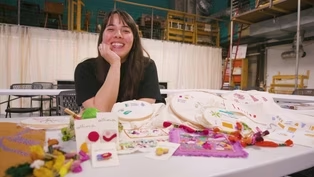
Textile folk artist shares tradition and healing
Video has Closed Captions
Clip: S12 Ep12 | 3m 7s | For Ireri Andrea Muñiz Ortega, textile art is a way to carry home with her from Mexico to Madison. (3m 7s)
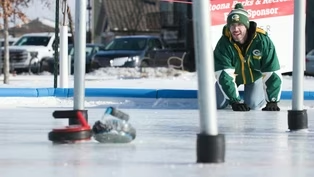
Crokicurl puts a new spin on sport of curling
Video has Closed Captions
Clip: S12 Ep12 | 2m 30s | Curling, long a popular pastime in the state, has a new variation, Crokicurl. (2m 30s)
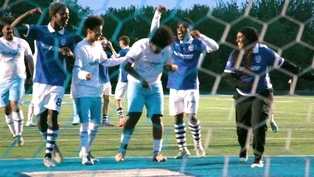
Developing local soccer talent in Wisconsin
Video has Closed Captions
Clip: S12 Ep12 | 2m 26s | Superior City FC prioritizes developing local soccer talent through community support. (2m 26s)
Video has Closed Captions
Clip: S12 Ep12 | 5m 12s | Exchange student Jwana Rostom’s journey is one of survival, grief and hope. (5m 12s)
Preview: Superior City Football Club
Preview: S12 Ep12 | 30s | It’s gameday with Superior City Football Club, a homegrown soccer team in the Northwoods. (30s)
Walk in the woods with an old growth guide
Video has Closed Captions
Clip: S12 Ep12 | 4m 23s | Guide John Bates explores a remaining old growth forest, the Van Vliet Hemlocks. (4m 23s)
How a distillery tour inspired a hit board game
Video has Closed Captions
Clip: S12 Ep12 | 5m 16s | UW-Stout professor Dave Beck created "Distilled," a whiskey-themed board game. (5m 16s)
Providing Support for PBS.org
Learn Moreabout PBS online sponsorship











Support for PBS provided by:
Wisconsin Life is a local public television program presented by PBS Wisconsin
Funding for Wisconsin Life is provided by the Wooden Nickel Fund, Mary and Lowell Peterson, A.C.V. and Mary Elston Family, Leon Price & Lily Postel, Stanley J. Cottrill Fund, UW...