
Supporting Local News in Marginalized Communities
Clip: 6/15/2024 | 12m 46sVideo has Closed Captions
Supporting Local News in Marginalized Communities
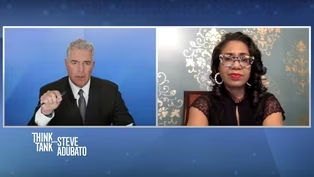
Steve Adubato speaks with Chris Daggett, Board Chair and Interim Executive Director of the New Jersey Civic Information Consortium, to discuss the importance of supporting local news in marginalized communities and news deserts.
Problems playing video? | Closed Captioning Feedback
Problems playing video? | Closed Captioning Feedback
Think Tank with Steve Adubato is a local public television program presented by NJ PBS
Supporting Local News in Marginalized Communities
Clip: 6/15/2024 | 12m 46sVideo has Closed Captions
Steve Adubato speaks with Chris Daggett, Board Chair and Interim Executive Director of the New Jersey Civic Information Consortium, to discuss the importance of supporting local news in marginalized communities and news deserts.
Problems playing video? | Closed Captioning Feedback
How to Watch Think Tank with Steve Adubato
Think Tank with Steve Adubato is available to stream on pbs.org and the free PBS App, available on iPhone, Apple TV, Android TV, Android smartphones, Amazon Fire TV, Amazon Fire Tablet, Roku, Samsung Smart TV, and Vizio.
Providing Support for PBS.org
Learn Moreabout PBS online sponsorship- Hi, everyone.
Steve Adubato.
More importantly, to talk about a whole range of critical issues is Chris Daggett, board chair and interim Executive Director of the New Jersey Civic Information Consortium.
Chris, good to see you again.
- Good to see you too, Steve.
Thanks.
- You got it.
We're gonna put up the website of the consortium.
Tell everyone what it is, because it's critically important, now more than ever.
- Indeed it is.
The New Jersey Civic Information Consortium is an entity, a nonprofit entity created by the state of New Jersey to support local news outlets across the state with a focus on marginalized communities and news deserts.
- Along those lines, there are six higher ed institutions you're affiliated with, correct?
- We are.
- And three of them.
Kean University, NJIT, and Rowan University are higher ed partners of ours.
First of all, what's the role of the higher ed community in the consortium?
A, and B, why are they critically important to the success of this work?
- They were part of the original legislation to include universities because they're training grounds for aspiring journalists, and they also are engaged in research that may be helpful.
And in the case of Rutgers, we've worked closely with the Eagleton Institute to conduct a statewide poll, which is about to be released.
- And so Montclair State University is a critically important part of this as well, right?
- Yes, Montclair State is important when, a number of years ago, from 2010 to 2018, I was the head of the Geraldine R. Dodge Foundation, and one of our first grants in local news was to create the Center for Cooperative Media at Montclair State, and that has become the focal point over the last number of years for local news in New Jersey with some 250 to 300 members, which are effectively every news organization in the state.
What is the connection in your view, and to be clear, Chris Daggett has a background in government, ran for elective office, served in the cabinet of governors in the past, understands public policy better than most.
What is the connection between a healthy, economically strong local media and the health of our representative democracy, Chris?
- It's a very simple equation in my mind, Steve, and a very good question.
If people aren't informed, they're not engaged usually, or their engagement is limited and then democracy suffers.
Local news is sort of the beginning of civic and community dialogue about issues of the day as well as what's going on in communities.
And without that information or very limited information, people just aren't as active and democracy suffers.
- So devil's advocate.
People say, "Well, I get my information "from a whole range of sources.
"Media organizations on the broadcast side often "who say things and report on things that make me know "that I'm right about what I think and I lean toward those."
Not I, I'm saying "devil's advocate" do that.
Or, "I go to a whole bunch of internet sites.
"I don't know who they are, but I picked it up in the news."
Not being critical of any of those information platforms, but what is the problem there if that's where folks are getting virtually all of their information pretty much telling them they're right about how they see the world?
- My guess is they're looking at the world and not the local community.
And that news that they pick up is usually oriented to state and national and international efforts and information as opposed to what's going on in the community and the cultural and recreational and educational richness of those communities.
- You've said in the past that this is potentially a losing battle.
The question is, will local news, and we are, in fact, when you say local, there's state, there's regional, there's local, and we see ourselves as partners with public broadcasting, but we focus on New Jersey.
Do you mean, by local news, my hometown of Montclair?
Is it that what you mean or how are you defining local news?
- Yes, your local news.
Hometown, Montclair, Linwood, Bridgeton, Trenton, Jersey City.
- But here's the question.
You've said that it's potentially a losing battle.
Why did you say that and what does it mean?
- So the losing battle only is we need to develop a financial model that supports local news, and it's been a challenge for people all over the country in this regard.
And we need to somehow develop a financial model to replace the advertising model that, for decades, supported news.
People bought ads, and those ads were really the driving force.
It wasn't subscriptions and sales of daily newspapers or weekly newspapers.
It was advertising that supported news and underpinned the financial strength of the news.
So without that financial model, we're trying new ideas.
And at the moment, I think, unfortunately or fortunately depending on your view, I think without public support of local news in this country, we're gonna find that these newspapers continue to decline and, in many cases, close.
We have some 200 counties in the United States with no or only one local news source.
- So Chris, I wanna be clear, are you advocating for more public dollars, taxpayer dollars, to support local news?
- Yes, absolutely.
And that's what's happened in New Jersey.
We're the only state in the nation that has created a nonprofit entity, wholly independent of government, to provide grants to online, local news organizations to try to replace or build on what's left of the local news organizations around the state.
- Chris, what is the Press Forward Initiative, which has raised a lot of money, and how is that connected to the consortium?
- So Press Forward is a national effort led by the MacArthur and Knight Foundations and a number of other foundations that have pledged $500 million over the next five years in support of local news.
There are two funds associated with it.
One's called a pooled fund, where they, at the Miami Foundation, they have about 10 to 15% of it, or 50 to 75 million, in a pool that will then give grants to news organizations around the country, and the rest of the money is what they call an aligned fund, where foundations across the country have pledged to either start or give more to local news, but they're gonna stay in their own community.
So if I have a Wichita Foundation, I'm staying in Wichita.
I'm not gonna give money to New Jersey or California.
And the Press Forward Initiative has a number of local chapters, and in February, Pacific Information Consortium in collaboration with the Community Foundation of New Jersey was named Press Forward New Jersey.
So that makes us eligible for some grants nationally, but also, it'll enable us to leverage that money in working with foundations in New Jersey to try to help or get them to support us as well.
- And some of the Press Forward initiatives is not only a national effort for foundations to raise money across the country.
The goal is to raise a billion dollars to support local journalism.
They have raised $500 million to date.
20% of that money is, and as Chris said, a pooled fund that will be decided on how to allocate to local newsrooms across the country, et cetera.
And also, team, let's put up the Press Forward website so people can find that as well.
Chris, where do you put public media in this local news equation?
Those of us either in public broadcasting or connected to public broadcasting, and not just public broadcasting, public media.
- Our work so far has been pretty much limited to online local news sites, but nothing precludes us from giving money to broadcast or other outlets that are trying to reach local news or to try to enhance their local news activities.
We haven't had applications from them.
We have a set of guidelines that we put out each year as to what we're looking for to support, and in some ways, we're indirectly supporting it in that NJ Spotlight, as you know, is part of WNET, and NJ Spotlight, we've given two key grants to.
One to provide a mental health reporter for the state of New Jersey to respond to the mental health crisis, particularly among youth, and then secondly, with the Star-Ledger's release of the last Washington DC based correspondent covering New Jersey, we gave money to NJ Spotlight to hire a new Washington DC based correspondent.
- Yeah, and also check out our colleagues every night at NJ Spotlight News.
Important programming that you will not find in a lot of other places, particularly in New York, Philadelphia.
Before I let you go, Chris, lemme ask you this.
To what degree do you believe that the average person, with all kinds of challenges in their lives, you know, family issues, economic issues, health issues, to what degree do you think they, A, are thinking about how the strength of our representative democracy and the connection between local media and that, and B, "Hey, listen, that's just not really "for me to be thinking about "'cause I have these other day-to-day issues."
And what would you say to those folks, not to scare them, but to give them a reason to understand that they're a part of this because it affects every one of us.
- So the first part of your question is I don't think many people are thinking of it in that way, but what we found is, and one of the sites we're working on is in Salem County.
They have, other than one tiny local news site, Salem County has no local news, and we've been working for the past year- - No local news?
- To identify and then develop a local news site.
- They have no local news?
- They have no local news other than one tiny newspaper covering three small communities, and it has no website.
I mean, it's a throwback to a local news newspaper.
But interestingly, as we've gone down there and met and worked with religious leaders and nonprofit leaders and government officials, they are hungry for local news.
They want it really badly because, as it turns out, a lot of them just wanna know what's going on in the community, and they don't have an easy way to do that.
So that's where people miss.
They wonder what's going on in the community this weekend or what's happening at the local zoning board or planning board meeting without having to go and attend the meeting.
And if nobody's reporting on that, a lot of things can happen, not just the loss of information, but bad decision-making may occur by local officials, not because there's any corruption, but because they're not being pressed as hard as they might be to make the right decisions on all the issues that face them on a weekly or monthly basis.
- Critically important issues, whether we realize it or not.
Local news, the importance of local information.
Chris Daggett is board chair and interim Executive Director of the New Jersey Civic Information Consortium.
Chris, thank you so much.
We appreciate the work you and your colleagues are doing.
- Thanks, Steve.
Good to see you again.
- Same here.
Stay with us.
We'll be right back.
- [Narrator] Think Tank with Steve Adubato is a production of the Caucus Educational Corporation.
Celebrating 30 years in public broadcasting.
Funding has been provided by New Jersey Sharing Network.
Johnson & Johnson.
Robert Wood Johnson Foundation.
Holy Name.
PNC Foundation.
The New Jersey Education Association.
Delta Dental of New Jersey.
The Fidelco Group.
And by The Turrell Fund, a foundation serving children.
Promotional support provided by NJ.Com.
And by ROI-NJ.
- I am alive today thanks to my kidney donor.
I am traveling and more active than ever before.
- I'm alive today thanks to my heart donor.
I'm full of energy and back singing in my church choir.
- I'm alive today thanks to my lung donor.
I'm breathing easy and I'm enjoying life’s precious moments.
- They are about 4,000 people in New Jersey waiting for a life-saving transplant.
- Donation needs diversity!
- For more information or to become an organ and tissue donor, visit NJSharingNetwork.org.
Intersectionality in Organ & Tissue Donation
Video has Closed Captions
Intersectionality in Organ & Tissue Donation (13m 21s)
Providing Support for PBS.org
Learn Moreabout PBS online sponsorship
- News and Public Affairs

Top journalists deliver compelling original analysis of the hour's headlines.

- News and Public Affairs

FRONTLINE is investigative journalism that questions, explains and changes our world.












Support for PBS provided by:
Think Tank with Steve Adubato is a local public television program presented by NJ PBS