
Surf Contest & Baja Scholarship Foundation
Season 15 Episode 2 | 24m 47sVideo has Closed Captions
We head to Rosarito for the excitement of the Mexican Open Surf Contest.
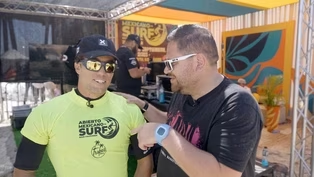
We head to Rosarito for the excitement of the Mexican Open Surf Contest, where surfers from around the world compete for $10,000 in prizes. The event organizer gives us a behind-the-scenes look at what it takes to host a professional surf competition. We also meet Sonia Stump of the Baja Scholarship Foundation and hear inspiring stories of how the foundation is helping youth across the region.
Problems playing video? | Closed Captioning Feedback
Problems playing video? | Closed Captioning Feedback
Crossing South is a local public television program presented by KPBS
Surf Contest & Baja Scholarship Foundation
Season 15 Episode 2 | 24m 47sVideo has Closed Captions
We head to Rosarito for the excitement of the Mexican Open Surf Contest, where surfers from around the world compete for $10,000 in prizes. The event organizer gives us a behind-the-scenes look at what it takes to host a professional surf competition. We also meet Sonia Stump of the Baja Scholarship Foundation and hear inspiring stories of how the foundation is helping youth across the region.
Problems playing video? | Closed Captioning Feedback
Where to Watch Crossing South
Crossing South is available to stream on pbs.org and the PBS app.
Providing Support for PBS.org
Learn Moreabout PBS online sponsorshipJorge Meraz: Hey folks, on this episode of "Crossing South," we're in Rosarito for the Mexico Open of surfing.
Top surfers hit the Baja waves in one of Mexico's biggest international competitions.
Then we meet the inspiring students of the Baja Scholarship Foundation and hear how education is transforming lives.
Stay with us, it's all coming to you right now.
♪♪♪ ♪♪♪ Jorge: The cool breeze of Rosarito's ocean, a perfect day for the beach.
Jorge: Okay, this may look like just a casual leisurely stroll in Rosarito Beach with nobody around, but it's anything but that.
I am actually at the Mexican Surf Open and I'm with Antonio Otañez who is the director of the Mexican Open.
I didn't even know there was a Mexican Open for surf.
Tell me about it.
Antonio Otañez: Oh yeah, this is the third edition about the Mexican Open here in Rosarito.
Organized by the Asociacion de Surfing de Baja California.
We are the organization.
Jorge: Governing body of surfing.
And what's your region, the state?
Antonio: All the state of Baja, California.
Jorge: Okay, okay, so, third edition.
What kind of surfers are you getting here?
What kind of competitors come here?
Antonio: We have Japan, Canada, Brazil, Argentina, Mexico, surfers from all around the world.
Jorge: Oh wow, okay.
And what kind of prizes do they get in an event like this?
Antonio: Oh, that's a very good question.
We have $10,000 cash for the first place and also a huge belt for the first place.
Jorge: Championship belt.
Antonio: The price of that belt is a little bit more of $1,000.
Jorge: Oh, really?
It's heavy duty stuff.
Heavy duty stuff.
So, tell me, where's the sport right now?
I mean, it seems to me like I wouldn't have known, the fact that I didn't know.
Tell me what message do you want to give out there about surfing in Baja?
Antonio: Since the surfing, it's already an Olympic sport, it's a huge demand on surfing.
And for us as a state here in Baja, the only thing that we pretend it's bring all this kind of tournaments, professional tournaments with this type of infrastructure, with a live stream, with that kind of prices, so we can promote our sport here in Baja.
This is the third edition.
Yesterday, we have a five-band concert.
Everything free.
We have food, the logistics, all the people here, a lot of professional surfers.
So, it's been great this event.
Jorge: Watching these gnarly soul surfers glide is mesmerizing.
And Rosarito turned out to be an excellent venue for this open.
Antonio: Here, we have Kilometro Uno.
Kilometro Uno it's an organization that we are doing cleaning, cleaning the beach.
Jorge: Okay, nice.
Antonio: So, all these guys are cleaning the beach.
They have sacks.
They have gloves.
Jorge: Fantastic, getting the kids involved.
Antonio: Yeah, that's right.
Jorge: Good job, boys.
Antonio: We have also a space from Greenpeace.
We have El Taller de Vela.
Jorge: Though I'm definitely a land lover, I've always had a liking for nautical themes.
I appreciate a good knot as much as the next sailor.
I know and use a couple, but I'm always willing to learn a new one.
male: So, you're gonna take this part, the whole loop.
And then by this side, yeah.
Antonio: It's an 8. male: And that's an 8.
Jorge: That's an 8.
Okay, so, right, the back like that.
Fantastic.
Oh, that's awesome.
Thank you, man.
And I learned a knot today.
Now I have two.
I have two.
Antonio: On this side, we have the competitors' area.
Jorge: Oh, you got massages for the competitors?
Oh, that's nice.
Antonio: Yeah, all free.
We have all their warming up with bicycles to all the competitors.
Jorge: Oh, to warm up.
So, this is where you'll live stream the event.
Antonio: This is the live stream event.
Jorge: Oh, nice, you've got your studio.
You're live streaming on where?
Antonio: In the Mexican Open page.
Jorge: Okay, give me a shot right there, cut to the snap.
Cut to two, cut to two, right now, right off, get it.
No, I'm just kidding.
I'm just kidding, just kidding.
Antonio: All our judges are from the International Surfing Association.
They are qualified to judge it.
Jorge: And what about the clock?
What does the clock mean?
Antonio: They have 20 minutes to catch 12 waves.
Antonio: And only count the best two waves.
The best two waves are the ones that counts.
Jorge: So, they gave me access to the inner sanctum of the judge's booth.
Antonio: This is how we are judging everything, all it's electronic.
And all the scores that they are putting right now, it goes directly to the livestream.
So, all the people that's watching on his tablet, his cell phone, in YouTube, they are seeing live the scores they're putting right now.
Jorge: This is incredibly sophisticated.
And everyone's like locked in, right?
Everyone's like professional right now.
Antonio: Because it's $10,000 the prize and these are professional surfers.
Is there any mistake on the score?
Oh, they will raise their hand and say, "Hey, let me see everything or let me see my score.
Why you don't see well on my score?"
They go to the video recording and they rewind the wave, and they check everything.
So, it's very professional.
Jorge: They can like call for a replay.
They challenge the play.
Antonio: Yes, we have one head judge and they can come and ask for the scores.
Jorge: Wow.
Well, it's a great venue.
Are you planning on continuing doing it here?
Antonio: That's the idea.
Maybe the next year, our intention is to make a stop from the QS, from the World Surf League.
I'll stop here.
We have a lot of professional surfers.
We have the first world champion Mexican here competing, Jhony Corzo.
We have the first Mexican get to the final in the pipeline Masters bodyboarding.
We have the 4th place in the world.
Jorge: Well, if these guys are that elite, I definitely wanna meet some of these killers.
Gabriel Jimenez, he is part of the Mexican team for surfing.
Are you gonna go to the Olympics?
Gabriel Jimenez: Of course, 2028, I'll see you there.
Jorge: Oh, my God, good job, man.
Antonio: This is very good surfer, believe me.
One of the best in Mexico.
Where are you from?
male: Puerto Escondido.
Jorge: Puerto Escondido.
Hey, represent, all right, represent.
Okay, so one of the surfers that is here right now participating, he just won his heat, we just saw him right now.
And who's looking to take home the discount double check is Jhony Corzo.
How you doing, my friend?
I hear you're the only Mexican world champion, is that true?
Jhony Corzo: Yeah, actually a friend of mine won after I won.
Jorge: Oh really?
So, now there's two Mexicans?
Jhony: Yeah, there's two, Alan Cleland.
Jorge: Hey, the more the merrier, right?
Jhony: Yeah, yeah, I was the first one to ever do it, and then my good buddy Alan did it again in a few years later.
Jorge: Have you been surfing in the international tour for a long time, or?
Jhony: Yeah, I've been at it.
Well, I started on the pro junior at first, and then I moved to like the open division, the qualifying series, the main one, and I've been at it since I'm like 16.
I won the ISA when I was 18, so.
Jorge: That's crazy.
So, how is it?
I mean, how do competitors from other parts of the world see, you know, Mexicans?
You're the first one that won it.
You get any--is there kind of like a little bit of competition or they welcome you?
Jhony: No, yeah, totally.
There's a lot of rivalries here in Mexico.
Yeah, and, of course, I get good vibes from everyone and yeah, it's just great.
I feel the good energy from my friends, family.
Jorge: But there is-- Jhony: Yeah, there's tension, obviously.
It's competing, you know, they will always be.
Jorge: Kind of like Ford versus Ferrari, but.
Jhony: Yeah, it's competition.
There will always be a lot of tension between us.
But then, at the end of the day, outside of the water we're good friends.
But we have that limit, you know, competition is, it's work.
Jorge: What's your favorite surfing movie?
Jhony: I think "Scratching the Surface."
Yeah, by Julian Wilson in Australia, and it's a great movie, a little bit of everything.
Jorge: So, what would you tell people like, you know, what they don't know about surfing?
Like you having been now locally in Mexico, internationally, world champ.
What's something about surfing that people at home may not know?
Jhony: It's just that it's hard to predict what's gonna happen every day, you know, every wave is different, every moment is different.
There's always gonna be a new feeling.
That's what we chase our surfers, you know, like going to different places, different parts of the world, like to get to know, like surf different cultures and all that.
There would never be the same wave as another one, you know?
It's a good feeling of this sport.
And it's not like football, or American football, you know, there's a ball that's always there, you could improve on that.
That feeling of surfing that would always be a new sensation.
Jorge: Each location brings its own.
Jhony: Yeah, it's different, even here every wave is different, you know?
You're never gonna get the same wave you got before.
Jorge: So, if you think that even though you may be super prepared, super skillful.
If the wave doesn't work, it could affect the outcome?
Jhony: Yeah, that's the exciting thing of this sport, you know?
Like, you could have an off day that things don't go your way, you don't get the waves.
Even if you're the most prepared, if the ocean don't cooperate with you, nothing you could do, you know?
Jorge: For sure.
It's an addicting sport, isn't it?
Jhony: Yeah, totally, the adrenaline.
The adrenaline of every day is what attach us.
Jorge: Well, you're a good ambassador, Jhony.
Congratulations on your wins and we'll be seeing if you win today.
Take home that discount double check.
Jhony Corzo, guys, nice to meet you, man.
Take care, take care.
Jorge: Man, Jhony took us at our word.
He won it all: champagne, grand prize, and the discount double check.
If you know, you know.
Inside joke.
Jorge: Very nice to meet you, my friend.
It's a really nice event.
You're putting a great show.
More "Crossing South" coming your way, folks.
Don't go anywhere.
We're at the Mexican Surf Open, third edition here in Rosarito, Baja.
Jorge: So, we move away from the constant rolling of the Rosarito waves to another part of town where we'll meet people who are striving to make lives better, doing so by providing new opportunities to the local youth.
Jorge: You know, expats living in Baja are not just enjoying life as they should, as everyone living in Baja should.
Many of them actually take the time to make a difference in their communities and where they live in.
And the locals interact, benefit from sometimes wisdom of retired expats living here, and the youthful interaction with people who retire down here, it's a wonderful thing to see when that synergy becomes something that you can actually measure, touch, feel, and see the benefit how both cultures just fusion with each other for a common goal.
And one of the things that's happened down here, some of them have been charities, some of them have been orphanages, some of them have been scholarships to help locals achieve higher education and different career paths.
And one of such foundations is led by the lady that's right next to me right now.
How you doing, Sonia?
Sonia Stump: Nice to meet you.
Jorge: Nice to meet you, Sonia.
Sonia, where are you from, first of all?
Sonia: I started off in Zimbabwe.
Jorge: What?
Sonia: Then I was in Wyoming.
Oh, no, South Africa, then Wyoming, and now in Mexico.
Jorge: So, you were born in Zimbabwe.
Sonia: I was born in Zimbabwe.
Jorge: Sonia, how did you end up in Baja?
Sonia: I had told my husband when I married him in Wyoming that I was retiring to the ocean and he better find me a good spot.
And we came down here one day, we bought that afternoon.
Jorge: Right, did you come to Baja on vacation, on holiday, or with a specific intent of finding?
Sonia: Well, yes, with some specific intent of finding someplace or just seeing what was here.
Jorge: Right, so, how long have you been in Baja now?
Sonia: Seventeen years permanent.
Jorge: Oh, my.
Sonia: And I don't speak any Spanish.
That's the bad part.
Jorge: Oh, so, how many languages do you speak?
Sonia: One.
Jorge: Sonia.
Sonia: I've learned several, but I don't have the best memory for anything.
And so, they've all gone away from lack of use, including my Spanish.
I did try at one point to learn a little Spanish, and it's just gone away, except for food and wine, and booze.
Jorge: So, now in Baja, you're living with your husband down here 17 years, correct?
And living in Rosarito.
You decided to do something following in, in an initiative that was started by a fellow expat, right?
Sonia: Baja Scholarship Foundation was started 30 years ago last month in August by Judie and Ken Kesson.
And they started with just one or two students a year back in the day.
And what we do is we send students to--from primary school up to university into education.
And we try to choose our students from lower income families that maybe the student would be really impacted by financial need and maybe not be able to continue their education.
And so, now, at this point, we have 23 students and actually 12 of them are university students, which is a huge percentage at university.
But in the past, we have--the foundation has sponsored up to 40 or more students in a year.
Jorge: How do you translate the help?
I mean, what's the pragmatic thing that happens for someone in primary school?
Are you helping the parents?
Are you helping the child?
How does it look like?
Sonia: Our students start in the early years.
Maybe some of them now are starting in secondary.
And we find a sponsor for the student and sometimes two or three sponsors when they get to the university level because it gets so expensive if they have to go to a private one.
Yes, so we find a sponsor and the sponsor sees them through for the most part.
Every once in a while we'll lose a sponsor, but the majority of the time, the sponsor will see the students.
So, like I started sponsoring a student when she was nine.
She's now in dental school.
Jorge: Wow.
Sonia: So, and it's a neat process because most of the sponsors will have good interaction with their students and have some kind of a relationship with the student's family.
We have events that they can do that if they live close enough to it.
And then fundraisers and one of the fundraisers we have regularly is a wine pairing luncheon here at Susanna's.
And so, we do that four or five times a year at the restaurant.
Jorge: Fantastic way to do it.
Sonia: It is, it's a great way and we have a great following.
Jorge: It's a win-win.
Sonia: It's a win-win.
Jorge: Now, what is the help for specifically?
For instance, I can understand in college tuition, a lot of books.
In the lower grades, what are you helping them with exactly?
Sonia: Well, in Mexico, mostly it's uniforms.
They have to have uniforms for sport and school, and then transportation, materials, books, and things like that, that would be expensive and, you know, not all families can afford to have those.
So, and then each level, it gets a little bit more expensive as they have more needs.
And then, of course, universities can be quite expensive.
Another important part about the scholarships right now is that we require the students to go to English school.
So, they go to Cambridge English School, they have to graduate with an IELTS diploma, which is, I think, you know, works for them to get into university and have English.
And that's been wonderful for us because now, we go to events, we actually, those of us that have not learned Spanish can actually understand them because they have to do their presentations in English and Spanish.
Jorge: Of course.
We actually got to speak to one of the kids who went through the foundation sponsorship program.
Now all grown up, she is well into a successful career path.
Jorge: Perla, you are a living example of this scholarship, you know, and how it's benefited people who are local, right?
So, you grew up in Rosarito or where did you grow up?
Perla Palafox: I came from a place called Durango in Mexico.
And my family moved because they were having struggles financially.
They used to live by the day.
Even though they have a job, it wasn't enough.
So, they decided to move to Baja.
And since always I'm really being a pretty good student, and one of the huge opportunities that my family received after moving to Baja was being part of Baja Scholarship Foundation.
Jorge: What age were you when you first entered the program?
Perla: I was 11 years old, almost finishing elementary school or primaria.
And when I was graduating from primaria, some of the board members of that time went to my graduation.
So, one of the funny memories, or nice memories I have, is was going to enter to high school.
To enter high school you have to make a test and based on the grades or the performance on the test, they let you choose which high school you can go.
So, here in Mexico, we usually choose public schools because sometimes it's easier for the families to support the kids and sometimes they are better in education.
So, for this test, I prepared myself a lot.
I didn't have like a special teacher or anything, but I remember like doing the questions and again and again and again, and surprisingly, when I did the test, you did it with a computer, and you got the results immediately.
Yeah, so I got perfect score on that test, and we didn't knew how much of a huge compliment was this, but I was supposed to be the first one student to get a perfect score on that test in Baja.
It was embarrassing but when I finished middle school, junior high school, they put a huge poster with my face on the school and they say like we have the best score coming out from the school.
That also came to the high school I was going to.
So, they also put a poster there and, like, being the, you know, the first grade and everybody knows you and it's.
Jorge: You're just trying to fit in and then they put this poster on you, yeah, I understand, I understand.
I was young once, you know.
Perla: And we have a very funny story that happened to us probably a month ago.
I was with Sonia, a BSF director right now.
And we were having drinks at the bar after this event we have for the students.
And we're just like catching up because we were very tired from all the work we've been doing.
And this bartender was just serving us our drinks and says like, "I know you.
You are Perla."
I was like, "Mm," I was thinking, "I don't know him."
Like, "Yeah, you were the student who got perfect score.
I remember your face from high school."
I was like that memory doesn't come to my mind very often, but it was.
Jorge: But thank you for taking me back.
Perla: Taking me back to those memories.
Jorge: Okay, Perla, now I heard that, you know, because you're a very good student, you chose a somewhat difficult career.
What career path did you take when you finally reached college?
Perla: Well, I wanted something challenging, I guess.
I went to study to a bachelor in science and the degree is genomic biotechnology.
Jorge: Oh, my goodness.
Can you translate that to me, someone who's not book smart, you know, in layman's terms, what that means.
Perla: The career focuses on us using the biology as a way to find a technology to help actual problems in the world.
So, in the end, you can choose different working paths.
For example, work in making medicines in pharmaceuticals, vaccines.
If you move to other areas, for example environmentals, you can find new ways to degrade plastics.
Or even in health, you can find new ways to diagnose diseases.
For example, when COVID, how can you make a faster way to find a diagnosis for diseases.
So, applies to really huge amount of biology and make it useful for the people.
I found the opportunity to work in the pharmaceutical field.
I worked there for a while, but I was, like, trying to explore what I really wanted to do.
Then and I moved to the wineries that are in Baja de Guadalupe.
Yes, because we can work-- Jorge: Explain that to me.
Perla: We can go work with the yeast and the bioreactors to ferment and make wine.
So, at the end, I was doing all the analysis of the wines.
Yeah, so that's also a biotechnology.
Jorge: So, are you making wine more delicious?
Perla: We can do that or have very production.
But yeah, it was an amazing experience.
But finally, what I ended up doing because I've been doing that for almost six years, I found the stem cells field to work with.
And I've been working in Tijuana in a laboratory.
It's called Instituto de Terapia Celular and I'm the chief of the lab in Tijuana.
So, what we make is we produce these stem cells to get a final product who could be delivered to any doctor or medical field so they can apply it to patients in the real world and make a better recovery in their health or some issue they could have.
Jorge: Okay, so not only did you receive help from the BSF, but you're also helping them.
Perla: I cannot back down now.
Sonia: We're gonna leave the foundation to her when we all die.
Jorge: Fantastic, Perla.
Thank you, Perla.
Congratulations on your career path.
Sonia, what a wonderful project.
And you guys are an example of what cultures can do for each other, learn from each other, and just make a region all the more better.
Thank you, guys.
Jorge: So, after feeling the energy of Rosarito's waves and witnessing the determination behind the next generation of surfers, and then meeting the students whose lives are being transformed through education, we leave inspired by the drive and opportunity shaping this community.
And as the spirit of Rosarito pushes us forward, we continue our journey eager for what lies ahead the next time we get to cross south.
♪♪♪ male announcer: Like to know more about the places you've just seen?
Maps, videos, podcasts, and more at crossingsouth.com.
We also do Facebook, Instagram, and YouTube.
Surf Contest & Baja Scholarship Foundation Preview
Video has Closed Captions
Preview: S15 Ep2 | 30s | We head to Rosarito for the excitement of the Mexican Open Surf Contest. (30s)
Providing Support for PBS.org
Learn Moreabout PBS online sponsorship











Support for PBS provided by:
Crossing South is a local public television program presented by KPBS