RTP180
Sustainability | July 2022
7/21/2022 | 1h 1m 58sVideo has Closed Captions
Exploring what we can do to maintain and improve our environment.
Even with the events over the last couple years, it’s more important than ever to discuss the topic of sustainability. At this month’s event, we are bringing in local experts to provide insight on ways we can better maintain our environment. Our speakers will share on agricultural sustainability, climate change, water and energy conservation and more.
Problems playing video? | Closed Captioning Feedback
Problems playing video? | Closed Captioning Feedback
RTP180 is a local public television program presented by PBS NC
RTP180
Sustainability | July 2022
7/21/2022 | 1h 1m 58sVideo has Closed Captions
Even with the events over the last couple years, it’s more important than ever to discuss the topic of sustainability. At this month’s event, we are bringing in local experts to provide insight on ways we can better maintain our environment. Our speakers will share on agricultural sustainability, climate change, water and energy conservation and more.
Problems playing video? | Closed Captioning Feedback
How to Watch RTP180
RTP180 is available to stream on pbs.org and the free PBS App, available on iPhone, Apple TV, Android TV, Android smartphones, Amazon Fire TV, Amazon Fire Tablet, Roku, Samsung Smart TV, and Vizio.
Providing Support for PBS.org
Learn Moreabout PBS online sponsorship- [Narrator] We stand on the threshold of a great new age of exploration.
It's ultimate destination, the furthest reaches of the universe.
- [Narrator] Three, two, one.
[upbeat energetic synthesizer music] ♪ - [Wade] Good evening, everybody.
And welcome to the frontier on the campus of beautiful Research Triangle Park, North Carolina for RTP180!
[audience members whistle] - Whoo!
- Whoo is the correct answer there.
Thank you all very much.
It's great to see such a big crowd out here today on a beautiful, if somewhat humid day in Research Triangle Park for RTP180.
We'd like to give a shout out as always to our presenting sponsor RTI International.
My man, that's right.
They've been making this happen for a number of years, now.
We could not do this without them.
We like to give a shout out to RTI international.
Now, tonight, for those of you who have not been here before, or those of you who are attending for the first time, what you're gonna see is four speakers of the evening.
Four, not five, but four, count them, four speakers.
They'll present for about, eh, five-ish minutes each.
And then we will come to you for Q&A.
Your questions make the magic happen, everybody.
You can connect with us live during the show.
That's right.
You can tweet at us.
You can find us on Facebook.
It's @frontierRTP.
You can use the #RTP180.
If you have questions that you don't feel like asking during the Q&A session, you can tweet it there.
We may answer your questions through social media.
Now, those of you who have not been here before you are sitting in the regions only free co-working space.
That's right, this is a free co-working space right here in the heart of RTP.
We also have meeting rooms for rent.
It's a beautiful facility.
This is what it looks like during the day when we don't have it set up in the stage configuration.
If you have a meeting or you need a little bit of space, please check out the frontier here at RTP.
We also have yoga, happy hours, lunch and learns.
You can even tour a beehive, that's right tour a beehive right here.
That's that one right there.
We also have on the menu, it's a lunch and learn session.
The next one coming up on August 8th is Trademark Basics for Entrepreneurs.
We've got Andrew Fisher up here telling you about trademarks, not John Cena's cousin, but trademarks in the business sense.
Find out about that Noon on August 8th.
Now our topic today is sustainability.
We've got four experts in the field up here.
They're gonna be dropping some knowledge on you, and you've heard enough from me.
So it's now time to bring up our first speaker of the evening.
He's been with RTI International for 30 years and leads research and sustainability, including urban corporate and environmental sustainability.
Please welcome to the stage, our first speaker of the evening.
Keith Weitz!
[audience applauds and cheers] - Thank you.
Can you all hear me?
- [Audience Member] Yeah.
- Pleasure to be here tonight and I'm gonna be leading off today with talking about sustainability in commerce.
That means sustainability in the products, goods, and all the packaging that comes with it.
So there's a number of factors that are currently driving a push for sustainability in products, consumer products, and packaging.
They sort of range across both consumers.
As consumers become more aware of the sustainability implications and impacts of different products and packaging on the environment.
They are industry led, as industries are responsive to ESG, environment, social governance reporting, and trying to find ways to make their processes, products, packaging more sustainable.
It's never a good picture when you have a photo of your product floating around the ocean, as a good example.
[audience laughs] And then there's the governments.
And when we're talking about products, packaging, we consume a lot.
And what we consume ultimately ends up in the waste stream.
And the federal government plays a role in that, but really where the rubber meets the road on waste management is at the local level.
So it's the cities, it's the municipalities that are dealing with that.
So a lot of the real government pushes on the not only developing federal level policies and programs, but also state, local, regional.
A good example of sort of government push right now, includes, and I don't know how many of you follow the news, but things like bans on single use plastics, or extended producer responsibility legislation.
And extended producer responsibility really means that companies become more of a responsible party in the management of their products and packaging at the end of life.
So if I'm consuming a product such as a computer or a tablet, what do I do with that at the end of the life?
Do I have a place to take that back?
The producers really become more responsible for either having a program to take back their product, or paying a fee into current recycling programs and infrastructures.
A lot of this has really stemmed from world changes.
So many of you may have heard the, in terms of Asia, China markets, where we used to send a lot of our recyclables, they have changed over time.
So you probably put a lot of your recycling into one bin.
And through programs that China in particular has initiated over the past number of years, Green Friends, now the National Sword, there has been more stringent requirements on the quality and contamination that goes into those recyclables that we send out.
So now we're having to deal with the fact that we have a lot of contamination in our recycling stream and not a lot of valuable product to recover.
Some of these problems have stemmed from innovation in packaging and products.
So I don't have a good example with me of a package, but there's often new designs that are multi-layer, multi-material packaging that are difficult to recycle.
So how do you separate the materials that are composite within a package?
What is the market for that material?
So these types of innovations have advanced some things, but also have taken us a step back in terms of the recyclability of products and packaging.
And we see now that some states and cities are looking towards legislation programs to have a certification of recyclability.
So what is a practical way to innovate and move forward?
This is not my garage.
It's a photo somebody had sent me.
Is this really a practical solution?
Probably not.
But there are innovations that are currently underway in different material categories, product design, material substitution, bio-based materials.
All of these are at different levels of technical readiness.
And so a key is what is ready now?
What can we deploy now?
And looking at the sustainability impacts of those innovations.
So we're sure they don't create problems down the road.
And really there's no silver bullet answer for any of this.
So we can't necessarily technology our way out of it.
It's really a whole host of actors and players from us as consumers, and individuals in households that put things in our recycling and trash bins.
It's retailers, it's the product manufacturers, state, and local governments and industry that have to deal with these materials at the end of the day.
So we often look at this as an ecosystem of different stakeholders of different players that are all involved.
And that is my talk for today.
Thank you.
[audience applauds] - All right.
Now it's Q&A time.
It's time to get your questions answered about recyclables, that's right, sustainability and packaging and product, right?
A man's about to charge the stage up here.
Also, we'll go over here before this guy like shivs me.
[audience laughs] Excellent, our first question.
And everyone who asks a question will receive a journal.
That's right, you get some swag tonight.
- [Audience Member] Yeah, so you showed us a slide with about eight differentiated bins that you said is probably not practical.
AI plus a good robot arm?
What do you think?
- I think that's been implemented at a lot of facilities.
They're good technologies.
They increase the recovery of different materials by maybe five or 10%.
The problem is having materials in the waste stream that don't have an end market.
So we can recover more of the material we want to recover through new technology like robotics, AI assisted, sortation machines, optical sorting machines.
It's really what are we targeting though?
So if we're targeting something like a PET bottle that has a high market value, we can increase our recovery rate for those particular materials.
But there's a lot of material in the waste stream and recyclable stream that doesn't have an end market.
So recyclers are always looking for where can I find an end market for these yogurt cups?
Or whatever the problematic material it could be glass.
Because for them it's a contamination.
And if it's a contamination they have to pay to dispose of it.
So the equation's pretty simple.
They get a certain amount per ton of material they take in their front door.
And whatever they recover and can sell is a revenue.
Whatever they have to then dispose is a cost.
So they have a contracted price usually on the front end.
And the market varies quite, you know, dynamically day to day, week to week, month to month by material.
And then the disposal price continues to rise.
- Great question there, all right.
You've got another question coming here from the back row.
That's right, you, that's right.
This isn't TV.
I can see you.
All right, next question.
- You're slide with all the gauges.
Everything was on the far left, except bioplastics I think.
Excuse me, where are we gonna be in 20 years from now with those gauges and what's gonna be the leading solutions?
- That's a good question.
It's often hard to predict those.
And we have been looking at some of the technologies that have been proposed for almost 20 years now, like gasification pyrolysis.
You may have heard of chemical recycling is sort of the new batch of technologies.
And we haven't seen those really take off in the US, or really globally to a large extent at this time.
And a lot of that isn't that the technology can't work or doesn't work.
A lot of it is more the environment that they operate under.
So they need to have the right economic conditions.
They need to have the right players and contracts lined up to be able to get the feed stock they need, and companies to take the product they're producing.
And those haven't all aligned just yet.
The other thing with sort of technical solutions like that is the feed stock that we're talking about, which is your waste stream, is a mixture of stuff.
And it's a mixture of a lot of stuff that can't be technically recycled, such as food waste, other yard trimmings, trash.
So it's really a matter of getting those technologies to a state where they can deal with a level of contamination and not mess up the back end product, so it's not sellable.
- All right, guys, another question, second row here.
Sorry, she beat you to it.
Next question.
- [Audience Member] How scalable is the bacterial recycling for the future?
- How scalable?
Yeah, I think these are all it's a similar response.
They're all in sort of the early stage technology development.
So they're at a lab pilot, in some cases a demo facility level.
But we don't really see them out at a commercially operating level.
The cost is a big factor compared to other options in the US.
But it's also, as I mentioned, having the right feed stock.
So how do you get them the right feed stock that works with their process out of the waste?
So that may entail some sort of segregation at the household level that we don't currently have, or it may entail some pre-processing of stuff that's already collected and that's an added cost.
So how do we deal with those pre-procesing costs and expensive process technology?
And then potentially needing some post process cleanup of that product so that we can sell it for a revenue.
- [Wade] And our last question on this topic will be coming from your left.
- [Audience Member] What's up with styrofoam, a forever chemical?
When I first heard about it as a young person, they said it would be recycled, but it's like a forever chemical.
I know Publix takes a few things back as recyclable.
But I have also heard that a lot of recyclables are shipped away from the US and then just burned.
And so as I get older, I just almost feel depressed that recycling doesn't seem to work.
And how do we stop things like styrofoam and start recycling?
- Yeah, I think those are exactly the types of factors that have been coming together, and into play with products and packaging.
And the layers of the onion have been peeled off over time in terms of where this material's going.
Where is it ultimately ending up?
And as I mentioned, we were shipping a lot of it internationally.
And once it leaves, it's hard to really determine where it goes from there.
You know, we've seen stories where they're using plastics to fill potholes.
So example, they put a bunch of plastic in a pothole and light it on fire, and it fills a pothole.
[audience laughs] In Indonesia they use waste plastic, waste paper to fire tofu cookers.
So it's a little bit ubiquitous around the world.
And some of that's education, but a lot of it again is having a viable end market for these materials.
And having the right economic and business environment with which to have better processes.
But some of it's on the policy side as well, in terms of what do we dictate as policy for where we can send our material?
I know I did some work in Japan, and in Tokyo they have city districts.
And those districts had to manage the waste that they produced in their district.
They could not send it to another district or another part of the country.
And so that forced them to really come up with how are we gonna deal with this material within our district?
And at least right now, we don't have that.
We send a lot of our waste and recyclable material to other states within the US and other countries.
So it's a difficult problem for sure.
But I think things are moving forward.
There's certainly a push and sort of acknowledgement, and recognition that things have been stagnant.
How do we move that needle?
And I think it's something that everybody has to be involved with, you know, us as individuals and consumers, government industry, all the above.
- All right, give it up for Keith Weitz!
[audience applauds] Couple quick cores of business.
Number one, if you didn't get your question answered many, if not, all of our guests will be sticking around for a little while after the show.
You can feel free to grab them over a beer, ask any questions that you didn't get answered.
Number two, just getting ahead of a potential technical difficulty.
We've discovered that our overhead projector here, my friend with the light it has got COVID.
So the projector's not feeling great today.
It may go dark.
If that happens, don't worry, we'll figure something out as soon as soon as we figure out what that is.
All right, good times.
All right.
It's time to meet our next speaker of the evening.
She's an assistant professor of public policy, and the environment at UNC Chapel Hill, and the founder director of that Data-Driven EnviroLab.
Please welcome to the stage Angel Hsu!
[audience applauds] - Thank you, Wade.
I feel like I should be playing hockey and not talking to you about climate change.
But it's hot, you all.
Am I right?
Today, I wanna talk to you about our research that looks at the intersection of urbanization and climate change.
We're living right now in the urban century.
More than half of the global population is currently living in cities.
And this number is expected to increase to 70% by 2050.
Here in the Raleigh area, we can witness this transformation of urban growth happen from the 1980s up until today.
We can see the land cover being transformed from green areas to bright urban areas.
Globally, we're also seeing the same patterns all across the planet.
These bright lights that you're seeing are coming from cities.
This is measuring from space economic activity.
Cities produce more than 80% of global GDP.
And most of this anticipated future growth is happening in China and India.
Following this growth and urban population in cities, and GDP is also these negative trends.
These earth system trends an acceleration of pollution, carbon dioxide, and other greenhouse gas warming pollutants, like methane, nitrous oxide.
Also an acceleration of ocean acidification and also tropical forest loss.
Here in the Raleigh area, I have a satellite image of Raleigh here on the left.
You can see some of this transformation happening in areas that are white following roadways, where buildings, residential areas are.
Are some of the hottest areas that you can see on this map here on the right and red.
Cooler areas are lighter and blue and in yellow.
Why is this happening?
Well, this is due to what's known as the urban heat island effect.
And it measures the temperature difference between an urban area and its rural surrounding.
And so you can see in this red squiggly line here, that areas that are rural or suburban where they have more tree cover and more grass are cooler, during the late afternoon.
And in commercial and city areas downtown, they tend to be much hotter.
Why is this phenomenon happening?
Well, think about asphalt and concrete.
In urban areas and downtown districts, they have a tendency to retain solar energy and heat.
They reradiate that out to make urban areas much hotter.
When we convert natural landscapes and forest into built environments, we also make them less impervious, or we make them more impervious rather.
And so they can't absorb rain water like a natural landscape can.
And so, as a result, the urban heat island can make cities three to 10 degrees on average hotter, that's Celsius.
But we also know that cities are not created equally.
And these are amazing photos from photographer, Johnny Miller's Unequal Scenes project.
This is actually New York City.
And you can see here in this scene that much wealthier upper west side residents have access to Central Park, more than 800 acres of green space.
And we're seeing these images of inequality all across the world.
In Mexico city we can see in this one image a much less wealthy neighborhood characterized by this informal soccer pitch juxtapose next to this much wealthier neighborhood where you can see these really nice sporting facilities.
In Johannesburg South Africa, it's the same picture, an informal sediment right next to a golf course.
In Raleigh as well, we're seeing the same types of inequality.
And that inequality is leading to different exposure in urban heat.
Here, this is a map that we produced of Raleigh and its various neighborhoods.
You can see the hottest areas in red coincide with those areas with fewer tree cover.
And that also happens to intersect with the neighborhoods that are the least wealthy in light white or blue on the right.
So we started to ask the question, is this an isolated incident?
Is this just happening in one city?
In large cities like Chicago, or New York city, or Mexico city and Johannesburg.
But what our research has found using satellite data is that this is not an isolated problem.
In 97% of cities across the United States signified by these triangles, we're finding that communities of color and people who are living below the poverty line are exposed to higher levels of heat than their wealthier and their white counterparts.
On average, we're finding a full degree Celsius, that's almost two degrees Fahrenheit, higher urban heat exposure than their counterparts.
And so this suggests that there's something more widespread going on, some systemic form of climate racism or environmental injustice that's happening all across America.
Some of this may be due to historic racist redlining policies that have prevented minority communities from accessing more desirable parts of cities.
This is a map of Durham and the red line districts that were graded in lower grades of D or F, as compared to non red line areas that happened to be cooler and shadier.
So what can we do about this problem and these disparities?
Well as a researcher and a data scientist, I'm gonna say we need to get more data.
And luckily last summer, the county of Durham, the city of Raleigh partnered with scientists to engage citizens to go out and map urban heat islands within Durham and Raleigh.
The problem with our current measurements of urban heat and temperature is that if you check your phone, if you go to the weather station, it's normally coming from one place, and that's normally from the airport.
Who lives at the airport?
I know maybe somebody does.
I certainly don't live at the airport.
I would imagine that most of us don't.
And so that's not representative of all the different intraurban differences that we experience on a, on a daily basis.
I'm sure all of us have walked around in a downtown area, outside in our neighborhoods, and we notice a huge difference when we walk under shade.
And so that's exactly what this campaign was doing.
And now the city of Raleigh is taking that data and they've invested $77,000 to try to mitigate these differences.
So they're looking at where they can plant more trees, increase access to green space, also coat roadways with titanium oxide to make them cooler and more reflective.
This data is absolutely critical to solving this problem.
Just as a last example, we replicated the same exercise in Chapel ill last summer on an extremely hot day in August.
And on that day, we sent 40 volunteers out with these handheld pocket lab sensors that you can see in blue to map five of Chapel Hill's neighborhoods that the town identified were particularly vulnerable to urban heat.
What we found was really surprising.
So when I checked my phone that day, it said the temperature in Chapel Hill was 94 degrees.
In some places we measured temperatures as high as 108 degrees Fahrenheit on that day.
And what was even more shocking, I don't know if you can see the box, the little plots in the middle Meadowmont neighborhood.
We didn't find that much of a difference between afternoon temperatures and evening temperatures.
That's incredibly worrying, because that's a time when our bodies are supposed to recover from high heat exposure in the day.
So this is just a start and I hope that you'll get excited to participate in our next campaign.
So thank you so much.
And this is a picture of a squirrel on Twitter, getting some relief in a bowl of ice on these incredibly hot days, so thank you.
[audience applauds] - That's right, protect the squirrels you all.
All right, Q&A time about urban heat island sustainability.
All right.
I'm gonna go back here first, front and left.
- [Audience Member] Hey, first of all, I'm a UNC grad, so go Heels.
- Oh, great.
- Second of all, I saw on your map of the US you said 97%.
- Yes.
- It was worse for lower income minority areas.
What are the- - [Angel] Lower income and minorities.
So some of those lower income could also be white populations as well.
- [Audience Member] Okay.
What were the ones that were not?
I couldn't find any of the circle ones.
And of those areas, are there any lessons in governance that the other areas could learn from?
- Yeah, so that's a really great question.
That there were only six cities where we didn't see this disproportionate exposure for minority and below poverty communities.
And actually in those cities, they just had a larger proportion of white, non-Hispanic white communities as compared to communities of color.
So that was really the reason.
They're just not very diverse cities.
And so, unfortunately there's not really, I think a policy lesson there, unless you just wanna keep your cities not diverse.
Which I don't think is [chuckles] a goal, But yeah, that's a great question.
And I mean, I would say that there are some cities that are doing interesting things.
I think this Raleigh example was fantastic.
So we had someone from the Office of Sustainability in Raleigh speak at a webinar last week.
And so that's available on our website, datadrivenlab.org, to hear exactly about how they're using the data.
I mean, I think it's so fascinating.
As a researcher and a scientist, we create these data sets all the time.
We hope that policymakers will use them.
And without this kind of data, they wouldn't know.
Well, what neighborhoods are hotter than others and why?
Is it because of tree cover?
And one of the things that they noticed when they pointed out on the map, is one of the highways is one of the hottest areas.
And they actually don't have control over it, because it's a state owned highway.
So things like that, you know, these lessons are really fascinating.
And without that really granular data, they wouldn't be able to identify, oh, this area is particularly hot.
So I think what city of Raleigh is doing is a great example.
City of Phoenix, they actually have a urban heat mitigation office, and they actually have metrics to increase shade and tree cover in their city.
I think that that's also from a data driven perspective, another good lesson that we can take.
- All right.
Next question.
Coming up here from the gentleman in the yellow shirt, front and center.
- [Audience Member] As far as solutions, you mentioned the titanium dioxide spray.
That sounds like a very quick fix.
I don't know if it's expensive or not.
But can you speak to any other things that are kind of quick, 'cause planting trees takes a little while before they're big enough to make a substantial difference.
Maybe also green roofs would be something that.
- Yeah, exactly, so green roofs also New York city when Mike Bloomberg was the mayor, they had this cool roofs campaign.
So they had a target to increase the number of cool roofs in the city of New York.
And so they were actually coating the rooftops of many buildings with a very reflective white coating.
I would say that that's like one of the biggest things for the buck, because white has a much higher albedo, so the surface reflectance.
So it's actually radiating and reflecting that heat back into the space, into space.
So I think albedo will be say, in the climate science, albedo management is probably the number one thing.
Yeah, 'cause you're right.
That tree planting takes takes a while.
And planning, urban spacial planning, making sure that buildings are configured in a way to allow for urban wind cannons to cool places, and designing parks that also are plentiful with tree cover.
I mean, I would say, yeah, this albedo management, so that's one of the reasons why.
I can't remember exactly the numbers she said in the webinar last week, it was either a 40% reduction in heat or 400%.
I know that's a big range, [laughs] but I was like, I remember thinking, wow.
But it was something like that where they were able to measure using this high resolution data, the difference before and after.
- [Wade] Other questions, let's see, we've got one right here, front end center.
- [Audience Member] When it comes to people moving to more urban areas, are you seeing any issues when it comes to light pollution, and how that could affect maybe minority communities more, or even like wildlife, also?
- Yeah, no, that's a really good point.
Yeah, light pollution is a huge issue, I think, particularly for wildlife.
I think the interesting things about this research is that there's actually been a lot of science, and a lot of research done looking at just environmental pollution, disproportionate environmental pollution exposure for minority communities that often have to live in less desirable parts of cities.
So next to landfills, or next to busy highways, or next to toxic waste facilities.
And so there's been a lot of research that has shown that minority communities are disproportionately exposed to air pollution and other toxic chemicals.
But I think what one thing that we did that was different was actually establishing that these patterns for heat.
But yeah, I mean, I think light pollution is certainly a concern.
And during COVID when people were not commuting, and we were reducing, we were emitting fewer emissions, we did see a recovery and a lot of species, particularly in urban areas.
- [Wade] Our last question be front left, from your perspective over here.
- [Audience Member] Are there any private or public incentives to build green spaces just to make those areas around it cooler?
- Yes, that's a great question.
I'm not sure if, I just recently moved back here, I'm originally from South Carolina.
That's why I felt okay appropriating you all in the title, because I'm actually from, I was born and raised in South Carolina.
I went to undergrad at Wake Forest.
So I felt okay, But I don't know within this area yet, because I'm still so new to it.
But I used to live in Singapore, and I lived there for five years.
And they absolutely do have laws, zoning laws, and building laws where if you displace any type of greenery, you have to actually rebuild it in your project.
And so I think that that's one example of a really innovative policy.
And so in Singapore, it's incredibly dense.
It's one of the densest and most highly concentrated populations in the world, and they have these incredible vertical gardens.
And so you can see these pictures of buildings where they've got greenery that's hanging off of buildings.
They've got sky gardens.
And I think that's one example of where there's direct regulation.
And I'm sure that there are some zoning laws, but you know, there's just so much diversity in the US.
But yeah, I think Singapore's a great example.
- All right.
Give it up for Angel Hsu!
[audience applauds] A lot of great research being done here in the Triangle, including at the Data-Driven Lab.
Hope you enjoyed that.
Now it is time for our third speaker of the evening, a native Californian, I know.
Who moved to the Triangle eight years ago and is an energy and sustainability manager at Cisco Systems.
Please welcome to the stage, Jordan Hart-White!
[audience applauds] - Whoo!
- Hello, we're gonna see how many things I can hold in my hand at once.
And it was a great transition to my talk, Angel, so thank you.
Today, I'm gonna talk to you guys about one of my passions and things that I get to work on, which is green buildings.
So this image really resonated with me, because I don't spend a lot of time outside.
I don't know about you guys, but I spend a lot of time looking outside.
And as beautiful it is outside and as healthy as it is, sometimes our built environment isn't quite that healthy.
And so it's my dream and hope working in the commercial real estate business, that we can make our indoor environment as clean as the outside, so that we can live as healthy and sustainable lives as possible.
So speaking of green roofs and green walls, I think this is what people think of when they think of green buildings.
And I kind of just wanted to level set us all on what green buildings actually are.
'Cause a lot of it is more than just this and really cool modern architecture.
So green buildings are essentially buildings that help conserve resources.
That could be energy, that could be water.
That could be greenhouse gas emissions.
It could be buildings with solar panels on the roofs, or ones that are powered by renewable energy like wind farms.
It could also be buildings that are zero waste that use composting, or have durables in the office.
It could be buildings that are built with renewable materials or materials from sustainable forests, for example.
And then most often they have good indoor air quality.
You guys may have heard of MERV filters, or HEPA filters when COVID first hit, things that we're implementing in airplanes.
A lot of green buildings implement these technologies as well.
And essentially green buildings really are focused on improving the quality of life of the occupants during the design, the construction, and the actual occupation phase.
So this cheesy hallmark image is I think what all of us want life to look like.
And I truly believe that green buildings have an opportunity to help us live that kind of life.
So green buildings that I've shared really help reduce the negative environmental impacts that are often associated with what is called sick building syndrome.
And they help optimize the positive benefits of being inside.
Green buildings help people live this life, because they help mitigate stress and burnout that a lot of us feel when we work in indoor environments.
But green buildings also have a financial benefit to the companies that operate these buildings, in case any of you operate buildings like I do.
So by doing some things like improving indoor air quality, increasing natural light, and actually adding greenery to buildings, can help reduce absenteeism, help people actually come back into the office.
It can help increase productivity as high as 30% for your occupants.
It reduces turnover.
In some cases, reducing the turnover rate by a third, and increasing hiring rate to twice as much as it was previously.
And it can additionally reduce medical costs.
If you have really high indoor air quality, some of your occupants that have asthma, won't be as likely to get sick.
They can come into the office more frequently.
And so as in my job at Cisco, I'm focused on greening our operations through a couple of green building certifications called LEED.
And I'll talk about WELL in a second.
So LEED is one of the older green building certifications out there.
You guys may have seen these plaques when you enter buildings.
It's been around since the '90s, and it's really focused on the built environment.
So indoor air quality, energy, water, greenhouse gas emissions.
And at Cisco, I'm helping to build a really cool building in Atlanta.
It's gonna be a showcase site for us.
And we're going for LEED platinum at that site.
And we really focused from the startups.
That was choosing a site that was good for occupants.
So that was choosing a site in a downtown location, so people could go to the grocery store, and they could go to lunch, and go to the post office and then come back to work, getting there with public transportation.
We're also designing the building, so it has a 28% savings in energy, and a 30% water savings compared to comparable buildings.
And we're also really excited 'cause we're integrating some Cisco technology that actually has indoor air quality sensors.
So you can see what the quality of the air is in the room before you enter it, and make that decision whether you're comfortable to go into that room.
And we're also getting WELL certified.
WELL is a newer certification, since I'd say the early '00s.
And it's focused on just like the name implies, well building, and building designs that are people first spaces.
So we are pursuing WELL gold standard at our Atlanta office.
And WELL includes things like focusing on natural light.
If you increase amount of natural light, and lesss artificial light, you don't mess up with people's circadian rhythms.
they can go to sleep at night, which is kind of a crazy concept.
We have healthy vegetables in the office, right?
So if there's fruits and vegetables, whole foods that you're eating, you're less likely to have that 3:00 p.m. crash that we all get.
It's having furniture like sit/stand desks, so you have less ergonomic injuries throughout the day.
And it's also having really cool benefits like mother's rooms or reflections rooms, a plethora of outdoor space for you to go take a break, nap pause so you can take naps, fitness classes, mental wellbeing classes.
We're doing all of us in our Atlanta office, and all of this is encompassed in this WELL building certification.
So I hope you guys are as inspired by the future, as I see it, of real estate.
And the opportunities there are to build spaces that are real people first, and help support the planet as well.
So thank you guys.
[audience applauds] - You've got questions about sustainability, and real estate and buildings.
We've got your answers.
We've got our first question coming way back in the middle here.
I'm coming.
I got little legs.
All right, here we go.
- [Audience Member] Hi.
Thank you so much for your talk.
I'm super curious.
It's like always really great to hear about like new buildings that are being built, and kind of seeing how great they are.
But I'm wondering how you think about the existing buildings, how to either retrofit them, replace them, or even like convince whatever inhabitant of that building that it's like it's worth the cost in the long run to replace it.
- Yeah, that's a great question.
So at Cisco, we actually do not build new buildings.
Is it almost a rule, very rarely.
So we do, we retrofit buildings most often.
And I say a good example of this is our New York office.
We're in Penn Station, which if you ever walked by is a fairly old building, old for New York standards.
It's not a great energy efficient building to be perfectly honest.
And so we are pursuing LEED certification there, but we've had to get really creative about ways that we can pursue the certification without relying on energy necessarily.
So it's talking about building materials, right?
So trying to have low VOCs volatile organic compounds.
It's working on water efficiency, it's doing other things that can make your building sustainable, not just energy wise.
But we do do a lot of work with landlords as well, and trying to make the case, right?
If we install this new HVAC system it'll pay back itself in 10 years, and the system can last 50 for example.
But it is tough and that is a challenge we face, but yeah, we do a lot of retro fitting as well.
And that's definitely an important part.
- [Wade] Next question, coming here from the gentleman.
- [Audience Member] Hi, so I know you mentioned that you work with companies with their buildings during occupation to make sure that they're complying with LEED certification.
I wonder if during the construction of these buildings, if you do anything, work with them in any way to make sure that they're protecting the environment like Bandwidth in Northwest Raleigh right now, or other large scale developments that are currently under construction.
- By sorry, clarification question, by bandwidth, what do you mean?
Can you clarify that?
- [Audience Member] The company Bandwidth in Raleigh.
- Oh, the company Bandwidth apologies.
- Building their new campus- - Went right over my head.
So I primarily work within our Cisco portfolio, so not with too many other groups, unfortunately.
I am trying to influence The Hub Project to get LEED neighborhood development.
And now that I've said it publicly, maybe we can make it happen.
[audience laughs] So TBD on that one.
- [Wade] All right, other questions about building world, over here to my left.
- [Audience Member] Hey, so I was just wondering have you seen any data where with this kind of concept of the sustainability in your building, has it made more folks go on site compared to being just remote?
- So we're really struggling with that.
And part of Cisco's technology uses, we sell WebEx, which is a great alternative to Zoom, I highly recommend it.
[audience laughs] Very secure.
Sales people would love me to say that.
And so yes we are.
We sell technology.
We've always been a company that let's people work remotely.
And so we are hoping that these green building certifications are kind of an incentive.
It's a nice place to work, right?
Everyone wants to work in a building with lots of light, and cool fitness classes during the day, and really healthy ingenious food, right?
Not things that you can microwave.
So we're making it kind of like a differentiating factor that our buildings are these really exciting, healthy places to come into.
So we're working on it.
- Other questions, all right, we're going all the way to the back row here.
all the way back, all the way back.
- Hi, thank you for doing this presentation.
As somebody who does cost models, comparing buildings with LEED certification compared to regular buildings, they're regularly 50% to twice as much expensive as a regular office building, or whatever facility that you need.
Is this something that only most affluent companies can afford?
Or what do you see that is making this more affordable?
'Cause right now LEED construction is not affordable for most majority of companies.
- Yeah, what I've heard is the pushback is largely on the certification costs, which can be pricey depending on how big your project is.
And so at Cisco, I can only speak to what we're doing, and that is we're really embedding LEED into our baseline.
So you have to build to the LEED certified standard.
And so that's having more environmental product declarations from our products.
That's making our constructions team document waste, and figure out how to get at least five materials recycled.
So we've really embedded it into our practices, but that is a common problem.
That certification is costly.
But what we have found at Cisco is that if we do not get it certified, we often miss building the building to the correct standard.
So we find that certification is paramount to actually reaching that.
But we do know it's a problem and costly, but we try to make that ROI case, that it can make pay for itself in as few years as possible.
- All right.
We've got time for one more question.
If anyone has one, all right.
Coming to you right on the aisle here.
- Hi, thanks for the presentation.
I just wanted to hear your thoughts on what do you think digital technologies are in the role of green building?
So for example, things like sensors and Internet of Things, you touched on them briefly.
Do you think like they're gonna be an integral part of green buildings, or do you think they're just like, there are fundamental more challenging issues there to tackle with green buildings first?
- I think there's definitely a role for them.
Cisco sell some of them.
But I think the example I gave here on sensors is really helpful.
So like rehab some, [sighs] I'm blanking at the name of our exact technology, but some technology in our conference rooms that can figure out how many people are in the room, what is the air quality of the room.
And it can display that.
So people can make the decisions, particularly in like times right now, where there's diseases going around, if you wanna enter that space.
And so things like that are really helpful.
It's also figuring out ways to integrate that into some of your base building systems, like your HVAC.
So if you know that you have a huge group coming in, you're gonna have a lot of people that might be carrying things.
You might increase the amount of outdoor air that your system brings in.
So I think it's very important.
It is important to get those sensors connected to the base building so that it can automatically do these updates when the needs arises.
But yes, definitely a place for that.
- All right.
Give it up for Jordan Hart-White!
[audience applauds] Wait, there are diseases going around?
I wish someone had told me.
All right, folks, we've reached our fourth and final speaker the evening.
I know, but that's okay.
'Cause he serves as the energy and water conservation manager at the US EPA right here in Research Triangle Park.
Please welcome to the stage.
Matthew Pait!
[audience applauds] - Hi.
Thanks for participating today, everyone.
What does it mean to be a good Earth human?
Or better yet, what can we do as humans in our daily lives to quantify these efforts to be good Earth humans?
Net zero energy, net zero water, net zero waste, and a strong ecological footprint.
Now, these are quantified goals that I came up with myself.
So just to be clear, these do not necessarily represent the opinion of my agency, disclaimer complete.
But these are personal goals that I've set in my daily life, and I'd love to tell you about them.
So here's a definition right from the US Environmental Protection Agency website about net zero energy, water and waste.
And basically what they mean is we should renewably power all of our energy needs.
We should gather rainwater to offset all of the potable water needs within our lives.
And we should send zero waste to the landfill.
So jumping right in, net zero energy, I like to divide this up into three steps.
The first step is implement energy conservation measures everywhere we can find them.
All right, we've got a few examples here.
Replacing your windows, new insulation, learning thermostats and LED light bulbs.
These are of varying difficulty, but the LED light bulbs one's really easy.
These have less than a one year payback.
Now, they're very easy to install.
Step two, electrify your life.
This means taking all the fossil fuel burning equipment out of our homes in our lives and converting them to electrical alternatives.
So this means taking your gas powered furnace, gas powered hot water heater, stove tops, anybody seeing one of those in a while?
And your vehicles, that's actually my vehicle parked at a gas station.
I'm inside probably getting some tots right after this.
But convert these all to electricity.
If anybody's felt the pain of the gas pump recently, we pay 11 cents per kilowatt hour for electricity at home to charge our vehicles.
That's basically the equivalent of 80 cents per gallon of gas.
Even if that price doubles, that's still pretty good compared to what we're paying at the gas pump right now.
Step three, once we've reeled in that energy consumption and electrified all of our equipment, now we power that remaining electric load with renewable energy and then add an applicable energy storage system, so that we're not pulling energy in from the supposed dirty grid at night.
Or during low power generation periods or during power outages.
That's actually a picture of my rooftop right there.
So this is a table directly from the US Environmental Protection Agency's website, basically details different energy sources we have available to us.
Effectively, the further right it is on the chart, the better and cleaner it is.
The entire idea here is we should be very cognizant as humans of where we're getting our energy from, where is our energy source, and we need to be making better decisions about the energy, or I'm sorry, the environmental friendliness of our energy sources.
Jumping into net zero water.
These two very detailed illustrations you can find at the Department of Energy website.
Look up net zero water building.
I recommend everybody go check both of these scenarios out.
They take rainwater into our building, and then we can either use the potable water from the city to offset part of our consumption, and then the rainwater is used for the other sources.
Or we can convert that rain water into potable water, and then use that as drinking water, and then offset all of our potable water consumption from the city.
The idea here is to minimize the pulling from water from our local aquifers.
So here are a few examples of water conservation measures we can implement within our lives, in our households to achieve net zero water.
Dual flush toilets, rain barrels, low flush faucets, and low flow shower heads.
I love these low flow shower heads.
I actually installed numerous ones, five minutes a piece.
I think they were less than $5.00.
We did a calculation.
We're saving 2,000 gallons of water every single year per person in the household, just from that unit.
That's less than a one year payback.
Net zero waste.
Basically this means we shouldn't be sending waste to the landfill, but there are a few caveats in here.
If we are sending all of our food and compostable waste into a compost stream, and then instead of throwing plastics and other single use waste into the landfill bin, we're now beginning to fill up our recycle bin.
And if we fill the recycle bin, everything in that recycle bin still has to go to a facility to consume energy and water, to be made into a new product, into a recycled product usable for human use again.
This really boils down to consumption.
I've heard consumption mention a few times today, and that's the whole point of this conversation.
When we shop for food, try to shop for food with zero packaging on it, and use a reusable shopping bag while we're at it.
That is a direct impact right there.
A little bit on batteries while we're talking about waste.
I'm an electric vehicle owner.
I drove my Nissan Leaf here today, 2013 generation one.
It's got a 30 mile range.
I'm up for a battery replacement pretty soon.
And I wanna make sure that battery does not go to the landfill.
Only 5% of the world's lithium ion batteries are actually recycled at this point.
That's wholly unacceptable.
There's a lot of technology innovation right now to try to make that recycling stream a little bit more whole.
But in our homes, we can do something direct right now.
If you're using single use batteries, and please stop that right now, go find a recyclable option.
Something that has two to 300 recharge cycles available, and that's 200 less batteries you have to purchase.
That's 200 less battery packages that go into the waste stream.
That's 200 less batteries that end up in the landfill in the first place.
Got a lot of work to do on this, but we can start making our headway right now.
So to achieve a strong ecological footprint, I mean, it's a cheesy name, but it came up with something that had to be quantifiable.
We could maximize and minimize, maximize good practices, such as pollinator friendly habitats, zeroscaping of our lawns, organic gardening and farming on our sites, and purchasing of local produce.
If we do that then a farmer doesn't have to travel as far, burn fuel to get that food to you.
And then we should also be building our homes and our buildings in ways that are actually beneficial to the local habitat, the local ecosystems.
So that like bird friendly windows and not, you know, minimizing runoff.
Similarly, we should minimize bad practices, such as chemical applications.
That needs to be 0%.
Large scale tree cutting.
When we cut down trees to build a home, we only need to cut out as many trees as we actually need to build the vehicle.
No mass grading of large sites anymore.
Turf installations, fence installations minimize all of these things.
So what's the common theme with all of these?
Consumption.
We're consuming too much.
Humans consume entirely too many things.
Why are we buying all of these things?
Most of it's useless.
Let's get out and enjoy this Earth, that gives us a little bit more life each year.
And then we can make each of these other principles a little bit more quantifiable and achievable on our own behalf.
So the idea here, we wanna be better Earth humans.
Let's treat this Earth today, like we want it to be tomorrow.
Because every action we have and we take today on today's Earth will affect tomorrow's earth.
And if anybody's a parent in the room, you know the importance of that.
So let's be good Earth humans.
Happy Earth Day everyone.
Thank you.
[audience applauds] - You've got questions about consumption.
I thought the consumption killed people in Jane Austin novels, I don't know.
All right.
First question coming right here.
- [Audience Member] Yeah, you talked a lot about consumption, and I'm a little curious.
Sometimes you go out and there's not an availability to choose from to choose like the better option.
All of the options would you know straight to landfill.
They wouldn't get recycled.
So how as consumers, can we voice up to the product makers that we would like a better product when there isn't, voting with our dollar to the better product?
- Is there a particular product you're referring to, or just products in general?
- I mean any makeup ever.
[laughs] - Really?
I mean, I would like to reel this back into a consumption issue.
If there are packaging options, or if there's food options with zero packaging, I mean, if you just don't have this option.
Honestly, I've written Sheets and asked them to install an electric vehicle charging station near my work.
They didn't do anything about it, but if a hundred of us do that, then that demand begins to increase.
These companies tell them what the demand is.
If they don't know that you're talking about it on your own, then you'll never talk to them in person.
So we need to demand in public, get loud about it.
- [Wade] Ah, yes, the Alice's Restaurant strategy.
All right, next question over here.
- [Audience Member] I have a tip for the last question.
One thing I do is if I go to a grocery store, and I don't bring my recyclable bags, I just take my groceries out to my car and package them right there with my bags that keep in my car.
My question is about wind power.
I had the first wind powered house in North Carolina back in '99.
I was frustrated that the weight counter inspector had never done a house like that before.
And North Carolina is lucky because we have tons of wind power available in both our mountains on the west, and our coast on the east.
But unlike many other countries, the US frowns on wind power, because it doesn't look good.
What is the EPA or anyone in the government trying to change that such that the US can start utilizing more wind power like the rest of the world does?
Because wind power is such a small portion of the amount of energy produced in this country.
- Sure.
I'm actually really glad, thank you very much for bringing up wind power in North Carolina.
Because this, low speed wind power still exists in our state.
I don't know if anyone's ever heard the term blade cut in speed, those large one, two megawatt wind turbines you might see in Midwestern states, they have a blade cut in speed.
You break the friction to actually get the blade moving.
And it's typically like eight or nine miles per hour.
Well, North Carolina, we might average half that.
So if you have a blade cut in speed down in the one to one and a half mile per hour range, these blades actually begin moving, and you can generate at a lower wind speed.
Low speed wind technologies are, are still in a, I'll still call it an incubatory phase, because there aren't many models out there that are affordable to let's even say like a medium size business, or even a public facility at this point.
But that is actively changing.
Honestly, a couple home projects, I'm trying to build a wind turbine with a bicycle wheel and some flashing right now.
And let's speak about recyclability of these products, too.
Most large scale wind turbine blades aren't recyclable.
They're gonna end up in the landfill.
And that's another huge issue right now.
If we can not down cycle, but recycle them into more appropriate materials, then that's gonna be another, that's gonna be another issue we're gonna have to overcome with that as well.
I'm not gonna speak anything policy related at the federal government level.
The outreach campaign needs to occur in this very state to show that low speed wind is an applicable option, not just solar as well, thank you.
- [Wade] All right, we actually have a question coming in from social media.
Maria's watching on our Facebook live stream, and asks, if you can compare the amount of fuel spent to produce the electricity that charges an electric car versus the direct fuel consumption of just putting that fuel directly in your building.
'Cause the fuel's gotta come from somewhere to generate the electricity.
What is the trade off there?
- Sure, electric vehicles are known to be quite a bit more efficient than internal combustion engines, or fossil fuel generating equipment.
So if you have a gas power plant down the road, that gas might be more inexpensive than a kilowatt hour at your home that you generate on your roof.
But there is an environmental cost to that too.
And we do see the downstream effect in the heat island that were discussed earlier.
You know, all of this entire conversation is about fossil fuel, fossil fuel offsetting.
And that 11 cents per kilowatt hour that we pay at home to charge our vehicles, as soon as we add a renewable power system to our home, that cost drops even further.
So if we consider it expensive, I think California, I was in Seattle last month.
It was like 35 cents per kilowatt hour for a residential rate, which is triple what we pay here.
But even at that rate, that's still $2.50 gallon of gas.
So if we add renewable energy to offset what we might consider to be a high electrical rate, then that rate just continues to drop, continues to drop.
And at some point we will cross what it costs to pull in the energy from the utility grid.
- [Wade] Excellent.
I hope you enjoy that, Maria.
All right.
We got a question I believe right up here front.
- [Audience Member] You strike me as just the guy to provide a definitive answer to this vexing conundrum.
I'm in a public restroom, electric hand dryer, or paper towel?
[audience laughs] [audience applauds] - I mean, I'm gonna give the latter answer every time, electrify everything, absolutely.
I mean, the products that you, that machine right there needs to be 100% recyclable.
We need to make sure that all of the components within there can be properly recycled.
Paper towels consume energy and water just to create them.
If you get a white paper towel, then it was bleached on top of that, which consumes more chemicals, energy, and water.
I just don't really see the need for a paper towel anymore.
I'm not even gonna try to try to fake like that would be a good option ever.
If you can renewably power the electricity in your building, and then use that electricity to power the faucets, and then the hand dryers, then we're not touching surfaces, and we've renewably powered that entire process.
- All right, I think we got time for one more question coming from right here in the center aisle.
Our final question on sustainability for today.
- Okay, so I went on a road trip last summer, and I traveled to many places.
And when I went to Alabama, I noticed that the recycling was once a month.
And other places like in Tennessee, my uncle had to drive probably like 10 minutes to recycle.
And I'm wondering, is that, do you think that's an incentive for people to consume less by having it less available to recycle?
Or do you think having a recycling bin weekly is a better option, or more sustainable?
- Sure, I think this is one of those happy medium opportunities.
First, you have to have kind of a champion group.
You know, if you send the truck around every single week and that truck's only filling up 10% of itself, then we're consuming a lot more fuel to get the truck around town.
I've heard people tell me that they do not recycle because they believe that the municipality just throws it in the landfill bin anyway.
There needs to be some data within the public infrastructure to know how much these recycling methods are actually producing in their waste stream.
If you're filling the truck up all the way, maybe that's another opportunity, double it up.
This all has to be driven by data from the public level, because the taxpayer's gonna pay for all of this.
- All right.
Give it up for Matthew Pait!
[audience applauds] All right, you all this concludes RTP180 sustainability.
Now wait for it.
I know you want to get back to the beer, but a couple of quick orders of business.
Number one, as you leave through that door right over there, you'll see a table, on that table will be surveys.
That's right, we have surveys for first time attendees of our RTP180.
We have surveys of our frequent guests.
See, they're running to get their survey right now.
They know what's up.
[audience laughs] I can't force you to do this, but I would like to ask you as a friend, as a personal friend of mine, please fill out the survey.
It helps us as we're providing this program to you.
Also, we will be picking people to win Amazon gift cards.
Not gonna talk about sustainability there, but you can win Amazon gift cards [audience laughs] for filling out our surveys.
Next up in August, that's right, August is coming up before you know, it accessibility.
Sustainability's other cousin accessibility will be our topic.
Third Thursday of every month.
Doors open at 5:00, show starts at 6:00, beer, popcorn, community, and lots of knowledge.
Now, on behalf of RTP180 presented by RTI International, I've been your MC, Wade Minter.
Thank you for coming out.
Enjoy the bar and the popcorn, and the people, and have a safe journey home.
Good night, everybody.
[audience applauds] [crowd chattering]
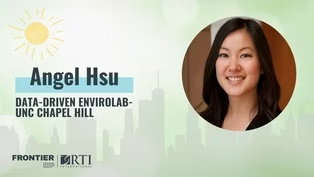
Angel Hsu, Data-Driven EnviroLab at UNC-CH | Sustainability
Video has Closed Captions
Clip: 7/21/2022 | 13m 21s | Angel Hsu looks at how urbanization is impacting global warming. (13m 21s)
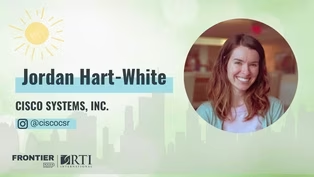
Jordan Hart-White, Cisco Systems | Sustainability
Video has Closed Captions
Clip: 7/21/2022 | 11m 51s | Jordan Hart-White discusses "green building" efforts. (11m 51s)
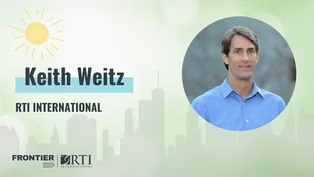
Keith Weitz, RTI International | Sustainability
Video has Closed Captions
Clip: 7/21/2022 | 15m 9s | Keith Weitz focuses on the sustainabilIty efforts in consumer products & packaging. (15m 9s)
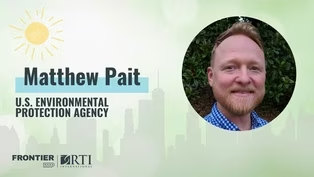
Matthew Pait, U.S. E.P.A. | Sustainability
Video has Closed Captions
Clip: 7/21/2022 | 15m 54s | Matthew Pait shares net zero goals relating to energy, water, and waste. (15m 54s)
Providing Support for PBS.org
Learn Moreabout PBS online sponsorship
- News and Public Affairs

Top journalists deliver compelling original analysis of the hour's headlines.

- News and Public Affairs

FRONTLINE is investigative journalism that questions, explains and changes our world.












Support for PBS provided by:
RTP180 is a local public television program presented by PBS NC