
Signature Dish
Sweet Home Cafe Serves Up Some of DC's Best Soul Food
Clip: Season 4 Episode 11 | 6m 20sVideo has Closed Captions
Seth visits Sweet Home Cafe at the National Museum of African American History and Culture.
Step inside Sweet Home Café at the National Museum of African American History and Culture, where Chef Ramin Coles serves up a dish rooted in his own family history. Seth Tillman pays Chef Ramin a visit and learns how red beans and rice — slow-cooked with andouille and head cheese — comes together with pan-seared fish, Carolina Gold rice, and bitter greens.
Problems playing video? | Closed Captioning Feedback
Problems playing video? | Closed Captioning Feedback
Signature Dish is a local public television program presented by WETA
Signature Dish
Sweet Home Cafe Serves Up Some of DC's Best Soul Food
Clip: Season 4 Episode 11 | 6m 20sVideo has Closed Captions
Step inside Sweet Home Café at the National Museum of African American History and Culture, where Chef Ramin Coles serves up a dish rooted in his own family history. Seth Tillman pays Chef Ramin a visit and learns how red beans and rice — slow-cooked with andouille and head cheese — comes together with pan-seared fish, Carolina Gold rice, and bitter greens.
Problems playing video? | Closed Captioning Feedback
Where to Watch Signature Dish
Signature Dish is available to stream on pbs.org and the PBS app.
Providing Support for PBS.org
Learn Moreabout PBS online sponsorshipRAMIN: Today, we're making Louis Armstrong's red beans and rice.
We're going to actually serve that with a seared rockfish and wilted bitter greens.
So, it's a classic dish that we run here at the museum regularly.
And this year being our 10th anniversary, the theme is "Welcome Home."
So, the doors are open and this is a dish that we would use to celebrate that.
SETH: And red beans and rice, I see a lot of ingredients.
I'm guessing this is a pretty labor-intensive dish.
RAMIN: Labor-intensive, not so much.
Time-intensive, because beans take time.
You have to kind of nurse them and love them a little bit.
We're going to start with our sausage.
I like andouille sausage.
As it starts to brown, we're going to add a little bit of oil and then we start with our aromatics.
So, we got green pepper, then we add our onions.
We're going to sweat these out.
SETH: And again, a lot of flavor from that andouille sausage.
RAMIN: The sausage is your base.
So, this is our spice mix.
So, we have a little bit of onion powder, granulated garlic, seasoned salt, that's a personal add-on, and Cajun seasoning.
SETH: And nice generous bit of seasoning there too.
RAMIN: Beans have a tendency to absorb salt and flavor.
So sometimes you have to go a little bit over the top, so we're going to add some tomato to it.
So, this is a little controversial.
Traditionally, you would not see tomato in this dish, but Louis Armstrong really was into tomatoes.
This is Louis Armstrong's favorite dish, so much so that when he signed his letters, he would sign it "red beans and ricely yours."
SETH: And if Louis Armstrong, one of the icons of the 20th century, if he says you put tomatoes in your red beans and rice... RAMIN: You put tomatoes in.
SETH: ...who are we to argue?
RAMIN: Not here to argue.
So right now, we're actually going to add a little bouquet.
This is just thyme.
So, we add that in as our aromatic.
So, our next step, we're going to actually add more pork.
This is a pork-on-pork dish.
So, we're going to add ham hocks to the dish.
Traditionally, you would just drop it in, let it do its thing.
But we make a fortified stock and this is ham hocks, onion, pepper, garlic, and we cook it down, we strain it and we remove the ham hocks themselves.
We're going to drop this in.
SETH: So, you're still going to get all the flavor of the ham hock into the dish, just in the form of a stock?
RAMIN: Absolutely.
But because we're not wasteful, we're going to take the ham hock that was left over.
It kind of looks like what's traditionally called head cheese or souse meat, and then we're going to fold it in, but that's adding more of that unctuous flavor to it.
So right now, while this is going, we're going to add our beans.
So, these beans were blanched and now, it cuts some of your cooking time down.
So, I'm actually going to add a little more stock.
So, this dish and many dishes like it started as a way to help you have a meal at the end of the day.
During Jim Crow-era South, Saturday was still a work day.
Sunday was for church.
Monday was your wash day.
So, while you're washing your clothes, you need something that you could leave and come back to.
It's on a low, slow heat.
It allows all the flavors to marry.
SETH: So, this dish was kind of born out of a practical need?
RAMIN: Absolutely.
Most dishes are.
SETH: And of course, as a great bonus, it's delicious.
RAMIN: Absolutely.
So, Seth, you see now it's starting to bubble up.
So, we're actually going to put the lid on and we're going to come back and check it in about an hour and a half.
But since we don't have an hour and a half, I actually do have some beans prepared, ready to go on the side.
SETH: All right.
RAMIN: Here's our finished red beans.
SETH: Oh, wow.
RAMIN: So, if you see, the beans have cooked through, they've broken down.
They've actually started to kind of let some of their starch out, which makes it creamy on its own.
SETH: Oh, yeah.
Everything looks like it's come together magically.
RAMIN: We're actually going to take this off and then we're going to start our rockfish.
We call it rockfish in Maryland.
Everywhere else in the world calls it striped bass.
We're going to heat our oil up and we are going to season it with salt.
And then here's a rub that we make.
It's equal parts white pepper, coriander, and fennel.
So, this is a really simple pan sear.
The fish likes to curl up, but what we're looking for is the skin to relax and then for it to start creating a crust.
So, as you see, the edge is starting to get like opaque.
We're actually going to take it off and finish it in the oven for about 8 to 10 minutes.
And as the fish is cooking, we're going to begin our plating process.
We're going to start with some Carolina gold rice.
On top of that, we're going to add our Louis Armstrong red beans.
We're going to sauté some bitter greens, with a little shallot, garlic, salt and pepper.
And then on top of that, we'll add our fish.
We'll finish it with our green onions and our dish will be ready to eat.
SETH: All right, Chef.
I was excited about the red beans and rice.
Even more excited for this feast, but I got to start with a little bit of that stew.
RAMIN: Enjoy.
Yeah, mix it up a little bit.
So, you get a little bit in each bite.
SETH: That is a special treat right there.
RAMIN: Thank you.
SETH: Wow.
Those beans have gotten so creamy.
The richness coming from that andouille, that head cheese you put in, there's just richness on top of richness.
RAMIN: And it's a great dish because we're enjoying it with fish and greens, but just rice and beans alone is a good dish.
SETH: Oh, yeah.
And of course, cutting into that rockfish, getting a nice little bit of crispy skin on the top there.
I just love rockfish.
So, it's a perfect accompaniment.
And tell me about these greens, Chef.
RAMIN: So, it's a combination of dandelion and mustard greens.
With the beans being so rich, we need something that's kind of balance it out.
We went with a little bit of bitter.
SETH: Nice little bit of garlic flavor there and a nice sharp pungency to that bite as well.
I'm enjoying your take on the Louis Armstrong family recipe here.
These tomatoes are working for me.
RAMIN: Absolutely.
You know, what's traditional to me is not traditional to you because our families have maybe access to different ingredients.
Maybe I don't like tomatoes, maybe I don't like pork.
So, your family takes it and makes it their own.
So over time, that's what becomes traditional to eat.
SETH: And just like people took the base of this and built on it, I feel like coming into this cafe, I mean, that's kind of true of pretty much all the food we're eating today.
A lot of it has its roots in African American history and culture and traditions, right?
RAMIN: Absolutely.
Here, let's have a little bite of this macaroni and cheese.
We'll talk about it.
SETH: Oh, I love mac and cheese.
RAMIN: So, macaroni and cheese we know was brought over originally by Thomas Jefferson, but it didn't really gain popularity until it made it to New Orleans where the Italian community, as well as the African community rubbed together.
So, it wasn't until people were trying to find that same feeling of home that these dishes started to grow.
SETH: Wow.
RAMIN: So, you know, we have the macaroni and cheese.
We also serve fried chicken.
It's one of our number one sellers.
We try our best to show the breadth of that diaspora.
So, we're really trying to reclaim fried chicken.
This is actually a variation of my mom's recipe.
It's brined for roughly 12 to 24 hours, been dipped in a little bit of buttermilk and we have a proprietary dredge that we use.
I won't tell you all the different parts of it and then we just fry it.
SETH: Well, you can keep your secrets safe.
I would come back and happily try that anytime.
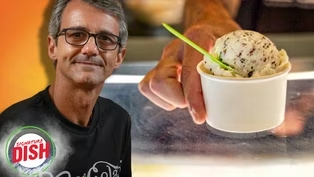
DC's Best Gelato Might Be Hiding in the National Gallery of Art's Basement
Video has Closed Captions
Clip: S4 Ep11 | 5m 22s | Seth visits Dolci Gelati at the National Gallery of Art for world class gelato. (5m 22s)

Immigrant Food Cafe at Planet Word Turns Recipes Into Advocacy
Video has Closed Captions
Clip: S4 Ep11 | 5m | Seth visits Immigrant Food at Planet Word Museum to sample ilipino fried chicken and pupusas. (5m)
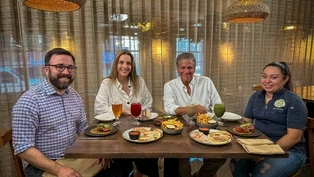
Preview: S4 Ep11 | 30s | Sweet Home Cafe at NMAAHC, Immigrant Food at Planet Word, Dolci Gelati at the NGA (30s)
Providing Support for PBS.org
Learn Moreabout PBS online sponsorship

- Food
Christopher Kimball’s Milk Street Television
Transform home cooking with the editors of Christopher Kimball’s Milk Street Magazine.











Support for PBS provided by:
Signature Dish is a local public television program presented by WETA