
Tackling Food Insecurity; Amanda A. Ebokosia
9/24/2022 | 26m 56sVideo has Closed Captions
Tackling Food Insecurity; Amanda A. Ebokosia
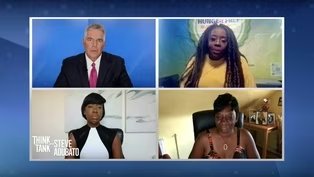
Steve Adubato is joined by a panel of Russ Berrie Making A Difference Award Winners who are working to combat food insecurity across the state. Panelists include: Stephanie Glover-Wilson Tanya Veltz Shenee Omuso Amanda A. Ebokosia, Founder & Chief Executive Officer, The Gem Project, joins Steve Adubato to bring awareness to the social justice issues plaguing their local communities.
Problems playing video? | Closed Captioning Feedback
Problems playing video? | Closed Captioning Feedback
Think Tank with Steve Adubato is a local public television program presented by NJ PBS
Tackling Food Insecurity; Amanda A. Ebokosia
9/24/2022 | 26m 56sVideo has Closed Captions
Steve Adubato is joined by a panel of Russ Berrie Making A Difference Award Winners who are working to combat food insecurity across the state. Panelists include: Stephanie Glover-Wilson Tanya Veltz Shenee Omuso Amanda A. Ebokosia, Founder & Chief Executive Officer, The Gem Project, joins Steve Adubato to bring awareness to the social justice issues plaguing their local communities.
Problems playing video? | Closed Captioning Feedback
How to Watch Think Tank with Steve Adubato
Think Tank with Steve Adubato is available to stream on pbs.org and the free PBS App, available on iPhone, Apple TV, Android TV, Android smartphones, Amazon Fire TV, Amazon Fire Tablet, Roku, Samsung Smart TV, and Vizio.
Providing Support for PBS.org
Learn Moreabout PBS online sponsorship- [Narrator] Funding for this edition of Think Tank with Steve Adubato has been provided by The Russell Berrie Foundation.
Making a difference.
The Healthcare Foundation of New Jersey.
Rowan University.
Hackensack Meridian Health.
Keep getting better.
Fedway Associates, Inc. Valley Bank.
Prudential Financial.
The Fidelco Group.
And by New Jersey'’s Clean Energy program.
Lighting the way to a clean energy future.
Promotional support provided by Meadowlands Chamber.
Building connections, driving business growth.
And by New Jersey Monthly.
The magazine of the Garden State.
Available at newsstands.
[MOTIVATIONAL MUSIC] - Hi everyone, I'm Steve Abubato.
We have a distinguished panel talking about the issue of, not just talking about, dealing with, confronting, addressing, the very serious issue of food insecurity.
We are joined by Stephanie Glover-Wilson, is the Founder and Executive Director of Hunger Free Unity in the Community.
Thank you so much for joining us, Stephanie.
- Thank you for having me.
- Your two colleagues, Shenee Omuso is Director of Education & Career Pathways at The Opportunity League.
Shenee, welcome.
- Ah, hello, thank you, thank you for having me today.
- And finally, Tanya Veltz is Founder and President of Tree House Cares, Tanya.
- Good morning, thank you for having me.
- You gotta, "Hey, let's take this on, let's deal with this."
And let's also make it clear that all three of you are winners of the Russ Berrie Award for Making a Difference, an initiative we've been involved with for well over two decades.
The Berrie Foundation recognizes people making a difference.
All three of you making a huge difference in the arena of food insecurity.
Let me ask you this, Tanya, first of all, tell us what Tree House Cares is, and connect it to issues of food insecurity, please.
- Okay, Tree House Cares is a nonprofit organization, I'm the founder.
We provide hot meals, meals daily, free groceries, to over 400 to 500 people per week.
We provide 1,200 meals-per-day to individuals, families, and our homeless neighbors without addresses.
- And what's the area that you are in that you do that work?
- We're located at 462 Sanford Avenue in Newark, in the West Forest section of Newark.
- Got it, let's put some things into perspective.
In New Jersey, 800,000 people face hunger every day, 200,000 of those who are facing hunger every day are children; that speaks for itself, you don't need to know any more than that.
Talk to us, Stephanie, about Hunger Free.
- So Hunger Free is a nonprofit that we started.
We only started to service the Bayonne community.
Once COVID hit, we became a traveling Hudson County food pantry, which we actually rescue food from big companies, me and my volunteers, 100% volunteer program.
And we go to different cities in Hudson County, to low-income seniors and veterans.
When COVID hit, it made sense, because seniors were so afraid to come outside, and they had no food in their homes.
And what made it really work was a lot of our, a lot of seniors, kids, moved away to Florida and California, so they couldn't get to their parents to feed them.
So we were getting a lot of phone calls through our website, and through social media, "Can we go drop food off to their families?"
And that's what we started doing, and we just kept doing it.
- Directly into their homes.
- Yes.
- Wow.
Shenee, you are down in, if I'm not mistaken, we're taping up north, you're down in Burlington County?
- Yes, we are here in Burlington City, New Jersey, yes.
- Talk about your organization and its connection to food insecurity.
- Sure, so The Opportunity League, in about 2019, we were brought together with a number of organizations, and challenged to identify a health concern in our community, by the New Jersey health initiatives.
So we received a grant to tackle food insecurity, which was the issue we decided to address.
And since then, at the height of COVID, there were about 42,000 meals that were being distributed here in Burlington City, through the police department, and through the school system.
So we definitely saw a need that food was a major issue.
So we decided to, along with some of these collaborative partners, kind of join together to create a village's community marketplace, which is an initiative to create a grocery store right here in Burlington City, New Jersey.
- Let's delve into this a little bit more.
Some of the primary causes, I mean, obviously COVID, and each one of you have spoken about that, to one degree or another.
But inflation, Stephanie, let me ask you, the connection between inflation, higher prices, and issues of food insecurity, please, Stephanie.
- The connection is that we still have single parent households.
So when the inflation's going up on food, their paychecks, co-payments, and people forget co-payments, just 'cause you have health insurance, you still have to do co-payments, you still have to buy medicine.
So food is going up, but their paycheck, and their salary's not going up, and doctor visits and co-payments are going up.
So they have to balance out, "Do I go on a line, or get food from an organization, or do I pay for healthcare, then my kids can't eat."
And then with seniors, social security, they're not increasing their cost of living anymore.
So it's harder for them, that they are living in these stable incomes.
And some seniors still own their own private homes.
So it's maintenance on their homes, and worrying about if they're gonna eat in the next couple of days.
- Yeah, the problem is getting worse.
Tanya, jump in, I see you shaking your head.
- Yeah, I see that with us providing, that the hurdles are, transportation is another issue.
We have a lot of people who are in need, but we're in a food desert zone, and they can't get to us, let alone the local market, which would, in my area, is within a two-to-three mile radius.
- Tanya stay right there, you used the term "food desert".
Could you define that, please?
- Okay, so a food desert is considered an area where people are not able to get to local supermarkets within a short distance.
So I'm in the West Forest section in Newark, although we service all areas, but I'm in a high poverty area.
Most of the residents here are low-to-moderate income.
And so the local supermarket where I am is at least about a mile-and-a-half.
And so they are not able to get fresh produce, you know, dairy, and organic products.
So what we do is we receive about 23,000 pounds of those items per week, and we're able to provide to them.
So it's a food desert because they're not able to get out, transportation is one problem.
And then a lot of people here are disabled, I'm right across from a 320-unit senior building.
And they just can't- - Let me complicate it even more, Shenee, I want you to jump in here, we're taping this program toward the back end of July, it'll be seen later.
But literally, as we're taping this program, it's bordering on 100 degrees outside, it is incredibly hot.
Shenee, what is the connection between the weather, and the issue of food insecurity, and getting access to those who are providing nonprofits, like yours, providing food options, but also getting to those folks, please, Shenee.
- Sure, so it really piggybacks off what Tanya and Stephanie mentioned, just about the accessibility.
So for us, we kind of see similar issues going on, where the nearest grocery store is actually about 6 miles, 6 to 10 miles away.
And in a commuter town like Burlington City, that is really inaccessible.
And not to mention you have to traverse some major highways to get there.
So it's not within walkable distance.
Then you pile on to that, the affordability component, and the overall income level of the individuals and families here in the city.
So we really try to think of a sustainable way for us to provide fresh foods, at affordable rates, right here in the city.
And so that has been a tremendous endeavor for us to really partner with other organizations, and entities, so that we can keep costs down, that we can stay local in the city.
And not only that, but that we can provide trainings and career opportunities, so that people, and individuals, and families, can afford the products, and supplies, and services that we will offer at the marketplace as well.
- Let me follow up on something.
It's not so much about food insecurity, but it's about each one of you, as individuals.
Can I get a minute or less from each one of you?
And I'll ask Stephanie first, why do you do this work?
- Honestly, because about 20 years ago, I was that person.
I had a low paying job, I had two children.
I was in a really rough first marriage, and I had to fend for myself and my kids.
And I said, "If I ever get the education, get the better job, leave the husband."
I would never want another person to live the way I lived.
And once I did all that, and got remarried to a wonderful husband, but since passed away, it makes me push harder.
Because things happen, and someone has to do it, and we can't leave it up to our politicians anymore.
Like we have to be the community to take care of each other, because that's what we're supposed to do.
It's in my DNA, it's in my spirit, God put it there, and I'm gonna do it until I can't do it anymore.
It's just a passion that I have.
I can't stop.
- That's pretty beautiful.
That is absolutely beautiful.
And that is the nature of the spirit of the Russ Berrie Making a Difference awards.
And that's why you're recognized.
Tanya, please, why do you, talk to us, why?
The why of what you do, go ahead.
- Just as Stephanie, her story, mine is similar.
I've always had a heart for giving, but I've always, in the earlier part of my life, I had tremendous struggles.
I too am married, I have a wonderful husband.
He's my right arm to doing all of this, but we were young parents.
And there were times that we faced eviction.
There were times when we had to send our children to school just so that they can get breakfast and lunch, and hope that we could provide dinner at the end of the day.
We suffered job losses, we know what it's like not to have lights and electricity.
And in 2013, I became very ill. And as a result of it, I lost my job.
My husband was my caretaker, it was difficult for him to care for me and keep his job, so we both were without jobs.
And I was really down.
I was really down, and it was so bad, that instead of praying to live, I was asking God to just, I didn't wanna be in that much pain, to just take me, take me from this.
But I made a promise, I said to him, "If you heal me, I promise you I will do your will, and do your work."
And boy, did he hold me to that.
(laughs) 'Cause it's been nonstop.
- And let me also add that Tree House Care has also created an arts organization, if I'm not mistaken, correct?
- Yes, the arts organization was founded first.
We provide free community entertainment events.
It's always free for the community in various locations.
And so we kind of spinned off, after my illness, and we kind of just went a little left.
And I said, "You know what?
I wanna really, really help those in need."
We had already built a platform with the arts and entertainment, but we used that to advance and to helping communities.
So we have pantries that we set up, pantries in schools.
We go to street corners, I'm very, very compassionate about our homeless neighbors without addresses.
And I'm here at my outreach site daily.
- Shenee, let me ask you this, as you're listening to your two colleagues, how much of that resonates for you?
- So much, you know, what Stephanie mentioned was spot on.
And I think it's really simple, "If not me, then who," right?
Like we can't sit back, and watch, and wait, for anyone else to create the change we wanna see in the world.
- Be the change, be the change.
- Be the change, exactly.
And as a mother of three small children, now there's a legacy at play here, right?
Like we've moved here to the city to be closer to the work, and the work that we are creating, the change that we are creating, we hope it's for years to come.
That our children will enjoy, our children will be the benefactors of this experience, and that we don't have to, you know, put off, or wait, or delay, we can do it now.
So really, if not me, then who, you know?
So we definitely, here, are about legacy and legacy building.
- First of all, powerful testimonials from each one of you.
But I'm curious, before we wrap this up, I wanna do something.
So I think Stephanie said, "We can't wait for government to do it," but if there was one government policy that you believe must be changed to improve the issue, or deal more directly with, and help those suffering and struggling with food insecurity, Stephanie, go, give me a minute or less.
- It would be to have local restaurants and stores pack up their food and send it home with the kids on Fridays, so the kids can eat over the weekend.
Because that is one of our problems, the parents send kids to school Monday through Friday to eat.
Saturday and Sunday, our kids don't eat.
So if there was a law that we can make, a backpack program, sign me up for it, I wanna do it.
- Yeah, I'm listening to somebody who should be making policy right now.
Tanya, go ahead.
- Tell me how, tell me how to do it, I'll meet you there.
- Listen, all you can do is what you're doing every day, and also put it out there.
And it's the job of elected officials, appointed officials, to pick up the ball and do the right thing.
Tanya, go, one policy that needs to be changed.
- More local supermarkets.
Instead of utilizing these abandoned properties, and all of these vacant buildings for new development, for housing, yes, we need housing.
But we need local supermarkets that will provide fresh produce, organic items, and nutritional foods to those in need.
- I'm gonna give you one more chance on this, Shenee, go, one government policy that needs to be changed or improved.
- Transforming school lunches to be healthier, to have nutritious, but tasty and delicious options.
And to bring the community in on the decision making, and budgetary process, of how school funds are used to create menus and to create healthy choices for students.
- To Shenee, to Stephanie, to Tanya, you represent the Russ Berrie Award community very well.
The winners of the Russ Berrie Award for Making a Difference, we thank you.
You honor us by joining us, in the fight every day, not just about food insecurity, but about a whole range of related issues.
And we also wanna especially thank you for sharing your very personal and poignant stories.
Thank you so much.
- Thank you for having us.
- Thank you for having us.
- Thank you.
- You got it, stay with us, we'll be right back.
To watch more Think Tank with Steve Adubato, find us online and follow us on social media.
- We are honored to be joined by Amanda Ebokosia, who's founder and chief executive officer of The Gem Project.
Amanda.
Great to have you.
- Thank you.
Thank you, Steve, for having me.
- We're gonna put up The Gem Project website.
We're gonna also acknowledge that you're a Russ Berrie awardee, the making, for making a difference.
What is The Gem Project and why does it matter so much?
- The Gem Project is a nonprofit organization that really aims to boost youth engagement and on time graduation through a year-round paid fellowship.
So we really create and help develop mentoring relationships between high school students and college students in such a way that they identify issues within their community and then seek out different actions to address them.
- Awesome.
And we, I interrupted you.
Go ahead.
- No, and it matters because youth need a space to be able to thrive and realize that their lived experiences do matter within the communities in which they reside and they do have the capacity to be able to address those issues effectively.
- You're, you're based where?
- Our organization is based in Newark, New Jersey.
- You are in Newark.
My, my hometown.
Brick City born and raised.
I happen to be in our Montclair studio.
I just wanted to be clear we're taping in real time in late July.
If you hear thunder and lightning, it's because there's thunder and lightning going on in Newark and Montclair, just to clarify.
Amanda, let's do this.
Let's talk about the young people that you're serving every day.
What are some of the most pressing issues they are facing that challenges them?
- Wow, there's a whole host of issues that they're facing right now, especially as they get right into coming back from being in a space of an virtual environment in schools, coming back to in person has been a great challenge for them.
Many have had several different mounting additional responsibilities at home, taking care of young, young ones, as well as helping parents along the way.
And there's also challenges that I even speak with our, our program managers and young people who say, like being able to, trying to navigate for those who are in college, being able to navigate the schoolwork and as well as their their side hustles or gigs that they have on the side while trying to make sure that they graduate on time has been difficult.
- Especially not, not, not to mention huge issues involving social justice, institutional racism, et cetera.
Please talk to us.
- Yes, definitely.
So our young people are directly impacted by the issues that they are trying to address every day, especially in the youth justice field and being around in spaces, being able to see and witness and find families directly impacted by violence, has been particularly alarming for our young people.
They have been seeking a lot of different mental health supports as well as initiatives to help to navigate during this time.
And so as an organization rooted in youth advocacy and, and social justice, our organization has been able to be able to match our young people with different resources, but at the same time, allowing our young people to create a space where they can address and talk about these issues.
And most recently, our young people, both our college students and high school students really engaged a community in Newark at Central High School in particular to have a mental health action day which impacted over 275 young people.
- You know, I'm glad you meant.
Well, the mental health piece is huge here, but also you, you did a Facebook live event with the former commissioner of health in the state of New Jersey, the former head of University Hospital, Dr. Shereef Elnahal, a national leader making a, talk about making a difference.
And Dr. Elnahal joined you and some of these young people to talk about health disparities and systemic racism.
Why was that event so important?
And what do you believe it accomplished?
- Yes, definitely.
The event was so important because we were at the heels in the early stages of COVID.
We're still in this pandemic where our young people are impacted greatly.
Some of them have lost family members and relatives and they wanted to really understand how racial issues impacted one's health and having those conversations, which by the way they led and they curated, was really helpful because it allowed them the space to get their concerns at a huge platform, as well as ask the critical questions.
Not, not just they that they had, but their peers, their fans, and and loved ones had as well especially doing with, in the pandemic.
- Let me ask you this, Amanda.
I met so many being a part of the Russ Berrie Making a Difference Awards for well over two decades.
I've met so many extraordinary leaders making a difference every day, but for you winning the Russ Berrie Award for Making a Difference, being recognized in this way in such a public way, what has it meant to you and your organization?
- It has truly really provided us a space that we did not normally engage in by providing such a platform.
We've been able to connect with former Russ Berrie award recipients to talk about future collaborations.
And it also allowed us to think about how well we can impact or help.
We can improve our community in a better way by collaborating with people who had similar initiatives and those also who are different as well.
- You know, I've talked to, we just did a a segment on food insecurity with three winners of the award for making a difference.
And I asked them this question and I want to ask you as well.
Why do you do this work?
- I do this work primarily 'cause I honestly believe that young people have everything that they need to change the world.
It's just a matter of access and opportunity.
Founding this work, I was a young person myself.
So we're talking about being in this work for over 15 plus years.
And it also comes with just providing the space and the resources and connecting our young people with positive allies who they can work alongside but not necessarily for.
So they're also building their leadership and, and also are the allies in our organization are also learning so much from the young people.
You can't be a youth organization or youth development organization without really putting the young people's voices at the forefront and learning from them because those are those critical moments that can really impact them the most.
- Got a few seconds left.
Amanda, we do a sister program called "Lessons in Leadership" I do with my colleague Mary Gamba.
And I ask this question of all kinds of leaders and you are clearly an important leader.
The number one leadership lesson you have learned in your few years is.
- To sit back and listen and do it often because those are when you get to hear the greatest takeaways.
And I see that every day walking into the spaces of our community, working with our young people, listening to them and hearing what their personal challenges are has been truly a worthwhile experience.
And they often let us know what we need to hear.
We just have to pay attention.
- Well said.
Amanda, congratulations.
Well done.
- Thank you.
Thank you, Steve.
- You got it.
I'm Steve Adubato.
That's Amanda.
She's making a difference every day.
We'll see you next time.
- [Narrator] Think Tank with Steve Adubato has been a production of the Caucus Educational Corporation.
Funding has been provided by The Russell Berrie Foundation.
The Healthcare Foundation of New Jersey.
Rowan University.
Hackensack Meridian Health.
Fedway Associates, Inc. Valley Bank.
Prudential Financial.
The Fidelco Group.
And by New Jersey'’s Clean Energy program.
Promotional support provided by Meadowlands Chamber.
And by New Jersey Monthly.
- Hi, I'm Abbie.
You might see me as an ordinary person, but I've been living with a brain injury since 2018.
Opportunity Project gave me hope and I've gained confidence through job skill training and helping my family.
Despite my challenges with memory, I see a possibility to keep improving.
- [Narrator] If you have a brain injury, you don't have to face your road to recovery alone.
Learn more about Opportunity Project and its partnership with Children's Specialized Hospital.

Providing Leadership Training to Young Adults
Video has Closed Captions
Clip: 9/24/2022 | 9m 23s | Providing Leadership Training to Young Adults (9m 23s)
Video has Closed Captions
Clip: 9/24/2022 | 17m 23s | Tackling Food Insecurity (17m 23s)
Providing Support for PBS.org
Learn Moreabout PBS online sponsorship
- News and Public Affairs

Top journalists deliver compelling original analysis of the hour's headlines.

- News and Public Affairs

FRONTLINE is investigative journalism that questions, explains and changes our world.












Support for PBS provided by:
Think Tank with Steve Adubato is a local public television program presented by NJ PBS