State of Affairs with Steve Adubato
Taiisa Kelly; Patricia Costante; Peg Wright
Season 9 Episode 27 | 26m 55sVideo has Closed Captions
Taiisa Kelly; Patricia Costante; Peg Wright
Taiisa Kelly, CEO of Monarch Housing Associates, explores homelessness in NJ. Patricia Costante, Board Member of NJ Health Foundation and Founding Member of the EJI Excellence in Medicine Fund, analyzes how the perception of public health has evolved. Peg Wright, Founder & CEO of The Center for Great Expectations, discusses her non-profit’s mission to break the cycle of homelessness and addiction.
Problems playing video? | Closed Captioning Feedback
Problems playing video? | Closed Captioning Feedback
State of Affairs with Steve Adubato is a local public television program presented by NJ PBS
State of Affairs with Steve Adubato
Taiisa Kelly; Patricia Costante; Peg Wright
Season 9 Episode 27 | 26m 55sVideo has Closed Captions
Taiisa Kelly, CEO of Monarch Housing Associates, explores homelessness in NJ. Patricia Costante, Board Member of NJ Health Foundation and Founding Member of the EJI Excellence in Medicine Fund, analyzes how the perception of public health has evolved. Peg Wright, Founder & CEO of The Center for Great Expectations, discusses her non-profit’s mission to break the cycle of homelessness and addiction.
Problems playing video? | Closed Captioning Feedback
How to Watch State of Affairs with Steve Adubato
State of Affairs with Steve Adubato is available to stream on pbs.org and the free PBS App, available on iPhone, Apple TV, Android TV, Android smartphones, Amazon Fire TV, Amazon Fire Tablet, Roku, Samsung Smart TV, and Vizio.
Providing Support for PBS.org
Learn Moreabout PBS online sponsorship- [Narrator] Funding for this edition of State of Affairs with Steve Adubato has been provided by The Russell Berrie Foundation.
Making a difference.
Robert Wood Johnson Foundation.
Working to create a future where health is no longer a privilege, but a right.
RWJBarnabas Health.
Let’s be healthy together.
Myron and Elaine Adler private foundation, in support of the Adler Aphasia Center.
New Jersey’s Board of Public Utilities.
Providing New Jersey residents tools to save money on energy costs.
The New Jersey Economic Development Authority.
Johnson & Johnson.
The Fidelco Group.
And by Kean University.
Where Cougars climb higher.
Promotional support provided by NJBIZ.
Providing business news for New Jersey for more than 30 years, online, in print, and in person.
And by Meadowlands Media.
A print and digital business news network.
[INSPRATIONAL MUSIC] - Hi, everyone.
Steve Adubato.
We kick-off the program talking about housing and homelessness with someone who knows it well.
She's Taiisa Kelly.
She's the chief executive officer of a terrific organization called Monarch Housing Associates.
We'll put the website up right away.
Taiisa, thank you so much for joining us.
- Thank you for having me.
- Describe the organization.
- Sure, Monarch, we're a nonprofit consulting agency that was formed in 1990.
Our belief is that everyone deserves the safest, stable place to call home 'cause we believe that housing is a human right.
And so, we do that by ensuring that we can help nonprofit organizations build affordable and supportive housing, working with developers, both non-profit and for-profit developers, to build housing.
And we work with communities across the state to really figure out how to better address homelessness within their region and develop and implement plans that really help people to get back into housing and get stable on their feet.
We also engage in public policy work to make sure that we have the resources to do that and the policies that make sense in this effort to create housing opportunity and to end homelessness.
- Taiisha, to what degree do our policies make sense on the federal and/or the state level to confront the crisis of homelessness?
- So, things are changing.
You know, we were going in the right direction for quite a while.
We know that there are best practices that work to really end homelessness.
Those are things like programs, such as Housing First, which say, "Let's help a person get into housing before we start to figure out the services.
Because at the end of the day, a person needs to be stable before they can work on other things."
There were investments in programs, like Rapid Re-Housing, that help to provide temporary rental assistance.
And so, we have a lot of those things happening at the state level.
And we did have some of that happening at the federal level, but there has been a change in approach and tone at the federal level that is moving in a direction that we know is not what works to end homelessness.
So, we've got a little bit of a unique situation in New Jersey, where we've got some state efforts to really end homelessness.
Engaging in practices that work and policies at the federal level that potentially can undermine that.
- So, let's be more specific.
Name a policy coming out of the federal government through the Trump administration that you would argue is not helpful as it relates to the homelessness crisis in our state and the nation.
- Sure.
So recently at the end of the July, there was an executive order that was released or signed called but ending crime in our streets.
And it really called for essentially the criminalization of homelessness.
It really called for communities to enforce camping bans, anti-loitering bans, bans on anybody who's experiencing unsheltered homelessness to prevent them from being on the street.
It calls for involuntary institutionalization of individuals if they do not choose to participate in services.
And it also pulls away from programs, such as harm reduction and Housing First that we know really work to help engage people in services.
Those types of activities really move us backwards in this work, because those were the ways that we approached homelessness, you know, 20, 30 years ago.
That did not work, and we moved towards a more productive approach of housing first, of trauma-informed, of course.
- Taiisa, so why do you think leaders in the federal government, we'll talk about the United States Supreme Court in a recent decision as it relates to some people argue making homelessness illegal in a second.
What would you, what do you believe the motivation is on the part of those in the federal government, in the Trump administration to push such policies?
How does that help communities.
A and B, they would argue they're just trying to get homeless people off the street.
- So, I think there's two things that are happening that are really dangerous, that are happening at the same time.
One, they are conflating homelessness with criminal activity and criminalization and you know, implementing a punitive criminal justice approach to addressing homelessness, when it is essentially a state of a person not having a place to- - One second.
I don't, I'm so sorry for interrupting.
At times when there are incidents, criminal incidents, high-profile criminal incidents that are sometimes caught on videotape, and then spread throughout social media, there is a perception on the part of many, not just in government, but in society overall, that there is a correlation between homelessness/mental health /criminal activities, violent crime in which innocent people are victims.
- So, I would say that the unfortunate reality is that those incidents are the ones that are highlighted, but the reality is the total population of people experiencing homelessness, the total population of people who are unsheltered experiencing homelessness do not represent, are not represented by those individual incidents that happen.
The reality is the majority of people who are experiencing homelessness are experiencing homelessness, because they're not earning enough money to afford a place to live.
They got behind in their rent, they got evicted, and for those who are on the street, they were not able to get into a shelter.
There's not enough shelter beds.
There's not enough housing opportunities for people.
Yes, there are going to be incidents of people who have mental health, who are struggling with mental health issues or substance abuse issues that are also within that homeless population as well, but that is not the majority and that is not the only part of the homeless population.
So, we are creating rules for a small segment that is being applied to the whole population.
It's like throwing out the baby with a bath water.
You're hurting everybody in the process and you're not supporting and helping those who do have mental health issues or support substance abuse challenges as well.
- What did the United States Supreme Court, Taiisha, rule as it relates to communities around the country being able to create ordinances that make homelessness a crime?
Is that it?
- Yes, so in 2024 with the Grants, the Supreme Court made a ruling in the Grants Pass Oregon v Johnson case, which said that it was perfectly fine for communities to pass local ordinances that made it illegal to camp or sleep in public places.
The challenge is that that type of ordinance ignores the reality of accessibility of shelter beds.
It assumes that there is a place for people to be, when there is actually no place for many people to go.
So we do not wanna see people on the street, but if there is no place for them to go, we should not be then pushing them to jail or to institution when there is no other available option for them.
- There'll be a new governor in New Jersey in January, 2026.
What's the number one issue in your mind they should take on and deal directly with whomever is elected governor in January of 2026 as it relates to the issue of homelessness?
And frankly, affordable housing, which are not disconnected?
- Yeah, they're intimately intertwined.
It's hard to say number one, but I would definitely say- - What's most pressing or couple most pressing, go ahead.
- Couple most pressing I would say definitely is we need to be investing in building more affordable housing and deeply affordable housing.
Housing that is affordable to people who are earning very, very low incomes, working minimum wage jobs.
That is gonna make it easier for folks to maintain their housing and avoid the homeless service system.
- Hold on one second.
Does that go beyond Section 8 housing that is more affordable?
Hey, you're building this development, a percentage of those apartments, there are those dwellings, whatever they are, they have to go to people who are under a certain income guideline.
Is that what we're talking about?
- Yes, that's exactly what we're talking about.
We need more Section 8 housing.
We need more housing that have vouchers attached to it.
We also need more landlords in the open market that are accepting vouchers and that are renting to people who have vouchers.
Because that's the other half of the challenge is that folks do sometimes have a voucher and have a really hard time finding - What's a voucher?
What do you mean?
- A voucher, meaning it can be a state rental assistance voucher, a Section 8 housing choice voucher, something to help them pay their rental assistance, long-term or short term.
And we do have landlords that are not always willing to accept those vouchers, even though they're supposed to in New Jersey.
Even though it's illegal to deny a person for a voucher, that still happens in the state.
And so, we need to both build housing that is dedicated, but we also need to open up the market of existing apartments within the state.
We need to, as a state, we need to be investing in and confirming that we are a housing-first state and investing in the services to help people get into housing and help a person navigate the process of getting into housing.
If you can imagine being unsheltered and being homeless for a long period of time on the street, you've lost your IDs, you've lost your birth certificate, you've lost your social security card, and those are some of the primary things that landlords are looking for when you're applying for an apartment.
So, there's a whole process of getting the documents that you need of signing up for programs of even just kind of getting started in the process before you can move into an apartment.
And so, investing in services to help support people through that process is really important.
- Taiisa Kelly, will not be the last time she joins us.
She's the CEO of Monarch Housing Associates.
Taiisa, thank you so much for joining us.
We appreciate it.
- Thank you very much.
- You got it.
Stay with us, we'll be right back.
(grand music) - [Announcer] To see more State of Affairs with Steve Adubato programs, find us online and follow us on social media.
- We are joined once again by our good friend and colleague Patricia Costante, founding member of the EJI Excellence in Medicine Fund and also a board member at the New Jersey Health Foundation, one of our underwriters supporting our healthcare programming.
Patricia, good to see you.
- It's nice to see you too, Steve.
- Patricia, we had this offline conversation recently about public health and trust or distrust in the public health system.
We'll put a graphic up.
A working title, Trust in Public Health we’ll drive people to our website to find out more.
Why is the question of trust/distrust in the public health system today so incredibly important now, more than ever, Patricia.
- So, Steve, I have spent my whole career healthcare adjacent and one of the things I have always been so proud of is the United States as leaders in scientific research and how that fueled the public health system and kept us all safe in a world that can be terribly unsafe.
And it's so disheartening to me now to see the undermining of science and of research all around issues like vaccine safety, really rolling back decades and decades of work rather than putting us in a position where we can celebrate the successes we've had through the funding, the really robust funding of scientific research.
It's heartbreaking.
- You know, Patricia, and by way of background, Patricia and I have been colleagues and friends for over 20 years, and we've had all kinds of conversations about medicine, physicians.
Patricia has been a key partner of ours in our Tomorrow's Physicians Leaders with the late Dr.
George Heinrich of New Jersey Health Foundation.
But here's the thing.
There's always been some degree of distrust and questioning of public health vaccines.
What's different in 2025 going into 2026, Patricia?
- What I personally believe is there was a time when scientists were viewed as people of integrity, and physicians were viewed as people of integrity.
And as we tried to make our independent decisions about which aspects of medicine or scientific discovery or vaccines we trusted or distrusted, we went to those sources looking for information to support our belief.
That's what I think is different.
People are not looking to expert sources of information.
They're looking at things that are on social media that are so divorced from scientific inquiry that it makes it very difficult to say that this is the same level of scrutiny that happened in the past.
It's very different and very disheartening.
- So, along these lines, Patricia, what role do you believe that we, in media, in public media, in media, not gonna pat us on the back, but we have no horse in the race, we have no agenda other than credible public information that matters to the masses and is peer reviewed and whatever that means to people, it means it's legitimate.
It's not fake news.
They're not alternative facts.
Question.
When it comes to vaccines, we've had so many people, prominent people come on and say, "It's my choice."
"MMR vaccine with my kid.
Nah, it's parental rights."
Help folks understand why, okay, you have certain rights clearly, but what you choose to do or not do as it relates to vaccines, impacts.
My mother's 90.
You understand this as someone you know who cared for your mom, right?
Not just older people, but people whose immune systems are vulnerable.
Does it not affect everyone, Patricia?
- Correct.
It's the whole concept of herd immunity and being able to- - Explain that again; herd immunity.
- You know, vaccinate a population to a level where everyone is protected and not only within our own community, but there's so much impact now with global transparency and how people move from environment to environment that our stance on vaccines not only affects the United States, it affects the world, and I think that we each, as citizens, have to think about what our responsibility is vis-a-vis that issue.
- And the media has a unique responsibility.
- Right.
And I think the importance of public media, mainstream media, being able to speak out and provide peer-reviewed information that people can trust is really important.
We are at a point where people don't know what to trust, and I think that media has to step up and really fill in some of the gaps.
- Patricia, before I let you go, remind folks, and we'll put up the website for the EJI Excellence in Medicine Awards.
Remind folks, we've been doing that.
you helped make that happen at MDAdvantage Company you were the CEO and chairman of for many years.
Explain to folks what that is.
You and I have been co-MCing and hosting it for years.
What is it, and why is it so important to the future physicians of our state and nation?
- So the Excellence in Medicine awards are two pronged.
We recognize really superior healthcare experts, physicians, scientists, executives throughout the state of New Jersey.
And through recognizing them, we have the opportunity to provide scholarships to medical students, dental students, pharmacy students, and really give them the opportunity to enter into providing care, especially in the state of New Jersey which has a pretty significant shortage, especially of primary care physicians.
So it's an opportunity to close that gap and something I'm very proud of.
- And I humbly am proud to play a small part in that great event every year with so many people making a difference in the world of medicine.
Patricia, as always, thank you, my friend.
We appreciate it.
We'll talk soon.
- And thank you, Steve.
- You got it.
Stay with us.
We'll be right back.
(grand music) - [Announcer] To see more State of Affairs with Steve Adubato programs, find us online and follow us on social media.
- We're now joined by Peg Wright, President and CEO of the Center for Great Expectations.
Good to see you, Peg.
- Thank you, it's great to see you, Steve.
- And you're also a Russ Berrie Making a Difference Awardee, correct?
- I am, yes, I'm proud of that.
- Yeah, tell us what the Center for Great Expectations is.
The website's up.
- The Center is a continuum of care for pregnant and parenting women that are presenting with substance use and mental health disorders.
So we do that in residential settings, outpatient settings, in home, child development, a whole continuum of care.
- Talk to us about government funding cuts, it matters.
What cuts, what are the cuts and how have they affected the people you serve every day, Peg?
- It's a bit of a nightmare.
We received SAMHSA funding, federal funding for 10 years, and then.
- Hold on, SAMHSA that's an acronym that not everyone knows, what is it?
- That's the Federal Substance Abuse and Mental Health Administration - Okay.
- At D.C.
And yeah, we received 500,000 for the last 10 years, which allowed us to serve Medicaid and underinsured individuals in our outpatient saying, that's gone.
I'm praying we have about $600,000 shortfall on the outpatient, which is a critical component of our continuum.
So I'm praying that we get that funding somehow.
We lost our state appropriation.
I'm hopeful that we can get a supplemental legislative appropriation in sometime in November.
That's roughly 1.5 million.
- It's interesting how some legislators and others are critical of those items that are added to the budget, those supplemental items.
As a former state legislator, I represented a district where there were dollars that we brought back to the district that we believe helping community members, helping municipalities, helping nonprofits like yours.
For those who say, hey, that's pork barrel stuff that they used to call them Christmas tree items.
Explain to folks why that is it 1.5 million?
- The legislators that had supported our appropriation really would like it to be a line item in the budget.
Maternal mortality is a critical issue in the state of New Jersey, and we are the premier provider of pregnant and parenting women presenting with substance use disorders.
So it's a no brainer for me.
- But I wouldn't call that pork barrel.
- No.
- Describe for us, Peg, the term trauma-informed care.
What does that look like?
- Well, the women that we serve have been generationally impacted by trauma, which includes poverty.
Complex trauma is, for example, living in a home with a mom that is using substances.
There's a tremendous amount of dysregulation going on.
There's, you know, food source is lacking, there are just a number of issues that create domestic violence.
So if you don't look at the underlying causes of substance use, it's a problem.
It's a big problem.
And, you know, we've been evolving a way of delivering care over the last number of years and collecting data.
We work very closely with Rutgers University, so it's just not my idea.
We have the data to prove it, and we're about to launch the Relational Recovery Model, which we've been working on for three years with Dr.
Denise Hien at Rutgers, and Dr.
Emily Bosque, who's the co-author along with my team.
So it's a big deal.
- Here's the thing that I'm not struggling with, but trying to make sense of.
We talk about these funding cuts.
We talk about certain programs that you and your team are leading at the Center for Great expectations.
We'll put up the website again.
Talk to folks about what happens to those women, those families, without those resources, if your organization can't provide those services?
- Well, the cycle continues.
And, you know, quite frankly, you know, living in the types of environments that the women that are referred to us live in without significant support.
And, you know, substance use is not an acute illness.
It doesn't, it's not one and done.
So someone doesn't come into my program for nine months and we just say, that's it.
They access outpatient care.
They access an in-home team that works with them for potentially 18 months in clinical case management, doula support, and peer support.
So we've recently partnered with Robert Wood Johnson University Hospital in providing their women with our care, which is really a big deal.
- Peg, how'd you get into this work?
- I'm a woman in long-term recovery.
You know, I was in a corporate setting.
It was the late 80s, you know, 90s.
I was selling diagnostic imaging equipment.
We partied hardy, and I had my, I got pregnant late in life.
And when I did, the light bulb went on and I said, I just can't live like this.
And ended up volunteering at Great Expectations Maternity Home, met Sister Rita Wilkie, and she changed my life.
- Wait a minute, you got help from the Center for Great Expectations?
- Not formally, no, you know, I was one of those lucky people, I didn't... and I'm not saying I did not get help at Great Expectations.
We were a maternity home at that point.
- Well, why'd you start volunteering?
- Because I was bored.
My son was at two years old then he was in preschool.
So it was a God thing, Steve, really it was.
And then I met Sister Rita, and she created a mission statement that spoke to Safe Place, Safe Presence, and Safe Path.
And that was in 1996 before people were even using the word trauma-informed.
- And PS, the Robert, excuse me, the Russ Berrie Foundation, being an awardee also means there's a grant that goes with it.
Those dollars matter, do they not?
- Oh, big time, that was just a magical day.
- It was, it was, - It was just.
- I was proud to host it with wonderful people like you.
- You did a great job.
And it was so wonderful to be with others that are impacting the community when it was really a tough, it's a tough time.
It's hard right now.
- Hey, Peg, you have an open invitation, we'll continue.
I know you're dealing with incredibly difficult fiscal challenges.
We will be here to continue to promote the work that you and your colleagues are doing and drive people to your website.
Thank you Peg, we appreciate it, all the best.
- Thank you very much, very grateful.
- I'm Steve Adubato, thank you for watching.
We'll see you next time.
- [Narrator] State of Affairs with Steve Adubato is a production of the Caucus Educational Corporation.
Funding has been provided by The Russell Berrie Foundation.
Robert Wood Johnson Foundation.
RWJBarnabas Health.
Let’s be healthy together.
The Adler Aphasia Center.
New Jersey’s Board of Public Utilities.
The New Jersey Economic Development Authority.
Johnson & Johnson.
The Fidelco Group.
And by Kean University.
Promotional support provided by NJBIZ.
And by Meadowlands Media.
Hi, I'm Naomi Gwartz from the Adler Aphasia Center.
Aphasia is a language disorder that usually results from a brain injury such as stroke or a brain tumor.
While aphasia can affect one's ability to speak, understand, read, and write, it does not affect intellect.
Programs offered at our center help improve communication skills as well as confidence and quality of life while surrounded by others who understand aphasia.
If you or a loved one is diagnosed with aphasia, there is hope and community.
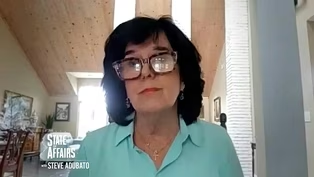
Breaking the cycle of homelessness and addiction in NJ
Video has Closed Captions
Clip: S9 Ep27 | 8m 41s | Breaking the cycle of homelessness and addiction in NJ (8m 41s)
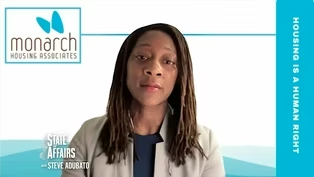
Discussing homelessness and affordable housing in New Jersey
Video has Closed Captions
Clip: S9 Ep27 | 10m 35s | Discussing homelessness and affordable housing in New Jersey (10m 35s)
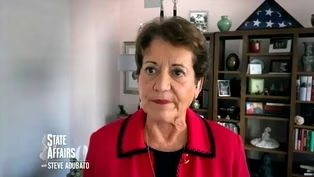
Examining the evolution of public health
Video has Closed Captions
Clip: S9 Ep27 | 8m 19s | Examining the evolution of public health (8m 19s)
Providing Support for PBS.org
Learn Moreabout PBS online sponsorship
- News and Public Affairs

Top journalists deliver compelling original analysis of the hour's headlines.

- News and Public Affairs

FRONTLINE is investigative journalism that questions, explains and changes our world.












Support for PBS provided by:
State of Affairs with Steve Adubato is a local public television program presented by NJ PBS