
Take a Stand
Season 1 Episode 15 | 26m 54sVideo has Closed Captions
Sometimes, you have to stick up for yourself, or somebody else. Hosted by Theresa Okokon.
Sometimes, you have to stick up for yourself, or somebody else...even when that little voice tells you it’s safer to keep quiet. Rev. Mariama gets down and dirty for a cause; Myles stops ignoring his stutter; and Tereza speaks up about her undocumented status. Three storytellers, three interpretations of TAKE A STAND, hosted by Theresa Okokon.
Problems playing video? | Closed Captioning Feedback
Problems playing video? | Closed Captioning Feedback
Stories from the Stage is a collaboration of WORLD Channel, WGBH Events, and Massmouth.
Take a Stand
Season 1 Episode 15 | 26m 54sVideo has Closed Captions
Sometimes, you have to stick up for yourself, or somebody else...even when that little voice tells you it’s safer to keep quiet. Rev. Mariama gets down and dirty for a cause; Myles stops ignoring his stutter; and Tereza speaks up about her undocumented status. Three storytellers, three interpretations of TAKE A STAND, hosted by Theresa Okokon.
Problems playing video? | Closed Captioning Feedback
How to Watch Stories from the Stage
Stories from the Stage is available to stream on pbs.org and the free PBS App, available on iPhone, Apple TV, Android TV, Android smartphones, Amazon Fire TV, Amazon Fire Tablet, Roku, Samsung Smart TV, and Vizio.
Providing Support for PBS.org
Learn Moreabout PBS online sponsorship♪ ♪ MYLES GREEN: I stood up in front of a crowd of people, and it was at that point that I felt the most naked, exposed, and alive.
TEREZA LEE: My dad said, "I have a very serious secret "to tell you, kids.
You cannot discuss this outside of the family."
MARIAMA WHITE-HAMMOND: I think it doesn't take more than common sense to know that highly flammable stuff, and a place where they blow up things are a bad combination.
THERESA OKOKON: Tonight's theme is "Take A Stand."
ANNOUNCER: This program is made possible in part by contributions from viewers like you.
Thank you.
The theme for tonight is "Take A Stand."
And when I think about taking a stand, sometimes I'm a little bit lazy, so I kind of go to there's always an easier way out.
Just in, like, minding my own business, and trying to stay quiet about what is happening around me.
And sometimes something happens, though, and you just need to actually stand up, and speak up, and say something, and take a stand.
♪ WHITE-HAMMOND: My name is Mariama White-Hammond.
And I'm from Boston.
I'm born and bred, grew up in Roxbury.
I'm a minister; I currently minister to young people, but I also do a lot of work around social justice issues.
OKOKON: And when did you realize that being a minister was what you were called to do?
Oh my gosh, that was quite its journey.
Both my parents are ministers, my grandfather, my uncle, both my godparents.
OKOKON: Wow!
So I was definitely clear that I was never going to become a minister.
(laughing) And then, you know, I kind of just started doing ministry work and not really thinking about it.
And I really don't think you have to be ordained to do ministry.
I think there are lots of people who do ministry that aren't ordained.
There have been women throughout centuries who haven't been able to have that title, but have been doing really great ministry work.
Um... but, you know, I think there is a role that black preachers play in our community.
And increasingly I saw that that was something I was called to do, and to be.
And I do stretch a little bit what it means to be a black minister.
(Theresa chuckles) Just to some extent by being a woman, to begin with.
Mm-hmm, mm-hmm.
WHITE-HAMMOND: Being young.
But I feel grateful when people allow me to be there-- both during the joyous and challenging moments of life.
OKOKON: Yeah.
And what are you hoping that people walk away with after your story tonight?
I just think we're in a time where, um, we all need to be more courageous.
I think there's so many times where we look at the world and wish it were different.
But sometimes I think we're waiting for somebody else to make that happen.
And the reality is it's going to happen when all of us in small ways stop settling for anything less than what we can be, what the world can be.
So I think... it's my hope that everybody feels like they can take a stand in whatever way, in whatever space they're in.
In 2015, I started hearing about this natural gas pipeline that was going to be built in West Roxbury.
Nothing this big had ever been built in a densely populated neighborhood.
Now I'd already signed petitions against pipelines in other parts of the country, and now there was one coming in my own backyard.
But I didn't get involved right away.
See, even though it was in a residential neighborhood, near my church, with two schools, plus a senior center, and even though it was across the street from a quarry... Now, I'm not an engineer, but I think it doesn't take more than common sense to know that highly flammable stuff, and a place where they blow up things are a bad combination.
All of these things were clear.
This was a terrible idea.
But there was one challenge.
See, I grew up in Roxbury, predominantly black neighborhood, where we feel like too often we get dumped on.
And this pipeline was going to be built in West Roxbury, a predominantly white neighborhood, very well connected.
I figured, I'm working so much on stuff in my own neighborhood, they got this, they'll handle it.
Everybody will come to their aid.
But the pipeline kept being built.
And finally some friends asked me to come to a rally, so I showed up.
And next thing I knew, I was in West Roxbury almost every week.
People were coming out, they were standing in front of the trucks, stopping the construction, and I supported them.
But in terms of getting arrested, I held back.
I figured, does the world really need another black person to go to prison?
So, finally I got an email from a friend.
It talked about how in Pakistan, the summer before, 1,300 people had died because of heatwaves-- so many people that grave diggers were starting to dig ditches in anticipation of summer.
And the ditches in Pakistan looked eerily similar to the ditch in West Roxbury.
So we decided to have an action to call attention to this, and to mourn all the people who were losing their lives because of climate change.
We chose a date, June 29th, my birthday.
My birthday's complicated.
It's a day I celebrate, but it's also a day that I mourn.
Anyway, the day came, I was in all black in my full clerical gear, and there was a lot of sun.
So, we had a prayer service, but we kept it short.
And then we jumped in the ditch.
Standing there, in the ditch, waiting to get arrested.
And I started to think about what I usually think about on my birthday.
See, June 29th is not just the day I was born.
It's also the day Kareem died.
In 2005, I was running a youth arts program to teach young people how to take their art and talk about social justice issues.
And Kareem was one of our young artists.
He was charismatic, and really committed, and all of the young people really followed his lead.
But on June 29, 2005, I woke up on my birthday to a call from a colleague, telling me that Kareem had been shot and killed in the early hours of the morning a few miles from my house.
He had wanted to turn his life around.
But some folks just wouldn't let him move beyond the life of his past.
And so standing in this ditch as the only person of color in a privileged part of the city, I felt like I needed to say something about Kareem.
That we shouldn't just fighting for people dying in Pakistan, or even in West Roxbury, if we couldn't honor the lives of young people who were dying because of even less futuristic things than climate change.
So I started talking.
First to the people next to me, then loud enough that the police could hear.
And then when I was done, people clapped and thanked me for sharing about Kareem's life.
As I got arrested and carted away, they cheered and said my name and his name.
I ended up in a jail cell with a 70-something-year-old activist in a tie dye shirt and Birkenstocks from the suburbs.
(chuckling) She talked about all of the different issues she had been working on over her whole life.
And as we waited for the bail bondsman, we started to question how could we build this world where we wouldn't sacrifice people in Pakistan or in Roxbury?
Finally, I got bailed out, my family picked me up, and they took me to the beach for, you know, watching the beach, sunset on my birthday.
And as I looked out over the waves, I realized that that day, I built a little bit of a bridge between two opposing neighborhoods.
And maybe I'd made a small dent in helping us see the connection between climate change and violence.
So, in the end, June 29th, it's not just the day I was born, it's not just the day Kareem died.
It's also a day where I stood up for something I believe in.
Thank you.
(cheers and applause) The first step to making the world better is working together, and that requires us to know each other, to care about each other.
And I think storytelling really does that.
It allows us to look into somebody else's life and identify with them.
It also is an opportunity to share about things that I've gone through that other people may or may not know about.
But, again, really making that human connection, that's the first step for anything to get better.
♪ OKOKON: Myles, it's really great to have you here tonight, thanks for being here.
Can you just tell me a little bit about yourself?
Sure.
I'm from the Boston area, I live here now, and among other things, I go to school at UMass in the Transnational Cultural and Community Studies program.
I keep honey bees, I'm an avid forager, and have worked in education for a few years now.
OKOKON: Wow, impressive.
So what was the first time that you told a story on stage, and what was that experience like for you?
Hm...
I guess the first time I told a story on stage was when I was working with a theater company in southern Italy.
And, um... it was a scripted set, and, um, in part based on some personal narratives and some poetry.
And it was really exhilarating to be in front of the audience.
Myles, I understand you also do improv, which is another type of performance, as well as storytelling.
So can you talk to me about what... how these mediums are important to you.
Storytelling for me and my story here is really important because the story that I'm sharing is one that's not often heard.
And storytelling is alive in my life in other ways, too.
I'm a part of an improv storytelling troupe where audience members share a true story from their lives and then the actors on stage use various forms of improv to play it back.
OKOKON: Oh, fun.
So, in that sense, I'm not telling my own story, but I'm a conduit for other stories.
So tonight's theme is "Take A Stand."
Can you talk to me a bit about how you relate to the theme?
For so long, I've...
I did everything I could to hide my stutter, to hide this part of myself.
And I eventually learned that that's not working.
And I needed to confront my stutter, and to come out and share it that this is a part of me, and it's something that I constantly am working with.
Myles Green is my name.
And that's important for me to tell everyone, because I have a stutter.
And as a stutterer, saying your name is one of the hardest things because there's no way of avoiding it.
Some people make up a nickname, or abbreviate their name in some way, bu... but I've never been into that.
And for pretty much my whole life, I did everything I could to hide and ignore my stutter.
Growing up I didn't talk about it with my friends, my family, my girlfriend from high school, not once.
It was always the elephant in the room, under the table that everyone knew was there, but no one spoke about.
Even though it was very obvious the elephant was there because every time I opened my mouth to speak, you could either see or hear my stutter.
And even the times I didn't speak, it was because of my stutter.
So growing up I ended up using all these tricks and avoidances on the words and sounds that I have a hard time with.
I don't say the word "stutter" for my entire childhood because it doesn't come out.
But I'm not hiding anything from anyone by not saying that.
Fast forward into my life a little bit.
I finish school, I go to college, I end up majoring in Italian.
(audience laughs) And then a few years later, I find myself teaching English in Palermo.
And at this point, I'm doing such a terrible, miserable job of hiding my stutter, of hiding this part of myself, that when I find myself in a block or in a freeze, everything in my mouth and my jaw seizes up and becomes tense.
And everything becomes so tense that I clench my jaw so much so hard and so frequently that I end up w... wearing away some of my tooth's enamel, to the point that I have a hard time eating and drinking things that are hot or cold.
And it was at about this time that I find out about this three-day long intensive course, this whole program to help you conquer your stammer.
I go online, I check out some of the videos, and I say to myself, "Oh, this looks useful."
I'm in tears for the first time in years.
So I fly to Scotland, and immediately there I can't hide anything.
Because everyone there-- the teachers, the administrators, and, of course, all the students-- they're all stutterers.
So for the first time, I feel like I'm seen in some ways.
But w... what makes this program so unique, though, is the way they view stuttering.
And they view it like an iceberg, with what you see at the surface just being the physical manifestations of the stutter.
The freezing, the struggle, the distortion of your mouth, your lips, your articulators, your jaw.
All that.
But that's just what's on the surface.
And what's underneath, what you can't see, is much bigger and much more important.
And that's the fear, the shame, the self-hate, the frustration, the anxiety you feel, that I feel, as a stutterer not being able to say my own name or speak like my four-and-a- half-year-old nephew speaks.
So to this end, on the second day of the course, they teach you this mentality, this approach to speaking called deliberate disfluency.
And I've been using this here with you now of "stuh."
Started and stop the first sound of certain words, and "pprolong" the first sound of other words.
That helps me with my speech because I'm coming out and showing you that I have a stutter rather than try to hide this part of myself.
Then on the third and final day of the course, they ask you to do what's called a disclosure.
And they set up a stage in the middle of the city center, and inevitably a crowd gathers in front.
And that's where, for the first time, I stood up in front of a crowd of people, and I said, "Myles Green is my name, and I have a stutter."
And it was at that point that I felt the most naked, exposed, and alive I've ever felt.
Thank you.
(cheers and applause) You don't hear about stutterers all that often in books, in media, in general.
It's kind of a hidden part of many people's lives, unless it's very obvious that it's there.
So for me, to go up in front of the crowd, to share my s-story here this evening is important because I want to give voice to a story that is often not heard.
♪ LEE: My name is Tereza, with a "Z," because I was born in Brazil.
And I came here when I was two years old.
I'm a pianist, as well as a mother of two, and a local activist.
And as a child, I understand that you were undocumented here in the United States.
Mm-hmm.
OKOKON: When did you first find out about your undocumented status?
I first found out that I was undocumented when I was seven years old, which is part of what I will be telling tonight.
And have you ever told your story or any story on a stage before?
I've never shared it on a stage such as this, so this is, uh... goes down in my bucket list.
(both laughing) The theme for tonight is "Take A Stand," so can you tell me about how you relate to this theme?
When I realized what it meant to be undocumented, I decided to stand up and say something about it, and share my story, and let other people know that this is happening to us.
This is happening all around us.
When I was seven years old, my dad called my brothers and me into the living room for a very important family meeting.
He said, "I have a very serious secret to tell you kids.
"You cannot discuss this outside of the family.
"We are undocumented.
"There's this thing called a green card and a citizenship, "and we have neither.
"We're not technically supposed to be staying here.
"We're supposed to go to Brazil," where I was born, "or South Korea.
"It's complicated.
"You cannot tell anyone outside of this family about our status.
"We might get separated.
That is why you cannot tell anyone."
The kind of fear that you grow up with as an undocumented child is all pervasive.
It's...
I've had many discussions with my friends who share the same... similar stories of recurring nightmares, of paramilitary police raids, of our families being taken away, or worse.
And with that fear comes a sense of isolation.
Like many undocumented kids, I also grew up very poor.
Um... our basement flooded every time it rained.
We didn't have furniture or beds.
There was no heat or hot water.
Some days we went without food.
And I remember my mom teaching me how to squash the bugs with my fingernails so that my hands wouldn't get too dirty.
But what I did have was the piano.
At that time, I started learning how to play the piano at my dad's church.
And my dad was a pastor who was unable to gather a large enough congregation to apply for a religious worker's visa.
But there was a parishioner who, after seeing how poorly we were living, she donated brand new furniture, including a piano for me.
I fell in love with the piano.
And it brought me joy, and a sense of purpose, and even a respite from the harsher realities of life.
I started accompanying my church services, and my high school choir.
I won some local piano competitions.
I also got a scholarship, full scholarship to Merit School of Music to study with world-class teachers, and also made friends there with other students that are passionate about music.
And soon I won a very big and important competition, which led me to perform the Tchaikovsky "Piano Concerto" with the world-famous Chicago Symphony Orchestra.
And I was the first inner-city kid in Chicago's history to have won.
(cheers and applause) The artistic director of Merit School of Music, Ann Monaco, called me up to her office and said... asked what colleges I was planning on applying to.
And as an undocumented kid, I didn't think that college was a possibility for me.
And even if I did get in college and got a scholarship, there were no DREAM teams at that time.
There were no undocumented activists, there were no support groups or public sympathy.
There was just me, a frightened 17-year-old girl and her confused teacher, who I told, I said, "I'm not going to college," and I left it at that.
And Ann Monaco, she kept her composure, and proceeded to print out ten college application forms, handed them to me, and said, "Fill them out as much as you can and bring them back to me tomorrow."
I did as I was told, I brought them back to her the next day, and she immediately noticed the missing social security number.
And I burst into tears, I confessed to her that I was undocumented, and, please, don't report me to the police because I cannot responsible for separating my family.
Instead of reporting me to the police, what she did instead was to help me, and which led her... which led us to Senator Dick Durbin's office.
Senator Dick Durbin's office looked into my case, and he saw that there was a broken and outdated unjust system, and he decided to write a bill.
And other undocumented students heard about this bill, and started coming forward to share their stories.
And Senator Durbin realized that he needed to redraft the bill into a larger bill.
And that bill, that bill became known as the DREAM Act.
(cheers and applause) In 2001, I was able to go to college.
I got a full scholarship into Manhattan School of Music, in New York City.
And on September 11th of that year, I was getting ready to fly to Washington D.C. for a hearing on the DREAM Act.
When all flights were canceled due to the terrorist attacks, the mood of our country changed that day.
Aside from all of the horrors that we all felt, what it meant for the DREAM Act was that any immigrant-friendly legislation was out of the question.
But what happened after that since then, over the years, DREAMers started coming out of the shadows to tell their stories, to march, and to demonstrate, and to support one another.
And, most importantly, to win public support.
A lot of us in the movement are starting to realize that the DREAM Act was just a seed that was growing, and growing into a larger movement that is needed for a broader comprehensive immigration reform.
Thank you.
(cheers and applause) ANNOUNCER: This program is made possible in part by contributions from viewers like you.
Thank you.
♪ ♪
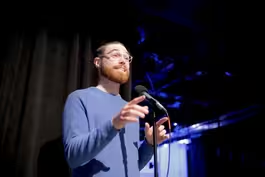
Preview: S1 Ep15 | 30s | Sometimes, you have to stick up for yourself, or somebody else. Hosted by Theresa Okokon. (30s)
Providing Support for PBS.org
Learn Moreabout PBS online sponsorship

- Arts and Music
The Best of the Joy of Painting with Bob Ross
A pop icon, Bob Ross offers soothing words of wisdom as he paints captivating landscapes.











Support for PBS provided by:
Stories from the Stage is a collaboration of WORLD Channel, WGBH Events, and Massmouth.