
Taking Note — Leland Ko
Special | 14m 8sVideo has Closed Captions
Cellist Leland Ko shares the impact his teachers have had on him on his musical journey.
Cellist Leland Ko shares the impact his teachers have had on him on his journey to becoming the musician he is today. Ko demonstrates his musical talent on a Pietro Guarneri of Venice cello from the early 18th century with two pieces that speak to him both thematically and personally.
Problems playing video? | Closed Captioning Feedback
Problems playing video? | Closed Captioning Feedback
Major series funding for GREAT PERFORMANCES is provided by The Joseph & Robert Cornell Memorial Foundation, the Anna-Maria and Stephen Kellen Arts Fund, the LuEsther T. Mertz Charitable Trust, Sue...
Support provided by:

Taking Note — Leland Ko
Special | 14m 8sVideo has Closed Captions
Cellist Leland Ko shares the impact his teachers have had on him on his journey to becoming the musician he is today. Ko demonstrates his musical talent on a Pietro Guarneri of Venice cello from the early 18th century with two pieces that speak to him both thematically and personally.
Problems playing video? | Closed Captioning Feedback
Where to Watch Great Performances
Great Performances is available to stream on pbs.org and the PBS app.
Buy Now
Great Performances Newsletter
Subscribe to the Great Performances newsletter to keep up with the latest full episodes to stream, exclusive content, and more!Providing Support for PBS.org
Learn Moreabout PBS online sponsorshipMore from This Collection
Taking Note is a new digital series spotlighting rising instrumentalists who have received Career Grant Awards from the Avery Fisher Artist Program. Each year, the program awards $25,000 to instrumentalists and chamber ensembles in support of professional music development.
Video has Closed Captions
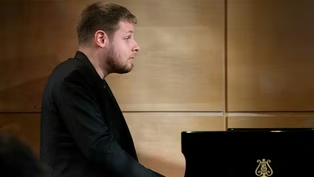
Pianist Dmitry Yudin immigrated from Moscow to the United States to follow his older sister. (10m 52s)
Video has Closed Captions
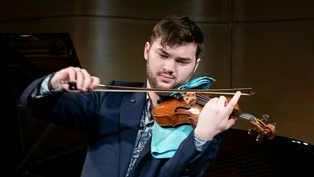
Nathan Meltzer first picked up the violin while living in Vienna and attending elementary school. (16m 16s)
Video has Closed Captions
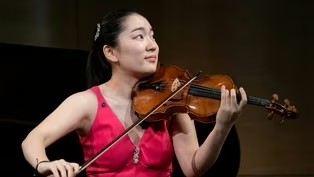
First taking up the violin at age three, Keila Wakao was raised in a musical family. (11m 55s)
Video has Closed Captions
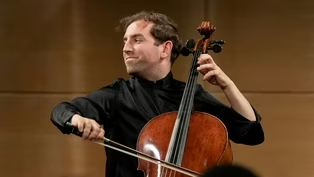
Cellist Tommy Mesa's love of music began with his interest in playing drums. (10m 44s)
Video has Closed Captions
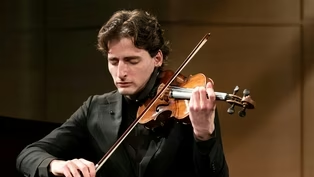
Following in his brother’s footsteps, Joshua Brown picked up the violin at age two. (9m 3s)
Video has Closed Captions
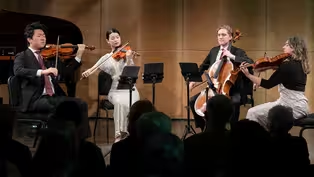
Composed of violinists Lucy Wang and Hao Zhou, violist Aiden Kane, and cellist Tate Zawadiuk. (11m 54s)
Video has Closed Captions
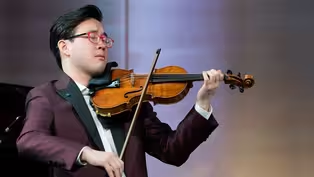
A profile of violinist Julian Rhee, winner of a 2024 Avery Fisher Career Grant Award. (10m 11s)

Taking Note - Balourdet Quartet
Video has Closed Captions
A profile of Balourdet Quartet, winner of a 2024 Avery Fisher Career Grant Award. (9m 18s)
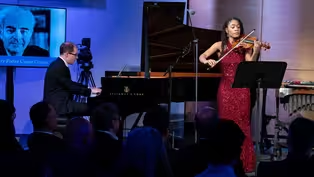
Taking Note - Njioma Chinyere Grevious
Video has Closed Captions
A profile of violinist Njioma Chinyere Grevious, winner of a 2024 Avery Fisher Career Grant Award. (8m 41s)
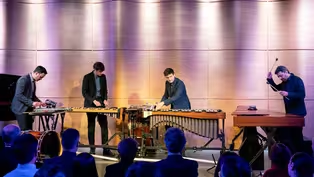
Taking Note - Sandbox Percussion
Video has Closed Captions
A profile of Sandbox Percussion, winner of a 2024 Avery Fisher Career Grant Award. (10m 4s)
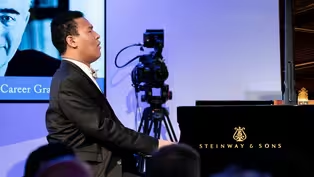
Taking Note - Clayton Stephenson
Video has Closed Captions
A profile of pianist Clayton Stephenson, winner of a 2024 Avery Fisher Career Grant Award. (9m 57s)
Providing Support for PBS.org
Learn Moreabout PBS online sponsorshipI had a teacher who used to call Dvorak the master of of nostalgia.
So I found out that I was going to be an Aver Fisher Career Grant recipient.
I think I asked her if she was joking.
Laughed, said two words, stuttered, one after the other.
I called my mom right afterwards.
So that's that was sort of... that's what I remember of it.
The Avery Fisher Career Grant comes with $25,000, and I think everybody it's interesting because everybody who receives this is in a different point in their careers.
And so I'm sort of just thinking, as someone who's 27, what are some things that I'd love to do that I haven't had the chance to do yet?
One of which is recording an album.
This is funny saying this on camera, because if this plan doesn't pan out, then that'll be really funny.
I'd love to have a portrait of myself in my 20s.
I'd love to look back on that in, you know, 30, 40 years and think, “That was a really stupid idea” or “That was a really interesting idea.
I see where where this young person thought that they were looking for a certain thing, were trying to communicate something.” So this cello, which I'm very fortunate to, to be the protector of, I guess.
This is made by Pietro Guarneri of Venice, which is for cellists, it's a very rare maker.
I've heard numbers of pretty much anywhere between he made six and ten cellos from Venice in the early 1700s, mid 1700s.
This is from 1728 to 1730.
Pietro Guarneri of Venice was the older brother of the famed Guarneri del Gesu, who made many of the world's most wonderful violins.
This cello was loaned to me to play by Canimex, a company up in Drummondville in Quebec.
I'm not a... I'm not necessarily the right historian, but, I, this is interesting to me that so the violin was sort of maybe perfected in Cremona, and at the time that the Stradivarius family was sort of at their peak and maybe had a stranglehold on, on violin making in Cremona Pietro Guarneri, decided to take a gamble and leave Cremona, where his family was, and go to Venice.
And Venice is sort of where the cello came into its perfect form, with makers like Matteo Goffriller, Montagnana, and Peter of Venice is sort of this remarkable blend, between Cremona, which had this almost like it was like the sound comes down to you on a platter from, from above.
Whereas Venetian instruments, to me, the cellos especially, kind of have it's like a steak with just a lot of fat, and a lot of... they're rich and they're earthy and they're, you know, they're deep and sort of bottomless.
And so, Pietro Guarneri of Venice was sort of able to mix those styles.
And this cello kind of has a little bit of both of that.
So while I was at Princeton, I was not officially a music major.
I was trying to practice as much as I could.
I felt like before I went off to college, I had been fed so many amazing ideas already by so many teachers Paul Katz, Ronald Leonard, Ron Lowry, Kirstin Peltz, just to name... I don't want to miss out on any of the people who have had an impact on me.
And by the time I got to college and kind of didn't really have a teacher for most of that time, I didn't mind it as much as I thought I would.
There's something about being a musician taking lessons week to week that is a lot of information to digest.
And weirdly, for me, in those couple of years, I could take six months to figure out what Paul Katz was trying to get me to understand about resonance or kind of, you know, sinking into the string a certain way and just how to, how to sit in a chair.
That if you get weekly feedback that's helpful for in one way.
But also having just the time to kind of aimlessly explore, I think is just as important.
It also meant that by the time, by the time I went back to, music school for my master's and postgraduate, I, I felt like I was a really bad student because I was so used to doing things my way.
I really had to figure out how to, how to take feedback again.
So the first piece that I played at the ceremony is Tibetan Dance by Bright Sheng.
He's a Chinese American composer, and Tibetan Dance is the last of seven in a set of seven pieces called “Seven Tunes Heard from China.” ♪♪ My understanding is that Bright Sheng was sort of a an ethnomusicologist, and he was traveling around China, different provinces, recording, gathering the music of folk people.
♪♪ It's so funny to look at his musical notation on the page and the way that he ties it into, I guess, standard Western classical music notation, because, it seems, it looks very cerebral and it felt very cerebral to learn.
He's a very detailed, very specific composer.
But the more that I got to play the full set, including Tibetan dance, the more I realized that coming out the other end means finding a certain freedom and a ertain way of existing with a piece that feels like it's not notated.
♪♪ I've never met Bright Chang, but the first recording I think of this piece was done by Yo-Yo Ma.
Yo-Yo Ma to many young Chinese American male cellists is quite the role model and for a lot of reasons.
But as a kid, I remember hearing this and just thinking, “It's so cool to hear music by Chinese composer.” ♪♪ ♪♪ ♪♪ ♪♪ ♪♪ The second piece that I played at the ceremony was commonly known as Silent Woods by Antonín Dvoák.
Its known as Silent Woods, which I believe is a translation of the German “Waldesruhe,” which is the publisher's title for the piece from a larger set, which was called “From the Bohemian Forest,” and I do not know if Dvoák suggested the title, if someone else did, or if the title came later.
My understanding is that Dvoáks original title in Czech was “Klid,” which means peace.
Peace and Silent Woods, they coexist, poets might argue that they are slightly different things.
I grew up knowing it as Silent Woods and always kind of had a certain imagery to it.
In the case of Silent Woods, there is always sort of a steady heartbeat provided by one of the two instruments, and then we call them off beats.
But between those beats provided by the other player, that composite effect, whether it's a heartbeat, whether it's the beating of time, we hear the swaying of trees and nature.
♪♪ A lot of the markings are quite quiet.
I think the very opening is, pianissimo, which is odd for a starting dynamic.
And so I think just the world that Dvoák was trying to create was a very comfortable in an unusually deep and kind of homey way.
♪♪ I had a teacher who used to call Dvoák the master of nostalgia.
A lot of the music that he writes is about love for his homeland and kind of everything that it symbolizes.
When I got to know this piece as a kid, it was something that I would just put on the radio a lot and kind of either lie on the floor or lie on my bed and just, like, stare up at the ceiling and process emotion as a teenage boy for, for the first time, whether I was, you know, whether I was in love with, I was I missed some friends, whether I was just really tired and needed to feel something else, you know, and I that piece stuck with me a lot as a kid, for a lot of the same reasons now, I still, I still love it.
And I think fitting that for an event like this, I got to play two pieces that are from my childhood.
♪♪ I was lucky to be on a youth orchestra tour in 2015, sort of in a couple different countries in Europe.
We made a stop in Berlin.
And a youth orchestra of 120 kids got to sit with Simon Rattle, and kind of just ask him questions about music, about life, about what it's like to be the music director of the Berlin Phil.
And one person asked him what his advice to young musicians is, and Simon Rattle attributed this story to Brahms.
Brahms's advice to any student was practice one less hour every day and read one more good book, because music is about life and not the other way around, as a would have been, what, 17 at the time?
I didn't really know what it meant.
It's been ten years.
I have a slightly better idea of what it means, but I've got the next again, 50 years to maybe figure out what exactly that means.
My current thinking, is that, as musicians who play pieces by all different kinds of people from all different points in history, from all different places, with all different kinds of people on stage with us.
Every moment on stage has an opportunity to communicate a different story, and there's only so much you can learn about what that story or what that moment can mean with an instrument in your hands in a practice room.
♪♪ ♪♪ ♪♪ ♪♪ ♪♪ ♪♪ ♪♪ ♪♪ ♪♪ ♪♪ ♪♪ ♪♪ ♪♪
 New Episode
- Arts and Music

Innovative musicians from every genre perform live in the longest-running music series.

- Arts and Music
The Best of the Joy of Painting with Bob Ross
A pop icon, Bob Ross offers soothing words of wisdom as he paints captivating landscapes.
 New Season






 New Episode
 New Episode
Support for PBS provided by:
Major series funding for GREAT PERFORMANCES is provided by The Joseph & Robert Cornell Memorial Foundation, the Anna-Maria and Stephen Kellen Arts Fund, the LuEsther T. Mertz Charitable Trust, Sue...