
Talents & Traditions
Season 8 Episode 11 | 26m 48sVideo has Closed Captions
Celebrate art, music and dancing as host Angela Fitzgerald visits the Folklore Village.
It’s a celebration of art, music and dancing as host Angela Fitzgerald visits the Folklore Village. Located in Dodgeville, the campus serves as a place for guests to learn and experience a variety of folk art traditions. Then we traverse the state to see the lives and passions of other Wisconsinites.
Problems playing video? | Closed Captioning Feedback
Problems playing video? | Closed Captioning Feedback
Wisconsin Life is a local public television program presented by PBS Wisconsin
Funding for Wisconsin Life is provided by the Wooden Nickel Fund, Mary and Lowell Peterson, A.C.V. and Mary Elston Family, Leon Price & Lily Postel, Stanley J. Cottrill Fund, UW...
Talents & Traditions
Season 8 Episode 11 | 26m 48sVideo has Closed Captions
It’s a celebration of art, music and dancing as host Angela Fitzgerald visits the Folklore Village. Located in Dodgeville, the campus serves as a place for guests to learn and experience a variety of folk art traditions. Then we traverse the state to see the lives and passions of other Wisconsinites.
Problems playing video? | Closed Captioning Feedback
How to Watch Wisconsin Life
Wisconsin Life is available to stream on pbs.org and the free PBS App, available on iPhone, Apple TV, Android TV, Android smartphones, Amazon Fire TV, Amazon Fire Tablet, Roku, Samsung Smart TV, and Vizio.
Providing Support for PBS.org
Learn Moreabout PBS online sponsorship- The following program is a PBS Wisconsin original production.
- Coming up on Wisconsin Life: meet a restaurateur cooking up authentic Chinese noodles, a coffin artist, a couple of hatmakers, an arcade game collector, and an author bracing for the winter weather.
That's all ahead on Wisconsin Life.
♪ ♪ - Funding for Wisconsin Life is provided by Lowell and Mary Peterson, Alliant Energy, Stanley J. Cottrill Fund, American Transmission Company, Focus Fund for Wisconsin Programs, and Friends of PBS Wisconsin.
- Hi, I'm Angela Fitzgerald, and welcome to Wisconsin Life.
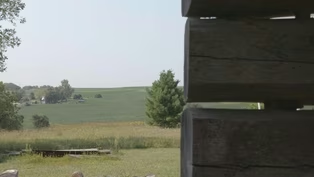
We're visiting the Folklore Village, a place celebrating folk arts and culture from around the world.
This 94-acre property in Dodgeville sits on the edge of a restored tallgrass prairie and houses a number of historic buildings.
The tours, classes, and events offered here focus on celebrating and experiencing ethnic and traditional folklife.
Visitors can try folk dancing in the red barn, walk through the woods to a church built in 1882, learn a lesson in a one-room schoolhouse, or explore an authentic Norwegian cabin.
It's an interactive way to explore art and folklife that's been a part of this community since the 1960s.
We'll explore more here later, but first, let's meet a Wisconsinite keeping traditions alive.
We visit a restaurateur in Middleton who is serving up authentic Chinese noodles that remind her of home.
♪ ♪ [sizzling] - There's a saying that, "If you want to try Chinese noodles, you need to go to Shanxi province."
That's where Hong Gao is from.
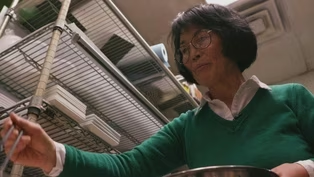
- Taigu is her Shanxi noodle restaurant in Middleton.
- Her dream came true.
However, at the start, the restaurant wasn't a hit.
Following her customer's advice, Hong decided to rename the restaurant.
- Hong's noodles today are rooted deeply in these memories of home.
- Another secret of Hong's noodles is mature vinegar.
- Her taste for nostalgia paid off.
[laughing] - When not making noodles, Hong enjoys painting.
Her art can be seen on the walls in her restaurant.
She donates the paintings to her daughter's high school and other area non-profit organizations.
- Giving back helps Hong to connect with the city she now calls home.
- It's the attachment to her grandmother's noodles that has become a way for Hong to offer Middleton a taste of her hometown.
- Thank you very much!
- Yeah, you have a good day!
- Now, we travel to Madison to meet a coffin artist whose work honors those who have passed.
[sawing friction] [pounding nail in] [planer scraping] - The sounds of a carpenter.
[pencil scratches against wood] Listen closer, and you hear a family legacy.
[scrape, scrape] Eric Adjetey Anang is a third-generation craftsman, and his art is to die for.
[rich laughter] - Usually, first thing, they will be like, "What are you building?"
So, I start by answering them.
"I'm building a coffin," and they'll be like, "Oh?"
- Eric's coffins are one of Ghana's most unique cultural exports.
A business his grandfather started when he merged carpentry and art.
- They were building the Kotoka International Airport in 1951.
So, it was during that time this old woman was like, "Oh, I would love to travel in one of those planes."
But she never got to do it until she passed away so he built her a coffin in the form of an airplane.
- That woman was Eric's grandmother.
[scrape, scrape] As a little boy, he remembers his curiosity around the family business.
- Growing up as a kid in the backyard of the house, when you point, you know, the cemetery or the coffins, we would have to bite our fingertips.
It was something very scary to us.
- Honoring his birthright, Eric took up the tools of the trade.
In Ghana, his design coffins can sell for $500 to $1,000 and are steeped in a rich tradition.
- Eric Adjetey Anang: So, in Ghana, when somebody dies, we have a period of three weeks to one month or more for the ceremony.
- Sending loved ones out in style is a fashionable way to celebrate life and is growing in popularity.
- So, on Saturday, when you have a crowd of between 500 to 2,000 people, that is how the coffin becomes so important because everybody wants to have a glimpse of it and take a photo of it.
[speaking in a Ghanaian language] - People would also start to ask, "Oh, who did that?
"Who was the artist?
Where was that coffin built?"
So that is where we get our praises.
- Behind each design coffin, there's a story.
- The bumblebee also goes with the story of the disappearance of bees.
The corncob was a piece I built during my five days' workshop in Iowa State University.
- The coffins can also symbolize a hobby, a favorite item, or a person's importance to her community.
- A coffin of that shape would be made for a chief.
- The Chazen Museum of Art in Madison is home to Eric's eagle coffin.
It's a design reserved for people of prominence.
- Anang: Something like the eagle we have behind us, they are symbolic coffins: the eagle, the tiger, this tool, the chief's status.
When I see a piece like that, I kind of want to see the inside.
Sometimes people look at it and they will say, "Oh, this is not big enough.
This cannot contain the body."
But anytime I build a piece, I build it to my size.
And the reason I do that is I consider myself as an average human being.
- In 2018, Eric took on a project at the Madison Public Library Bubbler.
[scrape, scrape] In a creative space where the smell of fresh-cut pine fills the air.
- That's knotty white pine.
I think it is the best wood I've ever used here.
- This time, his saw and hammer are pounding out a dinosaur, bringing awareness to endangered and extinct animals.
- It's easy for me but with this, I always have to carry the model with me and, you know, be thinking of how I want the shape to look like because sometimes you might get to a point where you need to stop and think about it.
[exhales loudly] [taps wood] I'm also figuring out how slope it is here on the back.
[murmuring to himself] So four, two.
Think out this slopes.
But as soon as you get it, and it is flowing, that is when you kind of work really fast.
- And if you're wondering, Eric has already decided on the coffin design for his journey into the afterlife.
- I do have my coffin already.
I have it in the shape of my wooden hand plane that I keep with me all the time.
That's the plane I've been working with for a very long time.
- Design coffins are one of the most celebrated forms of African art and he is fiercely proud of his grandfather's legacy.
- The reason I built the airplane was that was how he started.
I would say the airplane was his first coffin he built for the grandmom.
So, I sort of built it too.
This is really a dream to be here, to share with people the story of my family and what we do.
I mean, that's what has made me who I am today.
[board clacks] - I'm at the Folklore Village in Dodgeville, learning about their work and how this community resource came to be.
- The idea for the Folklore Village began with one woman's love for art, dancing, and bringing community together.
Today, a diverse array of cultural traditions are being explored and celebrated at the village, according to executive director Terri Van Orman.
- All kinds of wonderful things go on here from folk dancing to singing to craft making.
We host special groups who come here.
They're usually musical groups or dancing groups.
Another thing is something started just three years ago and it's-- we're calling it our folk school where people sign up with a particular artist or instructor to spend anywhere from half a day to several days, and generally, they are focusing on learning skills by making a thing.
I mean, it allows a lot of different types of expressions and that's one thing I love about our mission.
- Another learning opportunity and ongoing project on-site is the Norwegian Cabin Rebuild.
Originally constructed by hand in the 1840s, and recently saved by the Folklore Village.
We did that and they took the building down and they numbered every log and they did a big schematic about how to put it back together.
Mr. Nels Diller, he wanted to do it because he had just retired and he needed a project and he would like to adopt this project.
- Since I finished my career as a carpenter, I've doing Norwegian woodworking and I like to explain that actually, I may be Swedish, but I'm a born again Norwegian, I feel.
- Soon after, the work to rebuild the cabin began.
Volunteers and interns like Lauren Newby had the opportunity to experience using tools from another era.
- I would say my favorite part about this experience is learning from Nels.
He's really has a lot of really amazing information, both about what it means to work with wood, the way he approaches life and building; I feel like should not be lost in this generation.
And I think that's really surprising to see how far we can take hand tools.
And to make something so large and so useful [laughs] has been really, really amazing to see it come into fruition.
[sawing] ♪ ♪ From restoration of this cabin to other interactive events, it takes a village to keep these folk traditions thriving in our state.
We're off to Green Bay to find a collector celebrating the nostalgia that comes with playing arcade games.
♪ ♪ - Bradley Czech: I grew up in that golden era of video arcade games.
[coin clinks in slot] [1980s pop music] I remember going to the arcades years ago and seeing some of these new titles that are coming out.
- Norbert of Storylords: Got' em!
- I remember going to the arcades and seeing these elaborate cabinets with incredible artwork on them and hearing these new sounds.
[Pac-Man repeats an ambulance siren] - And seeing the graphics.
And, really, that's kind of what comes to mind when I think about the old memories of, "What do I remember growing up about arcade games?"
[tires skid] [percussion music] I got my first arcade game at the age of 13.
And I ended up spending $60 to buy an Asteroids game.
That's what started it.
And it just sort of happened that I just started acquiring more and more games over the years.
[electronic arcade sounds] [game over sound] I would say probably just over 200 games.
It's hard to say exactly because I'm always adding things in.
And once in a while, I'll let something go.
But I would say probably 200, 225 games.
[points scored sound] Well, storage is always an issue.
I do have quite a few games in my house in my basement.
[garage door creaks] And then, I have a lot in my garage that are stored there.
And then, I also have a warehouse location that I store many games at.
[garage door slides up track] Right now, we're at one of my storage locations, where I keep all my overflow parts.
With them being as old as they are, they need repairs all the time.
Those parts take up a lot of space, so I keep a lot of them here.
[computerized voice says, "I can fix it."]
Restoration is far more extensive than most people would realize.
You're talking about going to the absolute basic foundation of these games, stripping them down to the bare wood a lot of times, and starting over.
The process can take months and months.
Actually, just recently, I finished up three titles that I started a year ago.
I got to thinking, "How can I show these to people again so that they can appreciate and enjoy them?"
So then I started approaching some different museums about the idea of actually bringing arcades to be shown off to the public.
[1980s pop music] The games bring me back to a time of the 1980s, where life is very simple.
Today, I love the conveniences that we have with the Internet and all that.
But there was a simplicity to that time where people were just enjoying these games and having fun with that.
And to me, having these, and seeing people play them, and seeing people enjoy them, it kind of brings me back to that time.
[video game sound effects] - We now head to Milwaukee, where a couple is keeping a different tradition alive: handcrafting hats.
♪ ♪ - John McLaughlin: It's the last thing you put on, but it's the first thing people see.
- Hats are sculptures that we just choose to wear and that are really-- signify personality.
- We're the Brass Rooster Hat Company.
We are traditional hatters here in Milwaukee, Wisconsin.
- Milwaukee hasn't had a hatter in over 15 years.
I made my first hat when I was a junior in high school.
My husband was always a hat guy.
He had been wearing hats ever since he found his grandfather's.
- When a hat lover marries a hatmaker, she makes the hat lover into a hatmaker.
And we opened up this place.
- What we started seeing was in media, in film, in entertainment, in print, hats were coming back in vogue.
- We saw the need, and we're stepping up because people want them, and we know the quality of what used to be made, and that's what we're making right here.
When you make something by hand, it takes a little piece of you with it.
It's got that extra bit of care that's given to it.
If you want something that's extremely high quality, it's always made by hand because we're better than any machine will ever be.
To me, it's being able to continue something that was almost lost.
It's like saving an endangered animal.
- Every piece of equipment we find is golden to us because the equipment has become so rare.
Our line of hats is two-fold.
We have our Stand-Out, which is the more contemporary side.
Our Look Sharp are the hats in our line that are all taken from real traditional styling of men's hats.
- With every hat that I make, it's a sense of pride.
It's art that somebody gets to use every day.
- There's the term called "cock of the walk."
When men leave the hat store wearing their hat, they've got a strut, they've got a movement about them.
- This country used to make great things, and we can make great things again.
This country was built by small companies that were husbands and wives and brothers and friends that knew that they could make something that was fantastic.
- The most natural thing for our progression is to go from making custom hats to presenting and designing a line of hats that we are so proud of, of being American-made, of continuing a hat craft.
- Every cent that we've made, every hour that we've spent in here, we've put into this shop because we believe it's worthwhile, we believe it's something that we can pass on to our kids.
And we believe it's a craft worth saving.
- Our last story is an animated tale by author Christina Clancy, who shares how she prepares for the impending cold season.
[chimes playing a tune] - Like a dieter thinking about the New Year, I think about the approaching winter and make plans for how I'll deal with it.
I'll be honest, what I really want to do is curl up in my flannel sheets and come out of hibernation when the lilacs are in bloom.
But since that's not an option, I tell myself this will be the winter that I'll get out there so much that my blood will get as thick as petroleum jelly.
I'll go for brisk walks in my sleeping bag coat and suck up vitamin D through my face.
I'll use the skis in my garage that are getting brittle from disuse.
I'll try to be more like the crazy people I know and envy who don't mind and even relish the cold.
My brother-in-law could spend all day in hockey skates clearing snow off a frozen lake with a broom to make a gigantic skating rink.
I know cross country skiers and snowshoers who can't wait to put on their ultra-light down jackets and head outdoors as soon as the snow falls.
I have cycling friends who stud their bike tires and clean road salt out of their derailers when they get home.
For them, winter is the best season.
They sleep with their window open a crack.
They find beauty in the snow on the branches, the low, clear light, and the sight of their breath suspended in air in front of them.
Don't these icicle huggers know that winter is supposed to be unloveable, punishing, dangerous?
Jack Frost kills his victims by covering them with snow.
Exposed to the elements for too long, our digits can turn blue and fall off.
Winter means the search for the missing glove, slipping on black ice, clearing crud off our windshields with the edge of a credit card, the gross dampness on your wool scarf after it's been on our mouth, the mushroomy smell of boots, and wind like rocks in your face.
Winter lovers will tell you that it's all about having the right gear.
I wish it were that simple.
I'm one of those people who think of cold as a form of pain.
What I love about winter isn't the cold but the way I protect myself from it.
I like the contrast the bitterness creates between warmth, like sea salt on dark chocolate.
When I try to think about what I love about winter, I think of soup on the stove, my favorite sweater, of curling up on a couch with a down throw and book.
I think of hot chocolate and fires and steaming radiators.
I think I could handle winter better if it didn't stick around so long.
But I reach a point when the snow turns to dirty slush, my happy-lamp stops working, and the heating bill could be mistaken for a college tuition invoice.
[chime] Winter's okay until I hate it, and it gets ugly when I cross that line, something that could happen in a matter of months, weeks, or days.
But for now, the season of fender-benders and broken hips has just begun, and I'm cautiously optimistic.
[chimes playing a tune] ♪ ♪ - We learned a bit about folk traditions today while sharing stories of people who make our state wonderful.
If you'd like to learn more about the Folklore Village or see more stories on folk arts in our state, visit WisconsinLife.org.
Share your experiences and ideas with us by emailing Stories@WisconsinLife.org.
I hope that inspires you to get out there and create.
I'm Angela Fitzgerald, and this is our Wisconsin Life.
Bye.
- Funding for Wisconsin Life is provided by Lowell and Mary Peterson, Alliant Energy, Stanley J. Cottrill Fund, American Transmission Company, Focus Fund for Wisconsin Programs, and Friends of PBS Wisconsin.
Angela Fitzgerald Visits Folklore Village
Video has Closed Captions
Clip: S8 Ep11 | 3m | Angela Fitzgerald visits the Folklore Village. (3m)
Video has Closed Captions
Clip: S8 Ep11 | 4m | A restaurant owner brings Shanxi noodles to Middleton. (4m)
Providing Support for PBS.org
Learn Moreabout PBS online sponsorship












Support for PBS provided by:
Wisconsin Life is a local public television program presented by PBS Wisconsin
Funding for Wisconsin Life is provided by the Wooden Nickel Fund, Mary and Lowell Peterson, A.C.V. and Mary Elston Family, Leon Price & Lily Postel, Stanley J. Cottrill Fund, UW...