
Tallahassee's Bicentennial (Episode 1005)
Season 10 Episode 5 | 27m 22sVideo has Closed Captions
Tallahassee celebrates it's Bicentennial with a year of events and projects.
2024 marks Tallahassee’s 200th year as a capital city. We explore the celebrations, the history, and the tributes to the past including an inside look at the recreation of the log cabin that served as the first Florida Capitol.
Problems playing video? | Closed Captioning Feedback
Problems playing video? | Closed Captioning Feedback
Local Routes is a local public television program presented by WFSU
Tallahassee's Bicentennial (Episode 1005)
Season 10 Episode 5 | 27m 22sVideo has Closed Captions
2024 marks Tallahassee’s 200th year as a capital city. We explore the celebrations, the history, and the tributes to the past including an inside look at the recreation of the log cabin that served as the first Florida Capitol.
Problems playing video? | Closed Captioning Feedback
How to Watch Local Routes
Local Routes is available to stream on pbs.org and the free PBS App, available on iPhone, Apple TV, Android TV, Android smartphones, Amazon Fire TV, Amazon Fire Tablet, Roku, Samsung Smart TV, and Vizio.
Providing Support for PBS.org
Learn Moreabout PBS online sponsorship[MUSIC] Gulf winds blow through canopy roads all the way to Thomasville.
Native names written on the land.
Echo through the red clay hills.
Where the scent of longleaf pine reach up on past the Georgia Line.
Stroll through Tallahassee town or Southern Apalachee bound.
Take the local routes and journey down the route we call our home.
Take the local routes and journey down the roads we call our home Welcome to Local Routes..
I'm Suzanne Smith with WFSU Public Media, and today I'm at Cascades Park in Tallahassee.
You could say this episode is 200 years in the making.
That's because way back in 1824, the territorial governor announced that this was going to be the spot for the new capital of America's newly acquired land, known as Florida.
That makes 2024 Tallahassee and Leon County's bicentennial year.
It's been a year of celebrations and explorations of state and local history.
It's also been a place where we've been building connections to the past, like this log cabin behind me.
Watch out.
Watch your fingers in the sun.
On the bright summer day in June 2024, dozens of people from the community came together to officially start building the first Florida Capitol log cabin.
This is a tradition that we have in our community.
100 years ago, our community came together and built the replica of the first Florida Capitol.
We did it 50 years ago, and here we are at the Bicentennial, and we're doing it again.
And we're doing it in style.
The original cabin was one of three built for the first legislative session held in Tallahassee in November of 1824.
When the commissioners picked Tallahassee as the site for the new Capitol.
They engaged two local planners and, one of them was my fourth great grandfather Sharrod McCall, and they were engaged to build it.
And, I heard about that from my grandmother.
You know, my, my grandmother's grandmother was the granddaughter of the builder.
And he called me up and he said, hey, we've never met before.
I'm a direct descendant of the original builder, one of the original builders, and my family owns a pine forest.
And we're going to harvest the trees, and we're going to build the wood and we're going to donate it.
And this is our contribution to the project, which completely and totally blew me away.
In the middle of the design process, the mayor called me and said, stop everything you're doing.
This guy from Levy County contacted me and he's going to mill all the planks.
So we pretty much redesigned the building again.
So this has been through 4 or 5 really good strong revisions that are all.
And I in my mind, they're very consistent with the actual building saved for we had to add a front porch and a ramp for accessibility.
It's a lot of hauling from the street to the build site, because we're also very sensitive and we want to preserve the park.
We want to follow the rules from not bringing the heavy equipment in.
And so, it's a perfect fit with the rules and regulations of Cascades Park.
And we're absolutely thrilled that the park is allowing us to do this here.
But at the same time, it's an extra step being able to bring all the materials in.
However, think about it.
This is how they did it 200 years ago.
You know, walking the materials into the site for the build.
So it just adds an extra flavor to what we're doing today.
Good job team.
Yay!.
The first settlers didn't arrive until after Tallahassee had been made the capital with the American citizens.
Also came enslaved men, women, and children.
They were used in construction of the original cabin in the creation of the 1924 and 1974 replicas.
Organizations like the Boy Scouts took care of the builds.
In 2024, individuals from the community signed up to do the work under the watchful eye of habitat for humanity.
A project like this and community celebrating our bicentennial will just seem like a no brainer.
We are a partnership organization, so we do this all the time.
People come to our build sites.
They don't have to know anything.
We'll teach you what you need to know to build and be safe.
And I think it's just kind of a perfect partnership.
All right, don't roll it too fast, guys.
You tell us.
Go.
We don't want it down the lake, so it's going to be a mix.
But, I mean, we're going to do the vast majority of it with folks from the community.
We are going to have some subcontractors come and do some specialized things.
And we will have our staff in here doing some things.
But for the most part, it's going to be, built by the power of the community.
Here we are on a Saturday morning, and we got about, what, 20 or 30 volunteers?
And, we got Secretary of State coming out today, legislative delegation, local elected officials that are coming out as well.
There's a lot of momentum, and we're having a great time.
Who'd have thought 2 or 3 years ago we'd all be here today?
The teamwork is really a lot, makes a lot of fun and makes it a real community effort.
You look around, it's very inclusive group, for lack of a better word, and we're all from different walks of life.
We're all from different socioeconomic everything.
But we're all here helping do something for the city of Tallahassee.
The cabin is just part of the celebrations this year.
Within days of the start of 2024.
Bicentennial Day was held on the grounds of the current capital.
Governor William Duvall here.
I'm here to show you the proclamation that 200 years ago made Tallahassee the capital of Florida Territory.
It's been a wonderful day, but the Senate in the House hosted us in chambers.
And under this proclamation, to be able to have this amazing ceremony in the courtyard today and see everybody come out and celebrate Tallahassee downtown.
I was a member of the Sesquicentennial committee in 1974 I see the enthusiasm now roaring escalate.
The people are getting involved.
The one word that I write is history.
And I believe the history of this occasion will go down for many, many years.
This is a fantastic thing.
Yes, again.
My mother.
The celebrations continued in front of City Hall on March 4th, the official day that Tallahassee was named the capital for the 200 year bicentennial celebration is a time to reflect on the capital city's founding at a pivotal times in history.
It is a time to share stories of past struggles and triumphs.
Look at the present with pride and inspiration, and to the future with anticipation for new progressive things to come.
I think working together, if this is what we should be about, that's the only way we're going to make real, significant progress.
So when our children come along with the tricentennial, they will see that we've kind them even much farther along.
It doesn't happen every year.
It doesn't happen.
And to be here to see the people gather and the diversity and the diversity that's happening in this city and the way it's growing.
And you know, that notwithstanding some issues, we're going to always have.
I had issues, but we we are together.
We are doing wonderful things.
We are progressing.
And that's what it's all about.
And City of Tallahassee is just a wonderful place to live.
while the American city of Tallahassee is 200 years old, this area was a thriving community.
Long before that, the people were called the Apalachee and their city was named in Anhaica.
On Friday, September the 6th, the Tallahassee Historical Society and its partners at.
Past the Panhandle Archeological Society of Tallahassee, will be unveiling a historical marker here in Myers Park to Anhaica, which was the Apalachee native village, which spread all up and down this hillside and beyond behind me.
In 1539 and was waiting here for the Spanish, under Hernando de Soto when they got here.
It's estimated that the Apalachee had lived in the area since approximately 1000 or 1500 A.D. at one point, they built ceremonial mounds next to Lake Jackson in today's northwest part of the city.
Eventually, as many as 60,000 Apalachee lived in the land between the Aucilla and the Ochlocknee Rivers.
Almost immediately, De Soto and his 600 plus men clashed with the natives while the Appalachee were strong.
DeSoto temporarily forced them from their homes, taking some as captives.
One of the, consequences of what we call contact, here, the contact between European Americans and Native Americans, was a disaster for the Native American cultures, particularly through the spread of pathogens and disease.
And also all sorts of things that just wiped out, just wiped out, a large number of the Native American cultures, the number of Apalachee dwindled over the years.
By the late 18th century, many had merged with other tribes like the lower Muskogee Creek and the Seminoles.
As part of our bicentennial project, the Historical Society agreed, to produce and unveil ten historical markers.
And because this is such a culturally diverse area, we wanted to to make sure that all the cultures were represented.
This is one of three Native American markers that we will be that we will be putting up.
One of them is out is the vel, the mound site, which most people know.
Another one is what we call it, another one.
Be down, be near the Alfred Greenway, down near Lake Lafayette, and so forth.
And so, we think this is a duty and a responsibility that everybody be represented.
So how did the territorial government decide that this was the perfect place for the capital of Florida?
Well, thanks to a local group of actors and history buffs, we can see that process for ourselves.
WFSU's Mike Plummer takes the story from here.
Tallahassee has a birthday coming up, and local theater troupe theater with the mission has big plans to commemorate the event.
A rare troupe of actors, performers, researchers, community activists who really enjoy seeing how history connects to today.
The cast of historical actors is highlighting this area's transition from Spanish Florida to Florida's territorial capital, with a series of public performances in 1823.
Commissioners set out from Saint Augustine Doctor William Jameson Simmons and from Pensacola John Lee Williams to find a place for a new capital.
History and historians write down magnificent facets of the life from the past.
But we get to go in and create the context, and context makes things so rich.
Theater with a mission is performative.
Yeah.
It's performative.
They put on historical reenactments, they put on historical pageants and so forth.
But it's also ritualistic.
Here's an idea.
Yes.
That Rachel.
Let's start our story with the change of flags.
The Spanish style tiered descended to half mast bars and stretch rise.
And to meet it now Florida becoming U.S. territory.
That's where this habeas corpus practice really began.
The motions.
All right, ladies and gentlemen, our heroes, Adam and Mr. Laura Daniels and lovers of liberty everywhere.
One of the things that Ben does, and I think it's very important, is that he is that he reenacts those rituals, whether it be the ritual of a territorial ball, for example, which was one of the things he's going to do, whether it be the ritual of the Spanish dance, which in which he has done, whether it be the ritual of reenacting the territorial legislative debates, which he is going to do even even if you're a historian of the Old South, the ritual of killing each other in the duel, you know, where there were very specific rules involved.
You didn't just you didn't just, you know, start shooting.
You had to you had to follow certain societal rules.
And if you didn't, you were essentially banished from essentially banished from the community.
And that's what Ben reminds us of.
I mean, he's fun.
I mean, the stuff that he does is fun and it's entertaining, but it's also very important.
And reminding us of, of of the ritualistic aspects of creating a community from the wilderness.
2021 gave us the bicentennial of Florida becoming U.S. territory.
So we started investigating stories that connect people to history there, too.
And we found some wonderful ones.
Most recently, we've been dramatizing the run in that Governor Andrew Jackson had with the outgoing Spanish governor in Pensacola, Jose Maria Callaba because liberty is the legitimacy of law, and liberty governs Florida.
Now.
Ha ha ha.
And that brings us to Williams, Simmons and the beginning of Tallahassee over there.
Instructions were to come find a territorial capital that's midway between Pensacola and Saint Augustine.
So we don't have to travel, you know, over the state, you know, half all the way across the state every other year and so forth.
We're trying to dramatically reconstruct historical events.
And that does give us a framework.
It does give us some artistic restraints.
So it also sets us up to imagine very specific things.
Williams came by water and, and came, you know, right in the middle of hurricane season and apparently got shipwrecked on Saint George Island.
From what I understand.
And Simmons came, came by horseback with Saint Augustine.
And from our reading of the chronicles, John Lee Williams's journal, he was not a very forth thinking kind of man.
He was not tremendously organized.
He's leaving from Pensacola, which has been a major port for years and years and years, centuries by that time.
And he says in his journal, I didn't have any charts, any nautical charts with me because they just weren't available in Pensacola.
So here's where 1823 Pensacola meets 1630 to Spain, and we take La Carpio, Dora and make into the into that cape snatcher or dressing for success.
So our reading of that is John Lee Williams was a party boy.
Sweet.
And so he was charming.
The ladies all loved him and he was too busy having parties, saying, I'm about to go.
Won't see you for a while, must, must have a party.
He was too busy with his send off to prepare himself for the journey with you.
And so, you know, it's interesting.
I mean, we're sitting there doing this in Myers Park, and they came here under the, under the orders of the then territorial governor, William P Duval.
And of course, when they got here and decided on this place, why why do we get Williams and Simmons and why do we not get somebody else?
They were commissioned to write journals.
They wrote the journals.
The journals got published.
The journals are the official record.
for WFSU Public Media.
I'm Mike Plummer.
We Followed many of the Bicentennial events throughout the year.
The first Florida Capital Log cabin was supposed to be finished by Labor Day, but tornadoes, hot weather, and hurricanes delayed the build.
That's probably an understatement.
So we have had, at least two hurricanes kind of go through the area.
We had some tornadoes.
We've had a number of other, weather related, you know, setbacks.
But I mean, welcome to Florida.
And if you think about it, it's part of the community.
This is where we live.
Is this part of being, native in this area.
And, it's just what we do.
We roll with it.
It's finally wrapped up in October 2024.
One, three.
And I. I think we all had an idea that it had the potential to take on a life of its own.
I don't know if any of us ever thought that it would be this grand and celebrated.
And that is so exciting for Tallahassee.
Oh, it's.
Yeah, it's been an incredible project.
And this is only the first chapter.
The second chapter now is training up the docent corps and making sure that we are open and available to the public to come learn about the history of Tallahassee.
It was a very good feeling to work on this, to do something for the community.
And something that, you know, it's going to be there in the future and people will be able to look back and say, yeah, I was a part of that is something really nice to do.
I've been up for four community days.
Would have liked to done more, but, you know, I'm over two hours away and we probably had over 250, 300 volunteers over the last several months, working together.
So it's been quite a quite as well.
I truly think it builds a sense of community.
I mean, what is Tallahassee known for?
A government town and a university town.
And this story is the story of why Tallahassee is where it is.
And what I hope people take away is appreciation of Florida's history and their beginnings here.
You know, when you hear from people, those who came before us and, you know, it's been 200 years.
What's it going to be like another 100, 200 years?
We don't know.
But we need to know our history.
History, landmarks.
A history is important because you get people interested in Florida's history.
You can get them interested in that and its environment.
You know, we love this land and we need good stewards of it.
There's a lot to learn about the city and state history and this cabin, as well as the other historical markers around Tallahassee's Cascades Park are a great way to start your explorations.
WFSU's Mike Plummer also took a look at a local organization that is using technology to make Leon County history more accessible to you.
So you may or may not have heard the term GIS.
It stands for Geographic Information System.
It may sound like a pretty dull subject, but it is truly incredible what GIS can tell you about the world around you.
Something else you may not be aware of is that a ginormous amount of this information is available to you online for free.
So everything we see happen somewhere, right?
There's a location for everything.
And that's where GIS is so different than other information systems.
It's geographic.
So we have coordinates associated with all those features that we're collecting that we keep within the system.
And we're able to ask questions like for example, fire hydrants are mapped.
I wanted to ask how many houses are within a half mile of this fire hydrant.
I get that answer very easily, very quickly.
And that's a simple example.
A lot of research was conducted on how, parcels of land transferred to family members.
And some of that research which we had to, research, be, warranty deeds and, and that sort of thing, surveys and tie back to development at specific times.
Most people would probably associate this kind of information with records as in public records, but actually it's also history as in our history.
And it's so happens that our own Tallahassee, Leon County GIS Department has started to integrate these various geographic records into the story of our history.
Story maps is a product that allow you to, engage in storytelling, and it allowed us to, provide all different types of content.
So we can do audio, video, text, pictures.
And we've, managed to, source out information on, notable people.
Notable names.
One of our projects started out as, street name and, project, which, we wanted to know who the, the names were, the individuals that the streets were named after.
And for, namesake, for example, or, name faces in places.
We, attempted to do that and we identified, some of those individuals, notable people, governors, community leaders, and they've, they've had a story to tell.
And we tried to manage to tell that story in a way that is, informative and fun.
And, of course, the bicentennial has come up, and the timing is just perfect for that.
We've got lots of content that a lot of museums, historians, archeologists, just been, you know, so excited about.
It's, we've really branched out.
All right.
So kind of drive me through this thing.
All right?
First, do you see the, Bicentennial 200, logo here?
Yeah.
As we scroll down, you see the the time period from 1824 to 2024, and we have, quite a few, hearings here.
Government, the historical site.
Here it is.
Neighborhoods, farmers market, living history.
And also pictures of the, bicentennial meeting.
The reason why we selected this is, is is, in truth, form, the 1924 and the 1974 celebrations.
We took that format and kind of, mimicked that format and provided some additional content in there.
And we started with, the government.
Okay.
See, the government, state here.
We have information about when the, the state was formed.
The treaty that was signed here and this is a replica, that was built in 1974.
Of the historical capital, the heritage neighborhoods, that there were groups of areas around old Tallahassee that were considered to have their own identities.
Yes.
Los Robles is one, Calhoun Historic District.
This, first one is Magnolia Heights.
We're working on this one, right now.
One of the neighborhoods that I found especially interesting was Myers Park.
The particular houses that were highlighted for local history also had associated map locations along with public metadata.
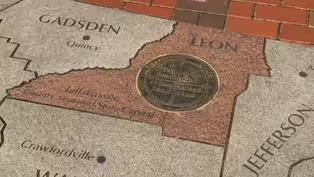
And finally, we have to mention the Florida Prime Meridian.
This is the land marker that all land surveys in Florida and Alabama are reference to, going back to 1824, after the territory was acquired from Spain.
The Meridian is the actual, prime meridian, which is the marker for, the public land surveying system where it started in Florida.
When the United States acquired it.
If you look at the papers here, this one, one is going north.
South?
Yeah.
That is, the meridian.
The prime meridian.
Okay.
And, this line also follows the, well, the, the street meridian Road follows this particular line, and the east west one is the baseline.
And, that is where at this intersection is the star, surveying and Florida.
And also, this is the southwest corner.
The Lafayette land grant, local GIS information and history are continuously being updated and added to and free access is at your fingertips.
TLC, gis.org somewhere online for WFSU Public Media.
I'm Mike Plummer.
That's it for this episode of Local Routes.
You can see these stories and more on our website.
wfsu.org/local routes.
And while you're online, follow us on Facebook and Instagram.
Plus, don't forget to sign up for our Community Calendar newsletter delivered weekly to your email.
It is a great way to stay on top of events happening in person and in the virtual world.
I'm Suzanne Smith, and for everyone at Wfsu Public Media.
Happy birthday, Tallahassee!
Magnolia trees meet te southern skies in the land where rivers wind.
Seeds that spring up from the past leave us treasures yet to find.
Where our children play along the land our fathers built with honest hands.
Take a moment now and look around at the Paradise we have found.
Take the Local Routes and journey down the roads we call our home.
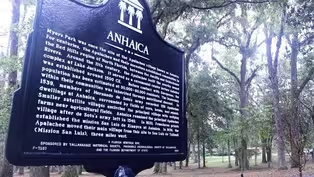
Anhaica Historical Marker|Tribute to History
Video has Closed Captions
Clip: S10 Ep5 | 2m 33s | The Tallahassee Historical Society pays tribute to Native history in our community (2m 33s)
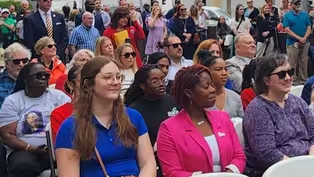
Kick off to Tallahassee's Bicentennial Celebration
Video has Closed Captions
Clip: S10 Ep5 | 2m 46s | The state and city kick off their Tallahassee Bicentennial celebrations with early events in 2024. (2m 46s)
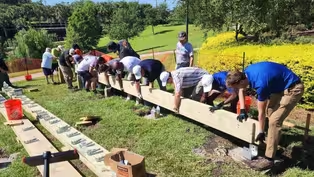
Tallahassee's Bicentennial Capitol Cabin | Building History
Video has Closed Captions
Clip: S10 Ep5 | 3m 54s | Tallahassee celebrates it's bicentennial by building a replica of the First Florida Capitol Cabin. (3m 54s)
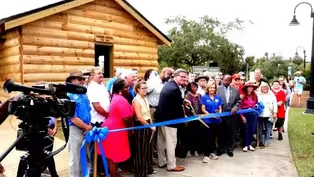
Tallahassee's Bicentennial First Capitol Log Cabin | Ribbon Cutting
Video has Closed Captions
Clip: S10 Ep5 | 2m 35s | On October 4th, 2024, the community cut the ribbon on the brand new First Florida Capitol Log Cabin (2m 35s)
Video has Closed Captions
Clip: S10 Ep5 | 6m 20s | GIS consolidates information about the 3-D world. It can also help us understand history. (6m 20s)
Providing Support for PBS.org
Learn Moreabout PBS online sponsorship












Support for PBS provided by:
Local Routes is a local public television program presented by WFSU