One-on-One
Tania Tetlow; Ralph LaRossa; Jonathan Lengel
Season 2022 Episode 2574 | 27m 18sVideo has Closed Captions
Tania Tetlow; Ralph LaRossa; Jonathan Lengel
Tania Tetlow, Esq., President of Fordham University, talks with Steve Adubato about her role as Fordham’s first female president, and ways to meet the pressing challenges facing higher education; PSEG’s new President and CEO Ralph Larossa, speaks about the critical need for energy efficiency; Actor Jonathan Lengel talks about his Netflix film “13: The Musical.”
Problems playing video? | Closed Captioning Feedback
Problems playing video? | Closed Captioning Feedback
One-on-One is a local public television program presented by NJ PBS
One-on-One
Tania Tetlow; Ralph LaRossa; Jonathan Lengel
Season 2022 Episode 2574 | 27m 18sVideo has Closed Captions
Tania Tetlow, Esq., President of Fordham University, talks with Steve Adubato about her role as Fordham’s first female president, and ways to meet the pressing challenges facing higher education; PSEG’s new President and CEO Ralph Larossa, speaks about the critical need for energy efficiency; Actor Jonathan Lengel talks about his Netflix film “13: The Musical.”
Problems playing video? | Closed Captioning Feedback
How to Watch One-on-One
One-on-One is available to stream on pbs.org and the free PBS App, available on iPhone, Apple TV, Android TV, Android smartphones, Amazon Fire TV, Amazon Fire Tablet, Roku, Samsung Smart TV, LG TV, and Vizio.
Providing Support for PBS.org
Learn Moreabout PBS online sponsorship- [Narrator] Funding for this edition of One-On-One with Steve Adubato has been provided by Robert Wood Johnson Foundation.
Working for a more a healthier, more equitable New Jersey.
Johnson & Johnson.
New Jersey'’s Clean Energy program.
Lighting the way to a clean energy future.
The Russell Berrie Foundation.
Making a difference.
PNC, Grow Up Great.
NJ Best, New Jersey'’s five-two-nine college savings plan.
Englewood Health.
Eastern Atlantic States Regional Council of Carpenters.
And by The Adler Aphasia Center.
Promotional support provided by The New Jersey Business & Industry Association.
And by AM970 The Answer.
- This is One-On-One.
- I'm an equal American just like you are.
- The way we change presidents in this country is by voting.
- I'’m hopeful that this is the beginning to accountability.
- Life without dance is boring.
- I don't care how good you are or how good you think you are, there is always something to learn.
- I did do the finale, and guess where my trailer was?
A block away from my apartment, it couldn'’t have been better!
- People call me 'cause they feel nobody's paying attention.
-_ It'’s not all about memorizing and getting information, it'’s what you do with that information.
- (slowly) Start talking right now.
- That's a good question, high five.
(upbeat music) - Hi everyone.
Welcome.
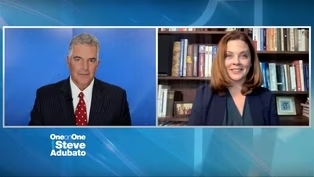
It is my honor to introduce the President of Fordham University, Tania Tetlow.
Madam President, it's great to have you with us.
- I'm so glad to be here.
- Let everyone know, I mean I will disclose that I had two sons.
We have one there now.
I had a previous son, still a son.
Went to Fordham 10 years ago.
Describe Fordham, because I know there are two campuses.
- We have the oldest campus in the Bronx 181 years old on Rose Hill.
And it's a beautiful 80 acre gothic building kind of campus.
And then we have half of our students at Lincoln Center.
It's right next to the Lincoln Center Complex is Fordham and it's high rise buildings with a green quad in the middle.
And our graduate business and law school but also a lot of our undergrads are there too.
So it's two very different campus experiences in one university.
- And it is a Jesuit university, one of 28 in the country.
You are the first layperson to be, first woman to be the president at Fordham, but also at Loyola you were also the first, correct?
- Yes.
I'm getting good at this.
- What's up with the first?
And let folks know that your family, your dad your family steeped in the Jesuit tradition.
Explain that to folks.
- So I have a lot of Jesuits in my family, great uncles.
My uncle Joe Tetlow is a famous scholar at Ignatian Spirituality and my dad was a Jesuit for 17 years.
So he came to Fordham for graduate school met my mom at Mass and they got to be close.
And he had this agonizing choice because he really loved being a priest but he felt called to have a family.
And I joked in my inauguration speech I like to think he make the right choice and I hope I've made it up to the Jesuits.
But I was raised with the Jesuit charism really from birth, got my own Jesuit education since infancy.
And it has prepared me very well for this role.
- It is close, but not exactly the Jesuit tradition.
I was raised and taught by the Christian brothers.
Does that resonate at all?
We'll leave that alone.
- Well, my dad taught at a Christian brother high school for a little while, so yeah, love them too.
- To all my brothers at Essex Catholic High School at Newark that doesn't exist anymore.
You know exactly what I'm talking about.
- Yeah.
- So let me ask you this.
We've had different university presidents throughout the region join us at different times.
The the most pressing challenge facing Fordham and the higher ed community almost three years into this pandemic is?
- You know, the pandemic itself of figuring out how best to protect our community and do right by people who come with very different levels of risk and you know to care about each other and express those values.
But I think the most pressing issue remains and COVID made this worse, how do we provide excellence to our students everything they deserve at a cost that they can afford?
And that's just getting tougher and tougher in higher ed.
- Spent a lot of time on the business side of things and again, I'm interested in this whole question of the job of a president and how it's evolved.
President of a major university.
People don't differentiate between a chancellor or a provost president.
Well, it's all the same.
Well, not exactly.
A significant part of your job as president is fundraising, business development and relationship building.
Fair?
- Yes.
Yes.
So both the internal role, you know, if I were CEO of a private company, I would get to just run the company.
I get to do that with the university but also have the external role of building partnerships across the community and also raising the kind of transformative gifts that really push us forward.
- President Tetlow, I'm curious about this.
We've had people on the past, one that a big influencer Gary Vee who people may know.
Gary came on a few years ago and I had this debate with him at our Lincoln Center studio right around the corner from your, the campus, Fordham campus in Manhattan.
And he kept arguing with me that higher ed is overrated.
Look at them.
All the money that's spent in higher ed later on, I mean you could have taken the money and started the business.
And I said, Gary, but the experience, the relationships, the social development.
Make the case for higher ed.
- We try to instill the kind of lifelong curiosity and habit of learning that you will have forever.
To give the variety of different skill sets that you need to flourish starting your own business or doing anything else you want to do in life.
So critical thinking, cultural competence in a global economy.
The ability to think clearly to reason persuasively to write, to speak, all of those sorts of skills to learn a field which is very important depending on what you wanna do, including business.
And then to be in a group of students who come from every walk of life, every corner of the planet.
And to learn as much from them as you do from us about how to get along with different people.
How to navigate the kinds of skills you need to be a leader.
- I'm curious about this.
I'm a student of communication, taught it, coached in the field, continue to coach in the field.
My advanced, my doctorate is from another university.
Rutgers is in the field.
So I'm a student of people who communicate effectively or not.
- Yeah.
- Especially when you do this.
Your background as a lawyer, how much does that have to do with your ability to communicate concisely and effectively in a situation like this, as well as, as president and building relationships with people over the region and the nation?
- A lot.
Particularly because I was for a stretch a lawyer trying cases to juries as a federal prosecutor.
So you quickly learn that most people listen for about 10 minutes that that's an awfully long time to communicate a great deal if you're focused that you need to think about where people are coming from, right?
You don't start in the middle of the story you don't speak in jargon.
You really try to teach and to persuade.
So being a teacher helps with that as well.
But that ability to stand up and with very little preparation, communicate something powerful and try to bring people over to your point of view.
That was very, very good training in the courtroom.
- Let me ask you real quick before I let you go.
We are in the middle of a football season as we're taping this program.
By the time it airs, it may be over and I've been to some Fordham football games.
It's a very exciting time.
- Yes.
- Sports and athletics and higher ed tied very directly, correct?
- Well, yes and no.
There are a few schools that get a lot of news that make a lot of money off of athletics and get a lot of attention for that.
And that drives their admissions, you know the sort of SCC effect.
- Yes.
Oh yeah I've heard.
- For the vast majority of us what we work to do is to have an experience for student athletes that gives them incredible discipline that sense of teamwork, comradery and just so that doesn't sound too vague and trite.
You know, when we look at the graduation rates of our student athletes and their GPAs they are some of our best students.
They graduated higher rates than everyone else.
And we like to think that's both the kinds of skills they bring to us and what we help them create when they're here.
So, you know, at its best athletics add something really valuable to the quality of an education.
- Thank you for putting that in perspective.
Some people have it twisted.
- Yes.
- Thank you President.
- It is not the point of what we do, is to provide TV games, right?
- Yes.
Academic first.
'Cause that's why our sons went there.
- Well, and right, and that sports can be a really powerful part of that.
But it's not supposed to supplant that.
- No, it's not the main meal.
- Yes.
Tania Tetlow as President of Fordham University.
I wanna thank you so much for joining us.
We appreciate it.
- So glad to be here.
- You got it.
Stay with us.
We'll be right back.
- [Narrator] To watch more One on One with Steve Adubato find us online and follow us on Social media.
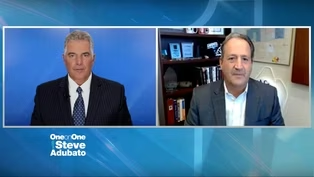
- We are honored to be joined by Ralph LaRossa, who is the President and Chief Executive Officer of PSEG.
Good to see you, Ralph.
- Good to see you, Steve.
- Let me also be clear that PSEG is a major supporter of public broadcasting in our state and also of the Caucus Educational Corporation.
Ralph, let me ask you.
I'll do storm preparedness in a second.
Could you just make sense of the quote, energy picture for us?
Where are we in terms of clean energy, and what do we need to do, loaded question, I know, in the next several years?
- Yeah, so Steve, I think we've made tremendous strides here in New Jersey, and let me go back a little bit in time, right, and we've saved the nuclear plants in this state.
The state stepped up and did a absolutely fantastic job over the last five, six years in making sure that we kept those plants up and running.
And we always say it all the time, but they provide 90% of the clean energy in this state and over 40% of the power in New Jersey today.
Great product, and the state did a great job from a policy standpoint.
Recently with the work that was done at the federal level in the Inflation Reduction Act, they now, at the federal level, have picked up that mantra and are now actually given us production tax credits, which will now take that burden from New Jersey rate-payers and spread it out over the entire country in a way that we're gonna save those plants for at least the next eight years.
So that was step one, fantastic work that was done.
Second thing we're doing in the state is offshore winds, right?
And we've done a lot of work to kickstart that industry.
The governor has done, again, just great work to be in the front run of that.
The federal government has done a lot from a permitting standpoint.
And so we're gonna utilize those resources that we have off the coast to generate power now, where we used to be taking power from the west, the coal plants in Pennsylvania, the gas plants in Pennsylvania, now we're gonna be taking some of that clean energy from the east and bringing it onshore.
So that's another big step.
We'll also help close that gap and make even more clean energy than the 40 to 50% we're producing from the nuclear plants.
Last step that we've been talking about, and my predecessor Ralph Izzo has done a tremendous job of really focusing us as a state on his policy is energy efficiency.
Just do what we can to use less electricity.
Might sound crazy coming from the electric and gas provider in the state of New Jersey, but it's absolutely the right thing to do.
And again, it not only saves folks money but helps keep the environment clean.
- And P.S., go on our website, you'll see, SteveAdubato.org, to look at a previous interview we did with Ralph Izzo, who is Ralph LaRossa's predecessor.
You know, you were with us many times during Hurricane Sandy.
We talked about storm preparedness.
Then you have Ida.
These storms are happening more and more.
Talk to us about storm preparedness, please, Ralph.
- Yeah, Steve, so I think, look, this company, and again, the state has done a great job over the years in being prepared for emergencies.
And, you know, I go back, not to date myself too much, but to 2003 when the lights went out in the northeast because a tree fell in Ohio.
- That's right.
- And we had a major blackout.
And at that point, this company and the state and the federal government came together and started to invest in transmission.
And as a result of that transmission investment, we really hardened and made the transmission system, the big wires you see on the New Jersey Turnpike, much stronger and much more effective than they ever were in in the past.
Sandy rolls through 10 years ago, and when Sandy came in, we actually started to raise our substations and our switching stations, right, bringing that resiliency and redundancy into the system.
- Excuse me, redundancy are backups, right, Ralph?
- Well, no, you know, Steve, some of it's actually redundancy.
Some are backups to where we actually bring power on where there might not be.
So I would call some of that, like the generators at your home and the backup generators we have.
But here in the city of Newark, we used to have two feeds into the city of Newark.
One that came from the south, one that was from the east.
Well, now we've added one from the northwest, and it's actually at a much higher elevation.
So we can hold up the entire city of Newark now if we had those same types of floods that we had during Sandy.
Where in the past, the city of Newark was down.
So we've brought that redundancy into this specific area, and we've done that everywhere.
So as a result, when Ida came through, and we had some pretty severe flooding in the state, some tragic loss of life, we didn't have any impact in any of those stations, because we had raised all of the equipment that otherwise would've been flooded.
And so we learned lessons from that.
Now, fast forward to where we were this past year and Ian coming through the U.S. Look at what Florida Power & Light did.
They brought back a number of their customers pretty quickly because they did exactly what we've done here in New Jersey, those transmission stations and switching stations.
Where we're all a little bit behind the eight ball and where we've gotta really focus now is on that last mile, that mile into your house.
So the wire that's going into your home, Steve, we don't wait for it to fall down.
We make that a much more resilient and, in some cases, bring redundancy other ways that we can bring that power to your home, loop the system back in so you have multiple sources of power coming into your neighborhood.
- Ralph, in the time we have left, you've talked a lot about the importance of quote, a more diverse workforce, diversity in the workforce.
Why?
- Yeah, so look, this goes back for me a long time.
I'm the son of an immigrant.
He was provided opportunities.
My mom's family all immigrated here, and they were- - From Italy.
- all here for opportunities.
- From Italy.
- All from Italy.
Yeah.
Yeah, Steve.
And so, you know, I see what that did for our family and what it's provided for, and I think that they were part of the community that was served by public service back then, and it provided someone like myself this opportunity to be here.
We have to continue to do that.
We need to look like, behave like, feel like, and act like the communities we serve.
It's the only way for us to continue the success that we've had.
Bringing that diverse workforce in will provide us, you know, we'll have a bigger pool of talent to choose from, which is exactly what we have to do.
And it's gonna raise the skillsets.
And we're doing things now that we've never done before.
We're flying drones.
Totally different environment than we've done in the past.
Don't get me wrong, we still need people with jackhammers.
We still need people to go up and down utility poles.
But things are changing, and we need to change with it.
- Ralph, let me just say this to you.
We've interviewed you many, many times over the years in different roles that you've had at PSEG.
First of all, congratulations on the position and the responsibility that you and your team have to make sure that all of us, again, PSEG has a certain, a very large section of the state.
They are by far the largest in energy providers and what they do.
We wish you all the best because it matters to all of us as well.
And thank you for, and I need to say this, for being significant supporters of public media in this state and region.
Thank you, Ralph.
- Thank you, Steve.
We appreciate everything you do.
- All right, I'm Steve Adubato, that is Ralph LaRossa.
We'll be right back.
- [Narrator] To watch more One on One with Steve Adubato find us online and follow us on Social media.
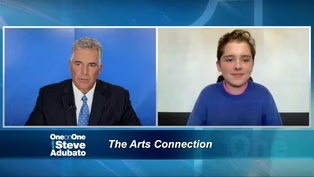
- We are honored to welcome a star.
We've got him.
He's Jonathan Lengel.
He's an actor, he's a singer.
He is Archie on the Netflix movie "13: The Musical."
You're a star, kid.
- Where did your confidence come from?
- I guess, you know, my upbringing in New Jersey, and I was always, you know, very comedic and very funny from a young age, you know, so I guess it's just natural - Yeah, it's natural but, you know, you've overcome an awful lot.
Just being a successful working actor, that's one thing.
But tell folks...
I mean, you're 16 years of age.
Tell folks what challenges you have faced physically from the day you were born.
- Yeah, so I was born with a rare form of congenital muscular dystrophy and, you know, when I was growing up, I wasn't as strong as everybody else, and this is a progressive disease that I have but luckily, it's slowly progressing.
And I am also an ambulatory wheelchair user.
See, I'm sitting in my wheelchair right now but I can also, you know, walk a few steps.
Before the pandemic, I was even, you know, singing and, you know, dancing and performing on stage.
I don't do that as much now because like I said, it's progressive but I'm still doing everything I can to, you know, make myself shine.
- You know, our daughter, when she knew that I was interviewing you, she looked and said, "You have Archie."
(Jonathan laughs) Here's what I'm curious about.
Tell folks who Archie is in "13: The Musical," which is from the 2008 Broadway play, in the film.
Talk to us about Archie, and why you connect with Archie and Archie connects with you.
- Right, well, like me, Archie also has a rare form of muscular dystrophy, and, you know, he's very funny and confident in the movie.
He's next door neighbors with his best friend Patrice.
And, you know, even though he is still grounded like Patrice because he's not in the cool kid crowd, he is kind of swayed by the other kids to do not so intelligent things like go see a horror movie in, like, the seventh and eighth grade.
So, you know, deep down, he's really just like everybody else.
- You know, and some of the notes in preparation for the interview, this really comes from an article that was written about you.
You talked about...
I'm gonna read directly.
"Growing up, I didn't see anyone on film or television that looked like me.
There were times that I would go to an audition and there were stairs that you had to get up into the audition room, and the director would get mad at me.
I feel like portraying Archie is gonna show everyone like me that this is possible.
I'm living my dream, I'm living my dream."
Talk about that.
- Well, you know, like I said, there are ups and there are also downs of, you know, living with muscular dystrophy.
There are some people who will stare at you and will think of all these things.
You know, when I was born, all of the doctors were telling my parents that I wouldn't be able to do this or that.
You know, like they said, I wouldn't be able to write with a pencil but, you know, today, I write in cursive.
And, you know, what I really wanna do is empower other kids that are like me to achieve their dreams.
Because at the end of the day, we're all just like everybody else, we're all human.
- Like any actor, rejection is part of it, were you turned down for a significant number of roles when you were auditioning?
- I'd say there were one or two and, you know, some of it might be from the disability, some of it might just be I wasn't good enough for that role.
You know, it's a tough business and, you know, I've submitted a bunch of auditions since booking "13" and sometimes you kind of just have to throw them over the fence and forget about them because at the end of the day, they're just auditions and sometimes they'll pick you and sometimes they won't.
PS this is part of a mini-series we're doing on "One-on-One" called "The Arts Connection" and you epitomize everything "The Arts Connection" is all about.
But I'm curious about something.
A lot of this comes from you, your personality, your grit, one of my favorite words, right?
But your family as well because I know your mom was actually, before you got on camera, was trying to fix something and... - Yeah, she was trying to adjust the collar.
Yeah, I mean- - Is your mom around there?
- Yeah, she is.
You know, and I feel like both my parents, my mom and my dad, they really have both been very supportive of me and my career throughout my whole life.
Even when I was doing a lot of regional shows, you know, before I booked "13," you know, they paid for the acting classes, they drove me for tech week, you know, when we were rehearsing.
And my dad would actually stay with me in the wings backstage to, you know, help me up and make sure that, you know, I was safe.
And yeah, so they have just been the absolute best parents in the world for me.
- Jonathan, I'm curious.
In what ways has "13: The Musical" and playing Archie changed your life?
- Well, I feel like, you know, it's changed my life because growing up, you know, like you read earlier, I didn't really see anybody like me.
And being able to portray Archie, it's just really empowering for me and, you know, to see that.
You know, during one of the auditions for "13," actually, I had to sing a song for Jason Robert Brown, one of Jason Robert Brown's songs for Jason Robert Brown.
And when I was finished, he told me, "I could feel your joy when performing."
And as a vocalist and a musician, that just felt so validating for me.
I even got emotional afterwards because, you know, him saying that, that kind of convinced me that I could actually do this and pursue this as a career.
So that's, you know... - Before I let you go, Jonathan, do you remember the moment you found out that you got the job to play Archie?
- Well, ironically, it was on February 13th, which, you know, the movie's called "13" so we found it on the 13th.
To be honest with you, Steve, I couldn't believe it.
I thought that it wasn't real and it was a dream that I was gonna wake up from because this has been my dream for such a long time, to do something like this.
And it was just so relieving almost because at that point, we were about a year into the pandemic.
You know, I was in virtual school, I was in virtual high school 'cause I was a freshman at the time, you know, so just hearing the words, you know, from the director Tamra Davis, "Look around because you are the cast of '13: The Musical' on Netflix."
That was a little bit shocking for me, you know?
So it was just...
It really was something else.
And it definitely, you know, the moment still replays in my mind to this day.
- Hey, Jonathan, I also know you do work with the Muscular Dystrophy Association.
We'll make sure the website goes up as well.
You know, we wish you, your family, everyone connected to your life, and supporting you and the work you do all the best.
But also, I wanna tell you that I have this strong sense that you helped a lot of people, not just younger people, all kinds of folks be more confident about pursuing their dream.
Thank you, young man.
You got a great future.
All the best.
- Yeah, thank you so much for having me, Steve.
I'll talk to you soon.
- You got it.
I'm Steve Adubato, that is a superstar, Jonathan Lengel.
See you next time, folks.
- [Narrator] One-On-One with Steve Adubato has been a production of the Caucus Educational Corporation.
Funding has been provided by Robert Wood Johnson Foundation.
Johnson & Johnson.
New Jersey'’s Clean Energy program.
The Russell Berrie Foundation.
PNC, Grow Up Great.
NJ Best, New Jersey'’s five-two-nine college savings plan.
Englewood Health.
Eastern Atlantic States Regional Council of Carpenters.
And by The Adler Aphasia Center.
Promotional support provided by The New Jersey Business & Industry Association.
And by AM970 The Answer.
♪ It only gets better ♪ ♪ When we stand together ♪ ♪ To tough through ♪ ♪ And get by ♪ ♪ Even though it's harder than ever ♪ ♪ 'Cause we're gonna make it ♪ ♪ Long as we don't break it ♪ ♪ Just do right ♪ ♪ There's no sights ♪ ♪ We must know it's part of forever ♪
"13: The Musical" Star Discusses his Love for Acting
Video has Closed Captions
Clip: S2022 Ep2574 | 9m 28s | "13: The Musical" Star Discusses his Love for Acting (9m 28s)
Fordham University Welcomes Their First Female President
Video has Closed Captions
Clip: S2022 Ep2574 | 9m 53s | Fordham University Welcomes Their First Female President (9m 53s)
PSEG President Discusses the Need For Energy Efficiency
Video has Closed Captions
Clip: S2022 Ep2574 | 8m 34s | PSEG President Discusses the Need For Energy Efficiency (8m 34s)
Providing Support for PBS.org
Learn Moreabout PBS online sponsorship
- News and Public Affairs

Top journalists deliver compelling original analysis of the hour's headlines.

- News and Public Affairs

Today's top journalists discuss Washington's current political events and public affairs.











Support for PBS provided by:
One-on-One is a local public television program presented by NJ PBS