State of Affairs with Steve Adubato
Tara Colton; Asm. Herb Conaway; Steven Fulop
Season 5 Episode 17 | 27m 21sVideo has Closed Captions
Tara Colton; Asm. Herb Conaway; Steven Fulop
Tara Colton explains how child care is critical to economic success in New Jersey and the importance of the Nurture NJ initiative; Asm. Herb Conaway addresses the disparities in health outcomes of minorities and the impact of the new federal rules on organ procurement organizations; Mayor Steven Fulop discusses the impact of the COVID-19 vaccine and police-community relations in Jersey City.
Problems playing video? | Closed Captioning Feedback
Problems playing video? | Closed Captioning Feedback
State of Affairs with Steve Adubato is a local public television program presented by NJ PBS
State of Affairs with Steve Adubato
Tara Colton; Asm. Herb Conaway; Steven Fulop
Season 5 Episode 17 | 27m 21sVideo has Closed Captions
Tara Colton explains how child care is critical to economic success in New Jersey and the importance of the Nurture NJ initiative; Asm. Herb Conaway addresses the disparities in health outcomes of minorities and the impact of the new federal rules on organ procurement organizations; Mayor Steven Fulop discusses the impact of the COVID-19 vaccine and police-community relations in Jersey City.
Problems playing video? | Closed Captioning Feedback
How to Watch State of Affairs with Steve Adubato
State of Affairs with Steve Adubato is available to stream on pbs.org and the free PBS App, available on iPhone, Apple TV, Android TV, Android smartphones, Amazon Fire TV, Amazon Fire Tablet, Roku, Samsung Smart TV, and Vizio.
Providing Support for PBS.org
Learn Moreabout PBS online sponsorship- [Narrator] Funding for this edition of State of Affairs with Steve Adubato has been provided by The Turrell Fund, supporting Reimagine Childcare.
New Jersey Sharing Network.
The Healthcare Foundation of New Jersey.
PNC, Grow Up Great.
Holy Name Medical Center.
This place is different.
Choose New Jersey.
TD Bank.
Rowan University.
And by Operating Engineers, local 825.
Promotional support provided by AM970 The Answer.
And by Northjersey.com and Local IQ.
Part of the USA Today Network.
[INSPRATIONAL MUSIC] - Hi, I'm Steve Adubato, welcome to another compelling program, talking about the issues that matter most to you.
I'm gonna kick off the program with a Tara Colton who is Executive Vice President for Special Projects at the New Jersey Economic Development Authority.
Tara, great to have you with us for the first time.
- Thank you so much, I'm excited to be here.
- Tara, let me jump into this whole question of childcare.
We're involved in an initiative called Reimagine Childcare.
You have said, and it's interesting quote, "Childcare has finally been recognized and acknowledged as a vital part of our economic fabric."
What does that mean?
- I think quite simply, if you look back on the past year and a half, if this didn't convince you that childcare was critical to our economic stability, success, and forward momentum, I don't know what will.
Just thinking about the fragility of how working families are able to sustain and support their lifestyles, their commuting patterns, and their work needs.
Childcare is really at the core of it and childcare as an economic enabler for both the workers in that sector, it's a substantial employer in New Jersey.
But also childcare as something that enables families and parents to go to work, go back to work, look for work, attend school, attend training without it really, I think is impactful.
And you can see that in a lot of the data and trends that have come out recently about working parents especially working mothers, leaving the workforce.
- Let's talk about the EDA, the Economic Development Authority.
What is the EDA's role as it relates to childcare?
Because the job of the EDA if I'm not mistaken is to stimulate economic activity in the state, connect that to childcare with the EDA.
- Sure, so the, you know, the mantra from Governor Murphy has been a stronger, fairer economy for all New Jerseyans and I think we can now add to that a more resilient economy and what's become so apparent is that without a sustainable and sort of well-structured, well-funded childcare sector, again the workers in this state will struggle but also businesses will struggle to attract and retain the staff that they need if they don't have a safe, high quality place to send their kids during the day, I can, as a working mom with two little kids I can certainly speak to that from personal experience and-- - How old are your children?
- I have a five-year-old and an eight year old and they've been-- - Great, I'm sorry.
- No, they've been in home-based childcare.
They've been in center-based childcare since they were three months old.
And as a working mom, it has been vital to my ability to succeed in my career and seeing us support our family.
So it's been crucial for me personally and that's partly why I feel so passionate about this but I also think that the just sort of the economic trends and values are so stark that this is a kind of a no brainer when you think about how critical it is for supporting businesses.
And so that's what we've been trying to do at the EDA is to think about how childcare businesses, even though many of the childcare providers in the state don't necessarily consider themselves businesses, they got into this because they love taking care of kids and they're good at it, or maybe they had small kids of their own.
And so what we're trying to do is support them to both build their business acumen and avail themselves of resources that are available throughout the state, but also to think through in the longer term, what are some smart investments that could be made to shore up the childcare sector?
- You know, it's interesting the EDA, the Economic Development Authority is one of our partners in innovation initiative we're involved in about innovation.
Now you may ask what the heck does that have to do with childcare?
It's because when we use the term innovation or it's called the innovation state, if you will, a lot of it's about technology, the biotech sector et cetera, et cetera.
But connect innovation to innovation in the world of childcare, (a) how much has it innovated and evolved, and (b) what does it need to do to innovate moving forward?
- Yeah, it's a great question and I think the state of providing childcare and really the focus of a lot of, you know, under Governor Murphy's leadership and our Department of Human Services, Department of Children and Families, they really focused on both innovations around curriculum and early childhood education, but also in raising the bar when it comes to quality.
And so there's a system called Grow New Jersey Kids which allows providers to enter into a rating system.
And if they receive higher ratings based on certain objective criteria, they're able to receive higher payments through the state subsidy system if they enroll low income children.
And so one of the areas where we're recognizing there's a gap is that there are many childcare providers who would love to be able to advance within that system but they don't have the resources to make some of the improvements that are needed in their facilities to then be able to qualify for that higher rating and ultimately that greater level of revenue.
So a big part of what we're trying to do is raise the bar for the quality of care for every kid in the state but also to think about long-term, what are some smart ways to sustain the sector and maybe do business a little differently, whether that's sharing sort of back office administrative functions, or thinking about new ways to support how providers are paid for childcare services, support the families, I think that there's a lot of ways to strengthen and really frankly, increase the amount of respect and professionalism that is bestowed upon the sector which it has always deserved.
I think it's just been during the past year that it's finally taken on the energy and focus that it long deserved.
- Tara I've got a minute left, I wanna ask you about this.
We have interviewed the First Lady, by the way we're taping on the 22nd of June.
We've interviewed the First Lady, Tammy Murphy about the Nurture NJ Initiative.
Remind folks what it is and what the EDA's connection to it is.
- Sure so the Nurture New Jersey, Nuture NJ Initiative led by First Lady Murphy is really an extraordinary cross-agency collaborative approach to combat New Jersey's frankly abysmal rates of maternal and infant mortality and the racial disparities that exist within our system.
So knowing that black women in the state are significantly more likely to die during childbirth than white women, black infants are significantly more likely to die within their first year of life.
And the First Lady has convened this incredible coalition of stakeholders, providers, mothers, caregivers to come up with a set of recommendations about how to really improve that and make New Jersey the safest and best place in the state to have a baby and raise a child and EDA has been involved in that on a number of forums.
But one of the areas where we've really been thrilled to partner with the First Lady has been to enact the establishment of a Trenton-Based Research Innovation and Healthcare Center that will be focused on maternal and infant health, particularly around racial disparities.
And so that's been something the EDA has been helping lead the charge on.
- Tara Colton, from the New Jersey Economic Development Authority.
We thank you so much for joining us, Tara.
- Thank you for having me.
- You got, I'm Steve Adubato.
Stay with us, we'll be right back.
(grand music) - [Announcer] To watch more State of Affairs with Steve Adubato, find us online and follow us on social media.
- Welcome back folks.
It has been too long, way too long, but he's back by popular demand.
State Assemblyman, Herb Conaway Jr., the Chair of the Assembly Health Committee.
Also a physician.
One of the, I think Herb are you the only one?
- I think I'm the only one, that's right.
- You're the only one.
Hey Herb, thank you so much for joining us.
- Glad to be here.
- And I'm only calling the Assemblyman and Dr. Conaway, Herb because we go back too long.
- Welcome.
- Let me jump into this.
You have so many issues, health-related issues, that you and your colleagues are dealing with, but as it relates to issues of racial disparity regarding health outcomes, what has COVID taught us to date as we tape at the end of June and what do we need to do more importantly moving forward to close that gap?
- Well, the pandemic has bought the health disparities which have always been there into sharp relief.
When you look at the statistics on who became ill, who died of COVID, who was getting vaccinated for COVID or rather against COVID, you see that there are disparities, again racial disparities that have always been there but because of the glaring light of pandemic has brought these issues to light and has rightly caused government officials and healthcare officials, public health officials to pay more attention to the issue and to take steps to address it.
- You know, let's deal with the vaccine issue.
My sense is all kinds of people coming to you, Black, White, Hispanic, other.
They ask a million questions about the vaccine.
The vaccine resistance in the African-American community, how have you taken that on directly?
- Well, to tell a personal story, I've been vaccinated, my children have been vaccinated and fortunately while we've had some side effects from the vaccine, which are expected, if you get a tetanus shot, you get arm pain.
If you get the flu shot, occasionally you feel unwell for a couple of days, but you have the peace of mind of knowing that you're now protected against the likelihood, I shouldn't say the likelihood but the possibility of death from COVID.
And so I tell people if you want to be there for your child's wedding, if you want to be there just to enjoy life, if you want to be part of the solution and stopping the spread of this disease then you should get vaccinated.
It is a safe vaccine and they're highly effective and you'll be doing a good thing not only for yourself and your family, but for your state and nation indeed as well.
- You know Herb it's so funny to say this, we're actually my wife and I were going to a wedding with our kids at the end of this week.
And it's a close friend, we go back when we were kids, growing up in the old neighborhood and he's not vaccinated, his wife's not vaccinated.
Their kids aren't vaccinated.
When I pushed 'em, I'm not gonna say his name 'cos people might figure it out, he's like, "No, it's my right.
And "The government's" not gonna to tell me what to do."
And we got into a heated argument about it, because he's having 300 people at a wedding.
Is it someone's right to say, "No?
you don't tell me what to do.
This is my right not to get vaccinated," but have 300 people at a wedding?
- Well, it is your right to say no, but it's also well within the government's responsibility to take measures in response to your refusal to vaccinate.
We do this in the vaccination program for school aged children.
You have a right, not to vaccinate your child but the government and society also has the right and responsibility to say, then your children need to be excluded from school.
Your employers, you have a right not to get vaccinated, but employers particularly private employers can say, "You know, you're a threat to my workforce."
We've already had a tough time dealing with this pandemic.
You bring a risk of exposure to a workforce which could make the pandemic as to our small business even worse.
And so I have a right to exclude you from work and ask you to seek other employment.
So as long as people are willing to face the consequences of those decisions, whether it be to their schooling or to their job, or if they're willing to live with the fact that they're infecting other people.
Quite frankly, then go ahead and not get vaccinated.
But I think it's ill-advised.
We agree on that.
And hopefully with constant reassurance and I would say kind reinforcement of the need to get vaccinated people- - Yeah.
I need to be kinder to friends who are resisting.
I always say, listen you have a choice to make that decision but don't think that it doesn't just affect you, but I'm not a physician.
He is.
Doctor, Assemblyman, Conaway, Herb, let me ask you this.
Assembly Resolution 212.
I know it has to do with the New Jersey Sharing Network and they are involved and they lead the effort in organ and tissue donation.
And we are very actively involved in a public awareness initiative around organ and tissue donation.
What is Assembly Resolution 212 and why does it matter so much to the organ and tissue donation community?
- Oh, the New Jersey Sharing Network here in New Jersey over the last 30 years have saved more than 15,000 people have enhanced their lives.
And we want them to continue to do that.
They have been able to increase their procurement of organs over that period of time.
And unfortunately, the Trump administration at the time was pursuing policies, which might've shut down half of the operations in the country, depriving people of lifesaving tissues and organs.
And we thought it appropriate working with the organ procurement organizations, particularly in New Jersey Sharing Network and others in the legislature to say to the Trump administration, don't move forward with these rules, which can imperil lives that could otherwise be saved.
- Explain again, Herb, what are the rules of the previous administration and how do they affect organ and tissue donation?
- Well, they were changing some of the reporting rules that would have made it very difficult for the organ procurement operators to in fact, procure organs and distribute them to people who needed them.
We believe that the policy thrust by the Trump administration was in contravention of law and expressed that to the Congress by resolution.
Fortunately, that policy is now not going to be put in place and the business of saving lives through tissue and organ donation will continue and hopefully grow in the years to come.
- Okay as the Chair of the Assembly Health Committee, let me ask you this.
Top three issues in 2021 into 2022, other than continuing to deal with COVID are?
- Well, I will mention COVID.
We need to make sure that we understand all that happened.
One of the things that this pandemic exposes that we are not as prepared as we might have been, it's not only New Jersey.
This is nationally.
And so we need to put, we need to debrief what's happened and begin to plan to prepare for the next pandemic.
We need going forward in the upcoming year to deal with this question of racial disparity around healthcare.
We know that it exists.
We've taken a number of measures in terms of tele-health, providing a means for hospitals to partner to develop housing.
Housing means stability for individuals in the population area of the hospitals, that will allow the provision of healthcare, education, job training, transportation, to and from doctor's appointments that will enhance the lives of people who have unfortunately done without.
And I think going forward too, we need to understand data and acquire as much data as we can in healthcare space, indeed all space, but particularly in the healthcare space because that needs to drive policy.
It has been driving policy, but we know that we can improve our ability to capture and manage data and use it for the popular good.
- Thank you Assemblyman and Dr. Herb Conaway, the Chair of the Assembly Health Committee.
Thank you so much Herb.
We look forward to having you back again real soon.
- I'm looking forward to it, myself.
Be well and stay well.
- Same to you.
I'm Steve Adubato.
We'll be right back.
(grand music) - [Announcer] To watch more State of Affairs with Steve Adubato, find us online and follow us on social media.
- We're now joined by the mayor of the second largest most populated city in the great state of New Jersey, Steve Fulop.
Hey mayor, how are you doing?
- Good, good to see you Steve, good to be back on.
- Yeah, Mayor Baraka in Newark asked me to just introduce you that way, is that okay?
- Obviously I'm not surprised, but we'll see when the census comes out at the end of August.
(laughter) - Oh yeah by the way, we're taping on the 22nd of June I may have outdated myself in a lot of ways, right there.
Hey, mayor, help us understand this.
Right now jump into COVID, we'll do economic development in a second.
Right now as we do this program, if I'm not mistaken 46% of the people in Hudson county are fully vaccinated.
What does that mean, A) in Jersey city, a part of Hudson county in terms of a whole range of things economic issues, school issues, business, etc.
Talk to us, mayor - Yeah, I mean, We're over 50% here in Jersey city.
Our team has done a really good job.
You see businesses obviously reopening.
Not only reopening but you know, being filled to capacity at restaurants which is nice.
And you see senior events getting back together, recreation events happening.
So it's going to be a great summer, I think.
And we're just going to continue on the path of educating people but also getting back to some degree of normalcy - Economics.
It's interesting.
The Biden administration selected Jersey City to participate in what's called local foods, local places.
What is it?
And why does it matter?
- Yeah, I mean, it's about solving for food deserts.
So, you know, similar to Newark or Camden or Paterson, you have big gaps between who has access to what kind of foods.
And so, you know, the Biden administration is looking to bridge that divide and we were selected as one of those cities.
So we've done a lot about, you know, food options and outreach.
And we're just going to continue to do that.
- Let me try this.
Journal Square.
For those who don't know what Journal Square is for all the years I'm going in, coming out of the PATH, right to Journal Square, not everyone's done that.
And it's evolved over time.
What is Journal Square in Jersey City?
A B, what's going on there that matters not just to Jersey city, but the economy of this region.
- Yeah, so Journal Square once upon a time was kind of the heart of the city.
It's going to be the heart of the city again.
We have huge amount of development there.
So I think 13,000 units under construction but it's more than just a residential development.
We have some major cultural and entertainment venues happening.
So we have the Loew's Theater which is a 3000 seat wonder theater that was born in 1929.
That's a partnership with the New Jersey Devils to be open in 2025.
There will be a huge venue in the New York market.
And then we have the Center Pompidou, which is one of the more significant museums in the world coming from Paris and opening a satellite location in Jersey city.
So we'll be joining Brussels, Shanghai and of course Paris as locations that will showcase some of the greatest art that was ever created.
- Yeah, Go back.
When I surf, I saw that on NJ Spotlight News the story about it's the Pompano, I'm gonna say it right.
- Pompidou - Pompidou, I apologize.
The Pompidou Center.
How the heck does Jersey City get connected to Brussels and all these other international cities?
- I mean, a couple of years ago, we acquired a building on top of the Journal Square PATH and it was slated for residential development.
And I thought it just had an opportunity to really be something special on a cultural front because it's on top of mass transit, It's got really good bone structure, It's in the New York media market, I thought Jersey City had a good story to tell.
So we started down the road of finding potential partners.
People were skeptical whether we would actually be able to exercise what I actually articulated at the time, but you know, we've outperformed.
We've done more than we initially expected and I think that anybody expected.
It'll be one of the largest and most significant satellite museums in the country.
And it'll be bringing hundreds of thousands of people to Jersey City on the tourism front per year.
- Steve, let me ask you, as mayor of Jersey city.
I don't think people understand.
(cough) Excuse me.
Exactly what a mayor, the mayor's job is.
And Jersey City is no small city.
As you talked about it, it may become at some point the most populated city in the state.
Is there a so-called typical day in your life as mayor?
- No, You know, first of all, I love this job.
I think it's the best job in government or politics because you're close to residents and you have an opportunity to really make meaningful change, which you don't really have at different levels of government.
So every day is different.
We're dealing with some real tough things whether it be a mass shooting or regular shooting or a fire issue, to the pandemic, to healthy diets as we said earlier, to recreation programs, to thinking about what the city's going to be in 10, 15, 20 years from now.
So, every day is different.
It kind of keeps you on its toes but it's really the best job and one that I'm really thankful that people have given me the opportunity to do.
- Yeah, It's interesting, You talk about crime, you know a horrific incident in Jersey City but I want to connect it to the larger question of crime.
So, economic development, economic activity, it's not commentary or analysis.
It's just a fact that it's tied in many ways to people's perception of safety or how safe they are or not.
So here's my question: What are your views, mayor, of those who argue as it relates to the issues connected to policemen interactions with the minority community which have been well-documented and clearly police reform is long overdue.
Defunding the police.
What does that mean to you and what are your thoughts on it?
- I mean, look, we've been vocal from the beginning that you know, we're not going to defund our police.
Our police play a critical role in keeping our city safe.
And that's not to say that reforms are impossible.
We've been at the forefront of that conversation.
We've been working very closely with the mayor of Newark on the CCRB, which is a civilian oversight review board.
- Review board, right.
- Yeah, so look, the police here in Jersey City have done a terrific job in over the last several years.
We've seen a historic decrease in crime and that's in no small part because of the job that JCPD does every day.
You know, people like to throw around a lot of expressions around defund the police or the police should be doing that or doing this.
But you know, in a given year, the JCPD takes 300 illegal guns off the street.
Generally they do that without an incident or a shot fired.
And all of those 300 illegal guns, the holder or owner of them has intentions of doing something illegal with them.
Thus, it's an illegal gun.
It's an amazing thing that the JCPD does every single year.
They're not perfect, but they're really important to keeping the city safe and we're going to continue to support them when they do right.
And at the same time to what we've been doing, which is you know, be a disciplinarian when they do wrong - Real quick, Before I let you go, mayor.
The Jersey City Public Schools.
Will the students- we are taping on the 22nd of June, will the students be all in person in September?
- Look, it's a autonomous entity obviously the elected- - Board of Education.
- Board of Education, yeah, but the hope is yes.
I think that everybody wants to see them back in person and that's where learning happens.
And the one thing we've seen over the last few years is that that the gap between the kids that have more resources financially versus the kids that don't has only widened.
So we need the schools back in person so that everybody can have the same opportunity to learn.
- You know what mayor, why don't we have you and your colleague and friend Ras Baraka, the mayor of the great city of Newark together, not to debate population figures, but to talk about a whole range of issues you have in common and how you see the challenges in each one of these faces mayor, why don't we do that?
Because you wind up talking behind each other's backs when you're on with me and that's just not good.
- Look, I'd love to.
He and I talk several times a week, we share a lot of ideas.
It would be a great thing to have that sort of conversation in person.
- Let's see, by the way for people who don't realize, I was joking, they do not talk behind each other's backs.
Mayor Steve Fulop of Jersey city.
Thank you so much, Steve.
- Thanks - Great having you with us again.
I'm Steve Adubato.
That's the mayor of Jersey city.
See you next time.
- [Narrator] State of Affairs with Steve Adubato Is a production of the Caucus Educational Corporation.
Funding has been provided by The Turrell Fund, supporting Reimagine Childcare.
New Jersey Sharing Network.
The Healthcare Foundation of New Jersey.
PNC, Grow Up Great.
Holy Name Medical Center.
Choose New Jersey.
TD Bank.
Rowan University.
Operating Engineers, local 825.
And by these public spirited organizations, individuals and associations committed to informing New Jersey citizens about the important issues facing the Garden State.
And by Employers Association of New Jersey.
Promotional support provided by AM970 The Answer.
And by Northjersey.com and Local IQ.
Part of the USA Today Network.
- New Jersey's early educators and childcare providers are more than twice as likely to live below the poverty line versus the general workforce.
Reimagine Childcare formed by a coalition in New Jersey is dedicated to improving accessibility, affordability and quality of childcare and re-imagining the way we support these essential providers.
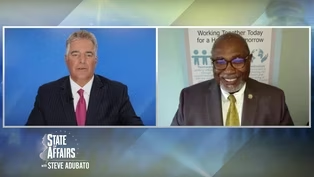
Asm. Herb Conaway Examines Top Health Issues in NJ in 2021
Video has Closed Captions
Clip: S5 Ep17 | 9m 32s | Asm. Herb Conaway Examines Top Health Issues in NJ in 2021 (9m 32s)
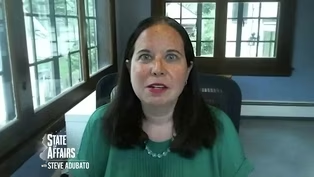
The Impact of Child Care on New Jersey's Economic Success
Video has Closed Captions
Clip: S5 Ep17 | 9m 23s | The Impact of Child Care on New Jersey's Economic Success (9m 23s)
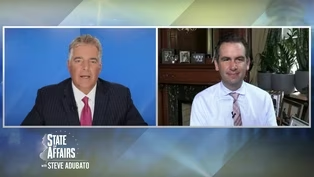
Vaccine, Tourism & Police-Community Relations in Jersey City
Video has Closed Captions
Clip: S5 Ep17 | 9m 35s | Vaccine, Tourism & Police-Community Relations in Jersey City (9m 35s)
Providing Support for PBS.org
Learn Moreabout PBS online sponsorship
- News and Public Affairs

Top journalists deliver compelling original analysis of the hour's headlines.

- News and Public Affairs

FRONTLINE is investigative journalism that questions, explains and changes our world.












Support for PBS provided by:
State of Affairs with Steve Adubato is a local public television program presented by NJ PBS