State of Affairs with Steve Adubato
Tara Colton; Roger León; Chrissy Buteas
Season 8 Episode 20 | 27m 24sVideo has Closed Captions
Tara Colton; Roger León; Chrissy Buteas
Tara Colton, Chief Economic Security Officer of the NJEDA, discusses food insecurity in Atlantic City and child care initiatives. Roger León, Superintendent of Newark Public Schools, highlights their academic priorities for the school year. Chrissy Buteas, President & CEO of the HealthCare Institute of New Jersey, highlights the organization’s mission to improve the quality of healthcare.
Problems playing video? | Closed Captioning Feedback
Problems playing video? | Closed Captioning Feedback
State of Affairs with Steve Adubato is a local public television program presented by NJ PBS
State of Affairs with Steve Adubato
Tara Colton; Roger León; Chrissy Buteas
Season 8 Episode 20 | 27m 24sVideo has Closed Captions
Tara Colton, Chief Economic Security Officer of the NJEDA, discusses food insecurity in Atlantic City and child care initiatives. Roger León, Superintendent of Newark Public Schools, highlights their academic priorities for the school year. Chrissy Buteas, President & CEO of the HealthCare Institute of New Jersey, highlights the organization’s mission to improve the quality of healthcare.
Problems playing video? | Closed Captioning Feedback
How to Watch State of Affairs with Steve Adubato
State of Affairs with Steve Adubato is available to stream on pbs.org and the free PBS App, available on iPhone, Apple TV, Android TV, Android smartphones, Amazon Fire TV, Amazon Fire Tablet, Roku, Samsung Smart TV, and Vizio.
Providing Support for PBS.org
Learn Moreabout PBS online sponsorship- [Narrator] Funding for this edition of State of Affairs with Steve Adubato has been provided by The Turrell Fund, a foundation serving children.
Valley Bank.
PSEG Foundation.
Kean University.
Where Cougars climb higher.
Hackensack Meridian Health.
Keep getting better.
Johnson & Johnson.
The Adler Aphasia Center.
The Fidelco Group.
And by PSE&G, powering progress.
Promotional support provided by New Jersey Monthly.
The magazine of the Garden State, available at newsstands.
And by Insider NJ.
[INSPRATIONAL MUSIC] - Hi, everyone, Steve Adubato.
Welcome to a half hour of compelling, important programming.
We kick-off with our good friend, Tara Colton, who's been with us in the past.
Check out our website for previous interviews.
She's the Chief Economic Security Officer for the New Jersey Economic Development Authority.
To fully disclose, an underwriter of our programming.
Tara, good to see you again.
- Good to see you as well, Steve.
- Yeah, there's a lot of topics I want to cover.
First, let's talk food insecurity in Atlantic City.
A, why is it such a terrible problem in Atlantic City?
And B, what is the Economic Development Authority doing in that regard?
- Yeah, we're really excited to be working to comprehensively try and address food insecurity and food access in Atlantic City.
Atlantic City is so unique for so many reasons, including where it is geographically.
But as many of us know, they've also been without a full-service supermarket for nearly two decades.
And so a lot of the food retail options that many of us take for granted, residents there just don't have access to that.
And so Governor Murphy has charged us with continuing to move the needle on bringing a full-scale supermarket to Atlantic City.
But we also don't want to wait.
You know, residents deserve and need food sooner.
And so the Economic Development Authority has awarded more than $5 million in grants to local organizations that will be improving food access and developing new programs on the ground in Atlantic City while we also work to build a supermarket.
- Tara, why is it so hard to get and have a supermarket in Atlantic City?
Why is it so hard?
- Yeah, I think there's a long history of trying to match the right grocery operator and the right consumer demand within the community.
There have been a lot of efforts over the years to try and make, sort of make that development match happen.
And I think what we're looking at now, especially after COVID, is really embracing the shift to e-commerce and just recognizing that shopping patterns change.
And so what we're looking to do is think creatively about how to build on the assets that are there, how to think a little differently about who a potential operator could be, but also to really understand what the community there wants so that we can actually make it happen.
- Tara, I'm remiss.
Remind everyone what the role of the Economic Development Authority is.
- Sure.
So the Economic Development Authority, or the EDA, is this state's government agency charged with driving economic growth and really delivering on Governor Murphy's commitment to a stronger and fairer New Jersey.
I'm very proud that we have, I believe, the first chief economic security officer in the country, and myself, which really underscores that we're putting our money where our mouth is.
That we believe that economic security is economic development and that we need to strengthen all New Jerseyans so that we can all thrive.
- You know, along those lines.
One of the things that I always have found interesting, and check out previous interviews with Tim Sullivan, the CEO of the Economic Development Authority, is that economic development initiatives are defined in some interesting and unique ways by the EDA.
I'll be more specific.
You know, we've talked about this before, but the connection between childcare, quality, affordable, accessible childcare, and economic development, make the case, please.
- I think, as our CEO has said, if COVID didn't convince you about the importance of childcare at our economic stability and growth, very little will.
I think there is no question that the data show how access to high-quality, affordable, accessible childcare allows parents and caregivers, particularly mothers, to enter or reenter the workforce.
But we also know that there aren't enough spaces in high-quality programs and so we're really proud to be leading the charge.
We're dedicating over $115 million to improving childcare in New Jersey.
- Break that down.
I'm sorry for interrupting, Tara.
$115 million goes where?
- Yeah, so we are making, we believe it's the third largest investment of any state, only after California and Texas, in improving childcare facilities.
So we're giving grants of up to $200,000 to hundreds and hundreds of childcare centers up and down the state for them.
- To do what?
- To expand into new rooms that have long sat vacant, to replace unsafe playgrounds, to improve the windows and allow them to open and get natural light.
We expect that this will result in thousands of new spaces and slots for children in New Jersey, especially infants and toddlers.
- So, I'm curious about this.
Tara, is it fair to say that, I'm gonna give you a quote and then I want you to play on this, because I'm trying to understand.
- Yeah.
- It feels as if there's a redefining of what economic development really means.
You said quote, "You can't throw money at a problem.
It's really an investment in our people."
So economic development is an investment in people?
Explain that.
- Yeah, I mean, I think that historically, economic development has been focused on the return on investment in the short-term.
How many immediate jobs are being created?
How much tax revenue are we gonna obtain from this investment?
And those are all real and meaningful and profound.
- They matter.
They matter.
- They matter, absolutely.
But what we're talking about are really investments that could take decades or even generations to have that lasting impact.
And so thinking differently about what the economic impact is and knowing that we may not see it immediately, but that we're making the kinds of smart contributions to shore up the economy for what people really need, so that they can avail themselves of all of the exciting work that's underway in New Jersey.
- Let me push back a little bit.
Historically, people in public life, elected officials, politicians, they're big on the photo op, you know where I'm going, shoveling the ground, hard hats that they only wear that day, and or that minute, and never again.
Neither do I, so I just want to make it clear I'm not great with my hands that way.
That being said, that projects, shovel in the ground, photo ops have been the definition of economic development for decades.
Are you saying that beyond the EDA, that trying to get public officials to think about economic development differently is part of your mission?
- Yeah, absolutely.
I think those photo ops and the shovels in the ground are really important markers.
- They matter.
- They bring a symbolism.
What matters is then the ribbon cutting and being able to deliver on the commitment that was made.
And so I think that pushing the boundaries of what it means to see impact in our economy, and thinking differently, and just more broadly about how that's measured, whether it's improved health outcomes, you know, reduced absenteeism at work, because parents now have reliable childcare, the ability of companies to, you know, hire and grow the workforce that they want and need, because people have their basic needs met, I think that that's something that isn't as neatly tied up in a bow or a ribbon, but it shows impact.
And so we're trying to again, push those boundaries, so that we can have an economy that works for everyone.
- Sometimes there isn't a photo op when you're making a difference.
It's not so visual.
Tara Colton is the Chief Economic Security Officer for the New Jersey Economic Development Authority.
Tara, once again, we appreciate you joining us.
Thank you.
- My pleasure.
Thank you.
- You got it.
Stay with us.
We'll be right back.
(grand music) - [Announcer] To see more State of Affairs with Steve Adubato programs, find us online and follow us on social media.
- We're now joined once again by Roger Leon, who's Superintendent of the Newark Public Schools, the largest public school operation in the state.
Is that fair to say, superintendent?
- Absolutely true, my friend.
Great seeing you.
- Great seeing you.
As we get to the back end of 2024, what would you say the number one accomplishment is of the Newark Public Schools?
Number two, clearly, the greatest challenge as we move into 2025, please, Superintendent.
- So of the major accomplishments, there are a wholesome lot of them.
We're in the start of the fifth year of our strategic plan.
So we have evolved an entire new redesign of our entire school system, creating a new ecosystem, starting as early as a baby being in a mommy's womb to mentorship at the collegiate level.
The students that graduated from the class of 2024 earned $169 million in college scholarships.
The class of 2023, actually, 48.9% of those students who graduated now two years ago successfully completed their first year of college.
So from the trajectory of where they're going, we clearly have plans set, and then obviously, the work ahead with regards to our strategy and increasing enrollment, which has exceeded even our wildest expectations of getting the little ones into schools.
That's kind of the great work that is before us.
In terms of the challenges, obviously, the realities of the impact of the pandemic linger, and so from our social-emotional- - How so?
Superintendent, how so?
Because I'm sure there are all kinds of impacts, all kinds of impact, but the most significant impact from COVID educationally in Newark is?
- We know that there are students in Newark and even across the country that were good during the pandemic, meaning that the way that they received remote instruction worked for them, but the overwhelming majority of students in Newark, that entire experience did not work for them, and I'm not trying to say that a child from Newark is different from a child in any other part of the country.
I'm saying as a kid from Newark, there's that interaction that we actually need in our classrooms between and amongst students, between teachers and support staff that is quite unique that a child actually needs to have the presence of somebody who cares about them, like our teachers do, in the room with them, and that the realities and however hard we worked during the pandemic to bring about the best instructional program, knowing that everyone was evolving in how to strategically do that, everybody did their best.
We know that our best work is when we're actually with students in school and interacting, whether it's one on one in groups or in classes as a whole.
So the impact of the pandemic is what I see as the challenge.
While I don't wanna blame COVID for anything, the reality is that its impact have lingered, and we're working aggressively towards addressing students' needs on two fronts, on the academic programming and then what the pandemic unveiled, which was the social-emotional learning needs of our students, that it wasn't some students needed assistance and support beyond the academic programming, but that the overwhelming majority of our students not only needed it probably prior to the pandemic but definitely needed post pandemic.
- I was remiss early on.
I should've disclosed that the Newark Public Schools has been one of the underwriter sponsors over our long-time Stand & Deliver leadership and communication development program for our nonprofit and continues to support our programming as an underwriter, but superintendent, let me try this.
You talked about the impact of COVID.
You've seen a series of articles in different publications, but in NJ.com, I wanna understand, A, if this is correct, and B, how you respond to it, that, according to NJ.com, less than 20% of the 3rd graders in the Newark Public Schools can read at 3rd grade level.
Less than 20% of 3rd graders read at 3rd grade level.
Reading proficiency.
To what degree, A, how do you explain it?
B, how much are you arguing COVID is a part of that?
- So, we know that... We wanna make a clear distinction between student performance on the state test and the ability of children to read.
So when people are saying the students performed on the NJSLA, which was the state test in 3rd grade, at a proficiency level less than 20%, that is not untrue.
That is a quite big difference from them saying how many children actually can read, that one doesn't correlate with the other at all.
- What's the difference, Roger?
- Well, we know that there are state standards by which the students are evaluated on an assessment for a four-day, five-day period, right?
And so the tools that the student utilizes to demonstrate mastery is what's more critical now that we've moved from a paper-pencil test to actually an online platform.
When we look at the students that are in 3rd grade as an example, we have approximately 2,500 students in 3rd grade across all of our schools.
The actual subset of the students that are having difficulty reading and comprehending is well below 300 students.
How do we determine that?
Through a number of multiple different other indicators that allow us to know what are actually the students' actual reading capacity.
I'm not suggesting that the state's test isn't a valid assessment of student proficiency.
I'm saying that there's a big leap to say a kid can't read because they didn't do well on that test.
One and the other are not the same.
- But superintendent, to be clear, you're not happy regardless of whether there's a difference or not.
You're not happy with where students are today in terms of reading.
- Absolutely not, no.
So that's a whole other issue.
The issue with regards to how students are performing, well, obviously there's a lot of work that needs to be done.
But if we take it full throttle, we know that 9th graders in our high schools as of last year, have, in fact, outperformed their counterparts from before the pandemic.
So over the last three and a half years, the students who have been in our schools and in fact took the 9th grade test actually surpassed what students were doing before the pandemic.
So as it relates to correlation, in English language arts, the students actually performed better than in mathematics, and in mathematics, we're still about 1.4 percentage points of what they were scoring before the pandemic.
- Superintendent, I have to ask you this.
We've asked every educational leader this question.
I'm gonna ask you.
AI and public school education, does it worry you, excite you?
What?
AI in public education in Newark.
- So I appreciate the pivot because part of what becomes extremely important, especially in education, is we like doing things a certain way and then not changing it.
So what AI has done for everyone is disrupted what we like to call our normal, and so the idea that anything does that brings about the type of change that inevitably would impact kids.
Anything that's new, we worry about.
The work that we're doing piloting with Khan Academy at First Avenue School in particular and a number of other schools in the North Ward were, in fact, Bill Gates visited our schools because of the distinction of the work is, in fact, what we believe is serving as a model, that it helps aid to and provide assistance for our students as opposed to replacing that which I already outlined prior, which is that human interaction is extremely integral to our students.
So what we're doing is utilizing AI to really provide the type of tutoring and assistance and additional support that students need while monitoring the implementation of particular strategies.
- Superintendent, I promise we'll continue the conversation about AI in public school education in Newark and a whole range of others issues, including a new universal school schedule.
It's 8:00 AM.
Real quick, 8:15 AM to 3:05 PM, universal across the board, right?
- It's true.
Regardless of the school, specialized schools, elementary schools, high schools, 8:15 is the start time.
3:05 is the end time.
- Thank you, superintendent.
Appreciate it.
We'll talk soon.
Stay with us.
- See you.
- You got it.
Stay with us, we'll be right back.
(grand music) - [Announcer] To see more State of Affairs with Steve Adubato programs, find us online and follow us on social media.
- We're now joined by Chrissy Buteas, who's the President and CEO of the HealthCare Institute of New Jersey.
Their website is up right now.
Chrissy, thank you for joining us.
- Thank you, Steve.
Happy to be here.
- You got it.
Tell everyone what the institute is.
- Gladly.
So when you think of saving patients' lives around the world, you think of our pharmaceutical industry and our medical technology industry, and that is who the HealthCare Institute of New Jersey represents, New Jersey's research-based biopharmaceutical research companies along with our medical technology companies.
And we have the privilege of representing this industry before our New Jersey and Washington policymakers.
- Yeah, hey, Chrissy, simple question.
- Sure.
- Why are prescription drug costs... Go ahead, finish the question.
- You're gonna say they're high?
- You need me to tell you they're high?
Why are they so high?
- I knew you were gonna go there, Steve, so, happy to answer the question.
- All yours.
- So look, I mean, the pharmaceutical industry and the medical technology industry saves, saves, money within the healthcare industry.
So what we wanna do is make sure that our patients are receiving the care and have access to care that they need.
For instance, we need our patients to take their medications and to have access to the diagnostics that they need because that prevents them from going into the hospital.
That helps them get treated and to identify a cure much earlier than if they wait any longer.
So that is the first thing we need to make sure happens, that they have access.
Second of all, we also need to make sure that any types of rebates that our manufacturers pass along to PBMs make it over- - Whoa, whoa.
Okay, no acronyms.
PBMs?
- Pharmacy benefit managers.
- Got it.
Go ahead.
So explain that again, that the- - Sure.
Absolutely.
So we wanna make sure that any discount that our manufacturers pass along to the pharmacy benefit managers make it down to the patient and what they pay at the pharmacy counter.
And so we can do that today by moving different state and federal legislation.
- I wanna be clear.
Are you saying that insurance companies that get the benefit of the discount given by drug manufacturers may or may not be passing down the savings to consumers, purchasers of prescription drugs, and that legislation... Is there legislation to mandate that on the federal as well as the state level?
- Yes, and you hit the nail on the head, Steve, so, exactly.
So if we can pass along some of those savings down to the consumer, you'll see a savings right away as well.
- What stands in the way of that... What stands in the way of federal legislation mandating that those costs or those savings get passed on to the consumer?
And on the state level, what's standing in the way of ensuring that the same thing happens?
Please.
- Well, we're making great strides there.
There is legislation that's introduced and in the Congress as well as the legislature, and we're going to keep advocating to make sure that that passes.
- Do you know in the state of New Jersey who the legislator, either the assembly member or the senator who's advocating for this?
Do you know who that is?
- So we have multiple, so I wanna, you know, just mention that we have some bipartisan support there.
I think you know that Senator Vin Gopal has been a real proponent of some PBM reform.
- He has.
- And so we'll see how things shake out, but I just wanna make sure that at the end of the day, our patients receive the medications that they need so that they stay healthy so that we are able to treat and mitigate any type of ailment that they have.
- Chrissy, let me ask you something.
New Jersey is called the quote, "medical chest of the country."
- Medicine chest of the world, Steve.
- The world.
- Proud of it.
- Explain that to folks.
- So we are proud, our companies are proud to call either their global or their North American headquarters home.
Our industry makes up nearly 20% of New Jersey's gross domestic product.
We have nearly 80,000 direct jobs in the state, over 350,000 indirect jobs.
You name it, we have a significant presence here in the state of New Jersey.
We not only wanna keep attracting our life sciences here, but we also wanna retain the companies that have been proud to call New Jersey home for over 120 years.
- Why is it called life sciences?
- Well, because there's so many different facets that go into it.
So you're using different sciences and technologies to advance our medicines moving forward.
And you're also pulling in technology and innovation.
And so we're keeping up with all the advances in medicine these days.
And now with artificial intelligence coming and advancing the industry even further, we're going to see R&D, research and development, even move the industry further at a more rapid pace.
- Last question.
What does New Jersey need to do to keep being the medical chest of the world, meaning policies on a state level to continue to attract and retain the companies you just described, pharmaceutical companies and medical device companies?
- Absolutely.
- Please, Chrissy.
- We wanna keep New Jersey the innovation state of the country.
We wanna make sure that we have policies that remain competitive with the rest of the country and also with the rest of the world.
And so that's on our taxation front.
That's also from an environmental and manufacturing front as well.
We need to make sure we're on the cutting edge.
So that's the best workforce.
That's having a great education.
And of course our location is phenomenal as well.
So when we put all of that together, New Jersey is well positioned to remain a leader in this critical industry, and HINJ is going to be at the forefront to continue to educate and to continue to advocate on behalf of all the patients that our members serve each and every day so we find the cures that our population desperately needs.
- And HINJ stands for HealthCare Institute of New Jersey.
That's why we always explain acronyms.
Chrissy, I wanna thank you so much- - Thank you.
- For joining us.
We appreciate it.
- Really appreciate it, Steve, thank you.
- You got it, and to all of you watching, make sure you catch us next time for compelling, important public policy conversations.
See you then.
- [Narrator] State of Affairs with Steve Adubato is a production of the Caucus Educational Corporation.
Celebrating 30 years in public broadcasting.
Funding has been provided by The Turrell Fund, a foundation serving children.
Valley Bank.
PSEG Foundation.
Kean University.
Hackensack Meridian Health.
Johnson & Johnson.
The Adler Aphasia Center.
The Fidelco Group.
And by PSE&G, Promotional support provided by New Jersey Monthly.
And by Insider NJ.
Here at Kean University, everyone gets their chance to climb higher.
Michael came to Kean and found his passion for health care, and now he's a doctor.
After Tricia graduated, her graphic design work was featured in The New York Times.
Samantha is studying athletic training and finding her path to an internship with the New York Giants.
Real Students.
Real Stories.
Real Success.
Cougars Climb Higher.
Kean University.
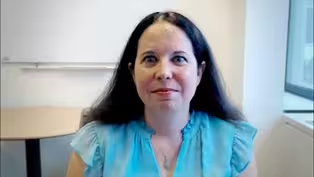
Addressing food insecurity & child care in Atlantic City
Video has Closed Captions
Clip: S8 Ep20 | 9m 16s | Addressing food insecurity & child care in Atlantic City (9m 16s)
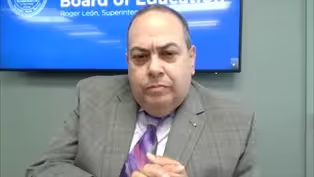
Superintendent of Newark Public Schools talks academic goals
Video has Closed Captions
Clip: S8 Ep20 | 10m 35s | Superintendent of Newark Public Schools talks academic goals (10m 35s)
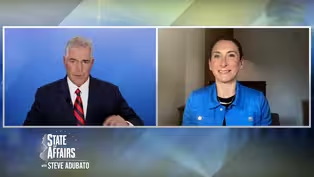
Supporting the life sciences industry in New Jersey
Video has Closed Captions
Clip: S8 Ep20 | 8m 35s | Supporting the life sciences industry in New Jersey (8m 35s)
Providing Support for PBS.org
Learn Moreabout PBS online sponsorship
- News and Public Affairs

Top journalists deliver compelling original analysis of the hour's headlines.

- News and Public Affairs

FRONTLINE is investigative journalism that questions, explains and changes our world.












Support for PBS provided by:
State of Affairs with Steve Adubato is a local public television program presented by NJ PBS