
Task force recommends changes for child welfare system
Clip: Season 51 Episode 21 | 48sVideo has Closed Captions
A Michigan task force addresses racial disparities in the state’s child protection system
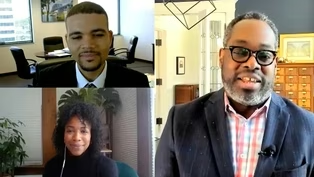
A Michigan task force has come up with recommendations on how to eliminate racial disparities in the state’s child protection system. The issues include an overrepresentation of children of color in foster care, many of whom age out of the system. Stephen talks with a senior deputy director in the Michigan Department of Health and Human Services about the issues and solutions.
Problems playing video? | Closed Captioning Feedback
Problems playing video? | Closed Captioning Feedback
American Black Journal is a local public television program presented by Detroit PBS
Task force recommends changes for child welfare system
Clip: Season 51 Episode 21 | 48sVideo has Closed Captions
A Michigan task force has come up with recommendations on how to eliminate racial disparities in the state’s child protection system. The issues include an overrepresentation of children of color in foster care, many of whom age out of the system. Stephen talks with a senior deputy director in the Michigan Department of Health and Human Services about the issues and solutions.
Problems playing video? | Closed Captioning Feedback
How to Watch American Black Journal
American Black Journal is available to stream on pbs.org and the free PBS App, available on iPhone, Apple TV, Android TV, Android smartphones, Amazon Fire TV, Amazon Fire Tablet, Roku, Samsung Smart TV, and Vizio.
Providing Support for PBS.org
Learn Moreabout PBS online sponsorshipA Michigan task force has come up with recommendations about how to eliminate racial disparities in the state's child protection system.
The issues include an overrepresentation of children of color in foster care, many of whom age out without finding a forever family.
The proposed changes from the task force were submitted to Demetrius Starling, a senior deputy director in the Michigan Department of Health and Human Services.
I spoke with him about the problems, and about the recommendations.
When you think of things like opportunity, and when you think of how important childhood is to that opportunity, the idea that kids of color are experiencing more hardship in the foster care system than than other folks, it just breaks your heart.
- Yes.
- So I wanna start with you talking about some of the things that you've learned about why these disparities exist, and then let's talk about the things that you think could be better.
- Right, absolutely, and again, Mr. Henderson, thank you for having me, and it sounds like you are keenly aware of some of the challenges that our Black and brown kids are presented with, and not only our children, but the families also.
But while 31% of Michigan's children are people of color, they make up 51% of our current foster care population, and that speaks to the disparities within our society.
When you think about our families that have a lack of access to good stable housing, or a lack of access to mental health services or food insecurity, so those things really, those disparities really lead to the level of disproportionality that we see in our systems.
And as a department, we're really doing a lot of work around the social determinants of health, and seeing how we can really tamp down on some of those things, seeing how we can assist in working upstream with families to provide them with good stable housing, good payable wage jobs, and also make sure that food insecurity is a thing of the past.
So it's a lot of work to to be done, however, we've done a lot of amazing things over the last several years in these areas.
- Yeah, so I wanna talk a little about Michigan's Child Welfare Improvement Task Force, where the idea for that comes from, what's it made up of, and what it's trying to do.
- Absolutely, so the Michigan Child Welfare Improvement Task Force was sanctioned back in the fall of 2020, and it is a group that's totally independent of our department, and it's made up of really staunch advocates of our department, people who are stakeholders in our respective communities, anywhere from former foster parents, biological parents.
We have folks from the legislative office that make up that group, judges, different folks who are advocates in our communities that come together to bring forth recommendations to the department that we could potentially implement, and this is an action oriented group.
This is not a lot of work that's being done so it will be put in a binder, sit on a shelf, and collect dust for the next couple years.
These are things that we are really putting into action.
And, you know, just a perfect example, when I transitioned into this role a couple of years ago, one of the things I saw was that was a focus, a priority focus for myself, is to see how we can transition our kids, primarily our Black and brown kids out of our congregate care facilities.
So I tasked the task force with that particular endeavor, and they brought forth really great recommendations, such as having really comprehensive reviews of those kids who have long length of stays in those facilities, where we can really do a deep dive into the family dynamics.
Is it something outside of the kid's behavior that's not allowing that kid to go back home at that time?
So some of the things that we found as a result of those comprehensive case reviews was really amazing, and it ties back to the disparity piece.
We saw quite a few parents who were struggling with getting good stable homes, so we worked with our housing department.
We also also looked at different ways to make sure that there were sustainable things in place for the family, such as making sure their utilities were paid, or making sure that the kids had mentors once they transition out of these facilities, and we started to see a steady decline in our kids in congregate care.
Several years ago, we were at over 1,000 kids who were in congregate care.
- When you think about some of the reasons that the kids of color faced these barriers, I think you come across the the idea of systemic racism really quickly.
- Yeah.
- Can you talk about how we see that?
- Yeah, absolutely, and so one of the things I truly am so enthusiastic and pleased to see is that the task force really goes forth with this undying, unyielding desire to really tamp down and eliminate systemic racism, and also address disproportionality in our systems as we look to continue to turn our systems towards equity.
There's some very bold and crucial conversations that occur in that in those groups, and as a result, it makes us take a look in the mirror as well, and what I mean by that is we understand that we have policies and procedures that were laced with biases.
We get that and we understand that, so it's incumbent on me to ensure that I am giving my folks, empowering my folks to really take a deeper dive into our processes and say, "Look, whenever we re-envision our way of doing business, it has to be done with this lens of diversity, equity, and inclusion across the board."
And just another example about that, Mr. Henderson, is that so just this past year, I was able to get allocated within my department, a child welfare human resource DEI manager that really, you know, has ingrained diversity, equity, and inclusion on all of our practices across the board.
So whenever we are hiring folks, whether it be internally or externally, we're looking at different ways to invoke this sense of diversity, but also that person is tasked with talking to their analysts and talking to their managers about when we redo our policies, when we redo our practices, how are we looking at being more inclusive?
How are we looking to knock down some of those disparities that we've seen in our past systems?
And right now, in fact, we have about 90 different projects when it comes to project, excuse me, program and policy enhancements.
And again, we understand fully that it's not gonna be an easy overnight fix, but if we don't do it right, when will we ever have time to do it?
So those are just a couple of things that I've put in place since I've been in this role.
- Yeah.
I also know that this ties pretty directly into who chooses to be a foster family, and that we have a problem in our communities of getting enough people to say, "Hey, I want make sure that there's opportunity for kids to find supportive environments to grow up in."
- Right, so I think one of the things that as a child welfare system we didn't do to the best job in in the previous years, was really leaning into kinship care.
And, you know, as I started to unravel the myths behind that, one of the things that came to my attention is that a lot of people internally and externally had this ideology of the apple with doesn't fall too far from the tree, so if you have folks from disenfranchised communities that are struggling with certain things such as substance misuse, or alcoholism, or lack of stable housing, they attach that with their particular family members.
So that's one portion that we're really addressing steadfastly, but also just having that really crucial conversation with my foster care workers and licensing workers about the importance of making sure kids stay connected to their community.
When a child must be removed from their parents, all efforts, of course, are made to keep the kid within their community, but if children are unable to be placed with the relatives, our department works to match our kids with families from their particular communities when possible.
So we all know that keeping kids closely connected with their churches, their schools, their support systems in their particular communities, their race and ethnicity, it really matters.
It really matters as far as the nurturing of that particular child.
It really matters in regards to that kid's mental and physical wellbeing and makeup, and allows children to be welcomed to homes where they feel like there's a sense of belonging.
So that's something that we're really, we have a steadfast approach to make sure that we are regionalizing some of our licensing efforts, making sure we have a boots on the ground approach, going into some of our inner cities, some of our urban areas to have this more refined focus on matching kids up with communities that they come from.
- Yeah.
I wanna give you a couple minutes just to talk about things that could be different, that you think could be different, that would really help the efforts that you're making there at MDHHS to ease this strain on both the children and on families.
What do you need, for instance, from the legislature?
What do you need from other interests that could help support?
- Absolutely.
I know that it's a difficult thing to ask, especially in the environment and the systems that we're in right now, especially with inflation and economy being the way that it is right now, but economic and concrete supports for our families means so much right now.
You know, folks are really struggling.
Mr. Henderson, when you think about it, you know, a gallon of milk can cost a family four bucks.
You know, 12 eggs can cost someone three bucks.
And for someone who really doesn't have the financial means and can be able to access some of those things, those are really difficult conversations to have with our families, because we're not trying to conflate poverty with neglect.
So I think that, you know, if the legislators and, you know, other stakeholders in the community can really help us with the messaging around the importance of heightening our foster parent rates, and also providing our kinship care providers as much economic and concrete support as possible, that would be amazing.
But also outside of that, you know, I spoke about placing children with families that share the same race, and which include, increases the likelihood that those kids will maintain that cultural connection.
So making sure that we have service providers out there that can provide really not cookie cutter services, but really appropriate services that helps the families with their self-esteem, academic success for our kids, behavioral stability for our kids, making sure that families have an outlet to job readiness, things of that nature, I think that's really important right now.
Giving families a sense of belongings, giving families a sense that they can thrive on their own is extremely important, especially for our disenfranchised communities and communities of color, but also just the messaging behind the importance of folks being foster parents.
I think we saw, unfortunately, during the pandemic, also in the pandemic, we saw a mass exodus of people who didn't want to be foster parents anymore for a number of reasons, one being the rate, which was not, in a lot of folks' eyes, not high enough to take all the kids with a high acuity of needs that they have, but also just the kids not having their access to mental health services.
- Yeah.
- These are things that we are really addressing steadfast, and we're doing a lot of good work in those particular areas.
So my message to those folks is that I would like for you to come back.
I would like for you to reconsider being a foster parent, an adoptive parent, a kinship care provider, and for folks who are interested in becoming a foster family, they can call our foster care navigators at 888-MICHKIDS.
That's M-I C-H-K-I-D-S. On the other end of the line, we have a foster care navigator that will be able to walk you through steps A through Z.
They'll connect you to either a private agency if you want to be licensed through a private agency, or work through our department, and they'll hold your hand through the whole process to make sure you have the support and guidance needed to become a foster family.

Detroit School of Arts Dance Ensemble
Video has Closed Captions
Clip: S51 Ep21 | 1m 41s | The dance students from Detroit School of the Arts perform on the Marygrove Theatre stage. (1m 41s)
Giving Back: The Soul of Philanthropy Reframed and Exhibited
Video has Closed Captions
Clip: S51 Ep21 | 9m 7s | An exhibit highlighting the work of more than 90 Black philanthropists comes to Detroit. (9m 7s)
Providing Support for PBS.org
Learn Moreabout PBS online sponsorship
- News and Public Affairs

Top journalists deliver compelling original analysis of the hour's headlines.

- News and Public Affairs

FRONTLINE is investigative journalism that questions, explains and changes our world.












Support for PBS provided by:
American Black Journal is a local public television program presented by Detroit PBS