
Utah's Mail-In Ballot Battle: Trust, Security & What's Next
9/25/2026 | 26m 55sVideo has Closed Captions
Understanding the mail-in ballot process, and the history of Utah's popular way to vote.
The mail-in ballot fight raises the question: Do Utahns have trust in our elections? Our panel of experts weighs in on how the issue is impacting public perception of local elections. On this episode, Utah County Commissioner Amelia Powers Gardner, Salt Lake County Clerk Lannie Chapman, and Fox 13 journalist Ben Winslow talk about what mail-in voting could look like from here.
Problems playing video? | Closed Captioning Feedback
Problems playing video? | Closed Captioning Feedback
The Hinckley Report is a local public television program presented by PBS Utah
Funding for The Hinckley Report is made possible in part by Cleone Peterson Eccles Endowment Fund
Utah's Mail-In Ballot Battle: Trust, Security & What's Next
9/25/2026 | 26m 55sVideo has Closed Captions
The mail-in ballot fight raises the question: Do Utahns have trust in our elections? Our panel of experts weighs in on how the issue is impacting public perception of local elections. On this episode, Utah County Commissioner Amelia Powers Gardner, Salt Lake County Clerk Lannie Chapman, and Fox 13 journalist Ben Winslow talk about what mail-in voting could look like from here.
Problems playing video? | Closed Captioning Feedback
Where to Watch The Hinckley Report
The Hinckley Report is available to stream on pbs.org and the PBS app.
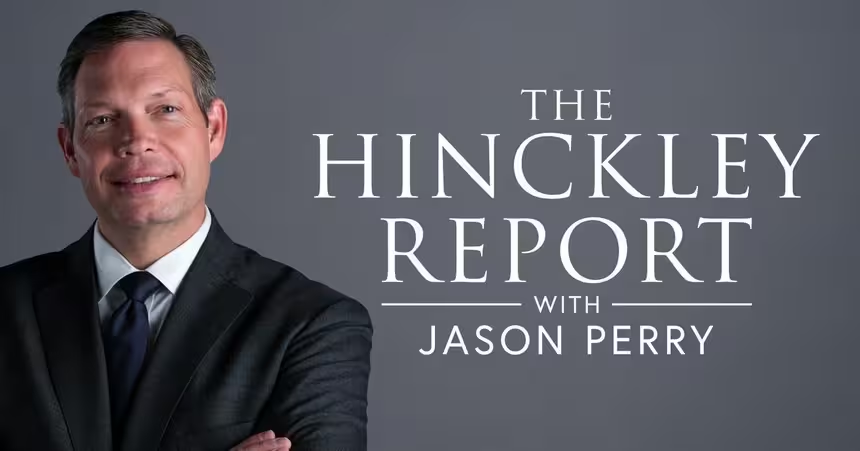
The Hinckley Report
Hosted by Jason Perry, each week’s guests feature Utah’s top journalists, lawmakers and policy experts.Providing Support for PBS.org
Learn Moreabout PBS online sponsorship(inspirational music) - On this episode of "The Hinckley Report," Utah's top election experts break down how elections are administered.
What can voters expect heading into the general election, and how can Utahans prepare to cast their votes in November?
- Funding for "The Hinckley Report" is made possible in part by the Cleone Peterson Eccles Endowment Fund, and by donations to PBS Utah from viewers like you.
Thank you.
(inspirational music) - Hello, and welcome to "The Hinckley Report."
I'm Jason Perry, Director of the Hinckley Institute of Politics.
Covering the week, we have Amelia Powers Gardner, Utah County Commissioner, Lannie Chapman, Salt Lake County Clerk, and Ben Winslow, reporter with Fox 13 News.
Thank you so much for being with us.
We have a very special episode today.
We're going to talk about election security.
We're going to talk about ballots, what's happening at the state level and the federal level, and you all are at the heart of it.
And we're so grateful you're willing to give your expertise here today.
I want to start with talking about elections generally.
I want to set the stage here.
Amelia, are elections safe?
Are they secure here in the state of Utah?
You've been a County Clerk.
Now you're a commissioner.
Tell us how safe these elections are.
- Yeah.
Our elections are very safe.
Are they perfect?
No, I mean, nothing is perfect, but they are incredibly safe.
I think we can have absolute confidence that the right person won and that the ballots were counted as accurately as possible every election.
- How about from your perspective here?
- Absolutely.
They're safe, secure, and accurate.
We do audits before the election starts, during administrating elections, post-election, and frankly, we have third party groups and the legislature coming in auditing us constantly.
While I can tell you that they're safe, trust but verify.
Come take a tour.
Come be a poll watcher.
Come participate in the event.
See that they are in fact safe.
- I want to get to a couple of those points.
So Ben, you interviewed so many people.
I've seen some really great stories about that.
Tell us about the perception of Utahans as they look at our elections, whether or not they're secure or not, the person they vote for is the person that gets counted.
Tell what you're hearing from Utah population.
- Voters have a lot of confidence in our elections, at least the voters that I'm speaking to.
You certainly see some online rhetoric and people who do express some concerns, but I think there's a lot of show and tell that we do see here in Utah, especially the work of County Clerks who open their doors, who say, "Come check it out.
If you have concerns or questions, there's no stupid questions here.
Come in, see how a ballot is counted, see how this is happening."
And I think that just resolves a lot of fears that people have.
And I would just tell everybody what Lannie said, just go out and check it out.
Really, see what's happening.
- So how do we do that?
Okay.
So people can.
So talk about this because you can be pretty transparent.
- Absolutely.
It's something that we hold near and dear to our heart here in the state of Utah, that we can come and watch.
The public can participate very easily just by coming to our doors, coming to the government centers, coming to their County Clerk's office and asking to take a tour, to come poll watch, to participate in our civic duty and watching how the process is actually processed.
- You could even do it beforehand.
I mean, one of the favorite ones to go to is the logic and accuracy test where the voting machines are set up and people who may have questions or concerns about that can watch it, even before the election takes place.
- And they can participate, right?
We ask for volunteers to help with the audits before and the audits after.
They can volunteer as a poll worker or in the ballot center.
They've got the ability to come and participate in the process.
- Lannie, I know you actually give these tours.
- I do.
- So how does one do that?
For people who are wondering how the whole process works?
- Call my office.
Just come on down.
I love giving tours.
Myself and my team, and frankly, I can speak for all of the County Clerks in the state.
We take so much pride in what we do because it's a hard job, but it's one that we hold near and dear to our heart.
And we love to show it off.
We love to show the procedures we have in place, the chain of custody that we have to make sure that the ballot that came in is the same ballot that we tabulated at the end, and we can account for every single one.
- Amelia, you were talking for a moment about whether or not we're perfect, and maybe it's almost impossible to have perfection, but there's a difference between sort of election error and election fraud.
And sometimes people jump to that end.
Talk about that for just a moment from both your hat now and what you had with the Utah County Clerk's office.
- Yeah, I mean, if you look at even an organization like the Heritage Institute, who sought for years to find election fraud, they could find three cases in the state of Utah.
When you have an error rate that is that low, then it really doesn't affect the outcome of the election.
When I was a County Clerk, the most common error I found was we found a mom signed a ballot for her missionary son.
And we'd call them up and tell them that unfortunately that's a felony, so don't do it again.
We've marked the voter file.
But these error rates that you have are so incredibly small that there's not a chance they could affect the outcome of the election.
- Ben, so put that into perspective from where Utahans are and what's been described from two clerks from other sides, both sides of the aisle right here with what's happening in Washington, DC.
You have a Republican administration and you have a Republican administration here in the state of Utah that seems to be at odds right now about election security and about mail-in ballots.
- Yeah, we are certainly having it right now, a moment.
The lieutenant governor is currently, as she has disclosed, under investigation.
And there's a lawsuit still pending too.
The Department of Justice is suing the lieutenant governor seeking voters' private information, information that is not distributed to others.
It is internal stuff and it is not, and she's refusing to hand it over.
Some of the voter advocacy groups that have jumped into the lawsuit have said that this is part of the creation of some type of a centralized database that could be used to target people, just building this centralized database of voters.
And the lieutenant governor has refused to hand this over, as have a number of other states.
In fact, Lieutenant Governor Henderson's Threads account, which I check religiously now, because she's always disclosing these things.
Last night she posted 20-40 signaling that yet another state, a federal judge in that state has rejected the Department of Justice's request for this information.
We have yet to have a hearing in this one.
I keep checking the docket every day looking to see what's going to happen with Utah's lawsuit, but right now the odds are not in favor of the Department of Justice.
There's not even any kind of a court split here.
They're just universally getting rejected.
- I want to play a clip from the Lieutenant Governor Amelia, if you'll give our first comment on this because it gets to the heart of what the Department of Justice is looking for.
And then I want to talk about what our information really is that's out there.
So let's play this clip from the Lieutenant Governor.
- I would be very supportive of legislation that helped preserve and protect people's Constitutional voting rights.
I would also be in favor of some sort of federal ID requirement.
Most states have these ID requirements, Utah certainly does, or even documented proof of citizenship.
If there's enough leeway for people to actually get their documents, having something like the SAVE Act that's implemented effective immediately, the purpose of that is just to disenfranchise people.
And that's crappy.
That should not happen.
That's despicable.
- Okay.
Break this down a little bit, because he's talking about what kind of information available and whether or not it starts infringing on people's access to the ballot box.
- Yeah, absolutely.
So I think one of the first things that she said is that she would not oppose legislation.
And I think that's important that she used those words because there is a place for the federal government.
There is a place for Congress to legislate in elections.
Where there doesn't seem to be any place in law is for the President to come out with an executive order.
And I think that that's one of the big issues that we have right now, is that the President has tried to dictate this, and nowhere in the Constitution or in law does it say that he can, right?
The governor doesn't have the ability to do that.
Neither does the Lieutenant Governor.
In the state of Utah, it's the legislature.
So this is the legislator's responsibility.
That's I think one of the first things.
Beyond that, looking at her idea of the premise of this legislation, absolutely, I agree with the premise behind the SAVE Act.
I think that you should have to prove your identity to vote and I think you should have to be a citizen to vote.
But how you go about doing that and making sure that there's enough time for offices to implement that will play to the legality and to whether it's even possible.
- Lannie, talk about that SAVE Act.
Senator Mike Lee has been working on this from the state of Utah, but that seems to be the heart of it.
Is it an implementation timeline that's the real problem or is there something else?
- So it's time and resources.
We're talking about implementation.
It takes us a while to be able to implement new laws.
However, we are very good at pivoting.
Since 2020 in the state of Utah, there have been over 60 laws that affect election law and election administration that have gone into law since 2020.
So 60 laws, that's a lot.
However, when we're talking about something nationally, you have to have a runway.
You have to be able to allow the administrators the time to make sure that there is an established process so that people can adhere to it and eligible voters can still participate.
Secondly, you need to have resources available for those people that might not have readily available access to the documentation that they need to be able to prove that they are in fact eligible.
- And the devil's in the details.
And I think that's why you're seeing this bill always seem to struggle to get across the finish line here, despite the efforts of Senator Lee and others, and President Trump, who would very much like to see this passed, is that there are all these concerns that need to be resolved before you get that consensus in order to get it passed into the President's desk.
- Yeah.
I think one of the unique situations that I'm in is Senator Lee is my constituent, right?
So he pays property taxes in my county.
And if the SAVE Act passed today, and we couldn't just use a drop box.
If we had to put two poll workers at every single drop box and have drop box hours, I would have to raise Senator Lee's property taxes by 2.4% to pay for that.
If we got rid of vote by mail completely, if Trump's executive order stands, I will have to raise Mike Lee's property taxes by 15% to pay for that.
- Interesting.
- It would cost millions more to run elections in the state of Utah.
It would be less efficient and we would see less participation.
- I think you'd see angry voters just because voters like vote by mail.
At least the voters I'm talking to overwhelmingly, they like the convenience of it.
The drop box, people don't seem to have a problem with that even if you're pushing people more toward drop boxes versus having the postmark deadlines and things like that.
Voters want this.
I think you'd hear it just so much from your constituents if that were the practical effect.
- Without a doubt.
We see over 90% of people historically that participate in any given election do so using their drop box, using their by mail ballot.
- Yeah.
Even in my county where we have a current County Clerk that's been telling people not to vote by mail and telling them to show up in person, we still have over 94% of ballots dropped in a drop box or come back through the mail.
So even when we've got a County Clerk that's telling them not to do it, over 94% of the people do.
- Interesting.
I want to get back to the history of this vote by mail in Utah.
But before I do, one more question on these lists, these voter lists themselves.
For the people who are watching, what is on these lists that we're talking about, what the Department of Justice wants versus what maybe the lieutenant governor thinks they should get.
As a voter, what of mine is available out there?
- Well, I think what's publicly available, what the DOJ wants are two very different things.
And I think that's where this matters.
Utah has very strict privacy laws.
We actually have the most strict government privacy laws in the nation.
You have a right to privacy from the government in the state of Utah.
Because of that, we have to safeguard your information.
For the lieutenant governor to give the DOJ a list that includes your address, your date of birth, possibly your Social Security Number, your place of birth, et cetera, without a warrant would actually violate our state law.
So the DOJ has essentially asked Lieutenant Governor to violate the state privacy laws in Utah without cause.
- And she won't do it.
She said, "I'll only give you what is publicly accessible, and therein lies where we're at where we are."
- Yeah.
And Lannie, to that point, the United States Supreme Court has weighed in recently on that letter.
And as Ben mentioned, this is one of maybe 30 letters that were sent from the Department of Justice, 24 of those resolved.
Talk about that for just a moment.
- Absolutely.
So the Supreme Court recently decided to dismiss the Department of Justice's suit saying, "No, the executive order and the final rule issued by the post office will not go forward for this election."
In large part because of timing, there was a huge confusion and chaos that would have been injected.
And frankly, the fallout there, it has been injected into this upcoming election.
However, beyond that, the time, place, and manner, Article 1, Section 4, excuse me, of the Constitution says that the state and Congress gets to make the rules up with regard to federal elections.
- We'll be watching those changes as they go forward because there's still a few of those cases out there.
But let's talk about this vote by mail for just a moment.
They're at the heart of these lists themselves.
So Amelia, vote by mail in Utah was established basically in 2013.
Give us a little bit of a timeline from then till now, including we'll start talking about a change that happened in our last legislative session.
- Yeah, absolutely.
So 2013, it started as a pilot.
Salt Lake County was one of the first counties to do that.
And in 2017, it became law statewide.
So we had time, county by county, pilot by pilot, to figure out how to do this.
Did it over the course of five years, and then in 2018 it went statewide.
And we've had this statewide since 2018.
Now, one of the things that I think it's interesting to note is why we went to vote by mail.
We went to vote by mail because we had very low voter turnout because a large swath of our state is rural, and they needed better access to the ballot.
That's their constitutional right and they needed better access to it.
And those two things happen.
We have higher turnout.
The rural communities have very high use and approval of vote by mail.
But I think there's a third aspect there that wasn't necessarily expected, but is a pleasant surprise.
And that is eligible female voter participation has gone up significantly.
What we found is that moms with a lot of kids, i.e.
Utah moms, don't stand in line to vote.
And their voice is now being heard at a level that it's not ever been heard before.
- And this is something you were talking about just for a moment ago, and it really is 90% plus of Utahans at some point have used vote by mail, and they still want it to continue, but we still see some chipping away at that.
- Yeah, you do certainly see that on a legislative level.
We have seen bills that have sought to restrict it or limit it.
Now we have the opt-in starting in 2029 and you renew every eight years.
But when I talk to voters, it's convenient.
It's easy.
People don't like sitting in the ballot box and then you go, "I don't know who's on the water board.
I don't know.
This person has a nice name, I guess.
Maybe I'll vote for them," and you don't know anything about them.
But when I talk to voters, they're like, "I love being able to sit and look up people's names, and read about what they're all about, what they're promising, if they're elected, what their platform is, how they feel about this specific issue."
Voters feel educated.
They feel more informed than if, and especially if they're not following the day-to-day news cycle of a campaign or anything like that.
And I'm talking not the big races, the big headline-grabbing races, but the smaller ones, the ones that more directly impact their communities.
And they don't often know who's on the school board or they want to know more about this and what their position is about school lunches or what their position is on recess, or something like that.
And this gives them the opportunity to just look it up and say, "This sewer board candidate represents my values."
And then they vote for that person, but it's that convenience.
And then they like the drop boxes because you can do it at any time of day or night and you're just fine.
"Oh, on my way into work, I'll drop off the ballot.
Cool.
It's in.
Did my service.
Voted."
People are still mad they aren't getting the stickers though.
They just need to point that out.
The stickers- - [Host] Did you resolve that?
- In the ballot.
As County Clerk, I put stickers in the envelope.
- Open the instructions.
They're right there.
- Okay.
We got the sticker problem.
- Resolved here.
- Resolved.
- Amelia, talk about this point that Ben brought up.
So this is in 2025 as House Bill 300s, Jefferson Burton.
They passed this vote by mail will now be opt-in.
As Ben said, it starts in 2029.
Talk about this change, this opt-in versus opt-out to the mail-in ballots.
- Now, luckily there's multiple ways.
You can do it when you renew your driver's license or when you get your driver's license, you can do it when you first register to vote.
There will also be a place when you return your ballot that you can opt in.
I personally think that if you returned your ballot by mail, that should be your opt-in, right?
We have enough election cycles between now and 2029 that I think if you filled out your ballot and you put it in a drop box, that's your indicator to the state that you want to continue.
I would prefer it just stay like that.
But, there are several ways to opt in, and you would have to opt in every eight years.
If you forget to opt in, that doesn't mean you can't vote, that just means you have to go to the polls to vote.
- Talk about the sort of the policy behind this, Lannie, as you understand it, implications for you as the County Clerk.
- Yeah.
So a lot of it has to do with voter education, educating voters that yes, they can still receive their by-mail ballot, but these are the additional steps they will have to take.
It's not insurmountable, and frankly, the bill ended up that passed was a lot better than where it started.
It would've cost time and resources, plentiful, for both election administration and for the voters had the bill passed originally as written.
But as it stands now, every eight years, a voter has to affirmatively say, "I want to continue to receive my by-in-by-on ballot."
We do have time between now and then to maybe update some of the law, to revise it, to make sure that it's more in line with our Utah values and maybe practice does make perfect.
- And what would some of those changes be?
- Similar to what Commissioner Gardner said, that we would be able to see patterns.
And if a voter votes by mail, I don't know, every even election, that they will continue to stay on the vote by mail.
Either way, even the people that prefer to vote in person, what I see and what I frankly hear is they love to receive that by mail ballot because they use that to do their homework.
There are many, like Ben Winslow was saying, there are a lot of candidates on the ballot, and you're not going to know all of them.
You're going to know the top of the ticket candidates.
But as you go further and further down, the service districts, the judicial retention, the different questions, how many double negatives are there in those questions?
It takes a minute to figure out exactly what it's saying and figure out what best aligns with you and your values so that you can vote appropriately.
- Ben, since you were talking about the confidence that Utahans seem to have in it, we've done some polling, The Hinckley Institute did for the Desert News.
Couple numbers to give you and talk about whether or not there's a disconnect or not given what we just talked about.
75% of Utah voters are confident that votes cast by mail in Utah are counted as they're intended.
And this is both sides of aisle.
72% of Republicans, 92% of Democrats, and 72% of Independents.
That's a pretty high number from all parts.
Is there a disconnect there between what we're talking about and sort of incremental changes to the vote by mail and the confidence that seems to exist with the Utah population?
- I think what you see is obviously lawmakers have their concerns about wanting to ensure that elections are safe and secure.
But then you have, there's rhetoric and then there's reality.
And the rhetoric is obviously you hear obviously from federal levels and things like that, concerns about elections or raising concerns.
But voters by and large still feel confident.
They see it.
They see it as it impacts their local communities.
And this goes back to what we were saying earlier, which is, go see these things.
If you have questions, show up.
You can watch it.
It's kind of fun.
Bring popcorn if you want.
- One of the things that's interesting is those numbers have actually declined in the last two years.
And I think that the reason they've declined is because we have people in positions of authority, legislators, that are continuing to pander to the super minority that thinks that there's a reason to not have confidence in our elections.
In 2024, our numbers were better.
And in 2022, they were better as well.
And so if you look at this, as Lannie pointed out, we've had 60 laws in the last six years.
We've had no major issues in the state of Utah, and yet that confidence number goes down a little bit every couple of years.
And I think it's a direct result of legislation like HB-300, of our elected leaders continually undermining confidence in the elections.
And I challenged them on HB-300.
I sent an open letter to the legislature and I asked several questions.
I said, number one, do you think that Spencer Cox is a legitimate governor?
And if you don't, why?
Which of your peers was elected fraudulently and were you elected fraudulently?
And if you don't answer those questions to say that you think that there's problems with our elections, why are you voting for a law, and why are you entertaining a law that undermines confidence in the elections?
- So Lanny, so there's the confidence in elections, which, and I've heard you talk about this before too, has a direct connection to our confidence in the institutions themselves.
- Absolutely.
The dis and misinformation that we're seeing nationally does have a huge impact locally in what we're seeing with the public, the kind of questions they're asking.
I've noticed my job has turned from almost 100% administrative to at least 30 to 40% voter outreach, education, explaining what we do, why we do it.
I love doing that.
I love explaining to people why the processes we have in place exist, the security mechanisms that we have to make sure that your vote is counted the way that you filled it out or cast your ballot, however you did it.
But at the end of the day, it is difficult.
It makes it quite difficult.
I think in 2020 or 2021, there were over 11 clerks in the state of Utah that had changed.
So there's a lot of fatigue that comes with this as well.
- Yeah.
Ben, talk about this confidence in institutions a little bit too with the people, the stories you're writing, the coverage that you're giving- - I work in media.
Confidence in institutions we also experience.
- Talk about that for just a minute because it does impact turnout and people's willingness to accept the results of where those elections are.
- And I think that, it also goes back to, I will also dump a little of this on voters.
You have a role to pay attention what is happening in your community, not just whenever the ballot comes around every four years, but what's happening all around you, and pay attention to what is happening in the news cycle.
Pay attention to these things.
And I understand people got lives, they got jobs, they're busy, but I'm just saying this is all part and parcel of being a citizen in an informed democracy.
So I guess I would just say, there is also a call for people to be more informed about these things.
- We only have about 90 seconds left, but Amelia, since you were talking about sort of this erosion a little bit, I was going from 2024 in terms of confidence in local elections versus national elections.
And just to comment on this, because this is where Utahans, and it does go down, not just overall, but it was 84% confident in local elections, 81% confident in state elections, and only 63% confident in Presidential elections.
That's an interesting from the same group of people.
- Yeah.
I think when it comes to local and state, what's interesting about that is that your local, the results are still our County Clerks, right?
There is no such thing as a- - [Ben] It's the same election!
- I think a lot of it, if you look at the Presidential, I think the confidence goes down significantly on the Presidential because of the talking heads on TV, right?
I think it's cable news in general, right?
If it bleeds, it leads.
Fear sells, confidence doesn't.
In elections, sorry Ben, we want elections to be boring.
Ben probably doesn't, but there's a joke that the County Clerk's prayer is, may your lines be short and your margins be wide.
A boring election is a good one.
- Okay.
Thank you.
And thank you so much for all you're doing for the state of Utah and your comments today.
And thank you for watching "The Hinckley Report."
This show is also available as a podcast.
Thank you for being with us.
We'll see you next week.
(inspirational music) - [Narrator] Funding for the Hinckley Report is made possible in part by the Cleone Peterson Eccles Endowment Fund and by donations to PBS Utah from viewers like you.
Thank you.
(inspirational music continues)
 New Episode
- News and Public Affairs

Top journalists deliver compelling original analysis of the hour's headlines.
 New Episode
- News and Public Affairs

Today's top journalists discuss Washington's current political events and public affairs.
 New Episode
 New Episode
 New Episode
 New Episode
 New Episode


 New Episode
 New Episode

Support for PBS provided by:
The Hinckley Report is a local public television program presented by PBS Utah
Funding for The Hinckley Report is made possible in part by Cleone Peterson Eccles Endowment Fund