
Teacher Contract Update, Teen Topics, and Tree Equity
Season 6 Episode 10 | 26m 46sVideo has Closed Captions
Nevada Week explores tree equity, teacher contracts, and how teens feel on major topics.
We start with an update on where things stand on CCSD teacher contracts. Then we meet two of the students who participated in the Sun Youth Forum. They have a lot to say about the current events impacting them! And finally, what is tree equity? And how are many Southern Nevada neighborhoods affected?
Problems playing video? | Closed Captioning Feedback
Problems playing video? | Closed Captioning Feedback
Nevada Week is a local public television program presented by Vegas PBS
Teacher Contract Update, Teen Topics, and Tree Equity
Season 6 Episode 10 | 26m 46sVideo has Closed Captions
We start with an update on where things stand on CCSD teacher contracts. Then we meet two of the students who participated in the Sun Youth Forum. They have a lot to say about the current events impacting them! And finally, what is tree equity? And how are many Southern Nevada neighborhoods affected?
Problems playing video? | Closed Captioning Feedback
How to Watch Nevada Week
Nevada Week is available to stream on pbs.org and the free PBS App, available on iPhone, Apple TV, Android TV, Android smartphones, Amazon Fire TV, Amazon Fire Tablet, Roku, Samsung Smart TV, and Vizio.
Providing Support for PBS.org
Learn Moreabout PBS online sponsorshipThe Clark County School District takes its largest teachers union back to court, plus... (Lisa Ortega) We're talking about your power bills being lower.
We're talking about your kids being able to play outside.
- ...what role trees play in reducing extreme heat and why certain Southern Nevada neighborhoods have more trees than others.
That's this week on Nevada Week.
♪♪ Support for Nevada Week is provided by Senator William H. Hernstadt.
-Welcome to Nevada Week.
I'm Amber Renee Dixon, and today we're talking trees.
Does your neighborhood have enough of them?
How you can find out and why you should care, that's ahead, as is a discussion with some local students from this year's Sun Youth Forum.
But first, what a week in the Clark County School District.
Too many teachers calling out sick led to several schools closing their doors.
The School District claims its largest teachers union, the Clark County Education Association, is behind the so-called "rolling sickouts" and took the union to court.
Rocio Hernandez from The Nevada Independent was there in court and joins us now.
And, Rocio, what did the judge decide?
(Rocio Hernandez) So the judge decided there was an overwhelming amount of evidence, even though it was circumstantial evidence, that showed that there was indeed a strike that occurred.
And she officially called the sickouts that we've been seeing for the past two weeks a strike.
And so she issued a preliminary injunction against the teachers union, basically telling them that the strike needs to stop; and if the strike continues, there will be consequences for the continuing violations.
-What would some of those consequences be?
-So the continuation of a strike, if it continues, it could result in a fine of $50,000 for the organization, meaning CCEA, and then there would also be fines of up to $1,000 for each officer.
And these are fines per day.
Now, for the individual employee, there could be disciplinary actions, including termination or withholding of partial or all pay for these continued sickouts.
-And will you remind our viewers why a strike is not allowed in Nevada.
-So under Nevada law, strikes are prohibited by public employees, because they offer certain services that you can't get anywhere else.
Like say a hotel closes down, you can just find another hotel.
A public school is different because that's the school that your student is supposed to be going to.
It's not like you can go and pick up your student and take them to another school that day.
It's not that easy.
So the law discourages teachers and other public employees from doing strikes, because these are essential services that we couldn't do without.
-According to your reporting, CCEA denied having anything to do with these sickouts.
The School District believes that they are a strike, a form of striking, which the judge upheld that belief.
And the reason behind the "strike" is that teachers are upset that they haven't gotten their contracts, what they wanted out of their contracts.
That's what the School District believes is behind them so-called striking, right?
So where do those negotiations currently stand between the teachers union and the School District?
-Well, even before this hearing on Wednesday, we had heard that CC-- or the School District officially declared what's called an "impasse."
And what that means is basically, CCEA and the School District have been going back and forth for several sessions now and still haven't come to an agreement on their contract.
So now they're going to call in a third party to come in and settle things with them.
So they will look at-- that third party will look at all the revenue that CCSD has to its disposable-- to its disposal to see exactly how much money they have to be able to afford teacher raises or the other points that CCEA is asking for.
They're going to look at what the School District is offering, they're going to take a look at what the teachers union wants, and they're going to come together and decide between them.
And the now arbitrator is going to make a final decision based on the information that it's received, and they're going to give a ruling.
And that rule should be binding, given that the School District does have the money to provide for those raises.
They're going to give an estimate as to the final decision and what that will cost the School District.
-Does arbitration benefit one side over the other?
-So CCEA will say that the third party is a good person to come into these negotiations because they will be neutral, you know?
They will be able to look at exactly all the revenue that the District has.
And CCEA says that the School District hasn't been forthcoming as to all the revenue it does have at its disposal, and that's one of the big arguments that they've been making.
When it comes to the contractor agreements, they've been saying they don't have enough money to afford everything that CCEA wants.
So CCEA does welcome someone coming in and making sure that those claims that the District is making are valid.
And in past negotiations, when it has come to this arbitration process, CCEA has been successful.
But it's unclear, you know, to know exactly what the arbitrator will find in the end.
-And our viewers gotta be asking, What is it that these teachers want?
In the simplest terms, it's a 10% raise in the first year of a new contract, 8% in the second year.
How long could arbitration take?
-So I heard from the executive director that past sessions have taken anywhere from like nine months to more than a year.
And so it wasn't something that CCEA necessarily wanted it to come to because it takes so long.
And in all this time, what's going to happen is morale between the teachers is going to go down.
That's one of the main things that they've been worried about is that teachers are tired of working without a contract, they want to see these raises go through, and they want to see the District agree to these raises and make them feel like they are valued.
So CCEA is concerned that we already have a large number of teacher vacancies and that these vacancies will be exacerbated as this continues to drag out and until none of us knows exactly when this will all be resolved.
-We will be following this as it moves through arbitration.
Rocio Hernandez of The Nevada Independent, thank you for your time.
-Yeah, good to be here.
-The local newspaper The Las Vegas Sun held its 65th annual Sun Youth Forum this week.
The Forum's purpose is to bring awareness to what young people think about issues important to them.
And joining us now to do just that are Kiyoni McCarty-Crenshaw, a senior at Silverado High School; and Pedro Tapia Zamora, a senior at Advanced Technologies Academy.
Thank you both for joining Nevada Week.
First off, the previous segment to this we discussed the contract negotiations between the school district and the teachers union.
I'm wondering from each of you, I'll start with you, Pedro, how important is that topic to you?
Is it impacting you?
(Pedro Tapia Zamora) It's a very important topic.
I mean, here at Advanced Technologies Academy, my teachers, who usually do after school tutoring and after school clubs, have decided to cancel all that stuff in order to be in solidarity with the movement.
And it's very hard because the tutoring sessions are for rigorous classes that we have in my school, such as calculus, and it's very, it's very rough to see people who are in my position not be able to have the same resources and opportunities that I had.
So I find it very disheartening, and I hope to see a contract to be reached soon.
-Yeah.
The teachers have said, We are not going to stay before or after school longer than our contracted hours until this is agreed upon, until we can get a new contract.
Kiyoni, how is it impacting you, if at all?
(Kiyoni McCarty-Crenshaw) The same as Pedro at school, teachers of mine, most of our extracurricular and club activities are now being student-based because teachers refuse to stay and they don't want to do more than their contract requires them to any longer, because they are not being compensated.
It's also a personal issue for me because my mom works directly in the education field.
And she is also undergoing the problems that go along with this contract.
-Waiting to get a new contract?
-Yes.
-How does that impact you at home?
-I can tell she's very stressed about it.
So it makes me feel bad, because there's not very much I can do, being just a student myself and not in that sort of academic power.
That's really it.
-Okay.
Well, let's talk about being a student.
I got to moderate your room at the Sun Youth Forum, which covered teen topics.
And the biggest question that got the most discussion was, How has the COVID pandemic affected teenagers?
What kind of answers did you get?
-So a lot of our answers about COVID, most of the students who wanted to talk about how it impacted them directly and how it impacted their, mostly their ability to learn and their ability to socialize with other people.
Teenagers are now very socially isolated.
They no longer know how to interact with each other because of the year of the pandemic.
We were all stuck at home.
We were stuck only speaking to our families.
And for those with not the greatest families, they didn't have very many places to turn to.
So they became very social media dependent.
A lot of the-- a lot of the teenagers talked about how they experienced-- what they experienced is now making them notice more generational differences between them and the incoming freshmen and generational class, how they are so much more outgoing and they look different because they did not experienced the same things.
But then again, some of them are also more-- they've grown longer and faster than they should have.
-How did the COVID-19 pandemic force people to grow up faster?
-I guess it really-- it was in the way that we were forced to learn how to live in isolation.
We were forced to learn how to deal with such a big, impactful event that isn't just affecting us.
But we have to take care of ourselves.
And some of us, like myself, I actually did experience the virus.
So those of us that experienced such things and being scared because it was life threatening for a lot of people, it causes you to think differently.
It causes your mentality to develop a lot faster than the normal adolescent.
-Pedro, your topic was about living in Nevada.
And the biggest question you told me that everyone discussed was, What ways can Nevada improve its education systems to ensure a higher ranking nationwide?
How does Nevada improve its education ranking?
-Yeah.
So there's a lot of solutions that my group discussed.
And some of the solutions were that since we were in high school, we believe that there's not that much leniency in our schools.
We felt that there's a lot of pressure and strictness placed on us.
For example, someone pointed out the fact that there's a bathroom policy where you have to ask the teacher to go to the bathroom.
And they expect you to come back in a time of five minutes.
And we also had another student who was an exchange student from Europe, where they said directly and open, they said Europe does not have any of these policies, because the teachers believe that these students can be trusted.
But here in Vegas, there's that pre-mindset where we're not trusted.
So we believe that that pressure is not worth going to school for.
And that's something we also discussed was the absenteeism, where a lot of our students here in Vegas, specifically, aren't going to school.
And we did also discuss how some of that contributes to the transportation here in Vegas.
As we saw, there's a lot of construction, especially near my zoned school, which is by Alexander and Ferrell.
And because of that, a lot of students, a lot of students are getting late to school.
As a result, they're starting to feel that mindset of like, What's the point of going if I'm going to be late and missing half of my classes?
-So construction is preventing kids from getting to school.
Also, policies that you think are too stringent are keeping kids from wanting to go to school.
And so that's the solution you think, is improving just in attendance in order to get a national ranking improvement?
-Yes, 100%.
We believe that just improving the fact that if students can get to school and start to learn rather than being held back from all that, then our scores would rise significantly.
-Kiyoni, why are teens expected to decide on a career before they even have a chance to explore who they are?
-So this is a really big discussion for my group.
A lot of-- a lot of the teens in that room were very passionate about this subject.
And one of the major conclusions that we came to is because that is what was expected of all of the generations before us.
Our parents were expected to know what they were going to do.
And the educational system is-- the major goal is college.
That is what they're working towards in the end, but they don't think about the bigger picture of life and how there are students who don't want to go to college.
It isn't for them.
That is not the path they want to follow.
And so the educational system is setting those kids up for failure, because this is not their ultimate goal.
You are sending them into the world with no skills for what they can do, for what they would like to do.
-Pedro, I see you nodding.
What do you agree with specifically there?
-I just I agree with the fact that there's already that just expectation that you have to decide your career before you even turn 18, before you're a legal adult.
Also, you have to have in mind that you want this job and you'll stick with this job for the long term.
And then as you see, the studies show that people change their majors in college.
And then it causes a lot of financial issues because they have to switch majors and go to a different school or just area, in general.
-Kiyoni and Pedro, we could talk for a long time, but we have run out of time.
Thank you so much for joining Nevada Week.
-Thank you.
-Thank you for having us.
-From education to the environment now.
Behind Reno, Las Vegas is the second fastest warming city in the United States.
That's according to the nonprofit research group Climate Central which says trees are part of the solution because they can cool the air and hot surface temperatures like pavement.
However, recent research shows trees tend to be sparse in lower-income neighborhoods, prompting nonprofits like Nevada Plants to take action for tree equity.
-This is a city of Las Vegas map.
And this is where we're going to be planting 250 trees.
-Lisa Ortega, Executive Director of Nevada Plants, knows which Las Vegas neighborhoods lack tree cover.
-Lower income, less canopy.
-And less tree canopy means less shade and hotter temperatures for Las Vegans like Felipe Arellano-- (Felipe Arellano) Vegas is being getting really hot, 115 degrees, and we need shade.
- --and Kristyn Dunne and her son.
(Kristyn Dunne) Trees can be a little expensive, and so we were really excited to get a tree that's going to grow really big and give him shade and eventually, you know, make it so he can play outside all year round.
-Thanks to Nevada Plants, Dunne and Arellano each got a tree and irrigation system for $20.
Their East Las Vegas area codes qualified them.
(Chris David) -We see a lot of communities in Eastern Las Vegas or Sunrise Manor as well as North Las Vegas that have often 1 or 2% tree canopy cover.
Those neighborhoods often have the highest numbers of people in poverty or people of color as well.
On the other side of the coin, the most treed communities, you might not be surprised that those are in those masterplanned communities of Summerlin and Green Valley.
-Chris David oversees map-based visual storytelling at American Forests, a national nonprofit conservation organization which created the Tree Equity Score tool.
-That's a combination of a measure of need of tree canopy cover that's based on the existing tree canopy cover for your community and a measure of equity based on demographics and heat.
The lower your score-- so the further you are from 100, the higher your priority will be.
[clicking] [buzzing] -We have our drone in an area of Summerlin where the tree equity score is a perfect 100.
You can see the difference in tree canopy here where, according to the Las Vegas Global Economic Alliance, the median household income is about $111,000.
Compare that to this drone footage from Dunne's neighborhood where the tree equity score is just 59 and the household income, less than $29,000.
(Marco Valotta) It definitely is worth it.
-Marco Valotta is a City Planner for Las Vegas and its Chief Sustainability Officer.
We met with him at the city's tree nursery.
-Why is it that lower-income areas tend to have fewer trees?
-There's a couple of different reasons why that might be the case.
You know, a lot of the low-income areas in Las Vegas happened to be in the oldest parts of town.
And those older parts of town, they tend to have the older tree species.
And over time they've started to die out, either disease or pests.
The other might be economic.
We have property owners, whether they're commercial or residential, they sometimes don't have the money or the ability to make tree or landscaping replacements.
-What is the City of Las Vegas doing to address this issue?
-So within the oldest parts of the city itself, anywhere within our public right of way, like within downtown Las Vegas, we've been planting trees.
We also are a Tree City USA, so it also means that we take advantage of Arbor Day.
Every year we do a tree planting event at a public park, and we have a goal of planting 60,000 new trees over the next 30 years.
-However, David says Las Vegas would need 346,000 trees to achieve tree equity.
-This is relevant right now today across the Southwest and across the country.
Heat-related deaths are on the rise, and they're expected to reach in this country over 100,000 deaths annually within the next decade.
So I keep saying this is a matter of life and death, and it is.
-The severity of the situation is Ortega's motivation.
-There's folks that live here.
They have toddlers.
They have kids that are going to school that need shade.
They have elders who walk to the bus stop to get their groceries, and these folks need shade.
They do.
-The Southern Nevada Water Authority is working to increase tree cover as well.
And here to explain why and how is John Entsminger, General Manager of the Southern Nevada Water Authority.
John, Welcome.
(John Entsminger) Great to be here again.
-So we are in a decades-long drought.
Trees need water to grow.
Why are you promoting the planting of trees?
-Well, really to combat increasing temperatures.
The urban heat island is a real thing.
If you've ever put your hand on the sidewalk, even at seven or eight o'clock at night, you know that thermal energy gets stored in all these hardscapes that we've built.
So in order to have a really livable city, we need to really try to increase that tree canopy.
-But you're doing this at the same time as you're asking people to remove their lawns and replace them with desert landscaping.
Is the use of water more justified for trees than it is for grass?
-I think both justified and much, much more efficient.
One square foot of grass uses 73 gallons of water per year.
So you're talking about 10 vertical feet of water for every square foot of grass in the valley; whereas, mature trees use about 17 gallons per square foot.
So much more efficient use of water and a much bigger return on our water investment in terms of the livability of our city.
-And as we showed in the previous piece, Las Vegas doesn't have enough trees as it is, but the Southern Nevada Water Authority is worried about the trees that Vegas currently has.
Why?
-Yeah.
You're really talking about kind of a two-front war, because a lot of the trees that have been planted here aren't going to survive.
As we get warmer temperatures, as early as 2035, we think there's about 100,000 trees in the valley that no amount of water is going to save.
Those trees are going to reach their heat limits, and they're gonna die.
So we need to be replacing those trees but also planting new trees throughout the valley, as you mentioned, especially on the east side of town where the temperatures and the equity issues are a real thing.
-So how does this Tree Enhancement program work?
-So the Board of Directors of the Southern Nevada Water Authority has already appropriated $10 million with the goal of planting 100,000 new trees.
It's part of our Water Smart Landscape program.
So participants in the Water Smart Landscape program are now being incentivized that for every tree they plant as part of their project, there'll be paid an additional $100.
-Wow!
Hey, not too shabby.
-Exactly.
-I want to move on to other work that you are a part of.
You are a General Manager of the Southern Nevada Water Authority, but you also lead negotiations for the State of Nevada in terms of the Colorado River and operating guidelines, which are set to expire in 2026.
Right now as it's set up, Nevada gets the least amount of water out of all the seven states that utilize the Colorado River, and Mexico as well.
What do you want out of those negotiations?
-Well, I think first and foremost, I want to continue the process that has kept the seven states together and out of litigation.
I think it's imperative that we continue to cooperate with our neighbors while also making sure that we have a safe and secure water supply for the residents here in Southern Nevada.
-What would prompt litigation?
-I think one state refusing to share in mutual sacrifice.
I mean, the reality of the situation is the Colorado River in the 21st century is going to have a lot less water than it had in the 20th century.
And every state, two countries, every water user throughout the basin is going to have to contribute to having a sustainable river going into the future.
-There is an idea being circulated right now about decommissioning Glen Canyon Dam to increase storage in Lake Mead.
What do you think of that?
-I think it would be really shortsighted to take that infrastructure out.
If you listen to the best climate scientists in the world, yes, we're going to experience megadroughts as the climate changes, but there will also be periods of potential megafloods.
And when those occur, we want the infrastructure in place to be able to store that water.
If Glen Canyon Dam hadn't existed in the year 2000, Lake Mead would be empty right now.
So we have really good infrastructure on the river.
There will be periods when we get more water, and we should be able to capture that water and save it for future years when those occur.
-Talking about the existing guidelines and the guidelines that are to come that you're working on right now, if you had your way, how would they impact farmers?
-Well, I think everybody's got to contribute, right?
So I think there should be standards to make agriculture more efficient.
But also I think we need to make sure we allocate enough water for winter fruits and vegetables.
The Colorado River is one of the most productive agricultural areas in the world, certainly in the United States, but we have to be more efficient with how we grow those crops.
-Would that come via federal regulation?
-Well, I think there's multiple avenues.
I think you can negotiate for more efficiency standards.
Certainly the agricultural areas in Arizona and California are participating in the Lower Basin Plan to conserve 3 million acre feet of water by the end of 2026.
So my preference is always to negotiate, not regulate.
But in the absence of being able to reach conclusion at the negotiating table, that possibility of regulation is always out there.
-And the current operating guidelines, how far off are they from what is practical in your opinion?
-I think they're probably 80% practical.
And we've learned about 20% of them aren't great.
I mean, the whole intent of interim guidelines in 2007 was to learn lessons.
And we've learned we were probably releasing too much water from Lake Powell to Lake Mead in the last 20 years.
Those balancing operations caused a lot of strife between the Upper and Lower Basin.
So there's some tweaks that need to be made.
-And are there implementations in conservation in Southern Nevada that you would like to see utilized in other states?
-Well, I would try not to be the person who's telling other localities what to do, but I certainly think we provide an example of what can be done.
We're on pace this year to use less water as a community than we used in 1992, during which time the population of this community has tripled.
So we have shown that you can grow your community, have a vibrant economy, and simultaneously use a lot less water.
I think there are lessons to be learned by the communities there.
-So could you pick one?
I mean, perhaps the turf removal?
-Well, there's a pending proposal in the California State Legislature right now to ban non-functional turf exactly as we've done here.
So our neighbors are looking at us and learning some lessons.
Yeah, I think, you know, grass that only gets walked on by the person who mows it doesn't have a place in the Western United States anymore.
-John Entsminger, General Manager of the Southern Nevada Water Authority, thank you for your time.
And thank you for watching.
For any of the resources discussed on this show, go to vegaspbs.org/nevadaweek.
♪♪
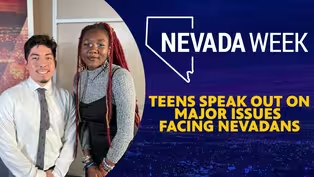
Teens speak out on major issues facing Nevadans
Video has Closed Captions
Clip: S6 Ep10 | 7m 48s | Teens share their thoughts on education, mental health, social media, and other issues. (7m 48s)
Where do negotiations stand between CCSD and CCEA?
Video has Closed Captions
Clip: S6 Ep10 | 5m 31s | Multiple schools have closed this week, citing a large number of teachers calling out. (5m 31s)
Why is Tree Equity Important to Southern Nevada?
Video has Closed Captions
Clip: S6 Ep10 | 12m 13s | What Tree Equity is, how it reduces heat, and why many neighborhoods trees. (12m 13s)
Providing Support for PBS.org
Learn Moreabout PBS online sponsorship
- News and Public Affairs

Top journalists deliver compelling original analysis of the hour's headlines.

- News and Public Affairs

FRONTLINE is investigative journalism that questions, explains and changes our world.












Support for PBS provided by:
Nevada Week is a local public television program presented by Vegas PBS