
Lebanese farmers say ceasefire fails to ensure safety
Clip: 12/3/2025 | 7m 1sVideo has Closed Captions
Lebanese farmers rush to salvage harvest as ceasefire with Israel fails to ensure safety
One year ago, Lebanon and Israel signed a ceasefire that was supposed to end a war between the militant group Hezbollah and Israel, a war that left more than 4,000 Lebanese and more than 100 Israelis dead. But with near-daily Israeli attacks still taking place, life for civilians in Lebanon's south remains dangerous. Special Correspondent Simona Foltyn reports from that tense border.
Problems playing video? | Closed Captioning Feedback
Problems playing video? | Closed Captioning Feedback
Major corporate funding for the PBS News Hour is provided by BDO, BNSF, Consumer Cellular, American Cruise Lines, and Raymond James. Funding for the PBS NewsHour Weekend is provided by...
Support provided by:

Lebanese farmers say ceasefire fails to ensure safety
Clip: 12/3/2025 | 7m 1sVideo has Closed Captions
One year ago, Lebanon and Israel signed a ceasefire that was supposed to end a war between the militant group Hezbollah and Israel, a war that left more than 4,000 Lebanese and more than 100 Israelis dead. But with near-daily Israeli attacks still taking place, life for civilians in Lebanon's south remains dangerous. Special Correspondent Simona Foltyn reports from that tense border.
Problems playing video? | Closed Captioning Feedback
How to Watch PBS News Hour
PBS News Hour is available to stream on pbs.org and the free PBS App, available on iPhone, Apple TV, Android TV, Android smartphones, Amazon Fire TV, Amazon Fire Tablet, Roku, Samsung Smart TV, and Vizio.
Providing Support for PBS.org
Learn Moreabout PBS online sponsorshipGEOFF BENNETT: The prime minister of Lebanon said today the nation was far from normalizing relations with its southern neighbor, Israel.
One year ago, Lebanon and Israel signed a cease-fire that was supposed to end a war between the militant group Hezbollah and Israel, a war that left more than 4,000 Lebanese and more than 100 Israelis dead.
But with near daily Israeli attacks still taking place, life for civilians in Lebanon's south remains dangerous.
Special correspondent Simona Foltyn reports from that tense border.
SIMONA FOLTYN: It's olive harvest season in Southern Lebanon, but after two years of war between Israel and Hezbollah, it's slim pickings from Mohammed Allawi.
MOHAMMED ALLAWI, Farmer (through translator): For two years, we have neglected this land.
There are few olives.
We didn't farm it.
We didn't even put fertilizer.
The people have abandoned their land.
They're not willing to come here.
We only come here when accompanied by the Lebanese army.
SIMONA FOLTYN: Under the protection of the Lebanese army, farmers have a week to complete their harvest.
Coming here alone is dangerous, despite a U.S.
brokered cease-fire signed last year.
In line with the deal, the Lebanese army replaced Hezbollah as the dominant security force in Lebanon's south.
But Israel has continued to carry out air raids and ground operations and still occupies Lebanese land.
Captain Elias Barich is in charge here.
Can you explain where we are at the moment?
CAPT.
ELIAS BARICH, Lebanese Armed Forces (through translator): We are now in the village of Maroun El Ras on the Southern Lebanese border that looks out on occupied Palestine.
This is the main area where you will find olive trees and it extends up to the village.
SIMONA FOLTYN: We are just a few hundred yards from the border.
The Israeli settlement of Avivim lies beyond the rubble of Lebanese homes.
On this side, the land lies fallow, in contrast to the lush green across the border fence.
During Israel's ground incursion earlier this year, countless olive trees were uprooted.
In a statement to the "News Hour," the IDF denied responsibility.
Now Lebanese farmers are trying to salvage what's left.
What would happen if you were not present here during this harvest?
What are some of the risks the farmers are facing?
CAPT.
ELIAS BARICH (through translator): The farmers are facing difficult challenges in this area because the enemy, Israel, is based close to their lands and sometimes carries out surveillance operations, provocations and even opens fire to terrorize civilians and prevent them from reaching their land.
Our presence here is to give them a sense of security and to protect their right to work their lands safely.
SIMONA FOLTYN: The Lebanese army has also come under attack.
Last year, during the height of the war, one of Captain Barich's men was killed when an Israeli tank fired at a clearly marked army base, an incident the IDF claimed to have no knowledge of.
CAPT.
ELIAS BARICH (through translator): The work in the border region is not easy.
The geography is difficult and the security is volatile because the enemy, Israel, is always trying to send threatening messages and ignite tensions in the area.
SIMONA FOLTYN: The captain has only around 170 troops for a sector that spans 10,000 acres of hilly terrain.
His men must secure five border villages and dozens of miles of roads.
U.N.
peacekeepers, called UNIFIL, are here to support them.
LT.
COL.
CIARAN HIGGINS, UNIFIL Irish Battalion: From what I have observed, they're well-equipped, the individuals that I have gone on, but the size of patrols that I have been on are small patrols.
They're one to two vehicle.
SIMONA FOLTYN: Do you think that the farmers would not tend to their land if LAF and UNIFIL were not present?
LT.
COL.
CIARAN HIGGINS: They absolutely would not come down here.
SIMONA FOLTYN: Why?
LT.
COL.
CIARAN HIGGINS: It wouldn't -- they feel, anyway, it wouldn't be safe enough for them.
There's been a large number of civilian excavators targeted by drones, usually actually small quadcopters that drop grenades on them.
So I think there would be the fear there from the civilians that that might happen to them.
SIMONA FOLTYN: Responding to these allegations, the IDF said it operates with utmost precaution to minimize civilian harm.
But the fact remains that more than 100 civilians have been killed in Israeli strikes during the cease-fire, according to the U.N.
Farmers like Mohammed need to come here daily to work the land, not just when the Lebanese army and the U.N.
are able to provide an escort.
MOHAMMED ALLAWI (through translator): We are not just living on olive trees.
We also grow tobacco and wheat.
We have to come here all the time to work.
SIMONA FOLTYN: You are a farmer.
If you cannot come to your fields, if you can't tend to your olive trees, what are your options?
MOHAMMED ALLAWI (through translator): We don't know anything else.
I mean, most people here survive on farming.
SIMONA FOLTYN: "And if there is no farming," I ask?
The painful realization that life as it was before the war may never return.
MOHAMMED ALLAWI (through translator): We don't know what will become of us.
We live from this land.
Our lives have been destroyed.
SIMONA FOLTYN: It's afternoon and the window of the army's protection is closing.
We leave the fields ahead for the village center along abandoned roads, past more abandoned fields.
And this is what's left of Mohammed's village, Maroun El Ras, just layers upon layers of destruction.
He shows us where he used to live with his wife and five children.
MOHAMMED ALLAWI (through translator): The IDF booby-trapped and detonated all the houses here.
They used this field for the tanks.
They set up a perimeter here and they detonated all the homes.
SIMONA FOLTYN: Mohammed's family fled during the heaviest fighting, and he's unsure if Hezbollah used his house to launch attacks.
There are, however, traces of the IDF.
In the rubble, we find a spent Israeli rocket alongside fragments of civilian life.
Mohammed doesn't feel safe to live here.
MOHAMMED ALLAWI (through translator): They won't allow any of the border villages that face them to be inhabited.
SIMONA FOLTYN: More than a year after the cease-fire, Lebanon's border villages remain a no-man's land, where life has been rendered all but impossible.
For the "PBS News Hour," I'm Simona Foltyn in Maroun El Ras on Lebanon's border with Israel.
GEOFF BENNETT: The "News Hour" reached out to the Israeli military with detailed questions about their activities in Southern Lebanon.
They issued a statement which read, in part: "Since the cease-fire came into effect, the IDF has identified Hezbollah's efforts to rebuild its military infrastructure, including in Southern Lebanon," and that "the IDF continues to act in a targeted manner against Hezbollah's reconstruction attempts."
Border Patrol's role in Trump's immigration crackdown
Video has Closed Captions
Border Patrol's expanding role in Trump's immigration crackdown (7m 39s)
A Brief But Spectacular take on connecting through reading
Video has Closed Captions
A Brief But Spectacular take on connecting through reading (3m 16s)
Hegseth's Signal chat put personnel at risk, watchdog finds
Video has Closed Captions
Hegseth's Signal chat put U.S. personnel at risk, Pentagon watchdog finds (3m 10s)
How Trump is using presidential pardon power in new ways
Video has Closed Captions
How Trump is using presidential pardon power in new ways (6m 11s)

Johnson faces growing frustration from Republicans
Video has Closed Captions
Johnson faces growing frustration from Republicans as key issues expose rifts (5m 34s)
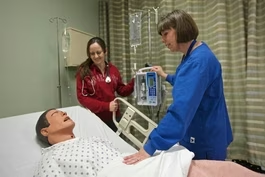
Student loan limits could reshape how U.S. trains nurses
Video has Closed Captions
Proposal to declassify nursing as 'professional' threatens ability to secure student loans (7m 30s)
Providing Support for PBS.org
Learn Moreabout PBS online sponsorship
- News and Public Affairs

FRONTLINE is investigative journalism that questions, explains and changes our world.

- News and Public Affairs

Amanpour and Company features conversations with leaders and decision makers.












Support for PBS provided by:
Major corporate funding for the PBS News Hour is provided by BDO, BNSF, Consumer Cellular, American Cruise Lines, and Raymond James. Funding for the PBS NewsHour Weekend is provided by...