
The Teton Dam Disaster
Season 9 Episode 8 | 26m 50sVideo has Closed Captions
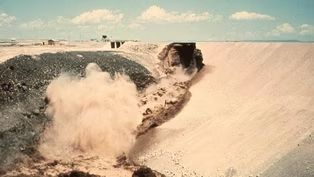
On June 5, 1976, Idaho woke up to a dam collapse on the Teton River.
On June 5, 1976, Eastern Idaho woke up to a dam collapse on the Teton River. This documentary revisits the warnings ignored, the wall of water that erased towns, and the lives forever changed. Through survivors’ voices and rare footage, it asks how this disaster happened and what it still teaches us about trust, power, and nature. It’s a human story of loss, accountability, and resilience.
Problems playing video? | Closed Captioning Feedback
Problems playing video? | Closed Captioning Feedback
Idaho Experience is a local public television program presented by IdahoPTV
Major funding for Idaho Experience provided by the James and Barbara Cimino Foundation, Anne Voillequé and Louise Nelson, Judy and Steve Meyer. Additional funding by the J.A. and Kathryn Albertson...
The Teton Dam Disaster
Season 9 Episode 8 | 26m 50sVideo has Closed Captions
On June 5, 1976, Eastern Idaho woke up to a dam collapse on the Teton River. This documentary revisits the warnings ignored, the wall of water that erased towns, and the lives forever changed. Through survivors’ voices and rare footage, it asks how this disaster happened and what it still teaches us about trust, power, and nature. It’s a human story of loss, accountability, and resilience.
Problems playing video? | Closed Captioning Feedback
Where to Watch Idaho Experience
Idaho Experience is available to stream on pbs.org and the PBS app.
Providing Support for PBS.org
Learn Moreabout PBS online sponsorshipANNOUNCER: Major funding for Idaho Experience is provided by the estate of Darrell Arthur Kammer, in support of independent media that connects communities and expands understanding.
Additional fundin was provided by the James and Barbara Cimino Foundation, Anne Voilleque’ and Louise Nelson, Judy and Steve Meyer and from the Corporation for Public Broadcasting and contributions to the Friends of Idaho Public Television and viewers like you.
Thank you.
TETON DAM WORKER ONE:The dam's gone.
TETON DAM WORKER TWO:The whole thing has gone.
Now?
The whole thing is gone.
It rolled over about five minutes ago.
SEN.
FRANK CHURCH, D-ID: The magnitude of this disaster cannot be overemphasized.
Thousands of Idaho people are homeless.
Accumulations of a lifetime are gone.
Prime agricultural land is either buried under sand and gravel or washed away.
MALE VOICE: As we came upon the town, there were several major fires burning.
Hundreds of buildings were completely demolished.
FEMALE VOICE: First reaction was it's taking our business first.
We had the drive-in theater out here, and it swept our drive-in theater out, washed it out completely, and less than a minute and a half, it got our home.
RADIO REPORTER: After this day is over, there are going to be many, many people remember this day, June 1976, the day the Teton Dam collapsed and the reservoir roared down the valley.
(MUSIC) KEENAN ARNOLD, DAM SAFETY COORD., BUREAU OF RECLAMATION:The purposes of dams are vast and wide, whether it be the irrigation that it provided to my great-granddad or whether it be the power that it provides to you and I, the benefits cannot be underestimated for the dams, especially in the West.
NARRATOR: As early as the 1930s, farmers lobbied for a dam on the Teton River.
DALE SWENSEN: Over the years, the irrigators realized that some additional supplemental water would be important to them and would help them to get through the very dry periods, the drought periods that come along from time to time.
And so, they had some discussions with the Bureau of Reclamation and came up with the idea of building the Teton Dam.
NARRATOR: Public sentiment for a Teton Dam in the 1960s was so strong that Idaho’s Congressional delegation, the Governor, most legislators and local leaders made a serious push for the project.
REP.
GERALD FORD, HOUSE MINORITY LEADER:And as I understand that project, George, it was one that had a good cost to benefit ratio.
It's a project that's badly needed in that area.
I, for one, would certainly do all I could to be helpful to you in seeing that this program is adequately funded in this next budget.
NARRATOR: And the Bureau of Reclamation was ready to start with its tried-and-true procedures to build a dam.
ROD VISSIA, BUREAU OF RECLAMATION: In this case, we had done a reconnaissance report.
We had started on a feasibility report, and the support apparently was so high for the project that the Congress introduced a bill before we finished the report.
NARRATOR: With Congressional funding in place, the Bureau of Reclamation proceeded with the project.
But geological concerns were never fully resolved.
DR.
SCOTT HUGHES, IDAHO STATE UNIVERSITY: By the time they finished their full geologic, full geologic investigation, the geologists were aghast.
It was like, why do you think you can put a dam here?
One of 'em even said right off the bat, this is the worst possible place for a dam.
NARRATOR: In 1970, the National Environmental Policy Act was signed into law.
So, the Bureau of Reclamation’s regional office issued its first environmental impact statement.
RUSS BROWN, ENVIRONMENTALIST: By any standard, the environmental impact statement for the Teton Dam, which was 14 pages long, was a poor impact statement.
They knew they had unusual problems, problems which we now learn were even worse than they perceived at that time.
But no mention of this was made in the impact statement.
No mention was made of this in any analysis was provided to the public, to Congress, or to the courts.
NARRATOR: With the help of Trout Unlimited, local environmentalists went to federal court to stop the dam.
But Judge Fred Taylor ruled against them and the Bureau continued its Taylor ruled against them and the Bureau continued its its work.
DOM GALIC, DAM SAFETY SUPER, BUREAU OF REC.
: The site was selected because it provided enough storage capacity to meet the irrigation needs that were being projected for this project.
It was also far enough downstream to place the dam close to the area that was going to be irrigated.
The first step in constructing an embankment dam is to prepare the foundation.There was quite a large cutoff trench constructed in the river channel at Teton Dam.
In addition to this foundation preparation practice, they included a pair of grouting key trenches along the sides where they were actually removing fractured bedrock with replacing the soil.
And this was something that had not been done before at Reclamation, or I don't think by anybody.
So, the next thing that would happen after the foundation was prepared was that a grout curtain would be installed.
NARRATOR: A grout curtain is a barrier that protects the foundation of the dam.
Even during construction, it was a concern.
JOHN WATSON, CONSTRUCTION WORKER: I know there were some areas in the grouting that we just simply couldn't fill the holes up, and they just pumped thousands of yards of grout into them, but yet they couldn't fill them up.
But yet, like I say, they considered it to be normal and apparently had been done on other projects.
GALIC: And so, once that was completed, then they would start placing engineered soil from the base of the excavation moving up in a series of lifts.
Each lift would be placed and then compacted using compaction equipment.
And in this way, the embankment would be built up to its top elevation.
NARRATOR: By early 1976, the dam was almost finished.
PAUL JENKINS KID PRODUCER: And that year was a heavy snowfall.
And so, the dam did fill quickly.
VISSIA: We reached a maximum filling rate on one day of a little over four feet.
The average, I believe, is about 2.5 feet or 2.7 feet per day for a 30-day period, and that exceeds the one foot per day filling rate, which we normally use as a guideline for new reservoirs.
JENKINS: Watching as the dam would collapse, you could see literally the dam looked like a mountain with a hole in it, and you could see it cutting more and more of the earth away from it, and it would shoot the water thousands of feet.
MIKE ADAMS: KUPI ANNOUNCER: I was on the board.
She came charging into the control room and said, "Have you heard anything about the Teton Dam breaking?"
First time I'd ever heard of the Teton Dam, it was right then.
And being a smart alec that I was, I said, "Yeah, but it's okay.
There's a little boy up there and he's got his finger in the hole and everything's fine."
And we both just laughed.
And within probably 15, 20 minutes, then all heck broke loose.
JENKINS: It was following the path of the river, but also as it would hit those banks, it would erode them and take them away.
And you could see literally houses being ripped off their foundations.
The dirt, it literally took the dirt off the top of the bedrock.
LARRY SAUNDERS, REXBURG: My wife Ruth decided to go into town to do a little shopping and just got to the end of our lane.
And one of the neighbors stepped out and said, "The Teton Dam has burst.
You better go home and get ready to evacuate."
RUTH SAUNDERS, REXBURG: And fortunately, all my kids were home.
When it happened, Saturday morning, you know, they’re out playing on the street, but they were home.
We were able to make quick decisions.
LARRY SAUNDERS: Henry B. Eyring was the president at the time, and he said to us, he gathered us together as a faculty and staff, and he said, "We're the innkeepers.
That's the job that we're going to take.” JENKINS: People stayed at the Rick's College campus.
They stayed in the dormitories.
They stayed in the libraries.
They stayed in gyms, anywhere that they could put people who were now unhoused and made sure that they had water and food.
Thousands of meals were prepared and provided for the people who were in need.
It's a pretty miraculous story.
KSL ANCHOR: One person was found two miles north and one mile east of Teton.
Another, a young man clung to a tree in the cold water but died after being rescued.
And a third, an elderly woman died of a heart attack.
No details are known on the other two deaths.
There are many more who are still reported missing most of them in Madison County.
It was hit the hardest.
Although Fremont and Bonneville counties are still fighting floodwaters.
Channel Five News has had a team of reporters on the scene since we first got word of the ruptured dam.
One of the first was reporter Louise Degn and photographer Bob Greenwell.
KSL REPORTER: In the city of Rexburg, most all of the grocery stores, gas stations, and other essential services, including the phone company, were under water.
This is Main Street in Rexburg, Idaho.
The flood started about one o'clock, crested about three o'clock.
Now, a few hours later, the flood is receding a bit.
That house over there used to be up by the high school, three blocks away, but the water washed it down, and now it's lodged against a few trees here on Main.
ADAMS: We knew the water was coming toward Idaho Falls.
When you have something that serious, and you know what it's like being in the news, you hear all kind of things.
JENKINS: Rigby, of course, was high enough and far enough away.
But in Idaho Falls, they were sandbagging the Snake River.
ADAMS: Probably one of the interesting parts of the Teton Dam breakage is the amount of people that just showed up.
I can still remember them back there bagging the sandbags and stuff and getting them all ready.
JENKINS: People worked all night sandbagging, trying to stop as much of the flow as they could, particularly in the low spots as the Snake River flows through the city of Idaho Falls.
One of the objects that was a problem was the Broadway Bridge in Idaho Falls.
ADAMS: Yeah, and the water was starting to come up.
I stood pretty close to the Broadway Bridge.
They actually dug a trench around the Broadway Bridge and to get the water pressure off of the bridge.
JENKINS: From there, it went to Shelley, Firth, and it did a great deal of damage in those two towns.
We don't hear a lot about the flood there, but it did hit through that area also.
The roads along there literally turned into waterfalls.
Finally, it hit Blackfoot and the Riverside Mall, ironically named, which was a parking lot, then became a place of low water all flooded into there so that it did major damage into Blackfoot also.
HUGHES: The real fear was that the American Falls Dam holding back the American Falls Reservoir would not be strong enough to contain this flood.
And since the American Falls Dam is the first dam downstream from the Teton Dam, that was a real fear, but it held.
KSL ANCHOR: Downstream, the flood waters began receding, leaving behind tons of mud and debris.
Some farms directly below the dam were covered with 10 to 15 feet of gravel and sand.
Virtually everything appeared contrary to nature.
The force of the water uprooted huge trees.
Railroad lines were noticeably altered.
Those farmhouses still standing were reduced to mere frames.
Mangled vehicles like this school bus remained as evidence of the tidal wavelike devastation.
Residents of Sugar City, evacuated in the nick of time, returned to find their town virtually destroyed.
LARRY SAUNDERS: It was shocking what we saw when we first came off the hill, drove through town out to our place.
The power of the water was amazing.
Where it flowed, it dug trenches.
It destroyed homes, it... just the devastation was unbelievable.
HUGHES: It's more than just water.
It's mud and debris, logs, furniture, fence posts, even some parts of the wires that were part of the fences could be carried down.
But you're getting all sorts of debris, vehicles and unfortunately animals.
JOHN PORTER, REXBURG MAYOR 1975-1990:The community of Wilford was right in the path.
I think they had 150 houses there and there were 138 disappeared.
And the people that lost their lives in the flood were in the area, in that area.
There were 11 deaths.
I think five of them were from drowning.
The rest of them came from heart attacks or some other.
ROGER WIBLIN, BYUI HISTORIAN: The flood mud is everywhere that those waters pour in, but as they go away, they leave the mud, which is high and thick and dense, and they had to shovel it out.
I mean, that's essentially what had to happen and it's backbreaking labor to do that.
RUTH SAUNDERS: The mud was horrible.
PORTER: The entire area has been hurt because of the flood.
Farmland has been destroyed.
Some, I'd say, 15 or 20% permanently.
JERRY DAWLING, MEYERS BROTHERS: Cattle were swept away with the water, and none were left here on the premises.
So many of them were dead.
Some were alive in tough shape and the feed lot itself was virtually destroyed.
NARRATOR: After the devastation, individuals and organizations rallied to help flood victims.
WIBLIN: The Church in Salt Lake is immediately aware of what's happening and they start loading trucks so as soon as the water's gone, they can get the supplies in, right.
LARRY SAUNDERS: Since our home was available, and our washer and dryer were functioning, we ended up being the laundry for all the families on our lane.
WIBLIN: There were tens of thousands of members of the church who volunteer from Utah, particularly other areas of Idaho and Utah who come in and they are really the driving force in helping these people.
There's a lot of people who say, if those volunteers hadn't arrived, I was ready to quit.
RUTH SAUNDERS: As I look back on it, I think that working together as a unit in our neighborhood made it all that much easier for each individual family.
As the days went on, we had to ascertain what we needed done on our property and in our lives.
LARRY SAUNDERS: The hardest part was just waiting to see what are we going to do.
Is the government going to give us money to build back, or aren't they?
Everybody submitted claims, but government doesn't work fast.
CHURCH: Today, however, our mission is to further determine not only what caused the dam to burst, but also to discover whether the Bureau of Reclamation failed to adequately design the structure and take other precautions which could have prevented the failure.
REPORTER: Three special investigating teams are searching through the rubble, looking for clues that might reveal why the Teton failed.
The committee with the most impressive worldwide credentials is a nine-member team appointed by the Governor of Idaho and the Secretary of Interior.
PORTER: One thing about this flood was that the government took, while they didn't admit that there was any fault in the construction of the dam, they did take full responsibility, and they gave 100% reimbursement to everyone.
BROWN: I think of it in terms of greed, corruption, and incompetence, sort of an unholy tri.. They certainly didn't follow their normal procedures.
They certainly didn't do their normal detailed analysis, but they defended what they did.
HUGHES: Call that politics or you could call it bullying.
You could call it anything you want, but it meant that when they decided they were going to build a dam and got everybody to agree, and Congress signed off on the bill to pay for it or to have it done by the Bureau of Reclamation, then all that was done with one thing in mind, and that was build a dam.
It wasn't done with what if the dam fails.
KAID/KUID REPORTER: After a six-month investigation into the failure of the Teton Dam, an independent investigating committee reported their findings.
Wallace Chadwick of Los Angeles said the panel concluded that a combination of a difficult site and mistakes in design caused the Teton Dam disaster.
Asked if the Bureau of Reclamation was to blame, Chadwick said it's hard to escape that conclusion since they designed it.
However, Chadwick made a distinction between negligence and professional misjudgment, refusing to directly place the entire blame on the Bureau.
WALLACE CHADWICK, TETON DAM REVIEW COMMITTEE: I have no conviction that there was negligence per se.
I think there may have ... I'm sure there were professional misjudgments.
HUGHES: So, you could boil it down to five things.
I think five things that were really the cause of the failure, one, poor site.
Two, the material they used to build the dam.
Three, the fact that they built the dam and several lifts, and there was a time, a period of time when they weren't working on it, they, it, got wet and four, it filled up too fast.
But I think one of the biggest ones was that the awareness, the engineers were not aware of what could possibly happen.
NARRATOR: Eleven people died.
Over 10,000 people were displaced.
13,000 cattle and thousands of other animals perished in the flood.
Damages from the collapse of the Teton Dam are estimated at 2.4 billion in today’s dollars.
And that doesn’t include the considerable costs incurred by the many church groups and other non-profits that offered aid and the value of thousands of volunteer hours.
In 1978, Congress passed the Reclamation Safety of Dams Act requiring all dams be inspected and then, the development of new dam safety engineering and safety standards.
It took four years to settle the bulk of the claims against the U.S.
government, but the remaining outstanding claims weren’t settled until January 1987.
SAUNDERS: You'd have a hard time knowing there was a flood because everything got built back.
A lot of things changed, but today you wouldn't know it.
Unless you knew the whole story, you wouldn't know.
ARNOLD: To this day, Reclamation advises and has many requests internationally to evaluate and see how we ensure that dams are safe.
Really, the mission statement of the Dam Safety Program of Reclamation is to ensure that this failure, Teton, never happens again.
BROWN: This is a frightful tragedy, but essentially the river has reclaimed itself.
And what man did, nature took back.
SAUNDERS: You don't need things.
You just need each other.
And we learned that mighty fast.
So, I think you just take a day at a time and be grateful for what you have.
JENKINS: Will the Teton dam be rebuilt?
I know there's a strong push for it.
I think it would be folly to put it back in that location, but it wouldn't surprise me to see a dam somewhere through that area where it might be replaced.
I wouldn't be surprised to see that.
(music) ANNOUNCER: Major funding for Idaho Experience is provided by the estate of Darrell Arthur Kammer, in support of independent media that connects communities and expands understanding.Additional funding was provided by the James and Barbara Cimino Foundation, Anne Voilleque’ and Louise Nelson, Judy and Steve Meyer and from the Corporation for Public Broadcasting and contributions from the Friends of Idaho Public Television and viewers like you.
Thank you.
Preview of "Teton Dam Disaster"
Preview: S9 Ep8 | 30s | On June 5, 1976, Idaho woke up to a dam collapse on the Teton River. (30s)
Providing Support for PBS.org
Learn Moreabout PBS online sponsorship














Support for PBS provided by:
Idaho Experience is a local public television program presented by IdahoPTV
Major funding for Idaho Experience provided by the James and Barbara Cimino Foundation, Anne Voillequé and Louise Nelson, Judy and Steve Meyer. Additional funding by the J.A. and Kathryn Albertson...