
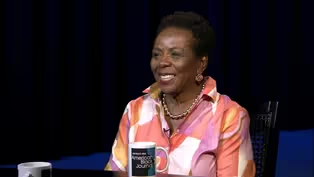
The "100 Caring Congregations" project, panel discussion on the challenges and triumphs of caregiving
Season 53 Episode 39 | 26m 46sVideo has Closed Captions
We’re looking at caregiving in the African American community.
We're devoting the entire episode to the important topic of caregiving. Our “Black Church in Detroit” series looks at the creation of family caregiving ministries in the city’s churches with the initiative known as “100 Caring Congregations.” Plus, we’ll hear from community leaders about meeting the needs of older adults and their caregivers.
Problems playing video? | Closed Captioning Feedback
Problems playing video? | Closed Captioning Feedback
American Black Journal is a local public television program presented by Detroit PBS
The "100 Caring Congregations" project, panel discussion on the challenges and triumphs of caregiving
Season 53 Episode 39 | 26m 46sVideo has Closed Captions
We're devoting the entire episode to the important topic of caregiving. Our “Black Church in Detroit” series looks at the creation of family caregiving ministries in the city’s churches with the initiative known as “100 Caring Congregations.” Plus, we’ll hear from community leaders about meeting the needs of older adults and their caregivers.
Problems playing video? | Closed Captioning Feedback
How to Watch American Black Journal
American Black Journal is available to stream on pbs.org and the free PBS App, available on iPhone, Apple TV, Android TV, Android smartphones, Amazon Fire TV, Amazon Fire Tablet, Roku, Samsung Smart TV, and Vizio.
Providing Support for PBS.org
Learn Moreabout PBS online sponsorship- Just ahead on "American Black Journal," our Black Church in Detroit series looks at the creation of family caregiving ministries in the city's churches.
We're gonna get the latest on the initiative known as 100 Caring Congregations.
Plus we'll hear from community leaders about meeting the needs of older adults and their caregivers You don't want to miss today's show.
"American Black Journal" is coming up right now.
- [Announcer] Across our Masco family of companies, our goal is to deliver better living possibilities and make positive changes in the neighborhoods where we live, work, and do business.
Masco, a Michigan company since 1929.
Support also provided by the Cynthia and Edsel Ford Fund for Journalism at Detroit PBS.
- [Announcer] The DTE Foundation is a proud sponsor of Detroit PBS.
Through our giving, we are committed to meeting the needs of the communities we serve statewide, to help ensure a bright and thriving future for all.
Learn more at dtefoundation.com.
- [Announcer] Also brought to you by Nissan Foundation, and viewers like you, thank you.
(upbeat music) - Welcome to "American Black Journal."
I'm Stephen Henderson, your host.
Today, we are looking at caregiving in the African-American community.
It is part of our Black Church in Detroit series, which is produced in partnership with the Ecumenical Theological Seminary and the Charles H. Wright Museum of African-American History.
A new initiative called 100 Caring Congregations is creating caregiving ministries in the city's Black churches.
Now the program trains faith leaders and church members on how to help families prepare for roles as caregivers.
Joining me now is the project's director, Dr.
Marilyn French Hubbard.
Welcome back to "American Black Journal."
- Thank you so much, Stephen.
- And it's great to see you.
So as we were talking about before the interview, this is something that we all come to in our lives.
We all will need to be cared for at some point.
And before that, I feel like now it's true that we will all be called on to care for someone.
And once you get to be of a certain age, it's your turn, right?
It's your turn to play one of those roles.
Talk about the challenges that we have though, specifically in the African American community, preparing people for both of those roles.
- Yeah, you know, many of us have these idiosyncrasies or fears that if we talk about, you know, growing older, if we talk about getting ill, that it may come to pass.
So, you know, just overcoming the fears, the stereotypes, the old ways of thinking to get people to really recognize that we all are aging.
And also on the other side of that, to recognize that just because we're aging doesn't mean that we're gonna get old and sick, you know.
And so one of the things that has been a continued challenge for us is to get people to really value their lives and to know that they have some control over planning and preparing and preventing crisis.
And so just to get people to talk about it.
- Yeah, I mean that discussion about it is the thing that I think is the most critical part of it.
Because once you start talking about it, all of the things that you need to do I think become more evident.
And I think for a lot of us, that is a difficult conversation, and that's why we kind of put it off.
But once you get there, it's a little bit easier to at least get your mind around what you're facing.
- And there's so many layers, you know, and every day brings a different challenge.
And none of us are trained to be caregivers.
We just get that phone call that somebody's sick or we make the phone call that something is happening to us.
And so one of the things that we're doing in the project, once we have really gotten people ready to talk about it, the awareness, the education, we're now looking at the practical things that you have to know about in addition to the activities of daily living.
But you know, what is my insurance like?
What does Medicare take care of?
How do I prepare for Medicaid?
What's the eligibility?
What do my finances look like?
And so we've developed a structure that helps people to know the right questions to ask.
And in our program, one of the beauties of the program is that we get the caregivers to take care of themselves first.
And that we learn that if you learn how to ask these questions for yourself, you have a listening ear to help other people.
And you can kind of, you know, observe some things, you know, just by listening and observing.
You know, dementia, and people are not having the correct information.
- Yeah, yeah.
Let's talk about the congregation caregiving, the project that you're doing, how it works and what it adds, I guess, to this conversation.
- Well the church has been the perfect place to do this.
We are supported by the Ralph C. Wilson Junior Foundation who had an initiative and funds to support family caregivers within congregations.
And as we have gotten deeper into the fabric of the congregations, it's just a great place to be because we have people with the hearts, the spirits, and the minds to serve.
But in most congregations, there was no structured approach to address the needs of the caregiver.
We're so focused on the person that we're providing care for that we don't think about the caregiver.
So one of the things about the church, we have the long history of serving, long history of caring.
It just has mushroomed now into kind of a movement.
So once we have mobilized, you know, we've mobilized almost 50 Black pastors and their churches, and they understand the plight and the people in the church, you know, that's who they are, they serve.
And so we're developing all kinds of programs.
So the program provides the structure, our training, but the churches, on the individual local levels, they provide the programming to meet their needs.
- I would also imagine that in addition to the programming, just introducing this kind of discussion and awareness in the church builds on the community of the church.
And then that gets leveraged in favor of these challenges as well.
So just the idea of that church community understanding that everybody is facing the same things.
- Yeah, it really helps to build capacity.
We made the conscious decision to work with congregations and communities.
So you already have a group of people there, and we work with teams, and then they work with teams within their church.
So it builds capacity.
And one of the things about the program is that we wanna develop vetted resources.
So when you become unknowledgeable about some things and you need to know where the resources are, instead of picking up a book that has national resources, we want you to be able to pick up the books that have the resources in your community.
So we're helping the church to even go within their community to find out who does what.
And it may be a caregiver's having a plumbing problem, you know, who are the plumbers in the church?
And so it goes much beyond just the medical care.
If you need a ramp to get them in, who's the carpenter?
- Who does that?
- And knowing that before you need it.
- Yeah, let's talk more about caregivers and the things that they need.
I feel like that of course is dependent on circumstances, but over time, I feel like the needs inevitably grow and change and the ability to maintain that level of care for whoever it is you're caring for becomes harder.
- Right, well one of the big things that comes up all the time is respite.
The caregivers need respite, - They need breaks.
- And they need trusted people to relieve them, because when you're leaving your home, you know, you're leaving your home as well as your loved one.
And so there's always safety.
And so we're hoping through the program that we'll be able to, through congregational families, if you will, that we can help to build capacity where there may be somebody in the church who can come over and provide respite for you, and then you're not so concerned about the safety of your home.
So respite is a big area, and then resources.
And the one resource that comes up over and over is caregivers.
Who can do this?
Where do I find them?
Who has the beliefs that we have?
So we're hoping that within these communities, that we'll continue to transform the current situation into a ecosystem of care where just within our communities that are natural to us that we can go to get support for respite as well as family caregiving.
- Yeah, I'm also struck by the potential connections between congregations on this.
And it's not that the congregations in town are not connected anyway, there's lots of back and forth, but I would imagine this is a different kind of- - Well yeah, what we did was we built community.
So we have a virtual community, so we have over a hundred people who have already graduated our program.
So they're all in a virtual community.
And again, all of those people learn how to get up on technology, to be able to go online and to be able to key in, this is what I have to offer and this is what I need.
And so as the community grows, the resource base grows, and the churches found out that they have common needs.
Grief is a big area that so many churches have to deal with.
And so there's a program that deals with grief that's already out there, that they're sharing that.
And so it's really become a collaborative, we call that co-creation.
That we're all co-creating, you know, a system that's gonna care for our people.
- Yeah, yeah.
I mean of course the hope here is to raise awareness.
If you had to sort of put your finger on the hope for changed outcomes, what would that look like?
- It would be conversations.
Being able have conversations.
So we're in the church, but many family members are unchurched.
And so what we wanna do is to be able to have the conversation and to get people to fill out the basic things that they need.
And one of the basic things that they need is an advanced directive.
So if something happened, you know, somebody else has the ability to obtain the information and to provide support.
And so what we're hoping is that the basic needs are met so there can be communications with other people within the family or within the church family have all the vital information that they need so you can be cared for if the need arises.
So the right documents, the right conversations.
- Right, right.
Okay, great to have you here.
But congratulations on the work, this is such a stark need in our community.
- It's a pleasure.
Thank you so much.
- Okay, recently, Detroit PBS partnered with the St.
Patrick Senior Center in Detroit for a public event about the challenges and triumphs of caregiving.
It was titled "Caring for Caregivers: The Art of Aging Well."
A panel of local agency and nonprofit leaders discussed the needs of older adults and their caregivers.
Here is a portion of that conversation, which was moderated by "American Black Journal" contributor Trudy Gallant-Stokes.
- My mother had Alzheimer's for 10 years, and my brother who's in the audience and I were caregivers, and she used to say to me sometimes, "You're really good at this, you know, you should go into business."
I said, "No, mom, this is because I love you.
I enjoy doing this for you.
I don't know if I'd be able to do this as a job."
But it's very important to have.
And that's what you see in the audience here tonight.
People who raised their hands said they're caregivers because those are people that are in their lives and people that they love.
And so you step up, you do what you have to do.
So SaTrice, tell me a little bit more about St.
Patrick and some of the history.
It's a rich history here in the services today.
- Definitely, St.
Patrick Senior Center, we're over 50 years old.
It was started by Sister Mary Watson.
We have a variety of program.
We're one of the larger health and wellness centers with the support of Detroit Area Agency on Aging of course.
(audience applauding) They do a lot for us.
We wouldn't be who we are without them.
So we have a number of programs.
Our congregate meal program where we cook food from scratch, we have bunches of exercise, dance classes.
We even are teaching older adults digital literacy.
So I have digital navigators who are seniors trained, and we're teaching VR, we're doing AI, we're in the community.
We also have started with workforce development training because we know that many older adults are being forced to get back into the workforce for whether it's self-fulfillment or just needing that extra money, even if it's to pay for your healthcare.
So we are training older adults to be entrepreneurs and community health workers.
- Okay, so Ron, since you're right next to SaTrice, talk about the interaction and how you DAAA as they say, how you're able to help others in the community.
- Yeah, DAAA, it's easy to help a entity such as St.
Pat's because of the commitment and the heart and just the love in which SaTrice pours out in which you could tell carries down to the rest of her team and to the services in which they provide and how they connect to the community.
So it makes it very easy.
But at DAAA, we've been around for 45 years, and it's been our mission to try to do what we can to allow individuals to age in the community with age, I mean with grace and dignity.
And we've done that by creating a system as far as a network of partners that allow us to provide what I say is a continuum of care.
And that continuum of care essentially allows individuals to come to facilities like St.
Pat's in which you can do, I recall one of the first times I got to Detroit, I came here and tried to do line dancing.
And so that's part of what SaTrice has on me.
She shows that video every now and then when she comes with ask and so.
But, you know, you could come in and do line dancing, you could participate in the VR programs, you could participate and play some pool, get a haircut.
I mean, you could really do things as far as socialization.
But then the continuum of care that we provide goes all the way to if you're home bound, if you need assistance in the home, in which we could send someone into the home to allow you to avoid going into a nursing facility and to receive care there.
So what I would like to say is that what really has given us our North Star is the fact that we also created a report probably about 20 years ago or so, and that report was entitled "Dime Before Its Time."
And what it really reflected was in regards to the fact that we have individuals within our community that because of the lack of access to healthcare, and also because of lack of, I would say, or having an increased rate of chronic illnesses or morbidities, that they were actually passing away at a rate that was two and a half times moreso than their colleagues in the rest of the state of the Michigan.
And so what we recognized is that there has to be some things in which we can do.
So a part of it was for us to invest in evidence-based programs or community wellness centers like St.
Pat's.
But the other aspect of it, and that's a long story, but what I wanted to say is that we knew that caregivers were the backbone of that system, and that we needed to do more to support caregivers.
So that's DAAA's role in engagement in this process.
- Absolutely.
Sounds wonderful.
Kristie, I know that your organization is very collaborative and you bring in a number of different organizations.
So what resources, what things are available?
- So one thing that's unique about the Senior Regional Collaborative is that we are a network of organizations.
So we are not a direct service provider, but what we do is bring those direct services providers together, opportunities for them to collaborate on different levels, to convene among one another.
So those small organizations.
You get an opportunity to work with organizations like DAAA, both of them are both members of the SRC as well.
One of the unique things that we do as well is our Change in the Care Conversation Coalition.
So it's not a support group.
We give that to the direct service providers that do this every day, like DAAA and St.
Pat's.
But what our opportunity is to bring those organizations together and to bring caregivers, family caregivers together to really have conversations on different levels around how caregiving impacts them.
So really putting resources together, thinking about how it looks education-wise with workshops and other issues like that.
So for us, we're really that place where we can bring organizations and people together to really look at resources.
People contact us, we actually refer them out back to our member organizations.
And we are across a number of counties.
So we are Wayne, Oakland, Macomb, Livingston, St.
Clair.
So it's legal services, it's providers that do a number of different things in and throughout the community for older adults, persons with disabilities, and caregivers alike.
- I think a lot of caregivers feel invisible because they are so involved and so wrapped up in trying to take care of that loved one.
But what are some ways for organizations that can help them feel seen and feel supported?
Anybody can answer that.
- One of the things that we like to do is really talk around advocacy.
And we can use that word in a number of ways.
So we really encourage caregivers that come to us to be their own self-advocate.
And we really go through workshops, we partner with a number of organizations, but the other part of that is also being an advocate on various levels on the state level, on a political level, on a policy level.
So also giving those skills out to the community at large, really to have conversations, really to get out and to tell your story.
It is so important to tell your story as a caregiver because that's where change happens.
And so not to be afraid of telling that story, but just making sure when you get out there, tell your story, keep telling your story, say it over and over again, write it down, email it, do all those things because that's really what we really press for change to happen.
- Ron, do you have- - I would say that it's this multi pronged approach, and advocacy, it has to occur, because again, caregivers are the backbone of our healthcare system.
And the appropriate resources need to be directed to caregivers.
And I say it as far as whether it's with the employer, as far as EAP programs, or if it's with the ability to reimburse or to provide payments to caregivers if it's increasing the rate of payment to direct care workers.
And, you know, there's a number of policy considerations.
And the other one I would say is like a tax credit for caregivers.
And so there's a number of policy considerations that should be promoted and needs to be advocated for.
And the greatest voice is your voice.
And it's, you know, and you have to speak to your legislators and talk to those that can influence policy.
But I would also say to recognize the realities of what's occurring in the real world.
And what's happening is that we work with a number of partners, and we also have, one of our team members is here today as far as Crystal White, as far as providing caregiving services.
And those caregiver services are allowed to help educate and to train caregivers through programs such as Trualta.
And then it's also where we can do intensive assessments to help caregivers understand where they're at and what their needs may be.
And also we can help direct them and to connect them to their appropriate resources.
And then also we just try to provide support to support groups.
And so I would say that as a caregiver, that you really need to make certain that you take care of yourself and that you spend time for yourself.
And also one of the things I continue to hear is that you don't beat up on yourself or don't feel guilty about if there's a bad day or if there's a bad moment, because we all have those in life and we will experience them.
- SaTrice, if you could just wave a magic wand and change one thing about how we support caregivers, what would you do?
- I would say just trying to find ways to make it easier.
You know, here at St.
Pat's, we're really into technology, but also finding ways that you can use technology to simplify your life.
So ways to stay connected.
Maybe you can't get out, but you can get on Zoom and be in the support group or get in a class.
Maybe you having trouble trying to get your groceries and you don't have time to leave and you can't take groceries to your mother because you're still at work, but maybe we can use something like (indistinct) and have groceries delivered to make it easier.
So there's ways that we can do it, and the wave is coming.
- I think that's excellent.
Any personal or family stories that anyone on the panel has to share about caregiving experiences?
- I think each and every one of us in this room has a caregiving story.
And I do recall, I would say that from a personal perspective, my caregiving story is, I can tell several, but one is direct reflection that's related to my mom.
And some of these, I've shared this with others, but I recall as related to as a young, I'll say in my younger years, but you know, we're providing services or providing caregiving to my mom.
She had a stroke at the age of, I would say 58, 59, had been a single mom, and was just starting to realize her career and her dreams.
And as a part of that, she also ended up having cancer.
And so she was bedbound, and at that time, I was living in Georgia, and so I was coming back and forth on a regular basis, but, you know, just the family dynamics.
I had two siblings that were in Toledo, Ohio.
One sister gave up her home and moved in with my mother.
One sister was somewhat MIA, and so it created some tensions between the two sisters.
And I would have to come home and I would feel guilty because I was long distance.
And so being a long distance caregiver puts you in another pickle.
But I recall one weekend specifically, I came home with my mother, and for the longest period of time, she would not allow me to be around when she was being bathed or clothed or anything of that nature.
And it happened to be one particular point in time, there was no one around.
And she said, "Can you bathe me?"
That was the most humbling experience that I ever had and I really questioned how much did I love my mother.
And it was the most emotional experience that I had, but it made me realize how difficult and how personal and how emotional caregiving truly is.
- That's gonna do it for us this week.
You can find out more about our guests at americanblackjournal.org and you can connect with us anytime on social media.
Take care, and we'll see you next time.
(upbeat music) - This program is made possible in part by Ralph C. Wilson Junior Foundation.
Across our Masco family of companies, our goal is to deliver better living possibilities and make positive changes in the neighborhoods where we live, work, and do business.
Masco, a Michigan company since 1929.
Support also provided by the Cynthia and Edsel Ford Fund for Journalism at Detroit PBS.
- [Announcer] The DTE Foundation is a proud sponsor of Detroit PBS.
Through our giving, we are committed to meeting the needs of the communities we serve statewide, to help ensure a bright and thriving future for all.
Learn more at dtefoundation.com.
- [Announcer] Also brought to you by Nissan Foundation, and viewers like you, thank you.
(gentle music)
Video has Closed Captions
Clip: S53 Ep39 | 11m 20s | A project led by Dr. Marilyn French Hubbard helps churches support caregivers in their congregations (11m 20s)
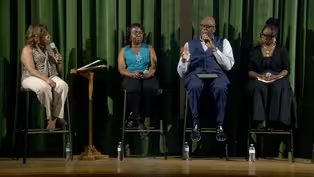
Panel of local agency leaders discuss the needs of older adults and their caregivers
Video has Closed Captions
Clip: S53 Ep39 | 12m 44s | The “Caring for Caregivers” event featured important conversations on helping older adults age well. (12m 44s)
Providing Support for PBS.org
Learn Moreabout PBS online sponsorship
- News and Public Affairs

Top journalists deliver compelling original analysis of the hour's headlines.

- News and Public Affairs

FRONTLINE is investigative journalism that questions, explains and changes our world.












Support for PBS provided by:
American Black Journal is a local public television program presented by Detroit PBS