
The 2021 Mackinac Policy Conference
Season 5 Episode 24 | 56m 45sVideo has Closed Captions
The 2021 Mackinac Policy Conference | Episode 524
Where does Michigan stand as a state at this point in the pandemic? The future of work is changing, not only how we work and where, but the priorities companies now have moving through the pandemic. A renewed focus on the inequities affecting communities of color during the pandemic and racial justice protests. All of this and more at the 2021 Mackinac Policy Conference. Episode 524
Problems playing video? | Closed Captioning Feedback
Problems playing video? | Closed Captioning Feedback
One Detroit is a local public television program presented by Detroit PBS
The 2021 Mackinac Policy Conference
Season 5 Episode 24 | 56m 45sVideo has Closed Captions
Where does Michigan stand as a state at this point in the pandemic? The future of work is changing, not only how we work and where, but the priorities companies now have moving through the pandemic. A renewed focus on the inequities affecting communities of color during the pandemic and racial justice protests. All of this and more at the 2021 Mackinac Policy Conference. Episode 524
Problems playing video? | Closed Captioning Feedback
How to Watch One Detroit
One Detroit is available to stream on pbs.org and the free PBS App, available on iPhone, Apple TV, Android TV, Android smartphones, Amazon Fire TV, Amazon Fire Tablet, Roku, Samsung Smart TV, and Vizio.
Providing Support for PBS.org
Learn Moreabout PBS online sponsorshipHi, I'm Christy McDonald's on Mackinac Island and here's, what's coming up this week on "One Detroit."
It's an hour special from the Detroit Regional Chambers Mackinac Policy Conference, where Michigan stands now, the biggest issues of community health, the future of work, and economic recovery.
You'll hear from state leaders in politics, business, and philanthropy.
It's all coming up on, "One Detroit."
ANNOUNCER: From Delta faucets, to BEHR paint, Masco corporation is proud to deliver products that enhance the way consumers all over the world experience and enjoy their living spaces.
Masco, serving Michigan communities since 1929.
ANNOUNCER: Support for this program provided by: The Cynthia & Edsel Ford Fund for Journalism at Detroit Public TV; The Kresge Foundation; Community Foundation For Southeast Michigan.
ANNOUNCER: The DTE Foundation is a proud sponsor of Detroit Public TV among the state's largest foundations committed to Michigan-focused giving.
We support organizations that are doing exceptional work in our state.
Visit DTEFoundation.com to learn more.
ANNOUNCER: Business Leaders For Michigan dedicated to making Michigan a top-10 state for jobs, personal income, and a healthy economy.
Also brought to you by, and viewers like you.
(light music) Hi there and welcome to, "One Detroit."
I'm Christy McDonald from the parlor of the Grand Hotel at the Mackinac Policy Conference.
It is good to be back for the yearly gathering of state, political, and business leaders.
This is the first conference since the spring of 2019 that we are face-to-face because of the pandemic.
There are safety precautions in place, a lot of the events were held outside.
There are fewer people here this year and there are mandatory vaccinations.
All of that has set the stage for conversations about moving our state into recovery from COVID, and beyond.
Coming up on this special one hour, "One Detroit" from Mackinac you'll hear from Governor Gretchen Whitmer, also business leaders on the future of work and diversity and inclusion, plus Walgreen's CEO, Roz Brewer, Detroit Mayor Mike Duggan, and a look at K-12 education.
We'll also have conversations on improving community health and I'll check in with our "One Detroit" contributors for analysis, Nolan Finley, and Stephen Henderson.
But first here is where we stand as a state right now.
Michigan 2021, this fall we find ourselves negotiating a new phase of the pandemic while tackling population loss, productivity, the future of work, education, and public health, with politics among it all.
As we look to this new COVID relief bill, there are gonna be so many resources and the work we do in the next couple of months is gonna set the tone for our ultimate economic resurgence and success.
CHRISTY: Governor Gretchen Whitmer, three years into the job, working with a Republican-majority legislature and butting heads on spending and executive powers coming out of the pandemic.
The $2 billion in COVID relief money, from the feds, could make a difference in shoring up Michigan's economic recovery.
The unemployment rate in Michigan is slightly lower compared to the U.S. average, but businesses are struggling to fill jobs.
I think we're kind of in the top 15, top 10, in terms of our economic performance, compared to most of the nation, primarily thanks to the strength of the manufacturing sector globally.
But at the same time, employers can't find employees.
There was a talent shortage before COVID began and it has only been exacerbated since.
CHRISTY: The pandemic has also changed the way we work.
The Delta variant postponed many back to the office plans this fall.
Auto companies idling plants due to parts shortages, parents searching for childcare and getting back to the workforce.
We've seen women who've had to actually voluntarily leave jobs, and then we've seen other women just really struggling to hang on and so I don't even think the pace of job loss, and job leaving for women, is over.
CHRISTY: Education is a key factor in training Michigan's workforce for the future, but pandemic schooling has been difficult for students.
I also like learning better when I'm around people that are also learning with me, which are other students, and also the teachers teaching me.
What has pandemic schooling in Michigan this past year shown us about education?
AMBER: Yeah, I mean one, I think it's shown us like how critical in-person learning and teachers are, there's really no substitute.
And I think for so many kids who have lost so much learning because they weren't in school, they just didn't have that option.
It really underscores how critical public education is for us as a society.
CHRISTY: State test scores are lower.
A growing number of teachers are leaving the profession and districts have to decide how to distribute funding for more counseling, literacy, and family support to address the learning loss from last year.
I feel like for at least two years, we have equitable amount of resources to address some of the wrap-around challenges that we have with our students and families.
CHRISTY: In the city of Detroit, Mike Duggan is heading to a probable third term as mayor.
The city lost population in the latest census, but there are large development projects still moving forward.
The Stellantis Mack Avenue plant and a new Amazon Distribution Center.
More work needs to be done to bridge the gap and economic opportunity for the city's residents.
The only jobs that have been growing in Detroit are low-wage jobs, for jobs in Detroit.
The jobs in the region are middle-wage jobs.
Now, you could say, well, a low-wage job is better than no job, but if those are the only jobs that are growing, right, then that's gonna be problematic for everyone.
CHRISTY: Job training programs, especially in skilled trades, are trying to attract the next generation workforce.
We're here- (saw motor whirring) To introduce them to carpentry so they can touch it, feel it, do it, make the mistakes on it, make sure they understand that it's not life-ending if they do make a mistake and how to fix it.
CHRISTY: In Detroit, and across the state, people are demanding more investment into aging infrastructure.
The summer storms and historic rain taking a toll on homeowners multiple times.
The infrastructure in this country was built for the climate of the 20th century, it worked well for a long time.
Eight to 10 inches of water in your basement, it don't makes sense.
CHRISTY: Our community health more important than ever.
COVID exposed disparities in healthcare access and information and communities continue to be at odds over mask and vaccine mandates.
That friction spills into the politics of getting things done.
Democrats are looking to push back against proposed election bills putting emphasis on voter ID requirements.
The Independent Citizens Redistricting Commission is working on redrawing the legislative maps across the state and we head toward an election year.
All right, and say hello to our "One Detroit" contributors.
Nolan Finley, the Editorial Page Editor of the "Detroit News," Stephen Henderson from "American Black Journal," and this is the first time that we have seen each other in-person in a while and I think that's- It's been a long time.
That's the feeling right here on Mackinac, right?
(laughing) Right, right.
Sort of the point, I guess, of this and the reason they worked so hard to put it together during this pandemic is at some point you got to regain some semblance of normal, or you gotta start bringing people back together to collaborate and have those sort of sessions where you work things through, and it's good to be back here.
Yeah, the importance of connection, Stephen, and really maybe starting to have some of the face-to-face conversations about the important decisions that are being made across the state of Michigan.
Yeah, I mean, that's always been the value of Mackinac, and maybe the sole value of Mackinac is that you get everybody from all different parts of the state together to be able to talk about our problems and in an intense way, I mean, three or four days straight.
And if you think of, I mean, the conference always gets questioned about, well, what really gets done on Mackinac, but you can tick off all kinds of things that we've seen actually happen here.
The bridge to Canada got cemented up here.
The grand bargain that helped Detroit out of the bankruptcy happened up here.
You can't do that by telephone, or by internet, face-to-face is how things really go together.
And keeping General Motors headquarters in Detroit.
That happened, yep.
That happened one year.
But we do have a lot of issues to work through and a lot of serious problems facing the state, serious concerns and we've got a ton of money flowing through Michigan.
That's right.
And one-time money that, we have to figure out the smartest way to spend that, the best use for that before it's just gone.
I mean, you'd think, well, it's not easy to fritter away $11 billion, but it can happen.
And restarting the economy, getting things, getting the workforce back to the place we need to grow in the years to come, these are all critical issues facing our state and they're all sort of on the agenda here.
Yeah, they are working on the budget in Lansing.
So Stephen, what are some of the conversations that you're having about some of the biggest issues up here that people are saying, all right, this is what we're gonna have to focus with Michigan moving through the pandemic.
Yeah, well, I mean, you know, this question of business restarting and getting the workers it needs to be able to do well and continues the growth that we were seeing before I think is one of the things that we'll hear a lot about up here.
I'm anxious to hear also from Mayor Mike Duggan who has always made Mackinac kind of a center stage for big ideas.
He's got an election in a few months that hasn't gotten a lot of attention.
We haven't heard very much from the mayor in recent months.
I expect that here he will talk about the city's future after the pandemic.
He'll also talk about, he's gonna spend this $800 million that's coming as part of, as part of the stimulus.
I had a conversation earlier with Lieutenant Governor Garlin Gilchrist, who is talking a little about auto insurance reform and the things that haven't happened.
The rates haven't gone down as much as we anticipated and the- That was done in Mackinac in 2019.
That's right, that was the most recent Mackinac Yeah.
Where that got hammered out.
It hasn't turned out the way people expected and on both sides, in terms of insurance rates themselves, and the reimbursement rates for caregivers in critical care situations, we have real problems.
They may have to go back into that law and change it again.
Nolan.
And governors have worked this conference in different ways over the years.
It will be interesting to see how Governor Gretchen Whitmer will play here, given she's got a, what could be a tough reelection year coming up in 2022.
And some governors have had a real big presence on the island, some have just sort of passed through.
There was a time Jennifer Granholm skipped the conference, so we'll be watching that.
A lot of also philanthropy here on the island and we've really seen how nonprofits and philanthropy have changed a bit of the trajectory of the city of Detroit, and the state as a whole, and moved into funding certain areas that government usually would have.
And so what are some of the conversations that you're hearing, Nolan, about that and shoring up some of the things?
Well, one conversation I hope I hear this week, is are we paying attention to what's happened in Detroit during this pandemic, because the downtown, downtown Detroit, which was on a very steep arc upward, before the pandemic hit, now looks like 1999.
You go downtown on a weeknight, at least, and kids are skateboarding in the street down Woodward again, and so we gotta figure out, and we have to have a conversation here, what we're gonna do with the future of downtown, as well as the neighborhoods with people working from home, those office buildings empty, there's not much commerce downtown, or not as much as you need to see and, you know, 18, 19 months into this, we've gotta start talking about, hey, if this is gonna be the way things are longterm how are we gonna get that Detroit Renaissance kicked back again?
Yeah, Stephen, you get the last word.
Yeah, I think the Detroit question is critical and that's one I hope to hear a little from Mike Duggan about, is what do we do?
How do we get back to that place we were before the pandemic now that people are just not gonna go back to work the way they were before?
All right, Stephen Henderson, Nolan Finley, stay with me, we'll get back to you a little bit later on in the show.
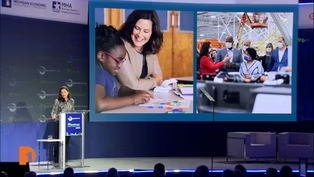
But Governor Gretchen Whitmer spoke on Wednesday of this week, addressing the needs of the state from education, and infrastructure, to building the workforce.
I'm really proud of what we've accomplished over the last couple of years, especially in all the circumstances we've been navigating.
Since I last took this stage, a lot has happened.
We partnered to grow over 15,000 auto jobs, we created the Michigan Reconnect, and the Futures for Frontliners, putting over 160,000 Michiganders on a tuition-free path to higher education and skills training.
We're working to solve the chip crisis by helping to open a new chip maker in Bay City, creating 150 jobs and bringing the supply chain from China to Michigan.
We made the largest education investment in Michigan history, $17 billion, without raising taxes to meet the decades-long goal, to close that funding gap between public schools and Michigan.
Four of my predecessors worked on it and we got it done in this environment.
Over 260,000 more people have healthcare in Michigan too, and we made a $3 1/2 billon investment in our roads through the, Rebuilding Michigan, bonding plan.
That's orange barrels, that is new roads, and that is 45,000 jobs.
We got a lot done, but there's no question we still face structural challenges that are big.
We need workers to fill open jobs, we need to cultivate, retain, and lure talent in Michigan.
There are too many jobs that don't pay enough and there aren't enough Michiganders with the training, or education, to fill high-skilled jobs.
We need to do more in terms of entrepreneurship in Michigan.
In the MEDC we've got a phenomenal new leader, but we need tools in the toolbox to compete on a global level and boost our speed to market.
We also know that housing is unattainable, or unaffordable, in many communities across Michigan.
Too many communities are struggling to attract families to build their lives, or businesses, to fill their Main Streets.
That's why we all need to tackle these big structural challenges by growing Michigan's economy, creating good paying jobs, and building industries of the future.
Together let's harness our potential to usher in a new era of prosperity for the state that we all love.
Now recently we unveiled the MI New Economy plan.
I love being able to say MI New Economy, it's not mine though, it's all of ours.
This is a $2.1 billion proposal to grow our middle-class, to support our small businesses, and to invest in our communities.
And I wanna thank you.
I want to thank the Chamber and so many of the members here for your input on this plan.
Your perspectives and insights helped us prioritize and put this bold proposal together.
The plan addresses many of the economic challenges that we face with strategic investments in people, in place, and building prosperity.
The MI New Economy plan is an important start.
I wanna work with you, I wanna work with the legislature, and anyone else who wants to work to empower Michigan's families, communities, and small businesses.
We have an incredible opportunity right now.
The future of work is changing, not only how we work and where, but the priorities companies now have moving through the pandemic.
Ryan Maibach, the CEO of Barton Malow, Sandy Pierce, Chair of Michigan Huntington Bank, and Wright Lassiter III, CEO of the Henry Ford Health System, talk about the changes.
We have about 38% of our colleagues actually work in the branches and we closed the lobbies at the very beginning of the pandemic for 60 days, but we kept the drive-throughs open.
Then after 60 days, even the lobbies were open.
And they had to work in the physical locations.
Everyone else, just about everyone else, went remote literally within one week of the shelter at home.
And so it's been challenging because it's sort of created this, you know, that's not fair.
Why do I have to go in to the physical location and everyone else gets to work from their home environment?
So we've had to deal with that and then as we are, you know, we've prepared our workspaces so that they're safe, but it's very, we don't wanna bring people back to the physical environment until they feel safe.
And right now we have the Delta variant, so we're being very careful, but we wanna keep our branches open and so that has been mentally challenging for our colleagues.
A very significant percentage of our workforce is out in the field, out on projects, and we had tapped it a phrase, you can't build buildings from home, through the course of the pandemic.
And so many of those individuals are working in difficult conditions already, typically out in the elements, and then you add in this psychological piece where, hey, we're out here doing this, and there's a number of colleagues that are sitting at home in potentially more comfortable surroundings.
And so we attempted at every possible time that we communicated as a company, just to express gratitude for that, and just to reinforce that as well, even though there was a perception that working from home might be preferred to them showing up in-person, being aware that a lot of folks that were working from home weren't necessarily always working in idealistic conditions as well.
Many had to overcome technology challenges, childcare challenges, so certainly through the initial stages of COVID, trying to figure out how to make your workplace function was really a challenge for everybody.
Well, and no more so than for you, because you have to have people at work because this is when we needed you most, but you also had to keep your workforce safe, how did you navigate?
You know, so for us, people think in healthcare, well, maybe 100% of your team is completely on the frontline, you know, the short answer is, frankly probably 75% of our workforce are either on the frontline, or directly supporting the frontline, so those individuals didn't have an option to not work directly in our places of work.
But about 25% of our team worked in corporate offices, work in IT shops, work in other settings, finance shops, et cetera, and so I would say that probably healthcare, pre-pandemic, probably was not as far along as other industries in terms of thinking about virtual work and so it was a bit of a challenge for us.
And there were a few areas that we were moving towards virtual before the pandemic, call centers, some of our revenue collection functions, but most of the rest, they were focused on being in the office.
And so we moved those folks pretty quickly in late March of last year, like most businesses did to a virtual setting.
And I would say that our team members experienced the same emotions that you see in other workplaces.
In some cases they felt guilty because they knew we have nurses, doctors, medical assistants, et cetera, that have no choice, in other cases they felt disintegrated and sort of detached from what we do.
Give me your takeaways about how this has changed the culture and the environment of where you work.
We're really paying attention to the culture within our company, and then how our customers are changing their behaviors, because that affects our culture and pre-pandemic, I would say that maybe our branch traffic declined 3% a year, post-pandemic, 30% decline.
So people are opening up their accounts online, but that's really difficult to deepen those relationships when you're not sitting across from each other.
And so from a culture standpoint we're all about looking out for people and taking care of people, whatever stage they're are in their lives, and we're really proud of that, it's harder to do digitally.
And so, as Jay said earlier, we're putting a lot of money into digital investment, but we've gotta figure out is how do we keep that personal connection, internally with each other, if we're hybrid, or remote, and externally with our customers, it's really, that's to me the challenge that we're facing.
The chapter on how COVID has impacted business is far from over and I think there's quite a bit more that that will be written.
I'm a generally optimistic person, I am a firm believer in the power of human potential, and the remarkable ability that we as people have to be adaptable and I think we've seen that over the course of the last 18 months.
I think it's encouraging that in many ways, in many businesses, metrics indicate to a higher level of engagement than there's ever really been in the past.
And so I think that there, despite the tremendous impact, negative impact, that COVID has had on so many lives, I believe in mass, in total, as business, we will be in a better place.
I think the work-life balance of people, our team members, will be improved as a result of a lot of the tools and the new ways of working that we've learned through this.
And I think that business five years, 10 years, whenever we move into more of a steady state, we will be far better as a society as a result of what we've experienced.
There was a renewed focus on the inequities affecting communities of color during the pandemic and racial justice protests.
As a result, businesses are working to better promote diversity, equity, and inclusion.
Matt Elliot, from Bank of America, Carla Walker-Miller, of Walker-Miller Energy Services, and Hussein Berry, of Delta Airlines, talked about racial equity in the workplace.
When the George Floyd incident happened, we had to take a deep look, it was an inflection point for us, as it is for many companies out there, right, you had mentioned that companies are doing and saying all the right things right now.
I think the biggest thing for us was to be transparent, to kind of live it, and understand it, understand what uncomfortable conversations were like.
I mean before the George Floyd came to light, before the whole pandemic thing came to light, we were already introducing things like uncomfortable conversations, and being open, and talk about things that have been taboo, like politics, and sexual orientation and whatnot, but the level of looking at our component of diversity and looking within our diversity lineup, and where the opportunities are, have been eye-opening for all of us.
And it's been eye-opening from the top all the way through the entire organization.
So, you know, to list out everything that we're doing, there's a lot going on, but I think the most important thing is that we're open and transparent and we're being bold about it, and, you know, not to insinuate anybody's being obsessive over watching Delta in the media, but Ed has put himself out there, right, on the pandemic front, on the racial injustice front, and the most recent thing that you can probably say while in terms of his participation in this world, is the voting rights in Georgia and the position we took from that standpoint.
So, I think it's important for us, not that we're experts in politics by any stretch, but it's been really important for us to represent our customers, represent our employees, represent the community in all the right ways, and so the work just started, there's a long way to go by any stretch, but I couldn't be more proud of Delta and all the work we're doing, especially coming from a diverse background myself.
The first thing for us is that diversity, equity, and inclusion, is part of our business strategy.
We really feel like in order to be a great organization we have to be a great place to work, and part of that means you can bring your whole self to work, you know.
And so we really started in doing more listening.
We have a concept called, Courageous Conversations, and we were able to have more, and still do have more than we ever did before.
Because when you get a chance to hear somebody's lived experience then it's real for you to, you know, then nobody's a label, their experiences is part of you as well and that's been a key part of our strategy is to drive that out and make sure that we're listening first and that people are heard, that's internal.
And then external we realized that there are these systemic barriers to economic mobility.
So we came up with what was that a $1 billion, now, $1.2 billion commitment, to driving out, and improving and breaking down some of these barriers to economic mobility in communities of color.
So we think about health, we think about small business, we think about jobs, and these sorts of things really help us we think drive over a period of time some catalytic change.
So the idea is that we make an investment here, that attracts more money, and then the thing starts to build on itself.
So, to put it specifically in Detroit, an example would be our investment in First Independence Bank.
So we make an equity investment, and a large deposit in First Independence Bank that helps Ken Kelly and his team further their mission.
So, we're making lots of investments like that all over the country and of course, Tiffany Douglas and I we're doing our best to bring that money here to Detroit.
Hopefully we get more than our fair share, but those are two of the basic things that we're doing.
But I think it's really critical for all of us as leaders, and all of us as people, to really be clear on our why, and, you know, diversity and inclusion is a big part of how we run the company and it starts at the top, our CEO, Chairs, our Diversity and Inclusion Council.
So, it's something that we're held accountable for and we all believe in.
I am blessed to have gotten a couple of calls about being on publicly-traded, or private company boards.
And one of the things I'll say about the women who are not getting those calls is everyone who wants diversity, if you want a woman, a black woman in particular on your board, you would have one.
And the only thing missing is the wheel.
The business case has been made over and over, the business case was actually made decades ago.
So if you don't have one, or two, or three, because it should be a percentage of your board, then you really should be looking at each other as C-suite executives, and as board members, because you are not getting the best, or giving the best value to your shareholders because you're missing something.
The last thing I'll say is people act like finding a talented black woman is like finding a Siberian white tiger in Detroit.
(audience laughing) (audience clapping) If you want, you can ask anybody, there are probably 50, 100 black women here, and for white guys, for generations, the entry point has been that you were someone's roommate, or you played golf with someone, so why is it different for black women?
You should be talented, you should be capable, you should have integrity, you should be a good person, you should be smart as hell, and that describes a lot of people.
So, use the same rules- (audience clapping) For black women that you use for everyone else.
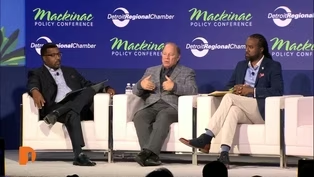
The Mackinac Policy Conference provides a platform for Detroit Mayor, Mike Duggan, to talk about improvements in the city and give a preview of what's ahead.
This year was no different.
The mayor outlined the city's successes and challenges.
Really much of the first eight years I've been in office, we're talking about removing blight.
I came in and there were 40,000 abandoned homes.
People flew in from around the world and took pictures of the abandoned train station, our book building, our Cadillac Stamping Plant, and did ruin porn, we needed to get graffiti off the buildings.
Removing blight was what people wanted, that was the aspiration.
We're in a very different place now where we don't have to talk about removing blight, we can talk about building beauty.
You look at what Ford is doing to the Michigan Central Depot in the neighborhood, it's spectacular.
(audience clapping) That Cadillac Stamping Plant was an abandoned hall at Connor and Gratiot for 40 years and now North Point is building the new Lear Seating Facility that's gonna support the GM plant when they build the electric vehicles that Mark Rice was here talking about a little while ago.
Dan Gilbert took a 30-year abandoned book building and is turning it into a 38 story, absolute building of beauty.
The Illiches just took the long abandoned Eddystone and opened them as housing.
and as you go into neighborhoods, it's not enough to talk about, hey, let's get the plywood down, let's build some streetscapes that you can be proud of, when we redesigned that Livernois stretch, we didn't just pave it, we put in streetscapes, we widened the sidewalks, we had lots of committee meetings, and the neighbors voted that this is what they wanted.
In the last two years, 22 new African-American owned companies, have opened up on that stretch.
Yes.
And it is now one of the most vibrant commercial districts.
(audience clapping) Was that deliberate, it seemed like- Oh yeah.
It was deliberate that that a lot of minority, and women-owned businesses there.
It was, two things happen, one was it was deliberate that we said right now Detroiters are going to downtown Royal Oak, downtown Birmingham, you wanna have that shopping experience, those are great shopping experiences in the suburbs, even Ferndale has come back to a really good commercial district, but Detroiters didn't have that experience so we set out to do that.
Then you pair it with something like, Motor City Match, which provides startup money to folks who have a lot of talent and drive, but don't have family access to money, and you put those two things together, a rebuilt district with access to financing, and it's just remarkable to see what the entrepreneurs in this community are doing.
And we're replicating it on McNichols, we're replicating it on Kercheval, we're replicating it on Grand River, and Antoine's gonna replicate it across the rest of the city.
(audience laughing) (audience clapping) So Antoine is that how we leverage what we have on the avenue of fashion and leverage it to make it even better in other areas of the city?
Yeah, we've had some tremendous successes that we already are seeing across the trade, as the Mayor just numerated, and we have the opportunity here to really listen and engage our residents to be able to drive that initiative forward.
One of the reasons why I was so excited about this, and I believe why the Mayor chose me, is because my focus has always been on community engagement.
I've been in this position, around eight weeks now, and for every single week what I've been doing is walking, and driving, and talking to residents all across the city.
Cities across the country experiencing significant infrastructure challenges, what's the plan to rebuild Detroit's infrastructure and how are we gonna pay for it?
Well, there's so many different pieces, if you'd asked this question a year ago people would've talked about roads.
In the city of Detroit today people are thinking about stormwater capacity and it shows you how fast things can change and anybody who doubts climate change has not been around here this summer.
But, you know, we've got a stormwater system that was built in the 20th century and served the city and the region extremely well.
It basically can handle a three inch rainstorm in 24 hours, which happens about once every 50 years or so, and beyond that you have a problem.
In 2016, we had a storm that was 4 1/2 inches, we had 20,000 people's basements flooded.
That was a once in 500-year storm.
June, we didn't have a 4 1/2 inch storm, we had a six inch storm, and we're starting to say, the assumptions that have been made, in building the infrastructure in this country, need to be reassessed.
And of course you see it on the East Coast in the way they're rebuilding after hurricanes, they build back very differently.
You look on the West Coast and what they're doing to protect against fires.
And so we are very fortunate and Gary Brown, who runs the Detroit Water and Sewer Department, is emerging as a national leader.
And our problem primarily is this, we've got, when this rain overwhelms our system, we have low-lying areas on the far east side, and the west side along the Dearborn border, those of you who live in Grosse Pointe and Dearborn, know you are in those low-lying areas as well and it's gonna take a few years to build the capacity.
And so I sit down with Gary Brown and say, okay, I'm not gonna say to people for the next three years, every time we get a rainstorm, more than four inches, "You can't use your basement, you've lost everything."
And so you'll see us roll out a plan in the coming months to protect those basements with so-called check valves that will block that storm drain from backing up on you and already Gary's got his team figuring out how to put in design capacity in the areas that are most effected.
COVID also changed the face of education.
Schools turned to virtual learning to keep students safe and now that in-person classes have resumed the focus is on improving academic progress and preparing K-12 students for success in higher education.
Emerging from the pandemic, there are a few lessons that we have to take with us.
One of them is symbiosis, that we are all interconnected, and we saw that through COVID.
If I am sick, you are sick, and if you thrive, I thrive.
And so the systems that are in place are actually what have never been built for black and brown children, whether it's economic systems, or education systems, and so while a child might be able to navigate a broken system, it isn't because they themselves are exceptional, it is because the opportunity gap, not the achievement gap, the opportunity gap, has been closed for them, right?
And so this is a moment where we need to realize the exquisite design of racism is everywhere.
And so we have to look with a laser focus on all of these systems right now, not on race-agnostic policies, but really on anti-racist policies so that we don't feel like only the exceptional make it through, but the systems are actually there to serve black and brown children, especially in the city of Detroit, and are built around them.
And that's why I'm so excited to have these partners on the stage, because they're so thoughtful in creating these approaches.
I believe there's this huge opportunity for employers to be part of the solution.
And we are so fortunate in Detroit to have, you know, groups of employers, like the Mayor's Workforce Development Board, and Business Leaders of Michigan, and the CEO Roundtable, and we are able to engage employers directly about what they need so that when we talk about, post-secondary success, and we start to back that up into what does that mean for K-12 solutions, we're able to pull back, or pull forward, or however you wanna think about it, what employers are going to need, what they know they need, what we project they might need.
Getting that into the conversation early and often, is going to be one of the key elements of any solution we design.
The first thing to do is what most of us in this room did when we were young thinking about college, is start a college-going culture.
The reality is you have to think about yourself in college from an early age, and almost have an expectation about that for yourself.
And if you don't have that, you're trying to build a college-going culture while you start.
So it's engaging high schools, mostly through dual enrollment, or early college programs, where high school students can go to their local community college and for the state allotment that the state gives that school district, for that student to have a high school experience, they can take that money and go to the local community college and earn a college credit, and start to get a college-going culture.
And we're proud that over 2,200 students on our campus now, whether virtual, or on ground, are from high schools.
But the truth is we have to convince the business community that this is an imperative 60 x 30.
It's rare we have a political agreement on this, but the reason why we have this rare opportunity is because we look around the country and people with more college credentials have more income and every single societal issue after that is better.
We have to also take accountability in higher education like the, about K-12 too many people say, well it's K-12, isn't achieving.
We created a College of Urban Education about seven years ago, but we did it quite differently, a master's degree, and we changed it with diversity inclusion in the curriculum, data analytics in the curriculum, weekly coaching, and there've been double-digit increases in teacher effectiveness.
And in fact students did better in math and reading than the rest of the school district.
And so we're creating an undergraduate of Urban Education and it's gonna be a STEM undergraduate, starts next fall, in science, and math, and technology, and this weekly coaching.
There'll be, like the nursing model, there'll be into the K-12 schools immediately and learning.
Right.
And so when they get to us, and that was your original question, many of them are first-generation students.
And so we have about 30% of our students are students of color, 40% are first-generation, and we've been doing peer mentoring and we found that the students who come to us, who don't use peer mentoring, retain at a 69%, but the ones who come to us and do peer mentoring, first-generation students, retain at 91%, and they don't have the guidance they're smart, and these students are smart in the school systems, but we have to dramatically change how we prepare teachers.
And, you know, it's easy, we have to be more accountable in higher education.
So much of success in college starts so much earlier.
Right.
And so it has to do with kindergarten readiness, and third grade reading levels, it has to do with afterschool programming, which is so critical in terms of thinking beyond the world around you.
And so there are these mile markers that are nationally recognized that lead to being able to, once you get into college, have success.
But I would also say that there are other things that are beyond those mile markers and at Skillman Foundation some of the things that we've been investing in are systemic hacks, like principals.
Principals are change agents within the school community, they're often overburdened and under-resourced.
And so, you know, Leadership Detroit is a program that's part of the Chamber.
I would posit that every leadership development program should have principals as part of it because they manage this ecosystem that's extremely complicated.
Another systemic hack is having black teachers, and there have been researchers from John Hopkins, that have found that a child, a black child that is exposed to a black teacher is much more likely, 13% more likely, to go onto college and graduate.
A black child that is exposed to two or more teachers, is 32% more likely to go onto college and graduate.
So there are things that are beyond just building supports to get through a system that again is a broken system that isn't meant for our children, but those are some places where we can invest.
The pandemic has pushed the importance of community health to the front of our priority list.
The pandemic show disparities in care and in access.
Roz Brewer, the CEO of Walgreens Boots Alliance, who also grew up in Detroit, talked with me about the role companies are playing to increase community health.
Our pharmacists have played a phenomenal role in vaccine executions.
You know, they have been right on the front line of delivering the immunization when someone looks back at them and says to them, "I think you just saved my life."
Early on during the pandemic when people were so worried, and so unaware, and access appeared to be so limited, you needed a company like Walgreens that had 9100 locations in the United States where we were capable of delivering 20 million vaccines to medically underserved communities in the United States.
That's pretty impressive, we were very deliberate about that.
We said we are going to bring it to you if you can't get to it yourself.
We went into, we worked with the black interfaith communities and developed clinic centers in churches, in communities where people are immobile.
We worked with our partners at Uber, if you didn't have transportation, to get to one of our immunization sites.
And so we actually went all-in on vaccine equity because we knew that was a game changer because I know we're 18 months into this, and sometimes we forget, but if you recall, this was impacting the black and Hispanic communities much greater in the beginning, and they were the most immune compromised.
So we went after that because we knew our customers needed us the most.
And so we'd been very deliberate about that.
We've delivered now over 30 million vaccines total and continue to do so right now as the plans are adjusting and we're going into third dose and boosters.
How has the pandemic changed the way WBA is dealing with employees in terms of flexible employment, and different kinds of hours and meeting people where they are and is that going to stay?
You know, for us, we're planning for it to stay.
We've been doing work, studying the future of work, not really so much because of the pandemic, we would've done this anyway because the work environment is changing every day.
And so for us the real answer is flexibility.
So I'm sitting now in the Chicago office, just north of Chicago in Deerfield, Illinois, and our plans are to be flexible and have people come back to work based on when it's best for them and the way that they need to come back to work.
So we'll have a flexible work arrangement, it's in our plans.
Right now we're working towards making sure that everyone is vaccinated before they come back into the office and we are a healthcare company and we believe in science, and we believe in the data, and so with that respect we're asking everybody to be vaccinated as well.
I also spoke with Dr. Paul Elam, who is the Chief Strategy Officer at the Michigan Public Health Institute.
MPHI is a nonprofit working to bridge the gap in health information and education.
We believe in trying to get upstream and understand where some of the underlying issues are that drive inequities, particularly public health inequities.
And so we focus on the social determinants of health, right, where people live, what policies might be contributing to a lack of access to food, insecurities, homelessness, housing issues, and what we found early on in this particular pandemic, when you think about the epicenter of the communities that were impacted most, they were definitely in Southeast Michigan with the exception of prisons and jails in a particular zip code area.
And so we tried to go in and talk to youth in the Cody Rouge area, for example, to find out what some of the concerns that they have and while we might be privileged to socially distance in our homes, some communities are not able to do that, right?
They live in homes where they don't have separate bedrooms, they're not connected to wifi.
And we've noticed that during the pandemic violence has gone up, lack of access to education has gone up, social isolation has gone up in some of these communities, that we're concerned with.
And so I don't think there's a one size fits all experience trying to manage our response to COVID-19.
Let's bring back in our "One Detroit" contributors, Nolan Finley of the "Detroit News," Stephen Henderson of "American Black Journal."
What a week it's been.
I feel like this is just our kind of entree into these large discussions.
Next May Mackinac will probably be back at full strength, but Nolan what was your sense from this week and from a lot of the conversations that you ended up having?
Well, it was a much smaller conference and I think the emphasis this year was just having a conference, and getting a foothold again.
It's been 28 months since the Chambers put this on and so you think of this as a warmup for a full conference next year.
I don't know what the official attendance was, but it didn't seem like very many people were here.
No politicians really were here, not a whole lot of CEO's, so it was a whole different dynamic, but I think everybody agreed that it was important to have it and to get back into somewhat of a normal routine.
Yeah, I mean I'd argue I think you could have some more substantive conversations here because the people- Sure.
Weren't pivoting and looking for who the next person was coming through the room.
Yeah.
I think also to share a lot of the ideas that people are working on when it comes to economic development, the future of work, and looking at K-12 too Stephen.
Yeah, I mean, we're starting to, I think, see real planning for the city of Detroit, the region, and the state, after the pandemic.
What is this all going to look like, how is it all gonna operate, everything from work, and who's working, and where, to the status of the infrastructure to support work in places like downtown Detroit, all these office buildings that are empty, the infrastructure is crumbling beneath us.
I think there was a real emphasis this week on thinking about that future, which we all hope of course is just around the corner, but we don't know.
Yeah, I heard a lot of spending of the money coming from Washington, where that's going to go.
Right.
And a lot of nonprofits who are going to end up being partners with government in being able to give services to people.
Well, Michigan's never had this much money, sitting on a pile of money that's bigger than the annual general fund budget.
And so trying to figure out in a hurry, what's the best way to spend that money so that five years and up from now you're not sitting here thinking, oh wow, we spent all this money and there's nothing to show for it.
So I think there's not much time to plan, the money's here and they gotta figure it out.
I think there was a lot of that going on.
The Governor announced her, MI Economy Plan, MI New Economy Plan, while she was on the island, and it's those kinds of discussions, we've gotta get this right, and we don't have a whole lot of time to do it so I think there was a lot of talk about that.
All right, let's talk a little bit of politics, or the lack thereof around here.
There's no politics here.
I know, so the congressional delegation wasn't here and a lot of our state legislators weren't, they're working on the budget actually in Lansing.
Yeah.
And then the Governor was here for about a day, a little bit of a different vibe here.
What would you say politically we should be looking forward to, Stephen, when we hit '22 and moving forward.
Well, we'll be in the middle of a pretty hot election cycle by then.
The Governor's race will be in full swing, you'll also have all of the new lines that the members of Congress and the state legislature have to figure out how to compete in.
I think it will be, it will be a very intense political Mackinac next year, it always is in election years.
But I guess I'm not all that surprised that this year was down.
I mean it was down for specific reasons, like people not coming, but it's also not an election year, this is an off year.
And we tend to do other things up here when there isn't some election barreling down on us.
But I never remember a time when there were no politicians here.
No members of Congress were here.
Yes.
The only, other than the Governor, the only politician I saw was Warren Evans.
Mike Duggan was here.
And Mike Duggan, of course.
Yeah.
But it's hard to talk policy when the policy makers aren't here and every year they have to work on a budget, every year there's something going on, but usually a fair number of 'em make time to come up here and talk with the business leaders, the community leaders.
So it was, I think a lot of it had to do with optics.
People don't wanna be seen up here on the porch, having little shrimps and cocktails, you know, in the midst of a pandemic, it's very sensitive for politicians.
You didn't have the university leaders here either.
No, they weren't here.
And that's unusual.
But moving forward, I guess, what do we take off the island now?
What are some of the conversations that you're going to expect to hear, Stephen, now in the next six months?
So, I mean, I thought this New Mi Economy, I think I'm saying that right.
Mi New Economy.
MI New Economy, I got it backwards, initiative by the Governor was really interesting.
This idea of moving hundreds of thousands of families from poverty to the middle class, that is an ambitious goal.
And I, you know, God bless for them coming up with that goal, but the practical ends of that I think are super, super complicated.
That is the hardest thing to do, as government, and it's hard to do in a state where we have as many poor families as we do, what is that gonna look like?
I'm really looking forward to seeing that.
30 seconds left, you got the last word, Nolan.
It's gotta be sustainable, anything they do with this $11 billion pile of money has to be sustainable.
Once the federal money drives up her program dovetails sort of with what Mike Devlin wants to do with the city's money.
Yeah.
So if they can figure out how to do this with one-time funds and not create an ongoing infrastructure, I think it'll be fine.
Yeah, and a once in a generation infusion of money that can really make some change.
All right, Stephen Henderson, Nolan Finley, it's good to see you guys I'll see you off the island- Back in Detroit.
In Detroit, that's right.
(Stephen chuckling) For the past 10 years, Tom Dalton, and the guys from Under the Radar Michigan, would come with us to the Policy Conference and always bring kind of a unique look at life on Mackinac Island.
So this year they decided to give us some of their best work, and when I say best, I really mean some of their best outtakes.
(upbeat rock music) I'm up here at the Mackinac Policy Conference doing some hard-hitting investigative reporting for, that's right, you.
Now there's a lot of things I wanted to say, and I forgot what they are.
I'm working hard bringing you the matters that matter here at the, I said, (chuckling).
Hi, can you help me, the Governor borrowed my bike and- (dog barking) (both laughing) You know, Christy, with all the incredible information and ideas that are being exchanged at this, yah.
Do you need a Michigan taster, 'cause I'm from Michigan (laughing).
Oh yeah.
So I understand you guys work harder than anybody else at this conference and you do it for virtually peanuts.
Oh, apples, okay.
I've always heard that the front porch on the Grand Hotel is the longest front porch in the world, well, I intend find out just how long.
Two, three, 264, wait a minute, no, darn it.
Boy, I didn't know they had hors d'oeuvres and wine here.
Excuse me, oh gosh, 300, oh!
522, oh wow, look, the bridge, oh!
Is it really the longest front porch in the world?
Well, it all depends on your criteria.
For a trendsetter, wood-framed vernacular hotel, that's open seasonally, it's the longest front porch.
We're 660 feet long.
You wanna know I have no life, here you go.
There's 100 rocking chairs out there.
there's 260 planting boxes, we just planted 1400 geraniums and there's seven tons of potting soil, how's that for Under the Radar.
If you're auditioning, I brought my spoons with me if you need any help.
(spoons rattling) I think we might have a place for you in the kitchen.
Tom Dalton, reporting live, from this year's Mackinac Policy Conference.
Ah, boy, not quite what I was expecting.
Wait a minute, that's it, ice cream, toasted pecans, and fudge sauce?
But I'm an investigative reporter, so there's no secret?
Mystery solved.
Oh, speaking of mysteries, what is that?
And that is gonna do it for us.
Make sure you head to OneDetroitPBS.org for all of the interviews and all of the sessions from the Policy Conference.
You'll be able to see them and share them A big thanks to our crew here on Mackinac Island.
We will see you back for "One Detroit" next week.
Until then, take care.
ANNOUNCER: You can find more at OneDetroitPBS.org, or subscribe to our social media channels and sign up for our "One Detroit" newsletter.
ANNOUNCER: from Delta faucets to Behr paint, Masco corporation is proud to deliver products that enhance the way consumers all over the world experience and enjoy their living spaces.
Masco, serving Michigan communities since 1929.
ANNOUNCER: Support for this program provided by the Cynthia & Edsel Ford Fund for Journalism at Detroit Public TV; The Kresge Foundation; Community Foundation for Southeast Michigan.
ANNOUNCER: The DTE Foundation is a proud sponsor of Detroit Public TV.
Among the state's largest foundations committed to Michigan-focused giving.
We support organizations that are doing exceptional work in our state.
Visit DTEFoundation.com to learn more.
ANNOUNCER: Business Leaders For Michigan, dedicated to making Michigan a top-10 state for jobs, personal income, and to help the economy, also brought to you by, and viewers like you.
(light upbeat music)
The Best Outtakes from Under The Radar at MPC 2021
Video has Closed Captions
Clip: S5 Ep24 | 2m 3s | Under The Radar shares their best outtakes from their coverage on Mackinac Island. (2m 3s)
Video has Closed Captions
Clip: S5 Ep24 | 6m 32s | With in-person education resuming, how will K-12 students best be served? (6m 32s)
Video has Closed Captions
Clip: S5 Ep24 | 4m 31s | Roz Brewer talks w/ Christy about addressing community health needs. (4m 31s)
Video has Closed Captions
Clip: S5 Ep24 | 12m 5s | Covid is changing how we work and where and also companies' priorities. (12m 5s)
Video has Closed Captions
Clip: S5 Ep24 | 3m 36s | Gov. Whitmer on what MI needs in education, infrastructure, and workforce. (3m 36s)
Video has Closed Captions
Clip: S5 Ep24 | 5m 31s | Detroit Mayor Mike Duggan shares the city's successes and challenges at MPC 2021. (5m 31s)
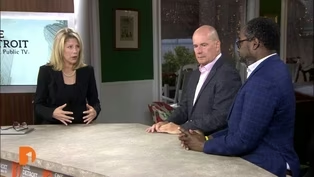
The One Detroit Team at Mackinac
Video has Closed Captions
Clip: S5 Ep24 | 5m 48s | Christy, Stephen, and Nolan catch up in-person at the Mackinac Policy Conference. (5m 48s)
Video has Closed Captions
Clip: S5 Ep24 | 5m 26s | The pandemic has highlighted racial inequities; businesses are working to confront them. (5m 26s)
Video has Closed Captions
Clip: S5 Ep24 | 4m 51s | One Detroit's Christy McDonald on where Michigan stands as a state right now. (4m 51s)
Providing Support for PBS.org
Learn Moreabout PBS online sponsorship
- News and Public Affairs

Top journalists deliver compelling original analysis of the hour's headlines.

- News and Public Affairs

FRONTLINE is investigative journalism that questions, explains and changes our world.












Support for PBS provided by:
One Detroit is a local public television program presented by Detroit PBS