
The 2023 National Black Men in Leadership Summit
Clip: Season 51 Episode 31 | 12m 3sVideo has Closed Captions
Preview the Michigan Diversity Council’s 2023 National Black Men in Leadership Summit.
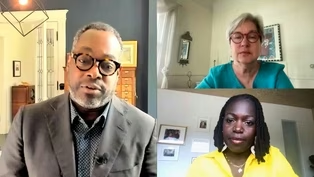
Michigan Diversity Council Executive Director Darlene King-Turner sits down with “American Black Journal” host Stephen Henderson to talk about the theme of this year’s annual National Black Men in Leadership Summit, 'The Legacy of Black Leadership and Excellence,' and the event's goal of uplifting Black males and providing them with opportunities for professional, personal and community growth.
Problems playing video? | Closed Captioning Feedback
Problems playing video? | Closed Captioning Feedback
American Black Journal is a local public television program presented by Detroit PBS
The 2023 National Black Men in Leadership Summit
Clip: Season 51 Episode 31 | 12m 3sVideo has Closed Captions
Michigan Diversity Council Executive Director Darlene King-Turner sits down with “American Black Journal” host Stephen Henderson to talk about the theme of this year’s annual National Black Men in Leadership Summit, 'The Legacy of Black Leadership and Excellence,' and the event's goal of uplifting Black males and providing them with opportunities for professional, personal and community growth.
Problems playing video? | Closed Captioning Feedback
How to Watch American Black Journal
American Black Journal is available to stream on pbs.org and the free PBS App, available on iPhone, Apple TV, Android TV, Android smartphones, Amazon Fire TV, Amazon Fire Tablet, Roku, Samsung Smart TV, and Vizio.
Providing Support for PBS.org
Learn Moreabout PBS online sponsorshipI'm your host, Stephen Henderson.
The Michigan Diversity Council is presenting its annual National Black Men in Leadership Summit this month at Huntington Place in Detroit.
This year's theme is the legacy of black leadership and excellence.
The event brings together black male professionals from a variety of industries and provides them with the knowledge and tools for professional, personal, and community growth.
I learned more about the summit from the organization's executive director, Darlene King Turner.
Tell us about this year's National Black Men in Leadership Summit.
The theme is "The Legacy of Black Leadership and Excellence."
Tell me what people will experience and learn if they can.
- Yeah, yeah, absolutely, thank you so much.
You know, our black men in leadership, this is our third year of having this summit, this year, due to the overwhelming request, it is going to be two days.
And our focus and our goal is to really help shed a light on the fact that when we think about black leaders in this country, they represent 3.2%.
And that is from a C-suite perspective, from a senior leadership perspective.
But when we think about CEOs that represent the black community in this country as a whole, for Fortune 500 companies, they represent less than 1%.
And so our goal is really to educate corporations and communities, whether you're for-profit or nonprofit, on the importance of black leadership, on the importance of diversity, equity, and inclusion, and the importance of belonging and the contributions that our community makes and has made and is making and will make in this country.
So often, black males have not been uplifted in the conversation about their contributions as philanthropists and fathers and coaches and leaders in this country.
And so our goal is to really be able to educate those on why is it important, what are their challenges and their struggles, for climbing the corporate and social ladder from that perspective or even becoming their own business owners and entrepreneurs in this country and having access to equity and the ability to be able to do so.
So that's the focus and the goal of our summit this year.
- Yeah, so, you know, during the pandemic, you saw a lot of corporations, you saw a lot of other institutions kind of acknowledge that diversity and inclusion and equity were not being served appropriately in those sectors, and they promised to do better.
Now we're three years later, I think a lot of us are looking around and saying, "Well, the rhetoric is better, "the narrative is better, but the outcomes, "we're still waiting to see that turn in a significant way."
And I wonder what it will, you know, what it will take, is it just patience, is it time, or do we still need these kind of fundamental changes in the way that other people see this issue to make sure that African-Americans, and particularly African-American men, get more opportunity?
- Yeah, you know that that's a great point because you're absolutely right.
You know, we didn't hear about equity in the way that we hear about it now until the murder of George Floyd in 2020 and the reckoning on race in this country as a whole, not just the United States, but globally, right?
There was an entire reckoning on race for people of color, not just black people, but Latinos and immigrants and migrants and so on and so forth.
And so when we think about, you know, the conversations around diversity, equity, and inclusion and belonging and how this shift needs to be made, and you're absolutely correct, there have been some shifts, right?
But when we think about the legacy and the history of this country in 400 years of oppression in this country around equity for whether that's black men, whether that's, you know, those that are native and indigenous and all the things that have happened and have been taken away from them, it is not going to happen overnight, right?
- Yeah.
- Because we have such a huge gap when it comes to equity in this country.
I will say that there have been some really amazing intentional efforts from some really huge organizations, even some really small organizations, right, around being intentional to shift those dynamics, being intentional about creating greater opportunities to access for capital and access for workforce development and just opportunities for growth and advancement.
And so I don't want people to think that it is not happening, because it is happening.
It may look as if it's not, but when you are dealing with something that has been taking place over hundreds and hundreds of years, it is not gonna change in the blink up an eye, right?
- Yeah.
It is going to take some time, it is gonna take some patience, but more or less, it's gonna take the collective of the whole, right, to say that we see this as an important and sustainable business case to the growth and the sustainability of our communities and our corporations as a whole to ensure that we have the voices internally to look like what our external clients and partners and communities actually look like.
- Yeah, yeah, you know, I think also the pressure on black men right now seems outsized compared to the time during the pandemic or before.
You know, and I'll go back to, you know, the election of Barack Obama as the first African American president.
I said, when that happened, that my fear was that we would pay this incredible price in backlash.
- Yeah.
- From people seeing a black man at that pinnacle point of leadership in our society and the fear that they would have about what that meant.
I think it's come true in a way that I wouldn't even have anticipated when I said it.
- Yeah, yeah, you're absolutely right.
It has come true, right?
And society saw it as, you know, President Barack Obama, you know, a black male has taken seat in the highest office in the land, so we're done, right?
You know, it's over, we need to do nothing else, right?
And that has been an enormous hurdle for black men in this country of saying, "Hey, he represents," you know, "He represented and still represents the community," but there is a community, right, of black men.
There is a community of black leaders and philanthropists, and they do it with a level of excellence because of the obstacles that they've had to overcome, that if they did not do it with a level of excellence, then they would not be in the positions that they're in.
And so how do we begin to remove the biases that exist and recognize that there are biases, right?
How do we move the micro and macroaggressions?
How do we remove the lack of opportunity and access to literally be able to create some equity?
Because equality is not equity.
And many people are confused with that concept that, you know, "It's equality and equity are the same thing."
And it's like, "No, they're far different from one another," right?
And so it still is about education and really looking at the business case and offering those opportunities and creating those resources to support our black men in this country for growth and for advancement.
- Yeah, yeah.
Tell me about some of the headline names.
- Yeah, we got some names.
- We got big ones?
- Yeah, we got some big ones, we do, we do.
So we have Dr. Eddie Glaude Jr. who is just, you know, a philanthropist, he's a philosopher, he's a CNN commentator, he's a professor, he is a huge leader in the black community and for the black voice and for black men.
And he is the epitome of when we talk about black excellence and leadership in this country and advocating for black men and black community, and we need that, right?
And so we are excited to have him open up our conference on Day 1, which is August the 17th at Huntington Place right here in downtown Detroit.
And then Day 2, I am so excited about him as well.
And it is Dr. Marvin Carr, and he is a native of Detroit, which many may not be aware of, but he is the director of the Equity Foundation for Walmart.
Walmart being one of the largest retailers in our country.
Dr. Carr is making some enormous strides in our community relative to returning citizens and ensuring that they have a second chance and an opportunity on Walmart Equity Foundation is supporting that and supporting communities of color and the advancement of young black men, not just starting at the corporate level, but moving back beyond college and moving into the grade school areas as well.
So we are really in for an amazing treat to learn exactly how can other corporations follow some of the footprints of Walmart because they have made some missteps along the way in history, past history, as we know, but they are trying to correct that as much as possible and to really learn what have they done and what are they doing.
And so people can really understand how to create equitable initiatives and programs to be able to support black men in black community.
That's not equality, right, from that perspective.
And so we are just really excited about both of our keynote speakers for these two days of learning and collaboration and networking and connectivity as we support black men across the country, not just here in Michigan, as a whole.
Brilliant Detroit’s citywide 2023 summer literacy program
Video has Closed Captions
Clip: S51 Ep31 | 10m 39s | Brilliant Detroit announces citywide summer literacy campaign to curb learning loss. (10m 39s)
Providing Support for PBS.org
Learn Moreabout PBS online sponsorship
- News and Public Affairs

Top journalists deliver compelling original analysis of the hour's headlines.

- News and Public Affairs

FRONTLINE is investigative journalism that questions, explains and changes our world.












Support for PBS provided by:
American Black Journal is a local public television program presented by Detroit PBS