
The Aftermath of Detroit's Historic Flooding
Season 5 Episode 4 | 26m 47sVideo has Closed Captions
The Aftermath of Detroit’s Historic Flooding/Getting Back Into Business
One Detroit’s Bill Kubota talked to flood victims and BridgeDetroit reporter/editor Olivia Lewis about the widespread water damage, tainted tap water and what can be done to fix the problem the next time heavy rains come. Detroit Regional Chamber CEO Sandy Baruah caught up with One Detroit contributor Nolan Finley to talk about the biggest issues facing local businesses.
Problems playing video? | Closed Captioning Feedback
Problems playing video? | Closed Captioning Feedback
One Detroit is a local public television program presented by Detroit PBS
The Aftermath of Detroit's Historic Flooding
Season 5 Episode 4 | 26m 47sVideo has Closed Captions
One Detroit’s Bill Kubota talked to flood victims and BridgeDetroit reporter/editor Olivia Lewis about the widespread water damage, tainted tap water and what can be done to fix the problem the next time heavy rains come. Detroit Regional Chamber CEO Sandy Baruah caught up with One Detroit contributor Nolan Finley to talk about the biggest issues facing local businesses.
Problems playing video? | Closed Captioning Feedback
How to Watch One Detroit
One Detroit is available to stream on pbs.org and the free PBS App, available on iPhone, Apple TV, Android TV, Android smartphones, Amazon Fire TV, Amazon Fire Tablet, Roku, Samsung Smart TV, and Vizio.
Providing Support for PBS.org
Learn Moreabout PBS online sponsorship- Hi, I'm Christy McDonald and here's what's coming up this week on "One Detroit".
The aftermath of flooding across Metro Detroit, what does this say about our infrastructure and improvements to the system?
Plus, Sandy Baruah with Nolan Finley on what businesses need to succeed post-COVID.
And former US Senator Carl Levin talks with Stephen Henderson about his new memoir.
It's all ahead this week, on "One Detroit".
- [Announcer] From Delta faucets to Behr paint, Masco Corporation is proud to deliver products that enhance the way consumers all over the world experience and enjoy their living spaces.
Masco, serving Michigan communities since 1929.
- [Announcer] Support for this program provided by The Cynthia & Edsel Ford Fund for Journalism at Detroit Public TV, The Kresge Foundation, Community Foundation for Southeast Michigan.
- [Announcer] The DTE Foundation is a proud sponsor of Detroit Public TV, among the states largest foundations, committed to Michigan-focused giving.
We support organizations that are doing exceptional work in our state.
Visit DTEFoundation.com to learn more.
- [Announcer] Business Leaders for Michigan, dedicated to making Michigan a top 10 state for jobs, personal income, and a healthy economy.
Also brought to you by and viewers like you.
(upbeat music) - Hi there and welcome to "One Detroit".
I'm Christy McDonald, thanks for being with me this week.
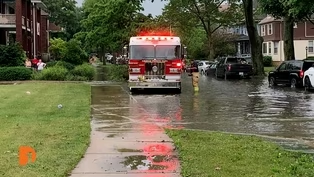
This summer has brought a lot of sun and warmth and with it rain, and that historic rain really hammered several areas of Southeast Michigan.
It hit the east side, Detroit, The Pointes, Harper Woods, especially hard.
The cleanup and damage assessment takes a lot of work as does the problem solving that comes next.
How to prevent this type of damage from historic flooding that seems to be increasing with frequency.
And what changes do we need in our infrastructure?
Bill Kubota has a story, along with our partners at Bridge Detroit.
Plus this week, the first in-person Detroit policy conference since COVID.
Nolan Finley catches up with Detroit Regional Chamber CEO, Sandy Baruah, and he talks about what businesses need to succeed now.
Then stories from the US Senate.
Michigan's longest serving Senator Carl Levin, talks with Stephen Henderson about his new memoir.
And you can head to Belle Isle Aquarium again, it's all ahead this week on "One Detroit".
And we're starting with the cleanup that continues on the East Side from historic flooding and the long-term plans for infrastructure solutions.
"One Detroit's" Bill Kubota has more.
- [Bill] June 26th, they knew it was a hard, a hard rain gonna fall, but not that much.
Vehicles stranded on streets, freeways, basements catch basins for sewer water.
- [Mike] In 2014 we got a four and a half inch rainstorm and many of our basements flooded.
And I was told it was once in a hundred year event.
And then we week go Saturday, we got six inches, something nobody could have imagined.
- [Bill] Well how high did it come up in your basement?
Foot, foot and a half - Yeah, yeah, yeah.
It flooded and receded, but everything got damaged with mold and flood and people had to rush and get it out because it was moldy.
- [Bill] How much water do you have in your basement?
- We don't have it anymore.
And I don't know how much water we had in because by the morning it was gone.
When I looked at it at eight o'clock in the morning, but all of our stuff, so you can see here-- - [Bill] There's there's water damage on these comic books.
- [Jacinda] Every single one.
And some of these were from my father, when he passed.
So this is my husband and father's collection.
And they're ruined.
- [Bill] They're not collectors grade anymore, are they?
- [Jacinda] No.
- It's asinine.
You know, if you look up and down these streets over here in Harper Woods, you'll see how much stuff people have lost.
We lost at least $5,000 worth of items and I still got to go in my basement and tear out about that much at a wall all the way around because it's a finished basement and replace it.
- [Bill] Turns out a Detroit pumping station lost power, but why, and for how long?
- [Johnny] Eight to 10 inches of water in your basement, it don't make sense.
The city need to do some about that.
Harper Woods need to get on them and do something about it.
The City of Detroit.
- [Bill] Olivia Lewis has been covering the story for our partner Bridge Detroit.
- Why couldn't the system handle all this water?
What did you learn about that?
- Right, so we've been told over and over again by the city, by the Water Department, that the sewer system is actually a hundred years old in Detroit, and that it's only built to sustain two or three inches of water a day.
Whereas Detroit received almost seven inches of water over the course of one weekend.
- [Bill] In the midst of the cleanup, parts of Detroit's East Side had bad tap water.
Here's Bernita Bradley a few days after the flood in the Morningside area.
- Yeah, I didn't know till Tuesday, till Tuesday evening, till Tuesday evening.
And we had been drinking the water all day Tuesday.
- [Bill] It's then she gave it a close look, yellow murky sediment of some sort.
This city posted a boil water alert.
Next door, Jacinda Casin filled a kiddie pool with tap water to cool off her grandkids.
- [Jacinda] This water, I'm not even thinking of connecting this water with my water inside of my home.
And so the baby boy had a stomach ache the next day.
- But it's still not clear.
It started out like it is now, which is this right here.
So it started out a little murky and you can see the little substance floating in it.
- [Bill] Bradley's hot water tank ruined, waiting to install one.
- [Bernita] So I think people were assuming that it was our hot water tanks because most of our hot water tanks are out.
And so we were thinking it might be rust from that or something sitting or something.
But then when you turn on the cold water, it's the cold water and hot water.
- There's this mass flooding, then you have murky water.
They must be connected, right?
- The city has repeatedly said that they're not connected, that it's due to old pipes, but I don't know that Detroiters really believed that, it doesn't seem like they do.
The questions that were being asked, and when we relay those questions to the water department, they've said that they're not related, but I guess it's hard to conceive that a massive flooding issue like this happens, and then the next day people have brown water out of their taps.
- [Bill] The city has given an all clear for tap water, but all this resurfaces lingering water and sewer concern.
- It got worse through the years that they don't clean the sewers.
When I ride my bike, we as neighbors clean the sewers here and there.
They're always plugged.
When I ride my bike, I take my foot and clean the church sewers.
- [Bill] What happens in Detroit, doesn't stay in Detroit.
Grosse Pointe Park, the overflow filled the streets and let itself inside a hot yoga studio.
Outside another surprise.
- [Interviewer] What happened to your planters?
- Well, I'm not sure.
I think the water took them away.
- [Bill] Surging waters doing some street scape debeautification, which brings us back to that pumping station.
The Conners Creek Station run by The Great Lakes Water Authority.
- And I'm standing at our Chapaton Pump Station at Nine Mile and Jefferson.
- [Bill] McComb County Public Works Commissioner Candice Miller said her sewage pumps were dangerously overworked, when Conners Creek had its problem.
- And the reason, one of the reasons, is because of what happened, which we still don't understand at the Connor Creek Pump Station.
- [Bill] The Great Lakes Water Authority serves most of McComb County, and Miller wants an investigation.
- If there was any human error as well, by not getting into the plant and flipping on the generator or whatever happened there, we need to know.
- [Bill] A couple of weeks later, the chain of events still not exactly clear.
Bridge Detroit keeps asking questions.
- [Olivia] There was mass flooding around that area and that the station for whatever reason, whether it was an electrical issue, whether it was just from backing up from the sewers that it was down for at least an hour, maybe two.
And that in that time there was mass water buildup.
And so on Detroit's lower east side, there is a lot of damage because of that pump station being unable to filter water in the proper way.
- We're gonna be talking with our board about conducting an independent investigation, in addition to the one that we will do as a common after event analysis with staff and assisted by consultants.
- [Bill] The Water Authorities, Sue McCormick said it'll be two or three months until that report comes out.
Last week, she hosted some congressional Democrats, the Environmental Protection Agency and mayor Mike Duggan with the makings of a fix-it plan.
- The infrastructure in this country was built for the climate of the 20th century.
It worked well for a long time.
- If we keep building the same thing that we built before, we're going to keep getting the same thing we're getting now.
- [Bill] They're connecting the dots, heavy rain, climate change, and President Biden's mega billion dollar infrastructure bill, perhaps the solution trouble with the water.
- What, we have to use, the innovation, the research, and the science, to ensure that when we tell the American people we're using your tax dollars to build an infrastructure so you won't have a flooded basement again, it is real because we are going to build a climate resistant infrastructure.
- And over the next 20 years, Michigan's drinking water infrastructure will require $13 billion in additional funding.
- [Bill] Infrastructure improvements would include replacing more lead pipes.
Lead, think the Flint crisis, something Bernita Bradley did with her murky water woes.
- [Bernita] I want somebody to come out and test it.
I don't want to just assume, I mean they told people in Flint that their water was okay when it was clear, when they started clearing up, right?
And I just don't trust it.
- [Bill] This whole situation comes as we're still feeling the pain of the pandemic.
- Detroit had so much loss during the pandemic and then to come in to this summer of 2021, and now there's a massive flooding where there's new financial burdens that are extreme.
It kind of feels like, why does this continue to happen?
And how do we think about who's in charge and how to talk to our leadership to make sure that they're understanding what we need as residents?
- Guess what happens in Michigan?
It rains and it's going to rain again.
And the next time, we need to be better prepared.
Whether it's climate change, whatever's causing all of these high intensity rains, we think we can do better.
Maybe we can't do better, but let's at least know that that's the best that we can do.
- This week the Detroit Regional Chamber held the Detroit Policy Conference.
The first in-person policy Conference since COVID.
It was a chance for business owners, non-profit leaders and policymakers to get together to talk about where the city is headed.
Detroit Regional Chamber CEO, Sandy Baruah caught up with "One Detroit" Nolan Finley, to talk about the biggest issues facing local businesses as we move through the pandemic.
- Now your businesses are getting up and running.
They're sort of emerging back into the light after this long period where some were operating somewhat normally, and others were operating completely differently than they ever had before.
What are you hearing from your businesses?
What's been their experiences as they reopen and start to re-engage with their customers?
- Well you're exactly right, Nolan, that it has really been a tale of two cities.
We've seen business industry after industry that was really running essentially full bore during the pandemic, demands never been higher.
And frankly, that hasn't changed since the restrictions have been lifted, but there are certainly businesses, entertainment, hospitality, street-level retail, that was really challenged.
In some cases, obviously we lost a lot of our businesses across the region during this last year plus, but I would say that the common themes of all businesses right now are, A, people, people, people.
Finding the people to come back to work is especially challenging.
And the Detroit Regional Chamber has some interesting statewide data that kind of points to as to why.
The other issue is supply chain, just getting materials for their businesses, regardless what those materials are, is very difficult right now.
- Now Sandy it's not just a matter of flipping a switch.
Everything's normal again, there's challenges these businesses have and there's things they need from policymakers.
So what do you need from the businesses perspective from our state and federal policy makers?
- Well, certainly, policies that help encourage people who may currently be on unemployment to leave the unemployment rolls, to come back to work.
And we have some policies pending in Lansing right now that would help do that.
That's certainly one thing that would be really useful.
Another thing that we have pending and Lansing right now, the Detroit Regional Chamber is trying to get a PPE tax credit for businesses.
For those businesses who have spent a lot of money buying PPE for themselves, for their customers, can get a tax credit on that, because the state actually collected a sales tax on all those items throughout this last year almost, and a half now.
And the governor doesn't seem to be inclined to sign that.
So we're having a little bit of a discussion with her right now.
- Now Sandy, you're going to be discussing all of this and a lot of policy at your Annual Conference on Makin Island at the Detroit Regional Chambers Policy Conference.
You didn't have one last year because of COVID and you pushed this one back to the fall.
I imagine folks are anxious to get back at the discussion.
You expect this conference to be as we've been accustomed to?
I know "One Detroit's" been up there last several years with you all, do you expect this to be a normal conference?
- Well, it'll be a little different.
I mean, obviously it's not going to be completely normal for several different reasons.
One it's happening in September as opposed to May.
So the chances of it's sleeting are significantly less, that's number one, number two is that we are going to be using our space differently.
We're going to be doing more of our events outside.
We're going to be taking advantage of the Grand Hotels new pool house, which is absolutely gorgeous.
And you know, so we're going to see a shift in how we use our space.
We're also going to use a little bit more video than we normally do.
So we might have say a fourth panelist on one of our main stage sessions that might come in through video.
So we're going to see a few differences, and obviously, one of the big difference is that we're going to curtail attendance.
We're going to limit, and we've already limited and stopped registrations at 1300.
- And the themes, what are you looking?
I mean, we've had this sort of crazy year, we've lived through and it's changed a lot of things.
Has that affected your planning and the things you'll be talking about up there?
- Oh absolutely, I mean, we can't go through this year that we've gone through and not have that as the major theme of the conference.
So our conference chair this year, we were incredibly fortunate for multiple different reasons is Wright Lassiter, the CEO of the Henry Ford Health System.
So he and his statewide CEO committee set the theme, which is, Rebuilding a Healthy Michigan.
And that doesn't mean just our personal health, although that's a major component of it, but that also means the health of our communities, the health of our economy.
And so that's going to be the theme of how do we rebuild that and how do we rebuild that stronger than we had before?
And how do we become more resilient, especially on these issues regarding preparing for the next pandemic.
- Detroit public television and "One Detroit" will be partnering up with the Detroit Regional Chamber to cover and air the Mackinaw Policy Conference this September, watch for more details, and of course head to OneDetroitpbs.org.
Retired US Senator Carl Levin holds the distinction of being Michigan's longest serving Senator.
The stories, his experiences, and the history he helped shape are now all in a new memoir called, "Getting To The Heart Of The Matter."
He sat down with Stephen Henderson on American Black Journal to talk about his life and career, from attorney to Detroit City Councilman, to US Senator.
- So I want to start with, of course talking about this wonderful memoir you've written.
But I want to start sort of specifically with the idea of your career.
You know, for so many of us in Michigan, you are synonymous with the word Senator.
You're the first person I ever remember associating with that word.
And that says a lot, I think about how long you did the job and how much of an impression you made in that job.
So I want to go back though, to your decision to do that job.
I mean, you were the president of the Detroit City Council, and then you decided, do you want it to be a US Senator.
What was it about the Senate that attracted you to run that year?
- You know a good elected official sometimes is going to do some things which is unpopular as a matter of fact, but in his or her judgment it's for the common good and it's necessary, and it's his obligation or her obligation I believe, to do what he or she believes in conscience is best for his city, or for his state, or his country.
And so what I found when I was in local government in Detroit, is that too often, the federal bureaucracy would just, we'd be told by elected officials, "Well, we can't do much for you.
You got 10,000 vacant HUD houses, sitting there vacant in your neighborhood, maintained by HUD, as eye-sores.
They're not being boarded up.
They're not being taken care of."
There they sit, helping to destroy my towns neighborhoods.
And when I went to my elected officials, too often, I was told, "Well, the problem isn't with us, it's with the bureaucracy, they're handling this.
This is a federal agency decision."
And so I actually went to Washington believing that Congress should have the obligation of overriding regulations by federal agencies.
It was actually part of my platform.
It was called Legislative Veto, obscure thought in a way, but I believe in it cause of our very disastrous experience with HUD in Detroit.
And so that kind of was one of the driving forces.
- And so you get to Washington and as I say, you have an incredible and very long career there that takes you, it seems like two to lots of different ideas and places.
But talk about those early years in Washington.
- Well, I focused on two things right away.
One was the oversight responsibility, which I've just tried to describe.
I believe Congress has the responsibility and it's one of its major responsibilities to oversee the operations of the Federal Bureaucracy.
The other thing I wanted to do, was to focus on an area that I knew very little about, and that's the military.
That's the security of our country, and how the military operated and to learn more about something I had not experienced personally, 'cause I had never served.
And I wanted to fill in that major gap and to really understand the importance of the military, where it may be wasteful for instance, and that also occurred in the military, but also too, I also gained a huge respect for our military leadership and the people who serve us.
- And you develop an incredible expertise on the military while you're in senate.
You also develop some real expertise on foreign relations and then do a lot of important work in that realm.
Tell us how that developed.
What interested you in that realm?
- Well, it's when you decide whether or not to send people to war or authorize it, you're making the most important decision that you can make.
There is no more significant decision than putting our men and women at risk and doing what we have to call upon their families to do.
And so when you finally gain that understanding, you have to take it seriously.
As a matter of fact, Joe Biden gave us one of our early lessons in the importance of meeting with foreign leaders and having coalitions with allies.
You know, the idea that we would have a president like this last president of ours, who hopefully is the last president like him.
Trump divided people.
He divided us from our allies.
And my gosh, if we're gonna be in a more secure world, you got to work with allies and people who have similar points of view, who believe in democratic government hopefully, and there's threats to that which have taken place.
- Did you ever imagine that we would see in our time, something like we saw on January 6th, where the building, where you worked for decades in Washington was literally under attack from Americans?
- I wasn't surprised totally that those kind of people exist.
And I also was not surprised when they lost, 'cause there were some real strengths that this country has that we've proven over the years.
And we've got to stand for those strengths in the world.
And one of the things that this new president is so strong at is working with other countries to rebuild the values that internationally we've gotta stand for if the world itself is going to be safer.
- And that is going to do it for "One Detroit" this week, we're going to leave you with a look inside the Belle Isle Aquarium, because great news, it is reopening July 16th.
Enjoy getting out and about this weekend, we will see you next week for "One Detroit", take care.
(crowd chattering) (upbeat music) - [Announcer] You can find more at OneDetroitPBS.org or subscribe to our social media channels and sign up for our "One Detroit" newsletter.
- From Delta faucets to Behr paint, Masco corporation is proud to deliver products that enhance the way consumers all over the world experience and enjoy their living spaces, Masco, serving Michigan communities since 1929.
- [Announcer] Support for this program provided by The Cynthia and Edsel Ford Fund for Journalism at Detroit Public TV, The Kresge Foundation, Community Foundation for Southeast Michigan.
- [Announcer] The DTE Foundation is a proud sponsor of Detroit Public TV, among the state's largest foundations, committed to Michigan-focused giving.
We support organizations that are doing exceptional work in our state, visit DTEFoundation.com to learn more.
- [Announcer] Business Leaders for Michigan, dedicated to making Michigan a top 10 state for jobs, personal income, and a healthy economy.
Also brought to you by and viewers like you.
(upbeat music) (gentle music)
The Aftermath of Detroit’s Historic Flooding
Video has Closed Captions
Clip: S5 Ep4 | 8m 51s | The Aftermath of Detroit’s Historic Flooding | Episode 504 - Segment 1 (8m 51s)
Getting Back Into Business Reveals Great Divide
Video has Closed Captions
Clip: S5 Ep4 | 5m 6s | Getting Back Into Business Reveals Great Divide | Episode 504 - Segment 2 (5m 6s)
Getting to the Heart of the Matter
Video has Closed Captions
Clip: S5 Ep4 | 7m 7s | Getting to the Heart of the Matter | Episode 504 - Segment 3 (7m 7s)
Providing Support for PBS.org
Learn Moreabout PBS online sponsorship
- News and Public Affairs

Top journalists deliver compelling original analysis of the hour's headlines.

- News and Public Affairs

FRONTLINE is investigative journalism that questions, explains and changes our world.












Support for PBS provided by:
One Detroit is a local public television program presented by Detroit PBS