
How the Sword in the Stone May Have Begun
Clip: Season 23 Episode 4 | 1m 53sVideo has Closed Captions
Iron smelting at a temple site may have inspired the legend of King Arthur’s sword, Excalibur.
Archaeologists uncover evidence of iron smelting and weapon forging at a temple excavation site. Prof. Mark Horton examines how this sparkling iron ore may have inspired the legend of King Arthur’s sword, Excalibur.
Problems playing video? | Closed Captioning Feedback
Problems playing video? | Closed Captioning Feedback
SECRETS OF THE DEAD is made possible, in part, by public television viewers.
How the Sword in the Stone May Have Begun
Clip: Season 23 Episode 4 | 1m 53sVideo has Closed Captions
Archaeologists uncover evidence of iron smelting and weapon forging at a temple excavation site. Prof. Mark Horton examines how this sparkling iron ore may have inspired the legend of King Arthur’s sword, Excalibur.
Problems playing video? | Closed Captioning Feedback
How to Watch Secrets of the Dead
Secrets of the Dead is available to stream on pbs.org and the free PBS App, available on iPhone, Apple TV, Android TV, Android smartphones, Amazon Fire TV, Amazon Fire Tablet, Roku, Samsung Smart TV, and Vizio.
Buy Now

Providing Support for PBS.org
Learn Moreabout PBS online sponsorship-Inside the temple, the excavation reveals another possible connection to the Camelot legends.
-I think thats almost pure iron.
-Is that pure iron?
It is, isn't it?
Gosh, thats slightly slightly sparkly.
[LAUGHS] Yes.
-These are slag remains, evidence the site was used for smelting, creating iron metal by heating up iron ore.
But examining the spoil heap with a powerful magnet reveals an even more intriguing piece of evidence.
-Can you see, so this is a tiny piece of hammer scale.
When you make weapons like swords, and you have to hit the iron really hard, and ou comes little splinters of iron that look literally like the scales on fish.
So, whats significant about the hammer scale on this magnet is that that is the evidence for smithing, so they're not just making the iron, but they're also forging the iron into weapons.
-Mark suspects the story of Arthur drawing the sword Excalibur from the stone could have its origins in weapons being made from the sparkling iron ore, known as hematite, found in this area.
With Camelot stories, there are ideas about magical swords coming out of stones, the iron that is coming from here, seams of hematite, this magical substance, and of course if they make weapons within a temple precinct then they probably will be endued with magical and spiritual qualities that will enable them to be victorious in battle.
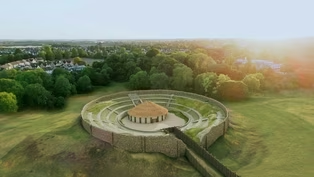
Discovered Ruins May Have Inspired the Round Table
Video has Closed Captions
Clip: S23 Ep4 | 3m 1s | New evidence suggests an amphitheater became a stronghold linked to Arthur’s Round Table. (3m 1s)
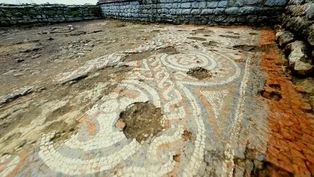
New Evidence That Roman Life Continued After the Empire's Fall
Video has Closed Captions
Clip: S23 Ep4 | 3m 1s | New dating shows a Roman villa mosaic was laid in the 5th century, reshaping post-Roman Britain. (3m 1s)

Preview | The Quest for Camelot
Video has Closed Captions
Preview: S23 Ep4 | 32s | A professor seeks to prove Arthurian legends have roots in actual British history. (32s)
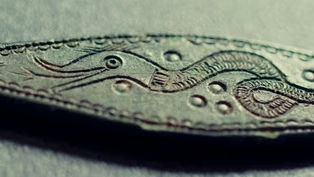
A Roman Dragon's Possible Link to King Arthur
Video has Closed Captions
Clip: S23 Ep4 | 2m 10s | A Roman military belt bearing a dragon design may hint at the military roots of King Arthur. (2m 10s)

Was This City the Real Camelot?
Video has Closed Captions
Clip: S23 Ep4 | 2m 53s | Did Cirencester remain the center of a prosperous post-Roman kingdom in the time of King Arthur? (2m 53s)
Providing Support for PBS.org
Learn Moreabout PBS online sponsorship













Support for PBS provided by:
SECRETS OF THE DEAD is made possible, in part, by public television viewers.